Back in the studio (part 1)

Music

Last Thursday & Friday, I was back in the studio with the Nick Gladdish Band, as we finally started work on his new album Last One Get The Lights.

In normal times, this would have taken place in April, and by now, we’d be on another tour supporting the finished product. In fact, we already released the lead single Blurry Lines last last year (listen to it here). However, the pandemic and subsequent lockdowns have held everything up. More recently, we’ve been able to get back on track.

The process

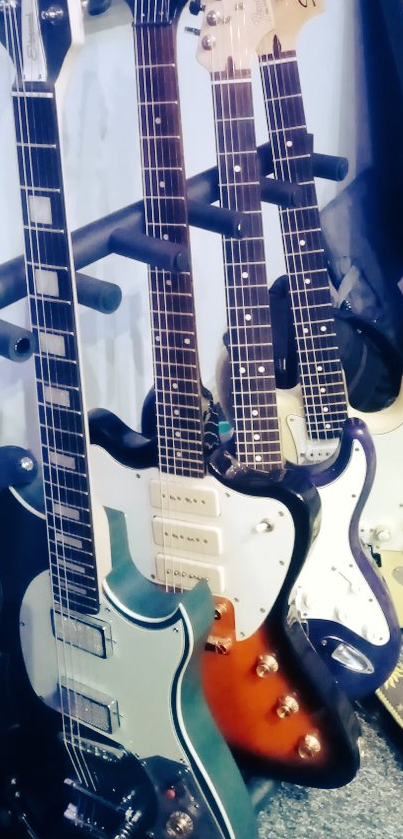
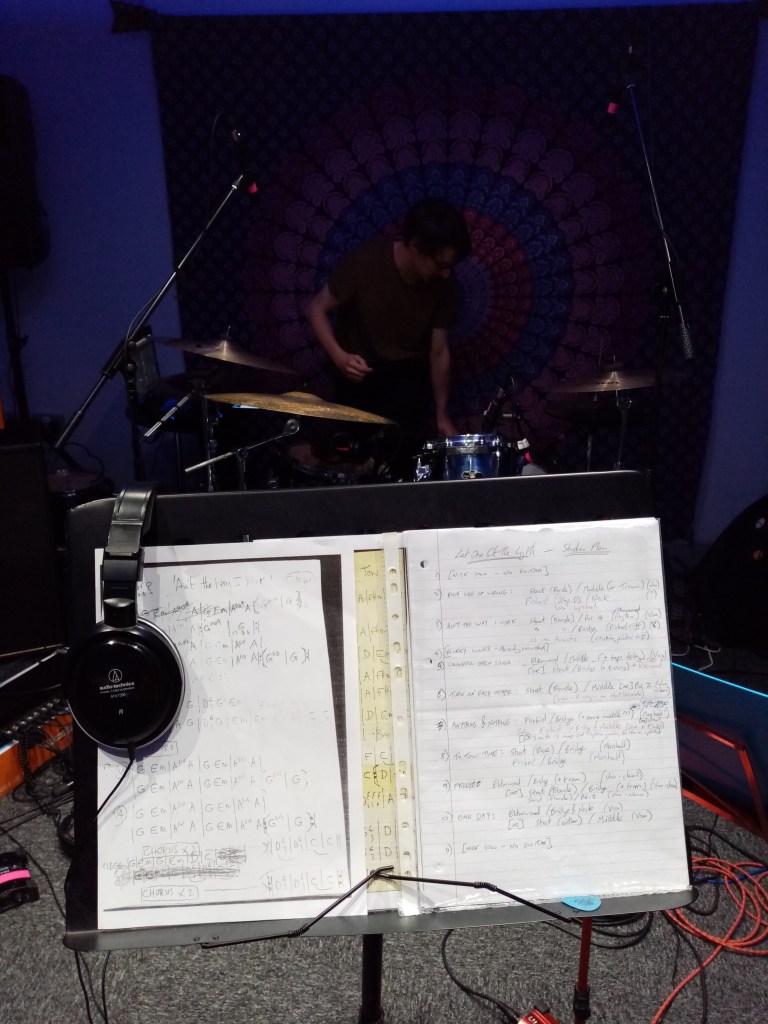
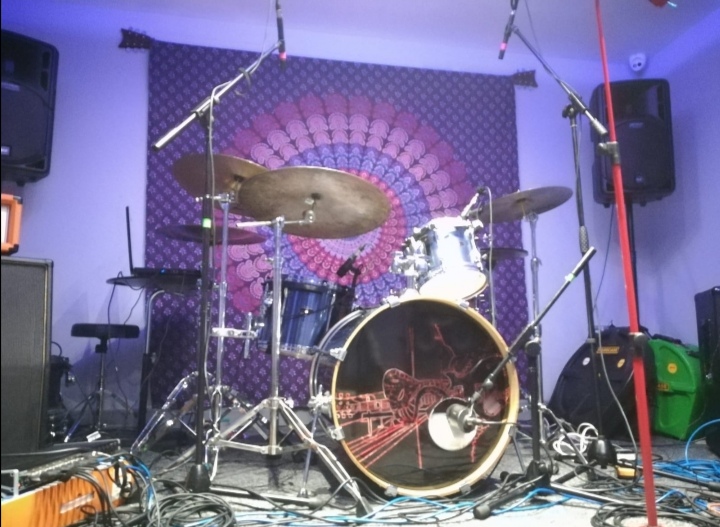
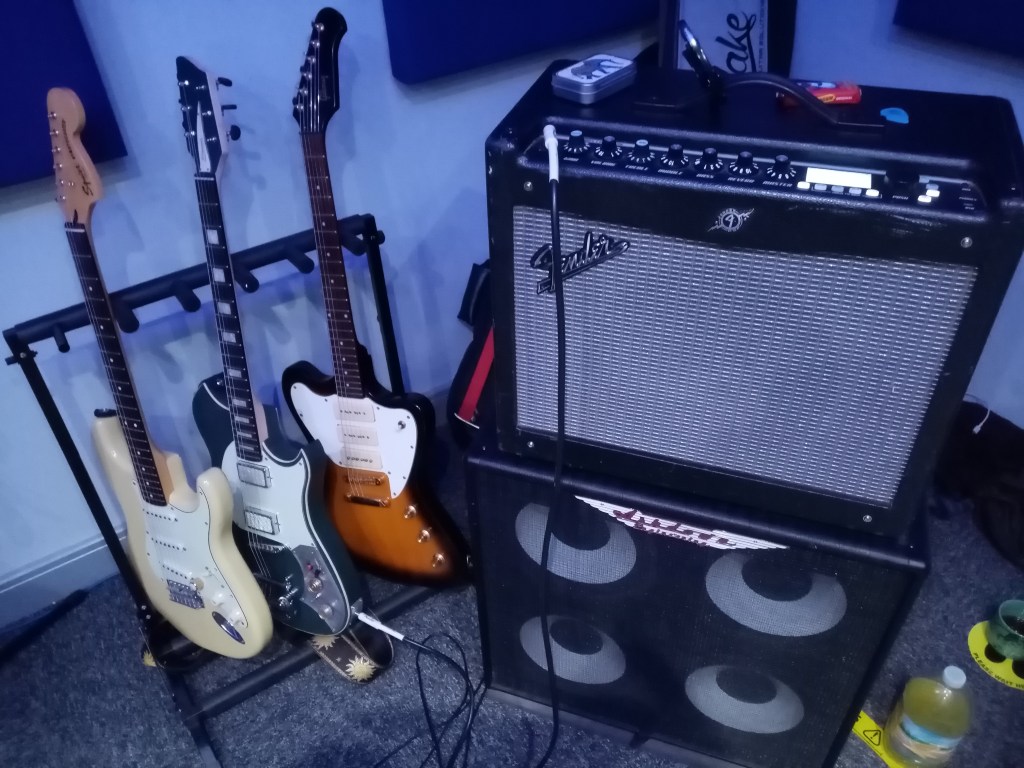
To start with, Nick shared demos of the songs, and we started listening and thinking of suitable parts. A few weeks ago, we held two days of rehearsals where we tried out different things to see what worked. These were recorded as draft ‘rough cuts’ and the best arrangement shared amongst ourselves, so we could refine our parts further. It also gave me time to consider the best way to record the guitars, and which instruments to use.

Here’s a few pictures from the two eight-hour days at Traxx Studios in North Tyneside. We spent these days recording the main backing tracks of drums, bass, most rhythm guitars, keys and guide vocals. The credits belong to everyone in the band (I’m not sure exactly who took which picture in some cases):

The whole recording process came together really quickly. In two days, we manged to get all the backing for the eight ‘full band’ tracks down, as well as additional rhythm guitar parts. Having rehearsed and arranged this set of songs in a live room setting, the guitar parts were quite simple to arrange and organise for tracking.

What happens next?

The initial plan was for John (Timney, drummer and engineer for this LP) to crew te rough mixes from what we had before we started on overdubs. However, the government’s announcement at the weekend, telling us we’ll be back in lockdown from Thursday, prompted a change of tack.

Instead, I will be going back into the studio with John to lay down all the guitar overdubs and solos tonight.

Tomorrow, Nick will record all of his vocals and a few additional piano & acoustic guitar parts. Shannon Powell, our backing singer at the live shows, will add her final parts remotely in the next week or so. That way, John has the whole period of lockdown to mix and master the record, and we can have the entire album finished in time for release at the start of 2021.

The Nick Gladdish Band. L-R: John Timney (drums, production), Adam Cornell (bass), Nick Gladdish (lead vocals, keyboards, acoustic guitar) and myself (guitars, lapsteel).

I’ll post some more pictures from tonight’s session, as well as further updates, in due course. Until next time…

Elderwood Guitar review: my custom-made semi-hollow

Guitars & Gear

I have never owned a semi-hollow guitar before, despite having played 335 style and ‘thinline’ guitars on several occasions. This year, I had the budget to rectify this, but with so many great options out there, I was undecided on where to invest my hard-earned money.

Enter Elderwood Guitars, a one-man operation based in Carlisle, in the north of Cumbria. I had seen a few Elderwood models for sale in a guitar shop in Newcastle, and a couple of players I know spoke highly of these instruments. Barrie, the man behind Elderwood Guitars, makes it his mission to create the guitar of your dreams at a more affordable price. You are involved in all aspects of the layout and design of your instrument, which is largely made up from recycled wood.

You may remember another guitar built for me, a nylon-strung classical guitar, which was also crafted by a solo luthier in Cumbria and made form recycled wood (and if not, you can read about that guitar by clicking here).

The two main principles of making something beautiful from old wood, as well as being able to design the guitar to my own specifications, was something which greatly appealed to me. To that end, I found myself in conversation with Barrie near the start of lockdown, and soon we went back-and-forth with ideas and draft designs. Rather than going for a more straightforward 335-style design, I was inspired by some of the beautiful high-end creations of small guitar companies such as Kauer. In the end, the final design looked like this:

The fifth & final draft of my custom design. Picture courtesy of Elderwood Guitars

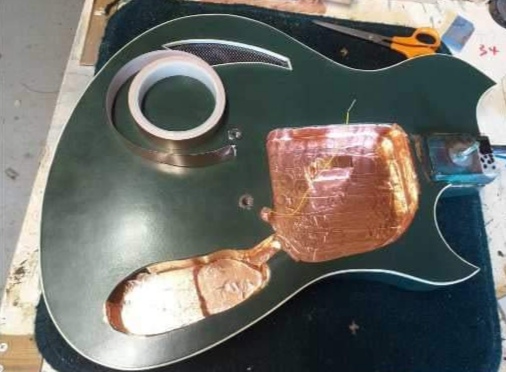
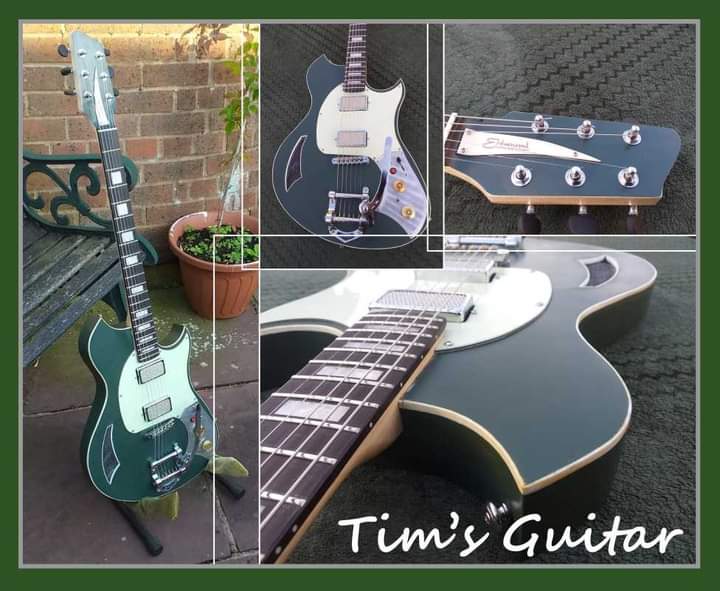
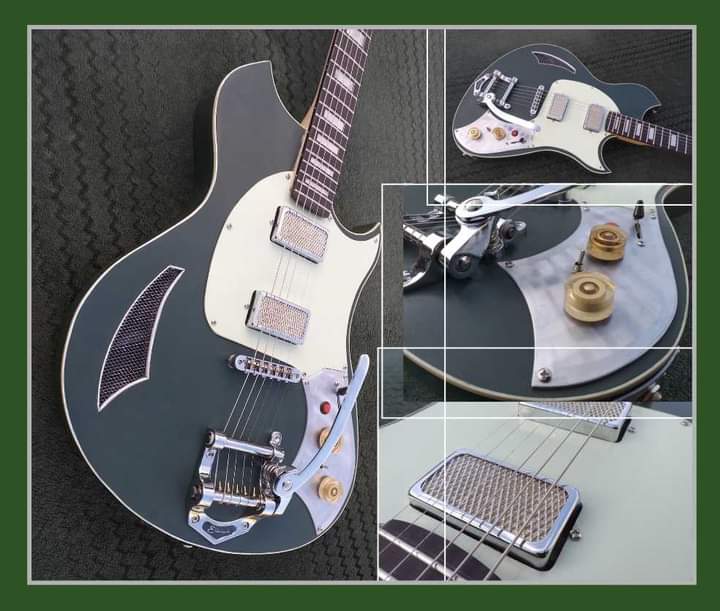
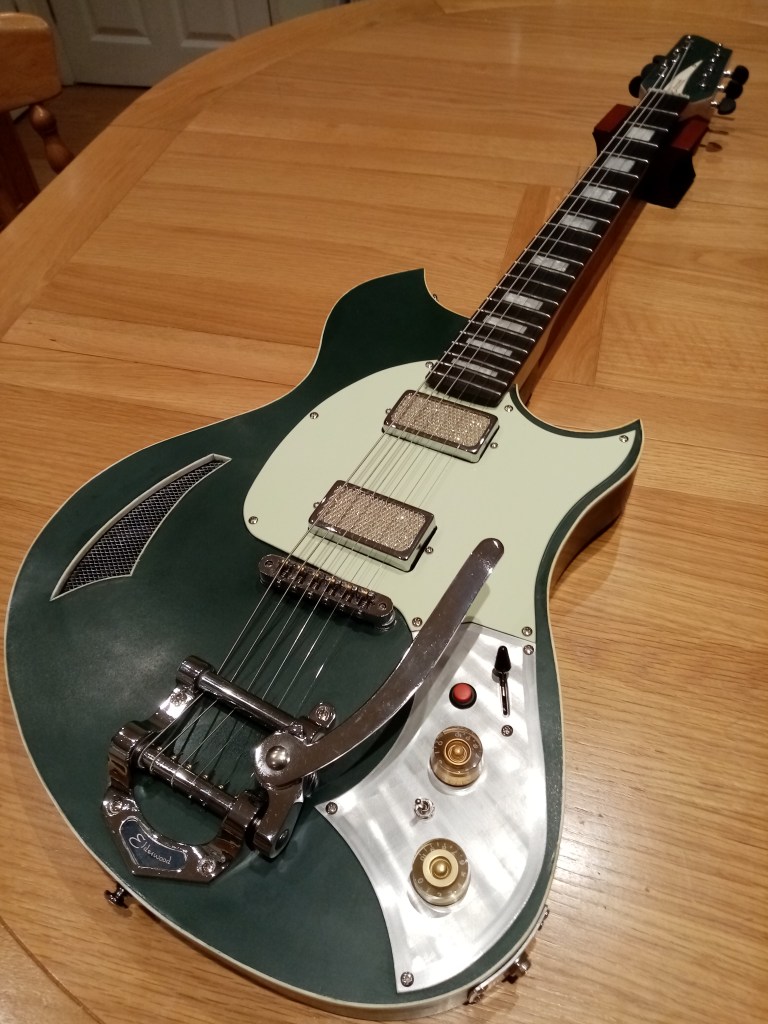
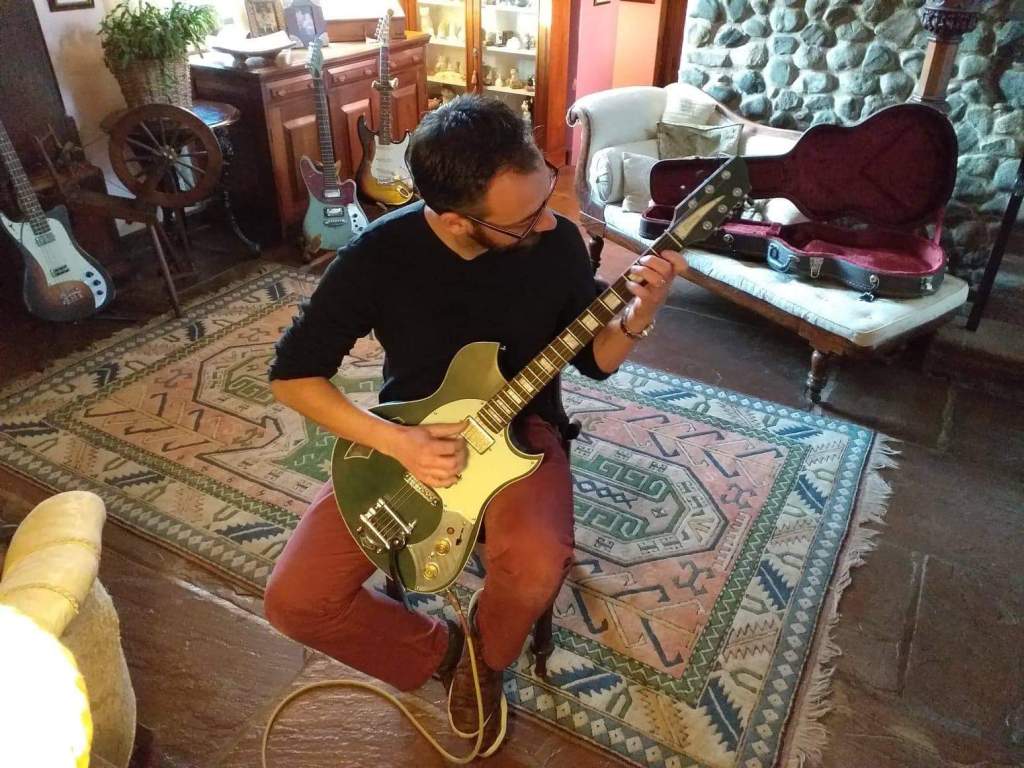
My guitar would be an offset semi-hollow with a serious vintage feel to it. The two humbuckers and sound hole on the upper half would be covered in a gold foil/mesh, and the neck would feature block markers. For the finish, I requested as close to British Racing Green as he could manage, with cream for the pickguard, binding and truss rod cover, likening the overall colouring style to that of a classic Mini Cooper. You don’t see many green guitars and I have always wanted one. Now I just had to wait for it to be completed (although since lockdown meant that I wasn’t gigging, I was in no hurry).

Over the next few months, I received occasional updates from Barrie which always got me salivating:

Barrie checked back to confirm my preferences for pickups, tremelo, control layout, as well as general updates on progress. He seemed to be having a busy summer but as each guitar was finished and presented on his Facebook page, they continued to look and sound as high quality as I had been told they’d be.

At last it was ready to collect in early October, and it did not disappoint…

Specifications

  • Offset semi-hollow body, made from recycled pine
  • Maple neck, with rosewood fingerboard featuring block position markers
  • 3-a-side headstock
  • Bigsby-style vibrato system and ‘roller saddle’ bridge
  • 2 x Vanson ’57 Alnico II humbuckers
  • 1 x volume & 1 x tone control
  • 3-way pickup selector switch, plus mini-switch for coil-tapping
  • Push button to bypass volume control (see below)
  • Side-mounted jack socket (secured by four screws for greater stability)

This guitar certainly looks the part. The green finish contrasts beautifully with the pickguard and copper coloured control knobs. After sharing the images above on my Facebook page, I was inundated with questions and compliments about the it. It’ll certainly make a visual impact at gigs (whenever they start back up again).

Sounds

Acoustically, this guitar is much louder than my other electrics. It’s interesting just how much difference the resonance of a semi-hollow together with the sound hole, can make. The matched PAF-style humbuckers give you all the tones you would expect from an early Les Paul, but with more airiness due to the mainly hollow body. These humbuckers are made by Vanson, a budget brand readily available on websites such as Amazon. Barrie shares my sentiment that one shouldn’t have to, and doesn’t need to, pay over the odds for a combination of magnets and copper wiring. I had said early on in the design process that I was happy with ‘budget’ pickups on this guitar, and they certainly sound as good as anything the big name brands churn out!

The bridge pickup provides everything I need, from classic rock crunch to an almost rockabilly style twang – the Bigsby certainly comes to the fore here. The neck pickup gives up warm jazz tones on a clean amp with the tone rolled back, and splitting the humbucker into ‘single coil mode’, I’m able to get a sound remarkably similar to a Strat or Tele in this position, which is no bad thing as far as I’m concerned. With both pickups engaged, I’m in my beloved funk and soul territory, great for rhythm playing and bluesy licks. Not only that, but it feels like BB King’s trademark singing lead tone is virtually built-in to this instrument.

Is it any good?

Oh yes, it’s very good. I love it! I’ve certainty enjoyed playing it so far, both through my amps and unplugged. It sits perfectly on a strap and the neck is comfortably chucky, like a true vintage instrument (which is exactly how I like it).

My only hurdle so far has been getting used to the Bigsby-style vibratio. I don’t use the vibratio arms on my Stratocasters, but as well as the right hand aspect, Bigsby units are notoriously tricky to keep in tune. However, this is something that can only be changed through practice and getting used to using it, rather than anything wrong with the guitar itself. Nonetheless, Barrie’s aftermarket service has been top drawer, offering all sorts of advice on how to get the most from the unit, as well as tips on maximisng tuning stability.

Finally collecting the new axe. Picture courtesy of Elderwood Guitars

I expect to be in the studio again in the coming weeks, recording a new LP with the Nick Gladdish Band, and this guitar will be coming along with me. I’ll share links to sounds and videos of this guitar in that (or any) setting as and when they become available…

If you are interested in your own custom-made guitar, Barrie can be contacted directly through Elderwood Guitar’s Facebook page. I’d recommend that you take a look through the numerous creations he has made, and make sure you have a good idea of what you are looking for when you drop him a line. Once you do, you will meet an affable and courteous man dedicated to making the best instruments he can, at a price point open to all of us – and that, like his guitars, is truly something to be admired.

Why is there so much poetry in my blogs now?

Poetry & Writing

You might have noticed that recent posts have featured poems (especially Haiku) rather than my usual guitar or music-related topics. Well, you don’t have to worry about this site turning away from it’s main focus. For one thing, my efforts aren’t very good!

Yet, in these uncertain times, I find myself composing small poems in my head and decided to try and write more of them down. I also recalled previous advice about writing one Haiku per day, in order to become better at distilling an idea into a short, succinct form. Now seemed as good of a time as any to put some of my poems out into the world, from those celebrating recent guitar purchases, or the bizarre thoughts that strike me while out walking. There were also a few other reasons, such as…

I’m not performing live at the moment

Due to COVID19, almost no one is gigging at the moment. Since March, I have managed one socially distanced gig in a garden with the Nick Gladdish Band, but otherwise have found myself with more free time on my hands, particularly on weekend evenings. All future gigs and musical projects are postponed. Also, not having much means (or space) to embark on live streaming or recording projects from home, I found my creative juices were becoming pent up, and seem to have manifested themselves via written ideas, rather than musical ones.

I decided not to be embarrassed about my poems any more

I recently discovered that a good friend has a passion for a very niche form of short story writing, which was as pleasing to learn as it was unexpected. The fact that I was happy for my friend made me realise that I shouldn’t have any shame in putting my own silly little rhymes and Haiku out into the world.

I enjoy writing them

Surely that’s the most important thing? I mentioned in my recent post about using the recent lockdown as a reminder to do the things you enjoy, when you can. For me, this is one of those things. Like a Sudoku, they serve to keep my sharp, in a creative sense, until I can start rehearsing my own musical compositions and playing gigs again.

This blog will still continue to be about guitar. music, music therapy and all sorts of arts-related subjects. Writing these articles are another way of channeling my creative urges, and if someone learns a little extra knowledge as a result, fantastic. In time, I will start to announce new tours, projects, albums, etc, as they start to emerge from our cultural hibernation – but expect to see the odd poem thrown in there as well, from time to time!

Lessons learned from lockdown

Advice & Tips

This year has seen the most use of the word ‘unprecedented’ that I have ever seen, and probably for good reason.

Do what you can now, and if you can’t do it now, plan for later

Getting started on something can often be hard. During lockdown, I’ve found myself exhausted after a full day of childcare, and in those few rare moments I had for me, working on a new composition seemed ridiculous.

Do what you can, in small steps. In fact…

Make a list

List what your daily tasks are, as well as goals for the medium term (i.e., the next few weeks) and long term (post-lockdown, or even post-COVID altogether). It will help you focus, and evaluate what is important.

List making sure was already an occasional habit of mine, mainly because I am aware of my own poor short-term memory. Going forward, I’ll be sticking to daily lists, as they seem to have made me more productive than when I worked from home in pre-pandemical times.

Speaking of lists…

Bring back the ‘weekly shop’

We must have gotten out of the habit of doing the ‘big shop’ only once a week. Lockdown forced us back into this habit, and although it somehow felt more expensive at first, it seems to be better value across the week, especially when it was harder to nip out on a whim for a treat. Give it a try, if you can, and see how it works for you.

Don’t compare yourself to others

Whether it’s FOMO (fear of missing out) or a kind of professional jealousy when another person seems to be working fine at home – you know, the one with all the recording gear in their spare room (or their parents) and no children.

Social media only shows you what people want you to see. Most of the time, it only shows what those people think everyone else wants or expects to see.

Some of it is real. Some of it is less than genuine. All of it is someone else, in a different set of circumstances (however slight that might appear).

Beware of fatigue

Some of my friends have been locked down at home by themselves, working from one room during day, then zoning out in front of the TV in the evening. They told me that even committing to an online quiz via Zoom felt like too much effort. Staring at a screen all day, even for leisure or socially distant socialising, is incredibly tiring. Give yourself time to reset, and do absolutely nothing. Just remember when you do…

Don’t be to hard on yourself

If the fatigue did’t get you, the guilt surely did – right?

This is connected to my earlier heading, Don’t compare yourself to others, but it’s worth looking at again from a slightly different angle.

We’re going through unprecedented times. No one in our lifetime has experienced this, on this scale, before. Survive. Look after yourself and those around you. Don’t feel guilty for doing less.

In fact, don’t feel guilty at all for how you are managing to get through a pandemic.

Do what you love, if you can (and if you can’t make a plan for doing it in the future)

You might have noticed that a few of my recent posts have been short Hailku form poems, or observations from walks with my family. I enjoy writing them. Since I can’t perform live at the moment, they give me some creative output while everything else is on hold.

If you have recently discovered a new passion, embrace it and enjoy it. Share it with the world. And if COVID19 is stopping you from doing what you love and enjoy (as it has for me with my love of playing guitar live), make another list; this time, make it a plan to get your passion up and running again soon, once all of this is – hopefully – a distant memory of an unpleasant time, now disappearing.

Best of luck, and let me know how you get on! Also, let me know what lessons you have learned from the last few months of lockdown by leaving a comment or getting in touch via my usual channels – I look forward to chatting to you!

Poem: A political ghost flew, ruining my view

Poetry & Writing

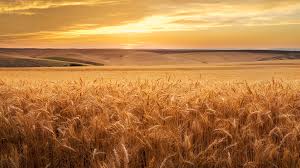
The wheat it rises fast by summer late

Honey yellow melting into rich gold

Yet now, streaking through the swaying barley

Comes ex-P.M. from Euro state of old

Fleeing worldly problems and past mistakes

With childish abandon and youth-lost glee

Surprised, then angry; next, aloud thinks I:

“Well, that’s stained this golden moment for me!”

Credit: news.ctgn.com

Somehow, this silly little poem (about former UK Prime Minister Theresa May running through one of the fields of wheat outside my home) felt best suited to the sonnet form (of somewhat loosely – see below).

For context, here is May’s past form, regarding running through fields of wheat.

Please don’t judge my efforts too harshly. It is my first attempt at writing in this form since secondary school (twenty years ago). I most definitely haven’t adhered to the ‘galloping’ rhythm of traditional Iambic Pentameter (5 pairs of syllables per lone, going weak-strong each time). This would have been a strict requirement for stage actors reciting these lines (usually as dialogue) in Elizabethan age plays, most famously those penned by William Shakespeare.

However, I’m not Shakespeare, Marlowe or any sonnet writer of any note, by any stretch – that much should be clear by now! I’m just a bored dad trying to get his youngest child (currently teething) to sleep by taking them out in the buggy for an evening walk…

New projects, despite lockdown

Music

As well as using Twitter to announce new projects, or update people on ongoing ones, I sometimes reminisce about ones from years ago, such as this one…

For some reason, I kept thinking of this, and on top of everything else I have planned (post-COVID), I’d quite like to explore what a power trio can do in terms of extended instrumentals (which aren’t based largely around improvisation); something more progressive in nature…

Having played in a rock trio format before, it can be a new challenge to fill the space adequately without the music sounding thin. Conversely, one has to avoid the temptation to stick to the more blues based method of sharing riffs, in union (or octaves) with the bass player.

Bear in mind that I currently have…

  • 3 music therapy jobs
  • A solo classical(ish) EP to finish
  • Another Nick Gladdish Band album to finish & tour to plan
  • My next band project (world/blues/Latin) to start rehearsing
  • A music therapy case study series to complete by the autumn
  • A small portfolio of compositions to develop

…and we’re still in a time of lockdown here in the UK, with no concrete sign of progress regarding indoor gigs (although the news today implies that this might change very soon).

Still, if you want something doing, ask a busy person, right?

A year of books (Apr-Jun)

Books

It’s been three months since my last article on the books I am reading in 2020 (which you can read here). At the end of March, the UK was officially in lockdown, and throughout April many of us got used to new ways of working (or not working), as well as working out what to do with the extra time spent at home. At times, it felt like I was trying to make time for reading – but that’s a story for another blog. Suffice to say, I haven’t gotten through anywhere near as much of my to-read pile as I would have liked. Indeed, it has taken me over a month just to finish writing and editing this article!

As promised, I aim to log and write very brief reviews of every book (fiction & non-fiction) which I have read this year. The only exception to this is the academic texts I have to research as part of my work as a music therapist (which has partly continued during lockdown through working online). These books and papers will only appeal to a small audience, so it makes sense to create a specialist article to discuss them at a later date. For now, here are the books I have managed to read in the last three months:

The age of genius: the seventeenth century and the birth of the modern mind by Professor AC Grayling (2016, Bloomsbury)

The title might seem like a mouthful, but the premise is simple: Philosopher-historian Grayling puts forth the argument that the seventeenth century (i.e. the 1600’s) was the ‘epoch’ in human history in which we (or rather the leading minds of the day) began moving away from what we now call superstition, and finding confidence in scientific inquiry separate to religious belief. Grayling believes that this is what made us modern humans. His argument is compelling and very well written, with scores of examples. However, a book with so much detail obviously means many references are fleeting, and surely many more are (for any number of reasons) omitted altogether.

This book is worth looking into if the subject even remotely interests you. It’s surprisingly accessible and doesn’t get too weighed down in any particular area for too long, although that is also a downside for many. Would-be scholars to this subject should view this book as a primer, before moving onto the texts which have greater detail on certain areas – Galileo, The Holy Roman Empire and the Papacy, to name just a few – without the overall breadth Grayling is able to present here. Those looking for an introduction to philosophy would be best served by some of Grayling’s other excellent books on the subject.

Shakespeare for grown-ups: everything you need to know about the bard by E. Foley & B. Coates (2015, Penguin)

Written by the two in-house editors behind Penguin’s Homework For Grown-ups, this book offers a light-hearted and accessible look into the greatest (or at least most famous) playwright of all time. Filled with fascinating historical and contextual nuggets, no portion of this book is overlong, and serves equally well as a reference for fans of the Bard, as well as ‘cheat sheet’ for newbies. Among the many useful sections it covers are guides to the language (including examples of the many, many words and phrases coined by Shakespeare, which are still in common use today) and a very brief overview of each play, reduced to a handful of lines in one section for super-quick, and rather pithy) reference. The larger sections examine examples of Shakespeare’s, comedies, histories, tragedies and poetry, highlighting key themes and use of language. The authors are good at reminding the reader about what an Elizabethan audience would have understood or expected from the performances of these plays too, which is particularly useful when things appear a trifle anachronistic to modern readers and audiences. By no means the final word on Shakespeare, but a great place to start for many, and a welcome addition to the collection of more committed fans.

The Ickabog by JK Rowling (2020, online at theickabog.com; print publication on 10th November 2020 by Hachette)

Based on a story JK Rowling used to tell her children, years before the publication (and phenomenal success) of her Harry Potter series and wider franchise, The Ickabog is a fairy tale brought into the public eye, it seems, because of the COVID19 pandemic. A chapter or two was released every week between March and July this year, seemingly as a distraction for people during lockdown. However, Rowling has stated that a print version of the book will be released in November this year, with some of the proceeds going towards a charity helping young people affected by the pandemic. Cynics might argue that it takes attention away from the negative press Rowling has received this year for her personal views on certain subjects, but a good deed is still a good deed. And anyway, what about the story?

Th story is the form of a fable, told by an omnipotent narrator, about a fictional country with a weak and vain king, whose closest advisors manipulate in an increasingly elaborate version of The Emperor’s New Clothes, with a strong dash of the legend of The Lambton Worm (an ancient local tale of an apparently un-killable dragon-like creature which stole sheep from a town in the far north of England) thrown into the mix. The 60 chapters of the story move fast, taking in various characters and sweeping across the entire fictional land, as well as a timescale of around a decade, without feeling too rushed – at least for the most part. The ending is both unexpected and rather typical of Rowling’s more famous work, but doesn’t quite wrap up the character arcs in a satisfying way, save a bittersweet epilogue involving the first characters mentioned in the book.

The Ickabog is a quick read, once the installments were available. It was rather interesting reading a serialised story, the way many famous works, such as those by Dickens, first appeared. It is written, like most of Rowling’s books, for children, and uses easy language with little in the way of hidden themes. In fact, my biggest problem with the book was the lack of subtlety altogether – Rowling tells you everything, including in one particularly frustrating instance, what four different characters (most of them minor) or thinking, without feeling the need to back any of these pronouncements up with dialogue or actions by the characters – this person loves that person because Rowling says so, and that has to be good enough. I understand that this is a story aimed at younger readers, but credit them with some insight!

Life by Keith Richards with James Fox (2010, Little, Brown & Company)

The back cover of this autobiography reads: “This is the life. Believe it or not, I haven’t forgotten any of it”. Perhaps the contributions from journalist Fox helped fill the gaps in the extraordinary life and career of one of rock’s least likely survivors. ‘Keef’ is one of the founders and driving force behind The Rolling Stones, as well as it’s main songwriter with frontman Mick Jagger, a partnership equally famous for it’s stories of hellraising over the years. The book covers everything you’d hope for – the music, the drugs, the women, his relationship with Jagger over the years, as well as numerous stories from the early days of The Stones and through their classic albums (and some of the many well-known faces they’ve encountered on the way).

At times, this book felt a little bit like an extension of the Stones Brand, and Fox has certainly steered these memoirs into something more coherent, but the book is no less enjoyable for these factors. It’s a funny and insightful read, and will definitely appeal to fans of the band, as well as those with even a smidgeon of interest. My advice would be to buy the paperback, as the hardback (as is often the way, especially with biographies) takes up a fair amount of shelf space!

Bring up the bodies by Hilary Mantel (2012, Fourth Estate)

This one was a re-read. I first read Bring up the bodies a few years ago, having come late to the party – a theatre and TV adaptation of this book, and it’s predecessor, Wolf Hall (2009), had already been produced by the time I started reading Mantel’s ‘Thomas Cromwell Trilogy’. I loved the writing in both books, especially how Mantel fleshed out the life of a prominent historical character, of whom so little biographical information remains. Both books won the Booker Prize for fiction for Mantel (the first time a female writer has ever won the award twice). The long-awaited final installment, The Mirror and the light, was finally released this year, and has already been added to the shortlist for the 2020 Booker Prize – could it be an unprecedented third win for Mantel (and the trilogy)?

Before starting The Mirror and the light, I decided to refresh my memory and immerse myself in Cromwell’s world once again – not least because I have heard that the third book picks up the story precisely from where this one ends. The story was just as wonderful to read for the second time as the first. Now, with my appetite well and truly whetted, I have made my transition from Bring up the bodies to The Mirror and the light just as June slipped into July, so expect my review on this final installment in my next blog in this series…

Any others?

As I mentioned at the start of this article, I have dipped into a few academic texts as part of my work. I’ve also been reading plenty of magazines and periodicals, which I have listed in a separate article that you can read here.

What have you guys been reading? Drop me a comment and let me know!
A year of reading: magazines & periodicals

Books

I’ve mentioned in my ongoing year of books series how I’ve actually had little time to read this year. The current COVID19 pandemic has affected my work and home life in a way that seems to have slowed down the rate I was getting through my (always increasing) to-read pile.

However, alongside my book list and the academic works I have read as part of my music therapy work, I’ve also been reading an increasing number of short-form writing. After all, an article is much easier to finish in one sitting than an entire book! I thought I’d take the time to list some of these now, before publishing my next year of books installment (covering April to June, available to read here).

Some of my regular subscriptions include:

The Week – a weekly digest of the UK (and international) news media. The editors are fairly good at providing an even tone, taking both sides of an argument (and certainly the perspective of left- and right-wing newspapers) into accounts. Useful if you find you’re not watching the news as much during lockdown!

The Musician – the quarterly trade magazine for Musician’s Union members, and always full of useful information. It can sometimes be bogged down in the nitty-gritty of union business, but what else would you expect? Prior to lockdown, they were running an invaluable ongoing series showcasing one city or town at a time and highlighting the best local live venues, studios and rehearsal spaces – useful information when you are (or at least were) planning a wider tour of the UK with your band.

The Music Therapy Journal (British Association of Music Therapists) – out twice a year, this edition was delivered at the end of June, featuring the latest academic papers in the professional field of music therapy, as well as book reviews. I wouldn’t call tis light bedtime reading, but it’s essential for my work as a music therapist.

Loud & Quiet – a music magazine, initially covering live and indie music in London, but long since branching out. This year’s pandemic forced this previously free magazine to move to a paid system, and I was happy to support the writing team with a donation for a year’s subscription, which includes free playlists of exciting new emerging artists.

The Big Issue – the famous magazine sold by homeless people to raise money for themselves. A great cause to support, especially in such uncertain times. However, it’s more then charity for charity’s sake; the articles are as well written as any national newspaper, and I especially enjoy their music & book reviews.

Guitar Interactive and Music Radar – two online-based sites which I’ve found myself returning to on numerous occasions for equipment reviews and guidance, as well as news on newly released gear. Lessons and technique tips are available too, but if I’m honest, I’m mainly there to drool over the guitars!

What magazines are you guys reading? Let me know!

A walk in the woods

Poetry & Writing

It is said that a walk in the woods is a great way to recharge your mind and revive a weary soul. I think we’ve all needed a little more of that during the last few months.

These two pictures were taken at the weekend, just outside of the market town Hexham, in the county of Northumberland, England. And when I say just outside, I mean less than a ten minute walk from the historic Abbey in the town’s market square – there really isn’t much by way of suburbs here.

Sunlight peeking through the tops of this wonderful pine forest in Northumberland

The forest is managed; parts of it are felled for paper at the right time, while other sections regrow. This means that the trees are planted roughly in rows, with paths of varying difficulty throughout it’s floor. However, on the day we wandered around, our only companions were the birds flying overhead in the July sun, and the ants busying themselves in and out of the enormous ant hills in the forest.

Access to experiences such as this on my own doorstep are a reminder of how lucky we are in this part of the world, especially during the last four months of lockdown here in the UK. It has certainly helped ease my anxiety and frustration at not being able to move forward with the music projects I had planned for this summer – but more on those soon…

A year of books: every title I read in 2020 (Jan-Mar)

Books

Every year is a year of books for me. I am an unashamedly committed bibliophile.

However, I rarely review the books I read, preferring to make recommendations in conversation with other book lovers.

This year is different. For those who don’t already know, the UK (like many countries) has been under a kind of lockdown since the end of March this year, due to the COVID19 pandemic. Although I’m still kept fairly busy, I’m making a conscious effort to post blogs & articles more regularly. With that in mind, I have decided to provide a quick summary & review of all the books I read in 2020.

Obviously, since it’s already April, this first installment will be looking back at the year (more or less) to date. I’ll post follow ups every couple of months throughout the year, with a pick of my favourites as 2020 draws to a close.

Picture taken from this interesting article by Literary Hub.

So, without further ado, here’s what I have read from January to the end of March, this year…

The book smugglers of Timbuktu by Charlie English (2017, William Collins)

The subtitle to this book, the quest for this storied city and the race to save its treasures, sums up the book perfectly. This once fabled city in Mali was home to thousands of manuscripts on poetry, history, religion, science and all manner of learned subjects. The takeover of the country by jihadists in 2012 threatened these ancient libraries.

The book weaves two threads in alternating chapters. The first chronicles the efforts made to smuggle as many texts to safety. The second is a history of Timbuktu, seen through the eyes of Western Europe’s expeditions to locate it, starting in 1788, and ending in 2003, almost bringing us up to date with the first narrative. Part history and part account of an ongoing operation, English brings the main protagonists to life, and provides enough historical detail to make you feel you’ve learned something. Highly recommended.


The accidental further adventures of the hundred-year-old man by Jonas Jonasson (English translation by Rachel Wilson-Broyles) (2018, HarperCollins)

This is the sequel to Jonasson’s hilarious comic novel The hundred-year-old man who climbed out of the window and disappeared. It’s funny and entertaining to meet the title character again, a cantankerous old man, Allan Karlsson, with a penchant for explosives and a knack for meeting (and enraging) a large cast of world leaders from recent history.

Where this sequel falls down is that it takes place roughly within one year, while it’s predecessor featured flashbacks through Karlsson’s long life, giving the book a fast paced feel which is still full of interesting detail, this follow-up feels a trifle forced. Jonasson said he felt compelled to write the sequel because he felt Karlsson’s voice talking to him about current events, such as Russian interference in worldwide elections and social media. While there is opportunity for humour and warning on this subject, story about Karlsson’s further adventures suffers slightly as a result. Best left for the enjoyment of die-hard fans of the original story.

The Popes: a history by John Julius Norwich (2011,Vintage Books)

A superb history of the papacy, from it’s Apostolic and Ancient Roman origins, through to Benedict XVI (this book was published in 2011, two years before Pope Benedict’s abdication, and the subsequent election of the Vatican’s current incumbent, Pope Francis).

Sometimes very detailed when discussing ‘dark ages’ popes, and on occasion it was difficult remembering who was who (there are a lot of cardinals, popes, kings and pretenders with the same name in some chapters), it nonetheless provides a thrilling insight into this millennia-old institution, the political crises it has faced – both within and against the rest of Europe and the world – as well as how it has survived and evolved over the centuries.

Norwich had an impressive career as a author of history books. This book is just one of many where he has skillfully brought his subjects to life. Also, despite having access to the Vatican library as part of his research, Norwich does not shy away from the seedier aspects of the papacy – a fitting subtitle might well have been Schism, simony and sodomy. However, it rises above gossipy, ‘Lives of the Caesars’ style titillation, and presents a fair light, good, bad and worst, on the men (and possibly one woman) who have held the position of Pontifex Maximus since St Peter. Worth a read, but only if you’re interested in the subject – casual fans of European Medieval history might prefer another of Norwich’s tomes, such as  Four Princes, which is on my to-read pile, awaiting me…


How to stop time by Matt Haig (2017, Canongate)

Haig is carving something of a niche in fantastical novels which certainly don’t qualify for a place in the Fantasy genre. This book is told from the viewpoint of a man of abnormally long life, one of a very small and secretive group known as ‘Albatrosses’. Frequently moving around the world to avoid arousing suspicion, not getting too close to others, having lost lost loved ones centuries earlier, what should happen if he fell in love again? So far, so Highlander, but told with Haig’s usual warmth and wit. It’s also very easy to read. I found myself finishing it almost before I was ready to. However, I found myself making comparisons to one of Haig’s earlier books, The Humans, which similarly deals with a man on the outside learning to love (or in that case, an alien sent to prevent humans progressing before their time). Of the two, I prefer the earlier novel, but How to stop time stands up well on it’s own merits, and is well worth a read.


Africa: by Richard Dowden (2008, Granta Books)

A well-written history of modern Africa, told by a journalist who has lived and returned to the continent several times in his life. At times delving into nearly-memoir, Dowden is able to pull back and maintain a journalistic eye on the wider events taking place in various countries through the later end of the 20th century onward. The book covers the Nations of Africa’s stories of post-colonialism, civil wars, economic growth and failings, as well as the AIDS epidemic, all told fairly and engagingly. The only downside was that no one book (even a 600+ page tome such as this) can truly cover the full history – even of just the 20th century – of such a large continent. Dowden’s book left me yearning to know more, and already I have more books on Africa ready in my to-read pile!

Any others?

Five books doesn’t feel like very many, even if two of them (The Popes & Africa) were quite long reads. However, my therapy work is (and must be) my priority, and there have been a few work-related books taking up my time this year too. As part of my work, I’ve been researching mentalisation and dissociation, specifically in relation to therapy with children, and have been dipping in and out of three or four very helpful books on these subjects recently. However, these titles are best left for an entirely separate article, one centered around music therapy and child psychotherapy. Expect that later in the year!


The next installment will cover April to the early summer [UPDATE – you can now read the April-June installment here]. It may well cover only the ‘lockdown months’, depending on how long that period turns out to be. Until then, stay safe and keep reading…