Wet English summers
It always rains in August
Dark evenings advance

Wet English summers
It always rains in August
Dark evenings advance
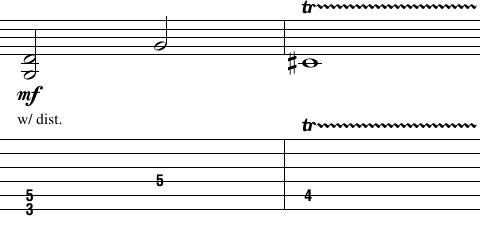
Welcome back to this overview of intervals in guitar playing! In part one, we looked at thirds, sixths and tenths. In this follow up article, we will be taking a brief look at fourths and fifths. Both of these intervals can be used more ambiguously, as they remain the same in the context of a major or minor chord (when sticking to notes in diatonic scale, at least – more on that later). Because of this fact, they can utilized in slightly different ways to the tones they sit alongside in common scales. Let’s take a look…
Fourths
Fretting the two highest strings together at the same fret creates this classic double stop, which can be heard all over rock’n’roll, but famously in the intro and solo for Chuck Berry’s Jonny B. Goode. Berry developed this style so he could recreate horn lines, as his live band was a smaller ensemble than many bands of the time (which would typically have more than one sax, trumpet, trombone, among other brass instruments). Every rock guitarist that followed has used phrases first made famous by Berry, from Angus Young to George Harrison. It is also a useful interval for slide guitar playing as it can be used over major and minor chords alike (you can see an example of me playing 4ths with a slide on this cover video of a well-known song).
In jazz, Wes Montgomery pioneered the use of stacked fourths, creating chord-based solos using 4th intervals on top of each other (for example, one chord would sound, low to high, as A, D, G, C), and the shape would move in line with the melody. George Benson kept up this tradition, but would also regularly employ diads (two notes played together) of 4ths in his lightning-fast solos.
Fifths
A fifth is an inversion of a fourth, and vice versa. Here, the strict definition can become blurred – think of the intro to the Deep Purple song Smoke On The Water and you’ll hear diads playing the entire riff in what sound like fourths (eg, the first pair of notes is a D, then a G on top). However, since the melody is following the G minor pentatonic scale (as the song is in the key of G minor), I’d argue that this riff is an inverted fifth (D being the perfect fifth of G), as the melody note is higher than the harmony note.
In rhythm guitar, a root and fifth creates the classic power chord heard in most varieties of rock music. Alternating the fifth with a sixth, and moving back and forth between the two, gives the famous (almost cliché) rocking riff used by artists from Chuck Berry to Status Quo and beyond.
Variations on ‘perfect’
The intervals we have discussed above – using the fourth and fifth notes in a diatonic scale, create what is known as perfect fourth / fifth. However, as with any note, we can raise or lower it’s pitch by a semitone for a new musical sound. Flat fourths & fifths are both referred to as diminished (and of course be found in diminished chords and scales). Raised ones are called augmented. As a fourth and fifth are only a tone apart, a diminished fifth is exactly the same thing as an augmented fourth – just in case you were confused!
Apart from being the famous Devil’s chord (famously used on the Black Sabbath song Black Sabbath), this interval often occurs in Blues-based music. The Pentatonic Blues Scale is based on intervals of R, b3, 4, #4, (or b5), and b7. Likewise, in dominant seventh chords (for example, C7), the natural interval between the chord’s major third (E) and flat seventh (Bb) is a diminished fifth/augmented fourth. Highlighting these notes over these chords creates a wonderful effect without having to overthink your playing too much!
Finally…
There are a few intervals we haven’t covered in these two articles. Off the top of my head, these would be seconds, sevenths, octaves and extended intervals used in jazz chords and arpeggios, such as ninths, elevenths and thirteenths. I plan to look at octave-based playing in a future article, because it is a staple of my own guitar heroes, such as the great Wes Montgomery. However, if you’d like me to look into some of the other intervals (such as sevenths, which is a really useful colour tone in jazz), do let me know!

Single line lead guitar playing is great. But when you have six strings and four fingers to hold them down, why limit your playing to one note at a time? Throughout the history of guitar, players have used two notes (or more) at once, resulting in something halfway between a single note line and a full guitar chord. We do this for a few reasons:
What is an interval?
An interval is he distance between two notes, in terms of pitch. Thinking of the C major scale (visualize the white keys on a piano), the root note (C) is 1, and the next note (D) is therefore 2, so the interval between C and D is known as a 2nd. More specifically, it is called a major 2nd because it is a whole tone away from C (whereas Db, only a semitone higher, is known as a minor 2nd). The next note in the C major scale would be E, which is called a major third (and Eb is the minor 3rd). I won’t bog us down in theory for this article, but if you need a more in-depth explanation, check out this video from Victoria Williams of mymusictheory.com.
It’s possible to use any interval when playing, especially lead lines. However, some are more effective than others. In this article, I’m going to stick to three types of interval: thirds, sixths and tenths, along with a few well-known examples in music. Go give some of these a listen and see if you can spot the intervals in use.
Thirds
Common in any music with a Spanish in Latin twist, particularly on acoustic guitar. Try going up and down a major scale by playing each note with another note ‘two places higher’ in the scale on the next string up. For example, starting with a C by fretting the G string at the fifth fret, you ‘think up two notes’, skipping D, and playing E by fretting the B string at the fifth fret. The next note in the scale (D) would be played at the same time as F. Going up the fret board/scale, the notes should match up above each other like this:

Check out this useful video by Pete Farrugia, which covers thirds and sixths in greater detail (see below).
It is also the most commonly used interval for twin guitar harmonies, such as:
Sixths
One of my personal favourites, which I use a lot in my guitar playing. Sixths are essentially an inverted third, where the base note (eg, C) is played highest (such as one the E string at the 8th fret), while the harmony note (E or Eb) is played two strings lower (in this case, the G string, at the 9th fret for E, or the 8th fret for Eb).

They can highlight major and minor chords, and sound great when you slide into them up and down the scales you’re using, as well as chromatically (think of the stereotypical blues ‘ending’). They’re great for soul playing too, implying a chord or scale with only two notes (as with tenths – see below). I’m not alone in this – examples exist across the various genres that the guitar is used for, including:
Steve Cropper’s guitar playing uses this time and time again, on many classic recordings from Otis Redding to The Blues Brothers. He had a knack for finding the right guitar line that complimented the songs he played on, without overpowering them, and rightly deserves his own article looking into his style in greater detail (watch this space)!
Tenths
Tenths are essentially thirds, but with an additional octave between the two notes. This has the interesting effect of creating the impression of a chord, while still leaving a sense of space. It is the interval used in the opening phrase of the well-known classical guitar standard Lagrima. Here’s a chart to demonstrate where the tenth harmony for Bb (played alongside a D, two notes then one additional octave higher) across the guitar fretboard:

There has been a few examples of this in big singles recently. In each case, t tenths are used for the main guitar park in the songs:
Tenths are also used in jazz. They provide a nice open-sounding stretch which is easy to play on guitar; they implied the chordal harmony while still leaving space for other instruments.
In summary
One thing that all three of these interval types have in common is their ability to reflect a major or minor chord. I think of them as the same interval, using a base note of C as an example again:
Each has it’s own feel and characteristic, and they are not always as interchangeable as you might think. Try playing around with them, across major and minor scales, then in your solos, and let me know how you get on!
Coming next: Part two of this subject will focus on intervals which can utilised over major and minor chords – fourths and fifths.
You might have noticed that recent posts have featured poems (especially Haiku) rather than my usual guitar or music-related topics. Well, you don’t have to worry about this site turning away from it’s main focus. For one thing, my efforts aren’t very good!
Yet, in these uncertain times, I find myself composing small poems in my head and decided to try and write more of them down. I also recalled previous advice about writing one Haiku per day, in order to become better at distilling an idea into a short, succinct form. Now seemed as good of a time as any to put some of my poems out into the world, from those celebrating recent guitar purchases, or the bizarre thoughts that strike me while out walking. There were also a few other reasons, such as…
I’m not performing live at the moment
Due to COVID19, almost no one is gigging at the moment. Since March, I have managed one socially distanced gig in a garden with the Nick Gladdish Band, but otherwise have found myself with more free time on my hands, particularly on weekend evenings. All future gigs and musical projects are postponed. Also, not having much means (or space) to embark on live streaming or recording projects from home, I found my creative juices were becoming pent up, and seem to have manifested themselves via written ideas, rather than musical ones.
I decided not to be embarrassed about my poems any more
I recently discovered that a good friend has a passion for a very niche form of short story writing, which was as pleasing to learn as it was unexpected. The fact that I was happy for my friend made me realise that I shouldn’t have any shame in putting my own silly little rhymes and Haiku out into the world.
I enjoy writing them
Surely that’s the most important thing? I mentioned in my recent post about using the recent lockdown as a reminder to do the things you enjoy, when you can. For me, this is one of those things. Like a Sudoku, they serve to keep my sharp, in a creative sense, until I can start rehearsing my own musical compositions and playing gigs again.
This blog will still continue to be about guitar. music, music therapy and all sorts of arts-related subjects. Writing these articles are another way of channeling my creative urges, and if someone learns a little extra knowledge as a result, fantastic. In time, I will start to announce new tours, projects, albums, etc, as they start to emerge from our cultural hibernation – but expect to see the odd poem thrown in there as well, from time to time!

This year has seen the most use of the word ‘unprecedented’ that I have ever seen, and probably for good reason.
Do what you can now, and if you can’t do it now, plan for later
Getting started on something can often be hard. During lockdown, I’ve found myself exhausted after a full day of childcare, and in those few rare moments I had for me, working on a new composition seemed ridiculous.
Do what you can, in small steps. In fact…
Make a list
List what your daily tasks are, as well as goals for the medium term (i.e., the next few weeks) and long term (post-lockdown, or even post-COVID altogether). It will help you focus, and evaluate what is important.
List making sure was already an occasional habit of mine, mainly because I am aware of my own poor short-term memory. Going forward, I’ll be sticking to daily lists, as they seem to have made me more productive than when I worked from home in pre-pandemical times.
Speaking of lists…
Bring back the ‘weekly shop’
We must have gotten out of the habit of doing the ‘big shop’ only once a week. Lockdown forced us back into this habit, and although it somehow felt more expensive at first, it seems to be better value across the week, especially when it was harder to nip out on a whim for a treat. Give it a try, if you can, and see how it works for you.
Don’t compare yourself to others
Whether it’s FOMO (fear of missing out) or a kind of professional jealousy when another person seems to be working fine at home – you know, the one with all the recording gear in their spare room (or their parents) and no children.
Social media only shows you what people want you to see. Most of the time, it only shows what those people think everyone else wants or expects to see.
Some of it is real. Some of it is less than genuine. All of it is someone else, in a different set of circumstances (however slight that might appear).
Beware of fatigue
Some of my friends have been locked down at home by themselves, working from one room during day, then zoning out in front of the TV in the evening. They told me that even committing to an online quiz via Zoom felt like too much effort. Staring at a screen all day, even for leisure or socially distant socialising, is incredibly tiring. Give yourself time to reset, and do absolutely nothing. Just remember when you do…
Don’t be to hard on yourself
If the fatigue did’t get you, the guilt surely did – right?
This is connected to my earlier heading, Don’t compare yourself to others, but it’s worth looking at again from a slightly different angle.
We’re going through unprecedented times. No one in our lifetime has experienced this, on this scale, before. Survive. Look after yourself and those around you. Don’t feel guilty for doing less.
In fact, don’t feel guilty at all for how you are managing to get through a pandemic.
Do what you love, if you can (and if you can’t make a plan for doing it in the future)
You might have noticed that a few of my recent posts have been short Hailku form poems, or observations from walks with my family. I enjoy writing them. Since I can’t perform live at the moment, they give me some creative output while everything else is on hold.
If you have recently discovered a new passion, embrace it and enjoy it. Share it with the world. And if COVID19 is stopping you from doing what you love and enjoy (as it has for me with my love of playing guitar live), make another list; this time, make it a plan to get your passion up and running again soon, once all of this is – hopefully – a distant memory of an unpleasant time, now disappearing.
Best of luck, and let me know how you get on! Also, let me know what lessons you have learned from the last few months of lockdown by leaving a comment or getting in touch via my usual channels – I look forward to chatting to you!

At the weekend, we went up to Hareshaw Lin in Bellingham for a walk. It was lovely exploring this northwestern corner of Northumberland, following the short walk (less than two miles), along the ruins of a former iron foundry on the North River Tyne, to a waterfall (the Lin, in Old English). On our route, we noticed something unusual…

Hundreds of coins inserted into the small slits of the bark of fallen trees. I noticed it in a few sidelong tree stumps, but it was most obvious on this large fallen tree and nearby stump (see above). I have no idea why this tradition started, but some of the coins look very well weathered, and I expect have been there for several years.
The waterfall itself was beautiful, a small oasis of it’s own within the woods (see below). Several younger people were diving into the pool at it’s base. Judging by how long it took them to resurface after diving, it must be quite deep in it’s centre, although there appears to be a lip of rocks around the pool’s circumference.

The foundry appears to have been washed away by a flood in the early years of the 20th century, and several more rocks swept downstream in a further flood in the 1960’s. The large stones which remain (many were taken to be used for local buildings) jut out the water to create numerous miniature weirs alongside our walking route. It’s a lovely spot, but was rather busy when we went, possibly because people see it as a good outdoor location in these socially distant times. Still, there are many worse ways to spend a Saturday afternoon…

The wheat it rises fast by summer late
Honey yellow melting into rich gold
Yet now, streaking through the swaying barley
Comes ex-P.M. from Euro state of old
Fleeing worldly problems and past mistakes
With childish abandon and youth-lost glee
Surprised, then angry; next, aloud thinks I:
“Well, that’s stained this golden moment for me!”

Somehow, this silly little poem (about former UK Prime Minister Theresa May running through one of the fields of wheat outside my home) felt best suited to the sonnet form (of somewhat loosely – see below).
For context, here is May’s past form, regarding running through fields of wheat.
Please don’t judge my efforts too harshly. It is my first attempt at writing in this form since secondary school (twenty years ago). I most definitely haven’t adhered to the ‘galloping’ rhythm of traditional Iambic Pentameter (5 pairs of syllables per lone, going weak-strong each time). This would have been a strict requirement for stage actors reciting these lines (usually as dialogue) in Elizabethan age plays, most famously those penned by William Shakespeare.
However, I’m not Shakespeare, Marlowe or any sonnet writer of any note, by any stretch – that much should be clear by now! I’m just a bored dad trying to get his youngest child (currently teething) to sleep by taking them out in the buggy for an evening walk…

Sunburst finished wood
Three clear voices singing out
A new soul machine
(this one is in honour of the guitar I didn’t expect to win in an online auction (read about it here)

I’ve noticed a few decent-looking guitars going for sale on eBay recently. In the past, I’ve picked up a few great instruments and amps, including the Strat which was my main touring guitar for a decade, as well as two Fender Mustang floor units, which I use for live work most of the time nowadays. However, buying something online, especially a musical instrument you haven’t played, or even held, can be a risky business. I therefore try to set an ‘absolute maximum’ price which I won’t go over. This is price is normally quite low, meaning I should be able to at least earn a small profit on any guitars I decide to move on – but it does mean I’m not usually the ‘winning bidder’ when interesting pieces catch my attention.
That is, until I saw this gem…

What is it?
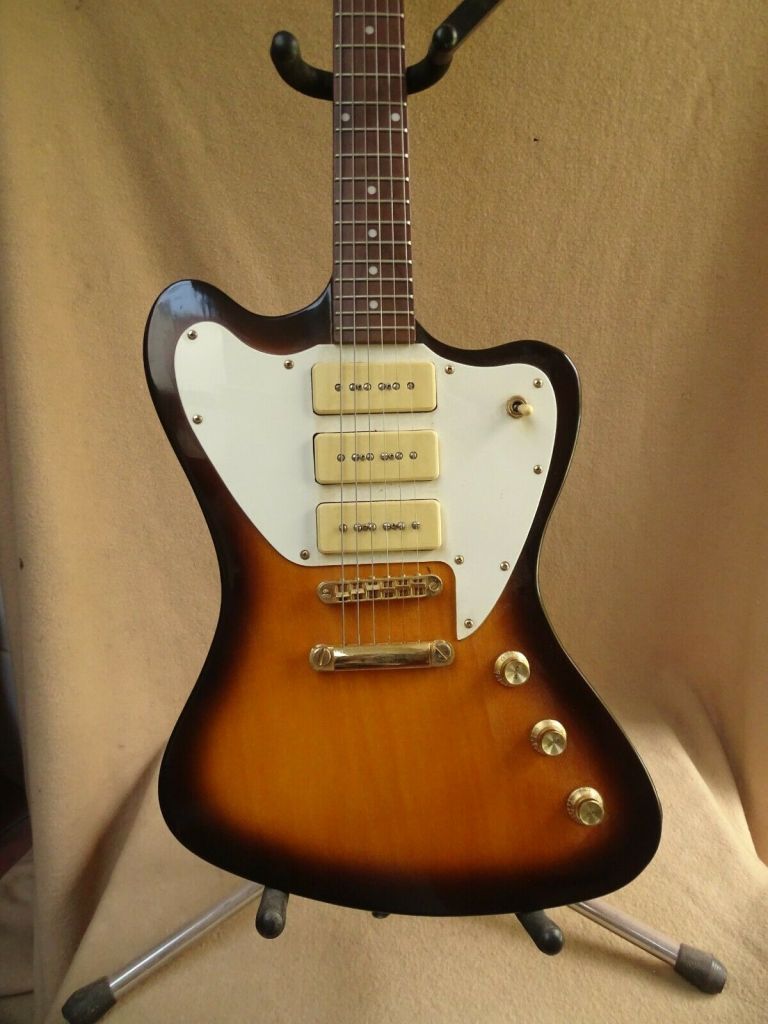
This guitar is modeled on the Gibson non-reverse Firebird III, one of Gibson’s early forays into the offset market, only flipping the body to be a mirror image of the shape in the above picture, hence the term reverse. From 1965 to 1969, Gibson offered a non-reverse version, in a much more Jazzmaster style shape. The ‘III’ in the name is a reference to the guitar having three P90 pickups, unlike the two mini humbuckers on previous Firebird models. Because these non-reverse bodied, three pickup guitars were only available for around four years, they are considered highly collectible and even ones in poor condition go for thousands of pounds.
However, I knew from the price I paid for it alone that this guitar was not a real Gibson. Once it had been delivered, it was clear that the ‘Gibson’ logo on the headstock is actually a decal, added after the original purchase (although some of these copies were actually supplied with stickers such as this, or alternative truss rod covers that read ‘Gibson’, so perhaps it came with the instrument). An original Gibson of this style from the mid to late sixties would have looked slightly different, too – chrome hardware, black pickup covers and probably a Firebird decal somewhere on the pickguard. But I have to say, I quite like the gold hardware, and I’ve always preferred cream/aged white pickup covers, especially on retro-styled guitars such as these.
So who made it?
In my initial research, the Japanese manufacturer Tokai looked the most likely suspect. Tokai, along with Ibanez, were famous for their ‘lawsuit guitars’ in the seventies; the lawsuit occurred because they were making better Les Pauls than Gibson were (the 70s saw huge reductions in quality from both Gibson and Fender guitars, making the Japanese rip-offs much more appealing, and better value). Tokai have certainly released their own take on the Firebird design, but after a little more digging, I discovered that this model is the Gould Stormbird. The almost completely unknown Gould brand are seemingly British-based, but put together in China, probably in the early 2000s, and possibly feature the talents of UK pickup legend Alan Entwistle behind the scenes. Very promising…
Is it any good?
Heck, yes. It sounds amazing, and reinforces my belief that sometimes, one is merely paying extra money for the right name on the headstock. This guitar plays really well, hangs nicely on a strap and has a good vintage-feel neck (i.e., it’s thicker than many modern guitars). The guitar’s budget P90 pickups sound as good as any other I have played, and the control layout of three-way toggle switch (neck / neck & bridge / bridge), shared volume for neck & bridge pickup, plus a separate volume control for the middle P90, allows for seven different pickup configurations, all of which can be tweaked by how you decide to blend pickups together. The master tone control appears to taper smoothly as well – rare for what is clearly a budget guitar. P90s sit somewhere between humbuckers and single-coil pickups in terms of output and ‘beefiness’, and I certainly get a ‘Strat on steroids’ vibe from this guitar. I love the sound of this guitar played clean, through a Fender Deluxe or Twin Reverb style amp as well as a more retro-styled dirty sound – a Fender Bass man plus a vintage tremelo effect sounded wonderfully evocative…
Could this instrument become my main guitar for soul work, replacing my main all-rounder, my vintage-voiced blonde Stratocaster?
There was one slight fault. The frets don’t seem to be the best quality, and a few were coming away slightly, causing bends to choke at certain points on the neck. I noticed the same issue might be happening in a few other places, so I sent the guitar off to my tech guy for a partial refret, which thankfully didn’t cost too much. Upon it’s return, the notes all sing beautifully, especially with those P90s…
Pros and cons
Pros
Neutrals
Cons
All in all, I think I’ve grabbed a bargain! Especially from a random purchase on eBay. At least it’ll give me a new toy to play with while I wait for my new custom guitar to be completed (more on that later this year…)

Welcome back to the Great Guitarists series. We’re continuing along a jazz theme for now, with a sometimes underrated master of understated single line guitar soloing…
Grant Green

Green was born in St. Louis, Missouri, in 1935, and died in 1979, aged just 43. In his all-too-short career, he played on hundreds of records, including numerous solo titles – almost thirty cuts for Blue Note Records alone. Many of these were played as part of an organ trio (organ, guitar, drums) in a style known as Soul Jazz. This style was sometimes sniffed at by jazz purists, but has since gone on to be something of a cherished gem, and ripe pickings for sampling, especially in hip ho and acid jazz (Read Jorge Cervera’s defence of Grant Green and soul jazz here).
Although less well known than some of his contemporaries, such as Wes Montgomery, his friend George Benson and his main guitar influence Charlie Christian, Green nonetheless possessed a highly recognisable guitar sound, which can be heard in the playing of many guitarists today, myself included. Indeed, his mix of blues, soul and hard bop licks over a funky back beat has become the quintessential sound of upbeat jazz guitar playing.
Equipment and guitar sound
Green most famously used a Gibson ES-330, which is essentially the same shape as the brand’s better-known 335, but with P90 single coil pickups (not unlike an Epiphone Casino). Later on in his career, he played a Gibson L7, Epiphone Emperor and custom-made D’Aquisto guitars, all of which featured similar P90 style pickups. This type of pickup was one of the first kinds added to hollowbody guitars, and Green obviously enjoyed the full, clear sound they provided.
Interestingly, for a guitar player known for his fluid single line style, Green was known to roll the treble and bass entirely off on his amplifiers, to better emphasise the midrange for more bite and attack in his tone – try it with a P90 neck pickup, and see if you can recreate Green’s sound!
Essential listening
Idle Moments (1963) is a great place to start. It’s a slow, contemplative masterclass in cool jazz guitar,and one of my favourite jazz guitar records, along with Midnight Blue by Kenny Burrell (more about that here).
There’s a couple of good options for live cuts, but the recently released collection Funk in France, From Paris to Antibes (1969-1970) (2018, Resonance) captures Green at his best. A few of the tracks see the trio lineup complimented by none other than the legendary Barney Kessel, which makes it essential listening for me!
It’s also worth seeking out some of Greenvs funkier efforts, such as… He also made an interesting album of Latin music (The Latin Bit from 1963, on Blue Note again), in which the main theme (the ‘heads’) were played in the usual samba or bossa nova style, but the solos are swung – give it a listen and make of it what you will!
As a sideman, he played on hundreds of recording sessions. Among my personal favourites are Herbie Hancock’s My Point Of View (1963, Blue Note) and Art Blakey’s Hold On I’m Coming (1966, Limelight). However, each record in Green’s expansive discography features great playing and lead lines that we guitarists would benefit from adding to our repertoire!


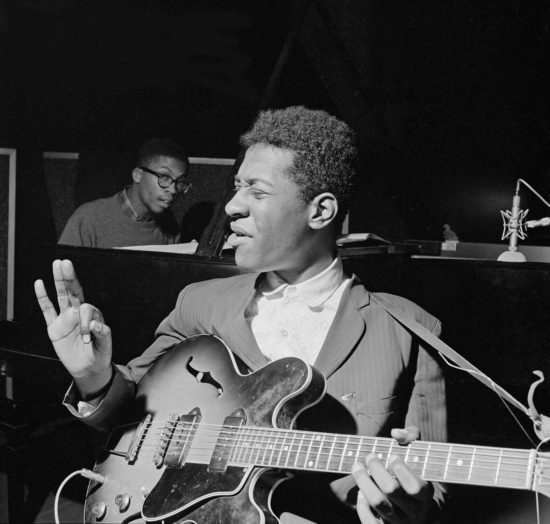
Just as Green (and countless other great jazz guitarists) did with Charlie Christian’s recordings, listen, learn, then find a way of making it your own…
 Tim Higgins, Guitarist
You must be logged in to post a comment.