Snow (double haiku)

Poetry & Writing

Snow on the Dyke-backs

Prophesying its return

And see, it comes now

For those who might not know, the dyke-backs are the sides of the short hills or ditches which, in winter, never get direct sunlight. As a result, snow takes longer to melt on these small sections of Northumbrian landscape. Around here, is taken almost as a given that seeing the snow remain on the dyke-backs, when it has melted everywhere else, means that it will likely snow again before the weather improves and the world gets warmer on it’s path towards the spring.

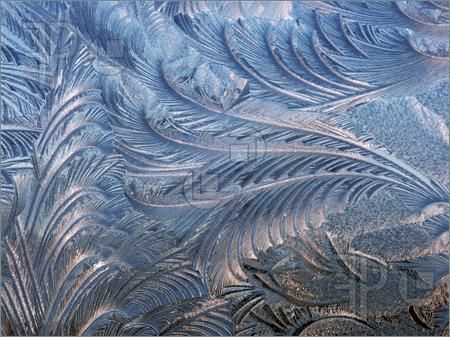
And while it stays cold, the frost can do strangely wonderful feats to your car…

Frosting cold and white

Nature’s stencil on metal

Accidental art

A year of books (October-December)

Books

Can you believe it? 2020 is over, and what a year!

No gigs since March, continuing to carry out my music therapy work in the middle of a worldwide pandemic, while the world is turned on it’s head… But there have been books. Previous installments of this series can be found here:

Even in my time not working, stuck at home, I feel like I’ve had less time to read (children take up your entire day if work doesn’t). So unlike some of my bibliophile friends, I’d sy I’ve read less in 2020, compared to previous years. Despite this, I’ve certainly enjoyed taking stock of every title I’ve read (with the exception of music therapy and psychotherapy books – I might provide some recommendations from those fields in a specialist interest article in the future). I well might continue this habit in 2021.

But for now, here are the non work-related titles I managed to read in the final quarter of 2020…

What we talk about when we talk about books: the history and future of reading by Leah Price (2019, Basic)

An interesting rebuttal to the common cries of “print is dead”, highlighting the ever-changing use of the book as an object and as an idea. The book is full of interesting information. For example, did you know that self-help books from local libraries are prescribed by the NHS in Wales to help treat depression? Price turns this tidbit into an entire chapter, although whether or not this needed an entire chapter is up for debate. The chapters feel like a compilation of essays which feel like they’ve been extended to make this ‘book worthy’. And for a book about the history and future of reading, padding out the chapters with repeated information feels like the author is doing her subject an injustice. This short book could have been even shorter, but less repetitive, and no less interesting as a result.

Finally, the middle ‘interleaf’ chapter uses the interesting device of running the text across both pages before starting a new line. This takes a little getting used to, not least because the text doesn’t always line up correctly between the left and right pages. Interesting, but perhaps only for skimming through.

Bue remembered Earth by Alastair Reynolds (2012, Gollancz)

I’ve read a few science fiction novels by Reynolds, such as the brilliant standalone book House of Sun’s. His experience before becoming a full-time author – namely his PhD in astrophysics and his work with the European Space Agency – mean that he can add an element of realism to what is obviously a fictional piece of work. Indeed, he has been quoted as saying he prefers to stick to writing about only the future technologies he believes to be possible (so light speed travel rarely makes an appearance in his work). This first novel in Reynold’s Poseidon’s Children trilogy sticks largely to that sensibility, while still encompassing some brilliantly fantastical elements such as off-world settlements and trans-human experimentation.

Set around a century or so into the future, the two main characters are brother and sister, heirs to a large family dynasty in Africa, now one of the world’s main centres of economic power. The death of their grandmother leads them on a trail away from Earth, to colonies on the Moon, as well as Mars and its two moons. Utopia, mystery and afrofuturism are combined in an intelligently written and well paced novel. I’ll be adding the next two novels in the series to my ever-expanding ‘to read’ pile…

The mirror and the light by Hilary Mantel (2020, Fourth Estate)

I’ve been waiting a while to read this, not least because the release of this novel, the final of Mantel’s ‘Cromwell Trilogy’, was pushed back more than once. But then, if the first two instalments of your historical fiction trilogy (Wolf Hall and Bring Up The Bodies) both win the Booker Prize for fiction, you want to make sure the last book is the best it can be. I can confirm that this novel is as good as it’s two predecessors.

The first book looked at Thomas Cromwell’s rise to become the senior advisor of Henry VIII, the second continued his survival at the top while accruing further positions of high office. This final novel deals with the last four years of Cromwell’s life, starting at the exact moment Bring Up The Bodies ended – the beheading of Anne Boleyn. It shouldn’t be much of a spoiler to say that Henry VIII turns on Cromwell – history suggests that he seems to do so on almost everyone around him, given enough time. Yet even though you might know (or could certainly guess) the ending, the journey there is so wonderfully written that you won’t mind. Mantel employs a [articular style of first person that can be a little difficult to get used to, but it’s worth persevering as it soon becomes normal, and fits the story (told from Cromwell’s perspective) perfectly.

The Mirror And The Light is a rich novel, full of detail, intrigue and a huge cast of characters. It marks a wonderful end to a fantastic trilogy of books. It remains to be seen if Mantel can get the ‘Booker hat-trick’ with this novel, but prizes aside, this book should be required reading for all fans of historical fiction, literary fiction, or indeed just good old-fashioned fiction.

Dave Brubeck: a life in time by Philip Clark (2020, Headline)

This newly-released biography of the famous jazz performer and composer was a Christmas present, and as a result, I haven’t finished it yet! However, although I’m only a third of the way in, I’m finding it an absorbing read so far. I believe fans of the jazz genre would be similarly interested in this book, which shows how much more there is to Brubeck beyond his most famous piece, Take Five. Sometimes dismissed in the past by jazz lovers who prefer who improvisation of bebop legends Charlie Parker, John Coltrane, and so on, Clark’s tome will help with the current restoration of reputation Brubeck (or rather his life and body of work) is currently experiencing. Brubeck was an devotee to music as an art form, and a lifelong anti-racist. Given the circumstances we find currently ourselves in, a renewed respect for Brubeck couldn’t come at a better time. I’m looking forward to quickly finishing this book in the first few days of 2021.

So there you have it. That’s around twenty books I’ve read in 2020 (that aren’t related to music therapy). Having counted them up, it definitely feels like less than a typical year – but then, 2020 has been a far from typical year!

As always, I’d love to hear what all of you are currently reading, as well as your thoughts on any of the titles I’have mentioned in these summaries.

Happy new year and happy reading!

Why is there so much poetry in my blogs now?

Poetry & Writing

You might have noticed that recent posts have featured poems (especially Haiku) rather than my usual guitar or music-related topics. Well, you don’t have to worry about this site turning away from it’s main focus. For one thing, my efforts aren’t very good!

Yet, in these uncertain times, I find myself composing small poems in my head and decided to try and write more of them down. I also recalled previous advice about writing one Haiku per day, in order to become better at distilling an idea into a short, succinct form. Now seemed as good of a time as any to put some of my poems out into the world, from those celebrating recent guitar purchases, or the bizarre thoughts that strike me while out walking. There were also a few other reasons, such as…

I’m not performing live at the moment

Due to COVID19, almost no one is gigging at the moment. Since March, I have managed one socially distanced gig in a garden with the Nick Gladdish Band, but otherwise have found myself with more free time on my hands, particularly on weekend evenings. All future gigs and musical projects are postponed. Also, not having much means (or space) to embark on live streaming or recording projects from home, I found my creative juices were becoming pent up, and seem to have manifested themselves via written ideas, rather than musical ones.

I decided not to be embarrassed about my poems any more

I recently discovered that a good friend has a passion for a very niche form of short story writing, which was as pleasing to learn as it was unexpected. The fact that I was happy for my friend made me realise that I shouldn’t have any shame in putting my own silly little rhymes and Haiku out into the world.

I enjoy writing them

Surely that’s the most important thing? I mentioned in my recent post about using the recent lockdown as a reminder to do the things you enjoy, when you can. For me, this is one of those things. Like a Sudoku, they serve to keep my sharp, in a creative sense, until I can start rehearsing my own musical compositions and playing gigs again.

This blog will still continue to be about guitar. music, music therapy and all sorts of arts-related subjects. Writing these articles are another way of channeling my creative urges, and if someone learns a little extra knowledge as a result, fantastic. In time, I will start to announce new tours, projects, albums, etc, as they start to emerge from our cultural hibernation – but expect to see the odd poem thrown in there as well, from time to time!

Lessons learned from lockdown

Advice & Tips

This year has seen the most use of the word ‘unprecedented’ that I have ever seen, and probably for good reason.

Do what you can now, and if you can’t do it now, plan for later

Getting started on something can often be hard. During lockdown, I’ve found myself exhausted after a full day of childcare, and in those few rare moments I had for me, working on a new composition seemed ridiculous.

Do what you can, in small steps. In fact…

Make a list

List what your daily tasks are, as well as goals for the medium term (i.e., the next few weeks) and long term (post-lockdown, or even post-COVID altogether). It will help you focus, and evaluate what is important.

List making sure was already an occasional habit of mine, mainly because I am aware of my own poor short-term memory. Going forward, I’ll be sticking to daily lists, as they seem to have made me more productive than when I worked from home in pre-pandemical times.

Speaking of lists…

Bring back the ‘weekly shop’

We must have gotten out of the habit of doing the ‘big shop’ only once a week. Lockdown forced us back into this habit, and although it somehow felt more expensive at first, it seems to be better value across the week, especially when it was harder to nip out on a whim for a treat. Give it a try, if you can, and see how it works for you.

Don’t compare yourself to others

Whether it’s FOMO (fear of missing out) or a kind of professional jealousy when another person seems to be working fine at home – you know, the one with all the recording gear in their spare room (or their parents) and no children.

Social media only shows you what people want you to see. Most of the time, it only shows what those people think everyone else wants or expects to see.

Some of it is real. Some of it is less than genuine. All of it is someone else, in a different set of circumstances (however slight that might appear).

Beware of fatigue

Some of my friends have been locked down at home by themselves, working from one room during day, then zoning out in front of the TV in the evening. They told me that even committing to an online quiz via Zoom felt like too much effort. Staring at a screen all day, even for leisure or socially distant socialising, is incredibly tiring. Give yourself time to reset, and do absolutely nothing. Just remember when you do…

Don’t be to hard on yourself

If the fatigue did’t get you, the guilt surely did – right?

This is connected to my earlier heading, Don’t compare yourself to others, but it’s worth looking at again from a slightly different angle.

We’re going through unprecedented times. No one in our lifetime has experienced this, on this scale, before. Survive. Look after yourself and those around you. Don’t feel guilty for doing less.

In fact, don’t feel guilty at all for how you are managing to get through a pandemic.

Do what you love, if you can (and if you can’t make a plan for doing it in the future)

You might have noticed that a few of my recent posts have been short Hailku form poems, or observations from walks with my family. I enjoy writing them. Since I can’t perform live at the moment, they give me some creative output while everything else is on hold.

If you have recently discovered a new passion, embrace it and enjoy it. Share it with the world. And if COVID19 is stopping you from doing what you love and enjoy (as it has for me with my love of playing guitar live), make another list; this time, make it a plan to get your passion up and running again soon, once all of this is – hopefully – a distant memory of an unpleasant time, now disappearing.

Best of luck, and let me know how you get on! Also, let me know what lessons you have learned from the last few months of lockdown by leaving a comment or getting in touch via my usual channels – I look forward to chatting to you!

Hareshaw Lin & coins in trees

Poetry & Writing

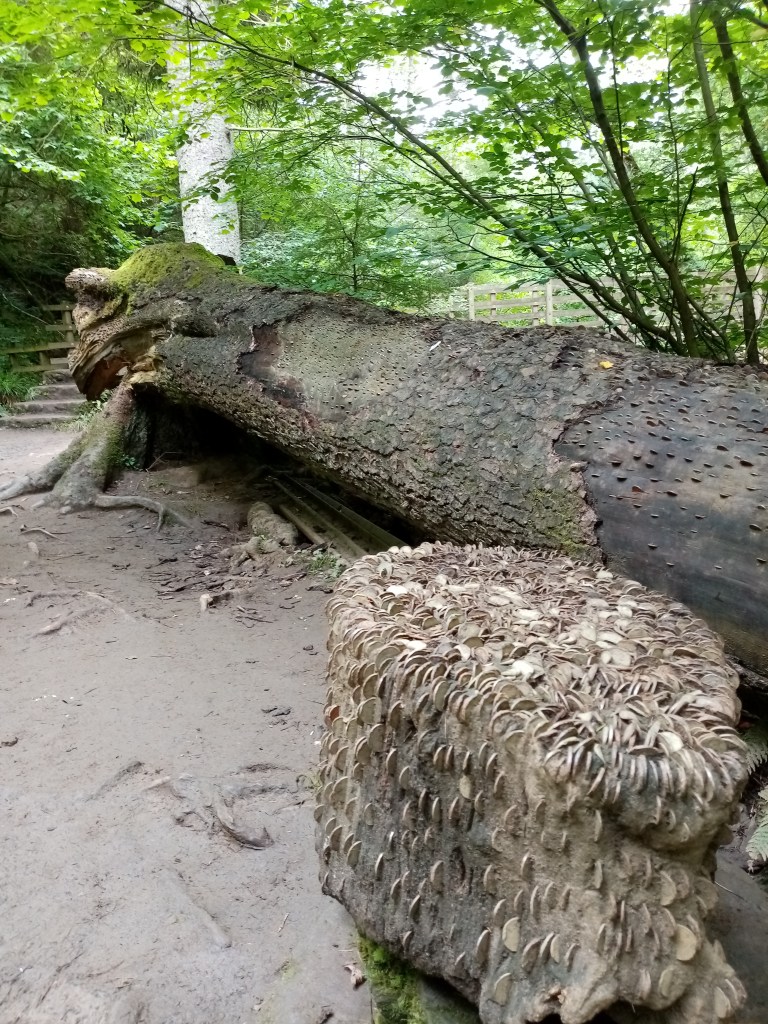
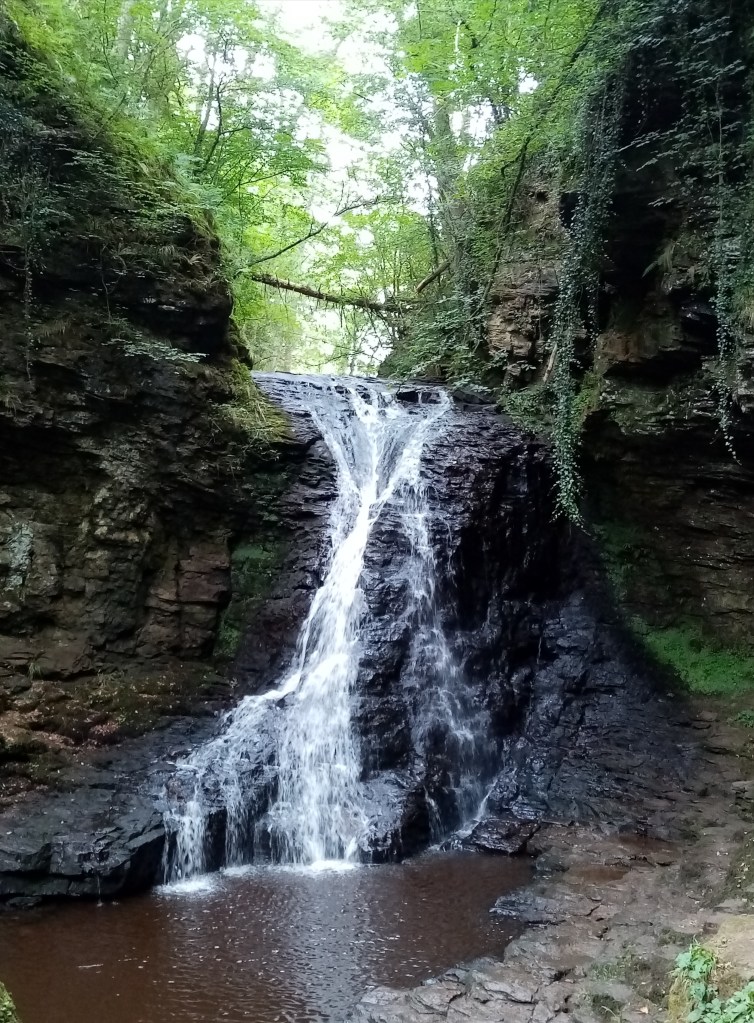
At the weekend, we went up to Hareshaw Lin in Bellingham for a walk. It was lovely exploring this northwestern corner of Northumberland, following the short walk (less than two miles), along the ruins of a former iron foundry on the North River Tyne, to a waterfall (the Lin, in Old English). On our route, we noticed something unusual…

A tree stump (and fallen trunk, behind) with hundreds of coins inserted into the bark

Hundreds of coins inserted into the small slits of the bark of fallen trees. I noticed it in a few sidelong tree stumps, but it was most obvious on this large fallen tree and nearby stump (see above). I have no idea why this tradition started, but some of the coins look very well weathered, and I expect have been there for several years.

The waterfall itself was beautiful, a small oasis of it’s own within the woods (see below). Several younger people were diving into the pool at it’s base. Judging by how long it took them to resurface after diving, it must be quite deep in it’s centre, although there appears to be a lip of rocks around the pool’s circumference.

Hareshaw Lin – the word ‘Lin’ means ‘Waterfall’ in Old English

The foundry appears to have been washed away by a flood in the early years of the 20th century, and several more rocks swept downstream in a further flood in the 1960’s. The large stones which remain (many were taken to be used for local buildings) jut out the water to create numerous miniature weirs alongside our walking route. It’s a lovely spot, but was rather busy when we went, possibly because people see it as a good outdoor location in these socially distant times. Still, there are many worse ways to spend a Saturday afternoon…

Poem: A political ghost flew, ruining my view

Poetry & Writing

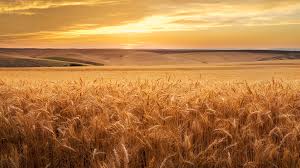
The wheat it rises fast by summer late

Honey yellow melting into rich gold

Yet now, streaking through the swaying barley

Comes ex-P.M. from Euro state of old

Fleeing worldly problems and past mistakes

With childish abandon and youth-lost glee

Surprised, then angry; next, aloud thinks I:

“Well, that’s stained this golden moment for me!”

Credit: news.ctgn.com

Somehow, this silly little poem (about former UK Prime Minister Theresa May running through one of the fields of wheat outside my home) felt best suited to the sonnet form (of somewhat loosely – see below).

For context, here is May’s past form, regarding running through fields of wheat.

Please don’t judge my efforts too harshly. It is my first attempt at writing in this form since secondary school (twenty years ago). I most definitely haven’t adhered to the ‘galloping’ rhythm of traditional Iambic Pentameter (5 pairs of syllables per lone, going weak-strong each time). This would have been a strict requirement for stage actors reciting these lines (usually as dialogue) in Elizabethan age plays, most famously those penned by William Shakespeare.

However, I’m not Shakespeare, Marlowe or any sonnet writer of any note, by any stretch – that much should be clear by now! I’m just a bored dad trying to get his youngest child (currently teething) to sleep by taking them out in the buggy for an evening walk…

A poor attempt at a Saturday morning Haiku

Poetry & Writing

I once took part in some writing seminars with a local author, who suggested writing a Haiku a day. In their opinion, the short form of this style of poetry (three lines of 5-7-5 syllables) was a great way to practice the distillation of a thought or mood into a very short set of phrases.

Here is one that developed in my mind as I finally roused in the shower:

I’m up for the day

Six A.M. on a weekend

Both children are up

But then I realised that there was no reference to nature, so this is not a Haiku in the classic sense.

The general ‘rules’ for a traditional Haiku are loosely as follows:

  • A focus on nature or the seasons
  • The juxtaposition of two subjects (something natural and something human-made, for example) a
  • A contemplative or wistful tone
  • Impressionistic brevity (no superfluous words)
  • Emphasis on imagery over exposition
  • Avoidance of metaphor and similes
  • Non-rhyming lines

I might attempt more Haiku poems in future. I remember finding the exercise useful, even if I am a little out of practice nowadays.

In the meantime, you can learn more about the Haiku form here