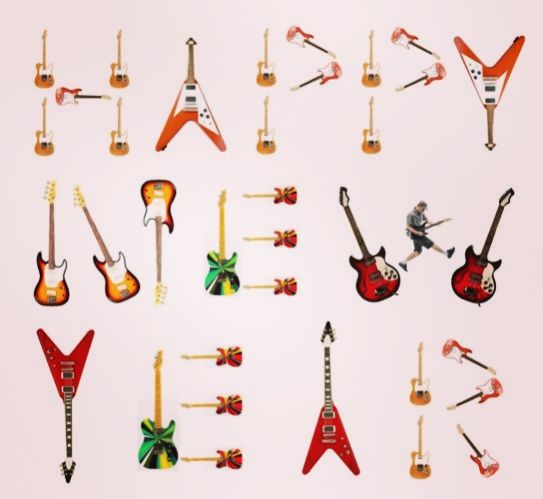
Hi all and welcome to 2022! You may have noticed that things have been a little quiet on this blog for the last few months. This is for a number of reasons, but don’t panic – I’m fine, just incredibly busy! Expect more posts in this new year, as well as updates on exciting new projects I’ve been working on. In the meantime, here’s a slightly rejigged post on New Year’s resolutions from a few years back. I hope you enjoy it! Until next time...
As a general rule, I don’t believe in New Year’s resolutions. My philosophy is that changes can be made at any time, so why wait until January?
However, there is something about the end of a year which causes us all to reflect on the previous twelve months and start focusing on our plans for the next twelve. For us working musicians, this would usually mean that we have reached the end of one of our peak times, the ‘Christmas Party Season’. For over a decade (pre-pandemic), I ended the year with a NYE gig. However, for obvious reasons, things have been a little quieter by comparison, which gives us time to ponder on the gigs we’ve enjoyed, what we didn’t enjoy, and what we hope to change for the new year.
So, with that in mind, here are a few of my suggestions for guitar-related resolutions for musicians looking to grow as better musicians in the coming year:
Learn a new style
Always wanted to start learning those jazz chord voicings? Perhaps you keep meaning to work on your reggae & ska rhythm playing? Or your country picking? Blues slide? The list goes on…
Take the time to work on these new genres & styles of playing. We are very fortunate to live in a time where we can access a world of free tutorials on the Internet, or videos in YouTube. However, don’t rule out the possibility of taking lessons to focus on specific areas – working one to one with an experienced guitar tutor does wonders for improving your playing!
Mix things up
Learning a style doesn’t mean you have to abandon all you know & travel the world playing strictly Django/gypsy jazz for the rest of your life (though I imagine there are plenty of worse ways to live)!
Have you found that the majority if your playing has been on acoustic guitar? Trying swapping to electric more often (or vice versa). Do you always practise at the same time of day? If possible, can you change to a different time? Your brain operates differently throughout the day – you may well find yourself going down very different musical avenues simply by switching from a morning to an afternoon practice session.
Sometimes learning to play a song you are very familiar with in a new style works brilliantly in helping your playing. Not only do you freshen up material which might be getting a bit stale, but you’ll have a safer means of exploring new options in your guitar playing.
One area of guitar playing I can’t recommend highly enough is solo performance. By this, I don’t mean the lead guitar solo in a song, but playing the melody, harmony, rhythms, etc on one unaccompanied guitar. It’s something a piano player wouldn’t think twice about, but I’m frequently amazed at how many guitarists simply haven’t tried it properly! If you’re unsure about how to start doing this, there are several books, online tutorials (like this blog!), and of course YouTube videos to help inspire you. Which brings us nicely in to…
Widen your horizons
Music is a language. Even when playing on your own, you are creating sounds for yourself to hear, effectively taking to yourself. But there’s only so long you can do that before you end up going round in circles, or going crazy!
Set yourself the following challenge for the year: discover a new artist each month. Learn from what you hear. Take examples of their playing & try to incorporate it into your own. It can only make you a better guitarist! The beauty of this is that you don’t have to focus on other guitar players. In fact, it might be better not to! Many of the jazz & Blues guitarists I admire take inspiration for their improvisational playing from horn players, translating their melodies & ideas into their own instrument. Try it!
It also helps to get out amongst other musicians, jam, join or start a new band, particularly in a new style. It also goes further than this – always wanted to sing while playing? Start! Learning a new instrument? Do it! The best way out of a rut is to climb upwards!
Get your music ‘out there’
…And if you’re meeting new musicians & launching new projects, you’re already doing this. Go to more live gigs and make sure you perform live yourself more often (when you can), especially new and original music. I know all too well how easy it is to get stuck in one ‘world’ for longer than you might like, finding it hard to make the time to do other things, but I promise it’s worth the effort.
Remember to have fun while you’re out there expanding your guitar playing horizons!
To finish off, allow me to wish you all the very best of health & happiness for the New Year! Let’s make 2022 – like every year – a great year for music, for the guitar, and for you!
Please do get in touch to tell me what your own guitar/music new year resolutions are, and stay in touch to let me know how you’re getting on with them! Tim xx






 Tim Higgins, Guitarist
You must be logged in to post a comment.