Auditioning tips (for both sides of the table)

Advice & Tips

Auditioning. In this line of work, almost everybody has to go through it at some point. I don’t know many people who enjoy the process – and by that I mean the groups holding the auditions as well.

I’ve held a few auditions in the last few years while recruiting for a few different projects. I was invited to join another group via audition fairly recently, which increased my own experience of being the auditionee for the first time in several years.

Having experienced it from both sides, here are some simple tips which will (hopefully) help make the whole thing go that little bit more smoothly.

1) Be clear about what you are looking for from the outset

Obvious but true. Many bands, in an attempt to appear open (and more likely to attract as many interested candidates as possible), will be vague about who/what they are and what they are looking for. Others may outright lie.

If you’re an act that is getting regular paid work and need a competent player, with their own means of transport, and who can read music – say so. If you don’t have any gigs at present, but are looking to get into paid work once you have a full lineup – say so. If you are mainly performing original material and the money from gigs won’t be that good – say so. If you’re all amateurs and would prefer someone of a similar playing ability to yourselves – guess what: say so!

Being upfront about who you are and what your expectations are actually saves you a whole lot of time, not least from having to filter through adverts responses from people who are simply unsuitable for your act. Likewise, auditionees looking for gigs – if you can’t sight read, don’t say you can and hope to busk it. Be clear on the styles you have knowledge of. You WILL get found out and not get the job. Worse than that, word will get around that you’re a bullshitter too.

2) Agree on pieces to go through before the audition / Plan a structured audition

You’re not doing any favours by inviting a potential band members down to your rehearsal space, shouting out the name of a tune and charging into it to see how well they cope. Even seasoned pros like to prepare first – that’s what makes them seasoned pros.

Have your space ready to go, with everyone in the band already there and set up, before the first candidate arrives. If going TO an audition, make sure all of your gear is in good working order, arrive on time and set up quickly.

Choose songs from your set, and perhaps some tunes both parties are reasonably familiar with, to work through. At a maximum, I’d suggest four or five. Make sure you also have plenty of time to chat and reaffirm exactly what it is both sides want out of working together. For a first meeting, I’d suggest an hour to an hour and a half. That should be more than enough time to find out how you gel musically, and crucially if you get along as people!
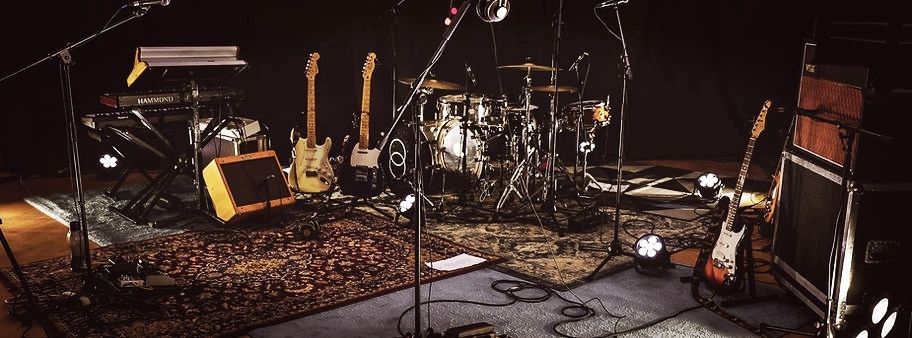
Have your audition space set up & ready

3) Relax – remember everybody is human

As I said at the top of this blog, no one I know enjoys the audition process. Try to make it as welcoming and relaxing as possible. Keep the pieces to learn down to a small number and make no attempt whatsoever to ‘catch someone out’ musically. Smiling always helps too! Even experienced players can be nervous entering a room of musicians known to each other, but not to them, and there solely to watch/listen to and assess the quality of their playing in the space of an hour or two. Keeping things short and friendly are the key elements here.

4) Follow up!

One of my biggest pet hates is when I put in time and energy into preparing for an audition or job interview, going through the whole nervous procedure, and then never hearing back. It takes minutes to drop someone a quick line to follow up, whether that is to arrange a second audition, offer them the gig or to let them know you’ve decided to go with someone else. It’s highly unlikely a rejection will cause an argument down the phone so be a grown up and get on with it!

Also, as a quick side note, have you ever found the ideal candidate through an audition, while still having other people left to see? If so, are these other candidates due the same day or in the next few days? If so, my advice would be to see them anyway – they will have put in time and effort preparing and it’s always best to have a wider network of musicians (in case you ever need a dep, etc, etc). If the next audition is not until the following week then by all means call them and politely cancel – but be nice doing it!

As a final thought, it’s worth bearing in mind one final (if somewhat obvious) piece of advice: listen. Listen to your prospective new members / band; listen to the music and how well you all play together; and finally, listen to your gut. Sometimes you can tell who the right fit it is without being too academic about the whole process.

Good luck! I’d love to hear what your best and worst audition experiences are. Drop me a message or comment below, and we can compare notes. Until next time…

Great Guitarists #15: Cornell Dupree

Great Guitarists

Following my last article on the recently passed Herbie Flowers, it felt fitting to return to some of the behind-the-scenes musicians in the next instalment of my (ever-so-intermittent) Great Guitarists series. I have already shone a light on some of my personal favourites, including Steve Cropper and Barney Kessel, and this time I’m focusing on another sideman who played on so many sessions he had the nickname “Mr 2500”, Cornell Dupree (1942-2011).

There’s not many guitarists, even in the session world, whose credits include such a diverse range of artists, from Barbara Streisand and Mariah Carey to jazzers Herbie Mann and Sonny Stitt, as well as rockers Joe Cocker and Ian Hunter.

Born Cornell Luther Dupree Jr in Fort Worth, Texas. His career began in Texas, having decided to learn guitar after seeing Jonny ‘Guitar’ Watson in concert. While playing in local bands, he will have undoubtedly encountered and opened shows for other well-known and respected Texan artists such as T-Bone Walker, Lowell Fulson, Albert Collins, Lightning Hopkins, as well as country stars such as Roger Miller and Ray Price.

In the early 1960s, Dupree was called to New York by saxophone player King Curtis (whom he had known from their days in Fort Worth) to join him in his band The Kingpins. This group were a joined a few years later by a second guitarist – a certain James Marshall Hendrix…

Left to right: King Curtis, Cornell Dupree, and Jimi Hendrix performing with The Kingpins

In a band without a keys player the two guitarists worked together to fill out the band’s sound; Hendrix quickly taking on soloing duties while Dupree filled out the rhythm section. While Hendrix was dismissed from the band in 1965 (for being too loud, too flashy and often late to gigs), Dupree stayed with King Curtis, both onstage and in the studio, up until the band leader’s death in 1971.

Dupree made is first foray into session work in the mid-sixties, while still in the Kingpins. He spent much of the next decade and a half as a much called upon ember for Atlantic Records’ in-house studio band. In the the 1970s alone, his playing graces the albums of artists such as Aretha Franklin, Grover Washington Jr., Donny Hathaway, Miles Davis, Lulu, Herbie Mann, B.B. King, Freddie King, Billy Cobham, Paul Simon and many, many more.

Atlantic Records producer Jerry Wexler stated (in the liner notes to Dupree’s 1994 solo record Bop’n’Blues) that Dupree’s ability to play lead and rhythm at the same time meant that only one guitarist was required to provide what was needed. Thanks to recommendations from former bandmates such as bassist Chuck Rainey, Dupree soon gained a reputation as the only guitarist a producer might need.

Amongst all this, Dupree not only found time to release over a dozen solo records, but also founded the jazz fusion group Stuff. Stuff were a who’s who of session musicians including bassist Gordon Edwards, Richard Tee on keys and Steve Gadd on drums and fellow session guitarist Eric Gale. Their appearance at the 1976 Montreux Jazz Festival is available as a concert video and LP (see one of the tunes, Stuff’s Stuff, below), showcasing these players at the top of their game.

Stuff live at Montreux, 1976

In later years, Dupree continued to perform despite declining health. He can be seen at the end of the Bill Wither documentary Still Bill playing ‘Grandma’s Hands’ with Withers while using an oxygen tank to aid his breathing. He died in 2011 while waiting for a lung transplant as a result of emphysema.

Playing style

As a soul-based guitar player, much of Dupree’s playing used a clean sound with minimal effects, except for a touch of reverb, in most cases. This allows his playing to shine through without becoming overly dominant in the mix. His style demonstrates that blues and gospel-based pattern of question & answer, where one melodic phase acts as a short opening statement (of less than a bar in length), before being ‘replied to’ by another phrase of similar length.

His choral work makes use of the sort of flickering embellishments familiar to use through Jimi Hendrix making extensive use of them (along with Curtis Mayfield and others). In Dupree’s case, they always feel very tastefully executed, and seem to leave ample space for the artist (usually a vocalist) whom he is backing. In this sense, he is following the golden rule of the sideman: to make the featured artist sound good.

Stuff; the all-session jazz fusion supergroup

An integral part of Dupree’s lead guitar style is his use of sliding sixth to augment and enhance the chords he was soloing over. For those who are unsure about sixths, you can find my explainer on sixths and similar intervals here. Steve Cropper was a big proponent of this technique, and like Dupree, one of the guitarists I kept hearing on soul records time and again, without really knowing who these backing musicians were until I was older and starting to dig deeper into this side of my own guitar playing.

Equipment

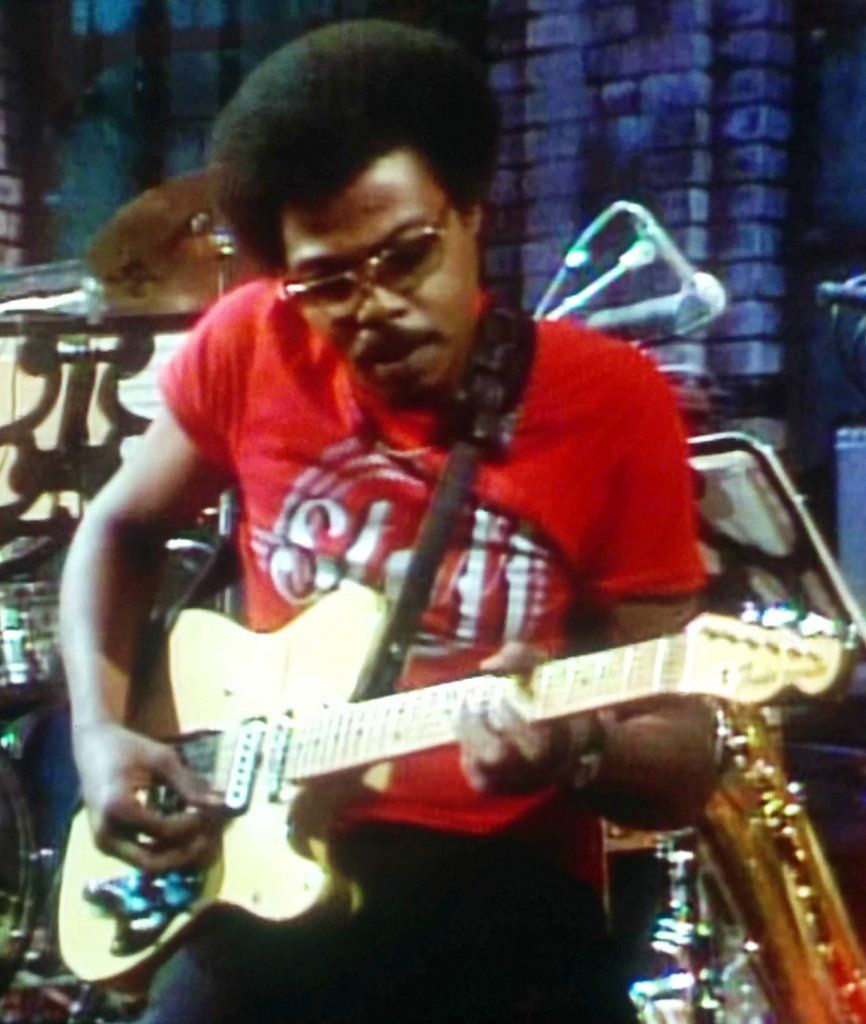
Although reported to have started out on a Les Paul, then a Les Paul TV Special (a stripped down, P90-equipped version of the Les Paul), Dupree appears to be mainly pictured with a modified telecaster (another common element he shares with Cropper). He is often shown in older pictures with a white/faded blonde model, with a third DeArmond style pickup added in the middle position. This addition meant the pickguard could not be refitted onto the guitar, so Dupree appears to have filled in the screw holes with rivets. It certainly makes for a distinctive look!

A recreation of Dupree’s long-time telecaster (with added bird artwork not on the original guitar) by Scero Guitars

In 2002, Yamaha made a Cornell Dupree artist model Pacifica, using their telecaster-style ash body with a one piece bolt-on maple neck. This signature model had the same atypical pickup configuration that Dupree had been using for decades on his modded Telecaster. The Pacifica came with a neck humbucker and Seymour Duncan ‘Hot Rails’ in the bridge position, controlled by a three-way switch to toggle between them, but not a rivet to be seen!

Dupree with his Yamaha signature Pacifica

There was also an alnico V single coil in the middle, which could be added to any selection via it’s dedicated on/off switch. I’ve seen this mod on the guitars of a few professionals, particularly those who like to get the most sounds out of just one guitar (something I have written about before). Indeed, I’ve modded a few of my own guitars to ensure a similar level of flexibility and range of sounds (read about some of my mods here).

What can Cornell Dupree teach us?

Dupree was the master of economy of style, never overplaying. I guess that’s one of the reasons he was always asked back to more sessions; he knew how to serve the song. Another factor is his clear professionalism. As with Herbie Flowers, showing up, acting professional, and learning to anticipate the producers needs is a key element to a successful career as a session player.

While his former bandmate Hendrix might be more recognisable, having made a wonderful career on his own terms (and in his own time, it seems), Dupree seemed content to remain slightly off-centre stage. As a result, he had a long and varied career. Indeed, although Hendrix is undoubtedly the more seen, I’d argue that Dupree – thanks to his appearances on thousands of recordings by some of the music’s biggest-selling artists – may actually be the more heard of the two. In my mind, that’s quite the achievement.

Happy New Year

Music

2022 has come to a close and I’ve had a stinking cold and been on the verge of losing my voice for the last few days. My final gig of the year was a New Year’s Eve show with Nick Gladdish, where I luckily don’t have to do much singing!

Next year brings more gigs of various kinds, on top of my ongoing Music Therapy work. I’m also looking forward to getting back into the studio to rehearse and record my old pal Nick’s next album at the start of 2023.

Speaking of studio time, next year will also see a couple of new projects from me, including a few releases of original instrumental material, both for solo guitar (under the working title Sketches) as well as some jazzier stuff with a small group of friends (still working out the details for that one). These pieces have been clogging up my drafts folder for ages, so I plan to record and release them before the end of 2023, meaning that I never have to think about them again!

I’ll keep you all updated via this blog. I’ll also try to keep up the musical articles, including more entries to the Great Guitarists series. In addition, keep an eye out for my round up of my favourite books read in 2022, coming sometime this month.

So enjoy the rest of your festive season, look after each other, and all the very best for the coming New Year. See you at a gig soon…

Tim x

Happy New Year, everyone. Here are some resolutions for guitarists (reblog for 2022)

Advice & Tips

Hi all and welcome to 2022! You may have noticed that things have been a little quiet on this blog for the last few months. This is for a number of reasons, but don’t panic – I’m fine, just incredibly busy! Expect more posts in this new year, as well as updates on exciting new projects I’ve been working on. In the meantime, here’s a slightly rejigged post on New Year’s resolutions from a few years back. I hope you enjoy it! Until next time...

As a general rule, I don’t believe in New Year’s resolutions. My philosophy is that changes can be made at any time, so why wait until January?

However, there is something about the end of a year which causes us all to reflect on the previous twelve months and start focusing on our plans for the next twelve. For us working musicians, this would usually mean that we have reached the end of one of our peak times, the ‘Christmas Party Season’. For over a decade (pre-pandemic), I ended the year with a NYE gig. However, for obvious reasons, things have been a little quieter by comparison, which gives us time to ponder on the gigs we’ve enjoyed, what we didn’t enjoy, and what we hope to change for the new year.

So, with that in mind, here are a few of my suggestions for guitar-related resolutions for musicians looking to grow as better musicians in the coming year:

Learn a new style

Always wanted to start learning those jazz chord voicings? Perhaps you keep meaning to work on your reggae & ska rhythm playing? Or your country picking? Blues slide? The list goes on…

Take the time to work on these new genres & styles of playing. We are very fortunate to live in a time where we can access a world of free tutorials on the Internet, or videos in YouTube. However, don’t rule out the possibility of taking lessons to focus on specific areas – working one to one with an experienced guitar tutor does wonders for improving your playing!

Mix things up

Learning a style doesn’t mean you have to abandon all you know & travel the world playing strictly Django/gypsy jazz for the rest of your life (though I imagine there are plenty of worse ways to live)!

Have you found that the majority if your playing has been on acoustic guitar? Trying swapping to electric more often (or vice versa). Do you always practise at the same time of day? If possible, can you change to a different time? Your brain operates differently throughout the day – you may well find yourself going down very different musical avenues simply by switching from a morning to an afternoon practice session.

Sometimes learning to play a song you are very familiar with in a new style works brilliantly in helping your playing. Not only do you freshen up material which might be getting a bit stale, but you’ll have a safer means of exploring new options in your guitar playing.

One area of guitar playing I can’t recommend highly enough is solo performance. By this, I don’t mean the lead guitar solo in a song, but playing the melody, harmony, rhythms, etc on one unaccompanied guitar. It’s something a piano player wouldn’t think twice about, but I’m frequently amazed at how many guitarists simply haven’t tried it properly! If you’re unsure about how to start doing this, there are several books, online tutorials (like this blog!), and of course YouTube videos to help inspire you. Which brings us nicely in to…

Widen your horizons

Music is a language. Even when playing on your own, you are creating sounds for yourself to hear, effectively taking to yourself. But there’s only so long you can do that before you end up going round in circles, or going crazy!

Set yourself the following challenge for the year: discover a new artist each month. Learn from what you hear. Take examples of their playing & try to incorporate it into your own. It can only make you a better guitarist! The beauty of this is that you don’t have to focus on other guitar players. In fact, it might be better not to! Many of the jazz & Blues guitarists I admire take inspiration for their improvisational playing from horn players, translating their melodies & ideas into their own instrument. Try it!

It also helps to get out amongst other musicians, jam, join or start a new band, particularly in a new style. It also goes further than this – always wanted to sing while playing? Start! Learning a new instrument? Do it! The best way out of a rut is to climb upwards!

Get your music ‘out there’

…And if you’re meeting new musicians & launching new projects, you’re already doing this. Go to more live gigs and make sure you perform live yourself more often (when you can), especially new and original music. I know all too well how easy it is to get stuck in one ‘world’ for longer than you might like, finding it hard to make the time to do other things, but I promise it’s worth the effort.

Remember to have fun while you’re out there expanding your guitar playing horizons!

To finish off, allow me to wish you all the very best of health & happiness for the New Year! Let’s make 2022 – like every year – a great year for music, for the guitar, and for you!

Please do get in touch to tell me what your own guitar/music new year resolutions are, and stay in touch to let me know how you’re getting on with them! Tim xx

Back in the studio (part 1)

Music

Last Thursday & Friday, I was back in the studio with the Nick Gladdish Band, as we finally started work on his new album Last One Get The Lights.

In normal times, this would have taken place in April, and by now, we’d be on another tour supporting the finished product. In fact, we already released the lead single Blurry Lines last last year (listen to it here). However, the pandemic and subsequent lockdowns have held everything up. More recently, we’ve been able to get back on track.

The process

To start with, Nick shared demos of the songs, and we started listening and thinking of suitable parts. A few weeks ago, we held two days of rehearsals where we tried out different things to see what worked. These were recorded as draft ‘rough cuts’ and the best arrangement shared amongst ourselves, so we could refine our parts further. It also gave me time to consider the best way to record the guitars, and which instruments to use.

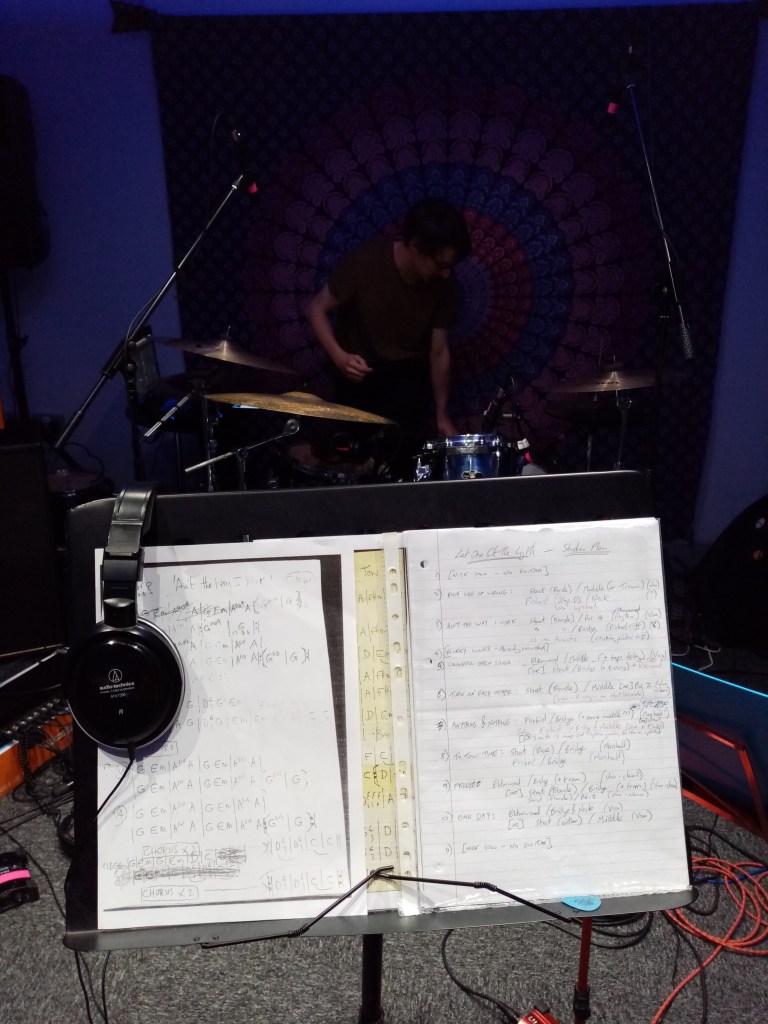
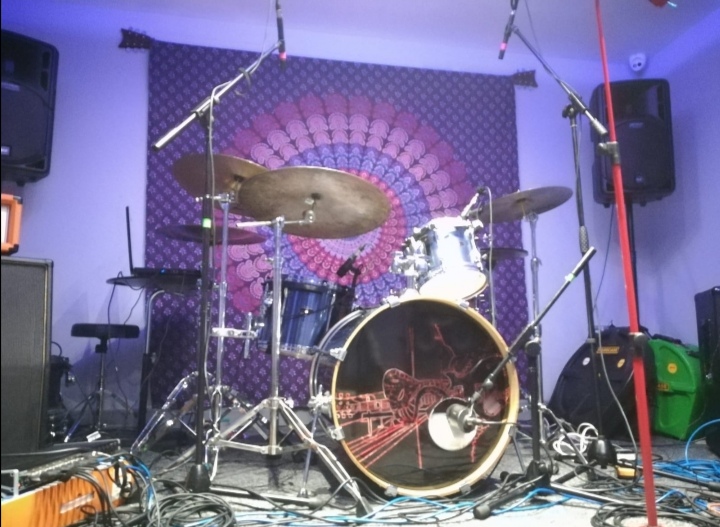
Here’s a few pictures from the two eight-hour days at Traxx Studios in North Tyneside. We spent these days recording the main backing tracks of drums, bass, most rhythm guitars, keys and guide vocals. The credits belong to everyone in the band (I’m not sure exactly who took which picture in some cases):

The whole recording process came together really quickly. In two days, we manged to get all the backing for the eight ‘full band’ tracks down, as well as additional rhythm guitar parts. Having rehearsed and arranged this set of songs in a live room setting, the guitar parts were quite simple to arrange and organise for tracking.

What happens next?

The initial plan was for John (Timney, drummer and engineer for this LP) to crew te rough mixes from what we had before we started on overdubs. However, the government’s announcement at the weekend, telling us we’ll be back in lockdown from Thursday, prompted a change of tack.

Instead, I will be going back into the studio with John to lay down all the guitar overdubs and solos tonight.

Tomorrow, Nick will record all of his vocals and a few additional piano & acoustic guitar parts. Shannon Powell, our backing singer at the live shows, will add her final parts remotely in the next week or so. That way, John has the whole period of lockdown to mix and master the record, and we can have the entire album finished in time for release at the start of 2021.

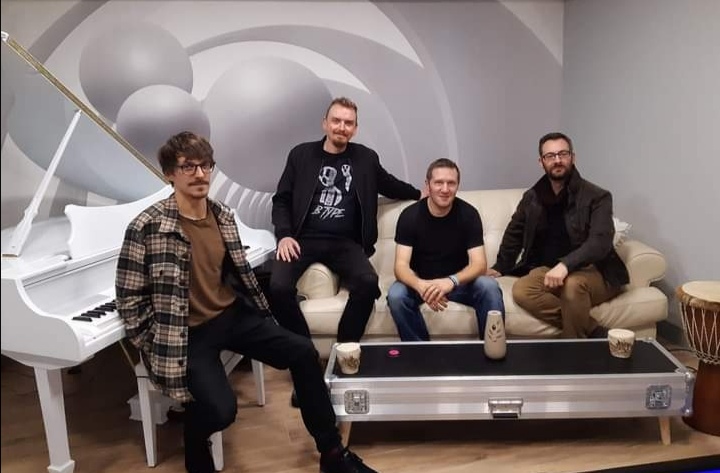
The Nick Gladdish Band. L-R: John Timney (drums, production), Adam Cornell (bass), Nick Gladdish (lead vocals, keyboards, acoustic guitar) and myself (guitars, lapsteel).

I’ll post some more pictures from tonight’s session, as well as further updates, in due course. Until next time…
Elderwood Guitar review: my custom-made semi-hollow

Guitars & Gear

I have never owned a semi-hollow guitar before, despite having played 335 style and ‘thinline’ guitars on several occasions. This year, I had the budget to rectify this, but with so many great options out there, I was undecided on where to invest my hard-earned money.

Enter Elderwood Guitars, a one-man operation based in Carlisle, in the north of Cumbria. I had seen a few Elderwood models for sale in a guitar shop in Newcastle, and a couple of players I know spoke highly of these instruments. Barrie, the man behind Elderwood Guitars, makes it his mission to create the guitar of your dreams at a more affordable price. You are involved in all aspects of the layout and design of your instrument, which is largely made up from recycled wood.

You may remember another guitar built for me, a nylon-strung classical guitar, which was also crafted by a solo luthier in Cumbria and made form recycled wood (and if not, you can read about that guitar by clicking here).

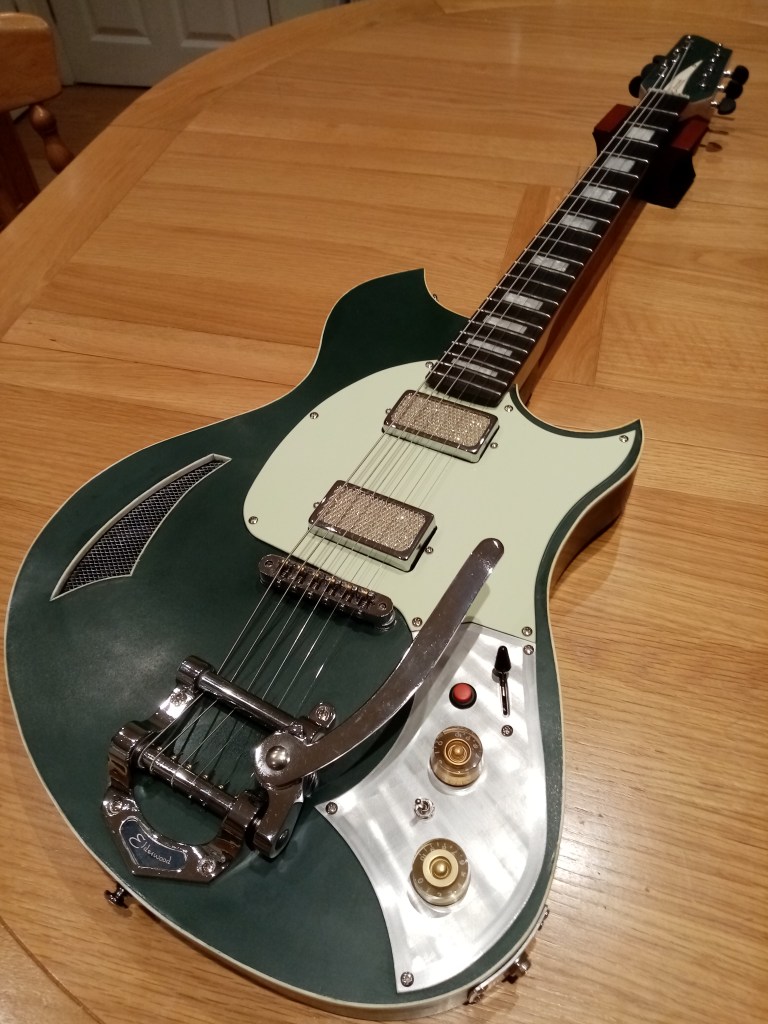
The two main principles of making something beautiful from old wood, as well as being able to design the guitar to my own specifications, was something which greatly appealed to me. To that end, I found myself in conversation with Barrie near the start of lockdown, and soon we went back-and-forth with ideas and draft designs. Rather than going for a more straightforward 335-style design, I was inspired by some of the beautiful high-end creations of small guitar companies such as Kauer. In the end, the final design looked like this:

The fifth & final draft of my custom design. Picture courtesy of Elderwood Guitars

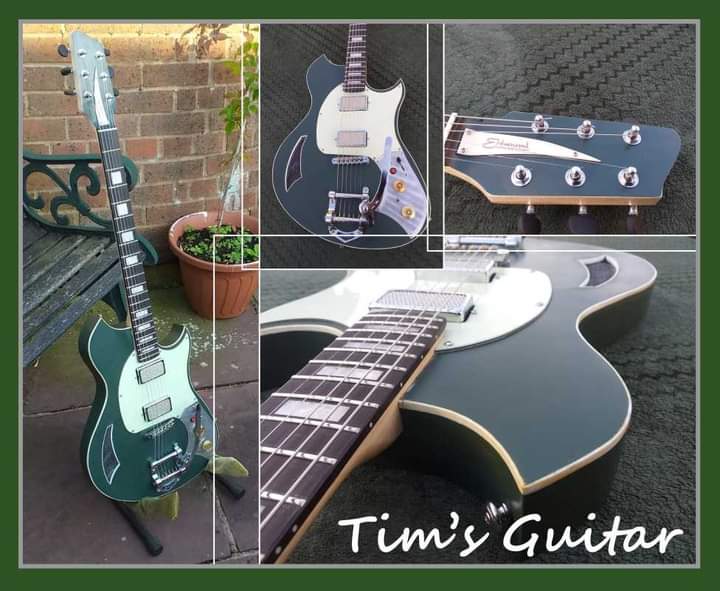
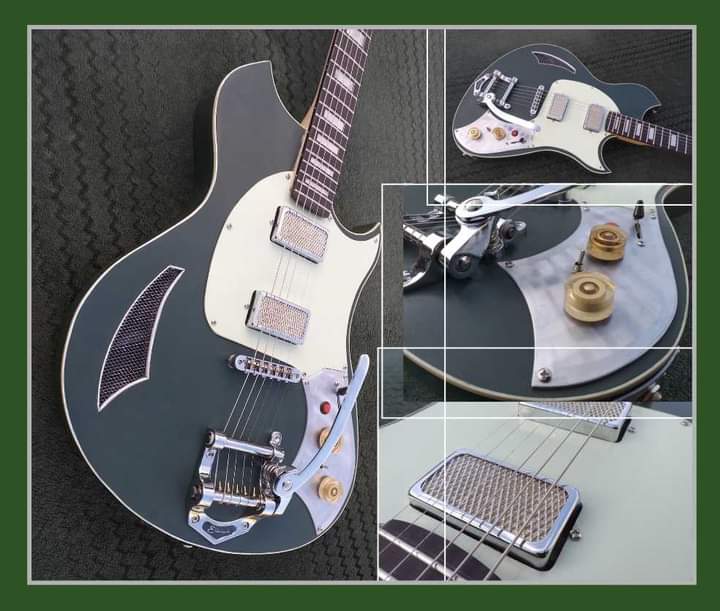
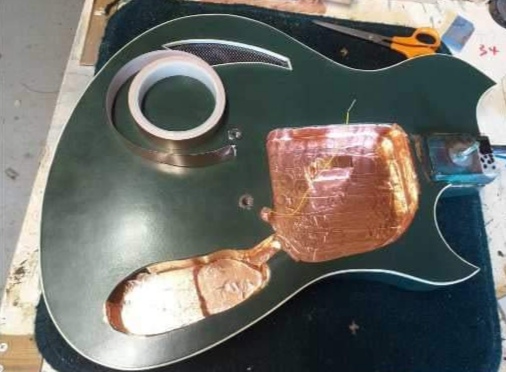
My guitar would be an offset semi-hollow with a serious vintage feel to it. The two humbuckers and sound hole on the upper half would be covered in a gold foil/mesh, and the neck would feature block markers. For the finish, I requested as close to British Racing Green as he could manage, with cream for the pickguard, binding and truss rod cover, likening the overall colouring style to that of a classic Mini Cooper. You don’t see many green guitars and I have always wanted one. Now I just had to wait for it to be completed (although since lockdown meant that I wasn’t gigging, I was in no hurry).

Over the next few months, I received occasional updates from Barrie which always got me salivating:

Barrie checked back to confirm my preferences for pickups, tremelo, control layout, as well as general updates on progress. He seemed to be having a busy summer but as each guitar was finished and presented on his Facebook page, they continued to look and sound as high quality as I had been told they’d be.

At last it was ready to collect in early October, and it did not disappoint…

Specifications

  • Offset semi-hollow body, made from recycled pine
  • Maple neck, with rosewood fingerboard featuring block position markers
  • 3-a-side headstock
  • Bigsby-style vibrato system and ‘roller saddle’ bridge
  • 2 x Vanson ’57 Alnico II humbuckers
  • 1 x volume & 1 x tone control
  • 3-way pickup selector switch, plus mini-switch for coil-tapping
  • Push button to bypass volume control (see below)
  • Side-mounted jack socket (secured by four screws for greater stability)

This guitar certainly looks the part. The green finish contrasts beautifully with the pickguard and copper coloured control knobs. After sharing the images above on my Facebook page, I was inundated with questions and compliments about the it. It’ll certainly make a visual impact at gigs (whenever they start back up again).

Sounds

Acoustically, this guitar is much louder than my other electrics. It’s interesting just how much difference the resonance of a semi-hollow together with the sound hole, can make. The matched PAF-style humbuckers give you all the tones you would expect from an early Les Paul, but with more airiness due to the mainly hollow body. These humbuckers are made by Vanson, a budget brand readily available on websites such as Amazon. Barrie shares my sentiment that one shouldn’t have to, and doesn’t need to, pay over the odds for a combination of magnets and copper wiring. I had said early on in the design process that I was happy with ‘budget’ pickups on this guitar, and they certainly sound as good as anything the big name brands churn out!

The bridge pickup provides everything I need, from classic rock crunch to an almost rockabilly style twang – the Bigsby certainly comes to the fore here. The neck pickup gives up warm jazz tones on a clean amp with the tone rolled back, and splitting the humbucker into ‘single coil mode’, I’m able to get a sound remarkably similar to a Strat or Tele in this position, which is no bad thing as far as I’m concerned. With both pickups engaged, I’m in my beloved funk and soul territory, great for rhythm playing and bluesy licks. Not only that, but it feels like BB King’s trademark singing lead tone is virtually built-in to this instrument.

Is it any good?

Oh yes, it’s very good. I love it! I’ve certainty enjoyed playing it so far, both through my amps and unplugged. It sits perfectly on a strap and the neck is comfortably chucky, like a true vintage instrument (which is exactly how I like it).

My only hurdle so far has been getting used to the Bigsby-style vibratio. I don’t use the vibratio arms on my Stratocasters, but as well as the right hand aspect, Bigsby units are notoriously tricky to keep in tune. However, this is something that can only be changed through practice and getting used to using it, rather than anything wrong with the guitar itself. Nonetheless, Barrie’s aftermarket service has been top drawer, offering all sorts of advice on how to get the most from the unit, as well as tips on maximisng tuning stability.

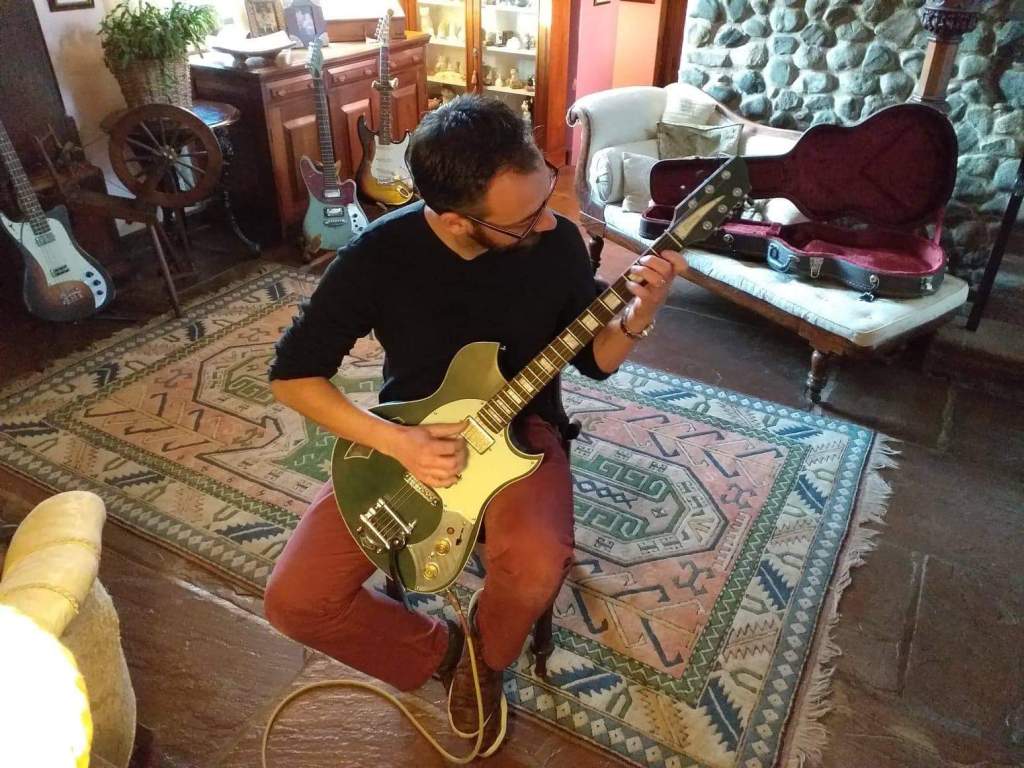
Finally collecting the new axe. Picture courtesy of Elderwood Guitars

I expect to be in the studio again in the coming weeks, recording a new LP with the Nick Gladdish Band, and this guitar will be coming along with me. I’ll share links to sounds and videos of this guitar in that (or any) setting as and when they become available…

If you are interested in your own custom-made guitar, Barrie can be contacted directly through Elderwood Guitar’s Facebook page. I’d recommend that you take a look through the numerous creations he has made, and make sure you have a good idea of what you are looking for when you drop him a line. Once you do, you will meet an affable and courteous man dedicated to making the best instruments he can, at a price point open to all of us – and that, like his guitars, is truly something to be admired.

Harley Benton launch £70 power amp for guitar pedal boards

Guitars & Gear

Greetings guitar folk. We are back with a little bit of guitar gear news which seems to have dropped this morning…

Most guitar players have probably heard of Harley Benton before. The brand (owned by the European online music superstore Thomann) are well known for bringing surprisingly good guitars into the beginner/lower priced end of the market which have significantly better quality control than their rivals (their 335 copy is in high demand). They also offer a range of instruments and accessories that are useful for working musicians to have in their arsenal. To that end, they have introduced the GPA-100, a power amp that fits in your pedal board.

Here’s a link to the Harley Benton page for more information

The GPA-100 features master volume, plus 3 band EQ (treble, middle, bass). It’s main purpose might be to save the day, should your main amp/floor unit fail. And £70 is a small price to pay for that piece of mind.

If I have the chance to test one out, I will drop a review on here. If you buy one, please let me know what you think! Bye for now!