A year of books (July – September)

Books

It’s hard to believe that we’re in the final three months of the year. What a year it’s been! I’m sure no one could have reliably predicted the majority of changes which most of us have had to undergo, hopefully on a temporary basis, because of this pandemic. I hoped that it might offer more time to get through my oft-mentioned (and ever increasing) ‘to read’ pile. However, if 2020 has taught us anything, it’s that life doesn’t always go the way you expect it to.

Still, there has been some reading since the last installment (which you can read about here), and here is a brief review of it…

The Italians by John Hooper (2015, Penguin)

An affectionate and sometimes amusing look at the characteristics common to Italians, and why that might be the case. Hooper also reiterates that Italy is a relatively new country (as a unified whole), and spends almost as much time highlighting what separates Italians from different regions; north and south; Romans and Sicilians; mountain dwellers and those who reside by the country’s ample coastline, and so on. Hooper regularly interjects anecdotes from his extensive time living and working in Italy as a journalist. These passages give the book a greater cohesion, in that the presumed reader (and Englishman) sees the situations unfold through the eyes of the author, and with similar inherent sensibilities. However, Hooper restrains himself from writing this as a straightforward memoir, which I expect that has increased it’s potential readership.

I read this book during lockdown in England. Of course, Italy had imposed one of the most stringent lockdowns of any country in the world, and the Italians have seemingly been obedient and compliant. This seemed to go against one of the common reoccurring themes in Hooper’s observations; that Italians will regularly bend the rules to suit their needs or preferences. The reports I was hearing on the news in 2020 didn’t sit with this assessment, until I considered another of the books themes – the emphasis and commitment Italians place on family. From this angle, undertaking the strictest measures, which seemed like virtual home arrest to some, made sense, as it gave your elderly relatives a fighting chance of making it through this madness alive. And that, argues Hooper five years before any of this was upon us, is a key characteristic of Italians. Recommended for anyone with an interest in staying in Italy for longer than an average-length holiday.

The Finkler Question by Howard Jacobson (2010, Bloomsbury)

Jacobson’s 2010 comic novel about three male friends – two of them Jewish and a third man who suddenly feels that he might be, won the Booker Prize for Fiction in 2010. This sudden interest in the religion of his friends is the author’s way of examining the universal themes of life and society. It is amusing in places, and the characters are interesting and well-written. Yet I certainly wasn’t gripped by it as much as I had been led to believe the reviewers who had gushed over this novel upon it’s release. Humorous and touching, yes, but also confused in places, and ultimately, slightly underwhelming.

Athelstan by Tom Holland (2016, Penguin)

A recent addition to the Penguin Monarchs series (that is, books on British monarchs published by Penguin books, although there’s a pun about Emporer Penguins in there somewhere), this book examines one of the lesser-known pre-1066 Kings (who wasn’t Alfred the Great).

I enjoy Holland’s writing, having read several of his books previously – in particular, I thoroughly recommend Rubicon, about the last gasp of the Roman Republic. At 160 pages, this is a quick read, but it covers what is known about Athelstan, from the few sources available. Personally, I’m pleased that Holland resisted the temptation to pad the book out with unnecessary additional information or unfounded presumptions.

Utopia for realists by Rutger Bregman (2016, Bloomsbury)

Alternate subtitles for this book, depending on country of publication, include and how we can get there (UK) and the slightly less pithy sounding the case for a universal basic income, open borders, and a 15-hour workweek (Holland). Although the latter of these two subtitles is somewhat unwieldly, it must be said that it up this book’s subject matter much more effectively. The book originated as a series of articles for the Dutch online news site De Correspondent by Bregman, a popular historian, and was later complied and translated. It has quickly became a bestseller, which ringing endorsements from a wide range of economists and politicians across the world.

The text centres on the three polices highlighted in the original subtitle, along with the principle that ideas can change the world, according to Bregman, who states “people are the motors of history and ideas the motors of people”. Of course, there are many who have said that Bergman strays into idealism, and it will certainly prove more popular with readers of a more left-leaning political persuasion. But Bergman is only aiming to issue a challenge, or a promise, of what could be possible but I doubt if the title Utopia for Idealists would have sold quite as well. A manifesto for a brighter future? Maybe not by itself, but a good place to start.

Goshawk Squadron by Derek Robinson (1971, Cassell)

In the afterword section of the book, Robinson recounts his inspiration for writing the story. He read a former R.A.F. pilot describe the tactic of the world’s first fighter pilots during WWI as “to sneak in unobserved behind his opponent and then shoot him in the back”. Hardly the cavaliers of the clouds they have often been immortalized as in tales such as the Biggles series, amongst many others.

This Booker Prize shortlisted book paints it’s fictitious characters in a more truthful light, based on the diaries and letters of real WWI pilots. The book was met with anger from veterans of the Royal Flying Corps (the forerunner to the Royal Air Force) when it was first released, but reading it in 2020, it feels much less controversial now – the idea of a ‘lovely war’ has remained a 20th century concept – but the story is no less gripping for that fact. At just over two hundred pages, it’s a relatively fast read, but I found that the story stayed with me long after I had replaced the book on the shelf.

The next and final installment of this series (due in late December) will feature two novels I have been looking forward to reading. You can also expect updates on some upcoming studio dates and an in-depth review of a new guitar built for me recently. Until next time…

Why is there so much poetry in my blogs now?

Poetry & Writing

You might have noticed that recent posts have featured poems (especially Haiku) rather than my usual guitar or music-related topics. Well, you don’t have to worry about this site turning away from it’s main focus. For one thing, my efforts aren’t very good!

Yet, in these uncertain times, I find myself composing small poems in my head and decided to try and write more of them down. I also recalled previous advice about writing one Haiku per day, in order to become better at distilling an idea into a short, succinct form. Now seemed as good of a time as any to put some of my poems out into the world, from those celebrating recent guitar purchases, or the bizarre thoughts that strike me while out walking. There were also a few other reasons, such as…

I’m not performing live at the moment

Due to COVID19, almost no one is gigging at the moment. Since March, I have managed one socially distanced gig in a garden with the Nick Gladdish Band, but otherwise have found myself with more free time on my hands, particularly on weekend evenings. All future gigs and musical projects are postponed. Also, not having much means (or space) to embark on live streaming or recording projects from home, I found my creative juices were becoming pent up, and seem to have manifested themselves via written ideas, rather than musical ones.

I decided not to be embarrassed about my poems any more

I recently discovered that a good friend has a passion for a very niche form of short story writing, which was as pleasing to learn as it was unexpected. The fact that I was happy for my friend made me realise that I shouldn’t have any shame in putting my own silly little rhymes and Haiku out into the world.

I enjoy writing them

Surely that’s the most important thing? I mentioned in my recent post about using the recent lockdown as a reminder to do the things you enjoy, when you can. For me, this is one of those things. Like a Sudoku, they serve to keep my sharp, in a creative sense, until I can start rehearsing my own musical compositions and playing gigs again.

This blog will still continue to be about guitar. music, music therapy and all sorts of arts-related subjects. Writing these articles are another way of channeling my creative urges, and if someone learns a little extra knowledge as a result, fantastic. In time, I will start to announce new tours, projects, albums, etc, as they start to emerge from our cultural hibernation – but expect to see the odd poem thrown in there as well, from time to time!

Lessons learned from lockdown

Advice & Tips

This year has seen the most use of the word ‘unprecedented’ that I have ever seen, and probably for good reason.

Do what you can now, and if you can’t do it now, plan for later

Getting started on something can often be hard. During lockdown, I’ve found myself exhausted after a full day of childcare, and in those few rare moments I had for me, working on a new composition seemed ridiculous.

Do what you can, in small steps. In fact…

Make a list

List what your daily tasks are, as well as goals for the medium term (i.e., the next few weeks) and long term (post-lockdown, or even post-COVID altogether). It will help you focus, and evaluate what is important.

List making sure was already an occasional habit of mine, mainly because I am aware of my own poor short-term memory. Going forward, I’ll be sticking to daily lists, as they seem to have made me more productive than when I worked from home in pre-pandemical times.

Speaking of lists…

Bring back the ‘weekly shop’

We must have gotten out of the habit of doing the ‘big shop’ only once a week. Lockdown forced us back into this habit, and although it somehow felt more expensive at first, it seems to be better value across the week, especially when it was harder to nip out on a whim for a treat. Give it a try, if you can, and see how it works for you.

Don’t compare yourself to others

Whether it’s FOMO (fear of missing out) or a kind of professional jealousy when another person seems to be working fine at home – you know, the one with all the recording gear in their spare room (or their parents) and no children.

Social media only shows you what people want you to see. Most of the time, it only shows what those people think everyone else wants or expects to see.

Some of it is real. Some of it is less than genuine. All of it is someone else, in a different set of circumstances (however slight that might appear).

Beware of fatigue

Some of my friends have been locked down at home by themselves, working from one room during day, then zoning out in front of the TV in the evening. They told me that even committing to an online quiz via Zoom felt like too much effort. Staring at a screen all day, even for leisure or socially distant socialising, is incredibly tiring. Give yourself time to reset, and do absolutely nothing. Just remember when you do…

Don’t be to hard on yourself

If the fatigue did’t get you, the guilt surely did – right?

This is connected to my earlier heading, Don’t compare yourself to others, but it’s worth looking at again from a slightly different angle.

We’re going through unprecedented times. No one in our lifetime has experienced this, on this scale, before. Survive. Look after yourself and those around you. Don’t feel guilty for doing less.

In fact, don’t feel guilty at all for how you are managing to get through a pandemic.

Do what you love, if you can (and if you can’t make a plan for doing it in the future)

You might have noticed that a few of my recent posts have been short Hailku form poems, or observations from walks with my family. I enjoy writing them. Since I can’t perform live at the moment, they give me some creative output while everything else is on hold.

If you have recently discovered a new passion, embrace it and enjoy it. Share it with the world. And if COVID19 is stopping you from doing what you love and enjoy (as it has for me with my love of playing guitar live), make another list; this time, make it a plan to get your passion up and running again soon, once all of this is – hopefully – a distant memory of an unpleasant time, now disappearing.

Best of luck, and let me know how you get on! Also, let me know what lessons you have learned from the last few months of lockdown by leaving a comment or getting in touch via my usual channels – I look forward to chatting to you!

Hareshaw Lin & coins in trees

Poetry & Writing

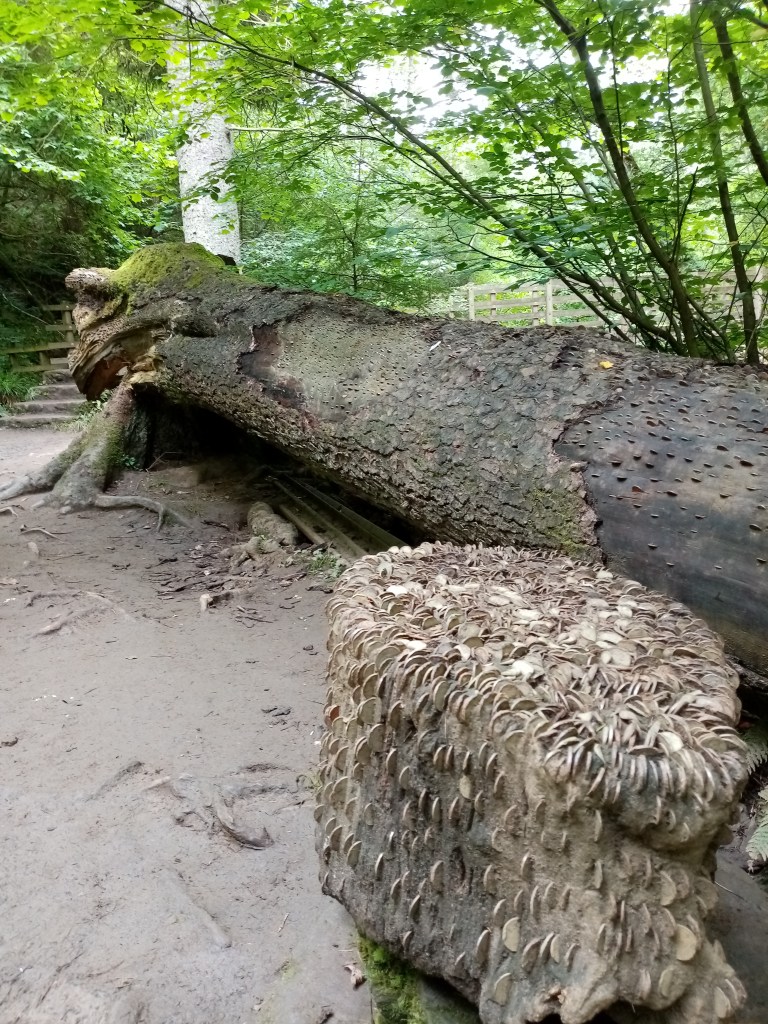
At the weekend, we went up to Hareshaw Lin in Bellingham for a walk. It was lovely exploring this northwestern corner of Northumberland, following the short walk (less than two miles), along the ruins of a former iron foundry on the North River Tyne, to a waterfall (the Lin, in Old English). On our route, we noticed something unusual…

A tree stump (and fallen trunk, behind) with hundreds of coins inserted into the bark

Hundreds of coins inserted into the small slits of the bark of fallen trees. I noticed it in a few sidelong tree stumps, but it was most obvious on this large fallen tree and nearby stump (see above). I have no idea why this tradition started, but some of the coins look very well weathered, and I expect have been there for several years.

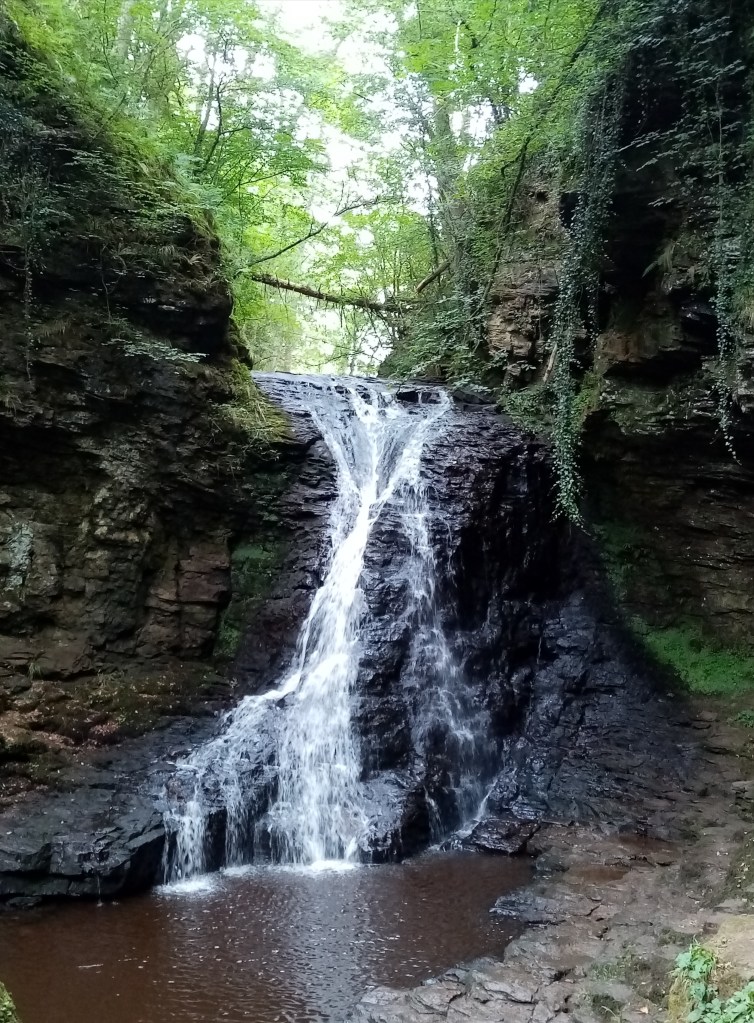
The waterfall itself was beautiful, a small oasis of it’s own within the woods (see below). Several younger people were diving into the pool at it’s base. Judging by how long it took them to resurface after diving, it must be quite deep in it’s centre, although there appears to be a lip of rocks around the pool’s circumference.

Hareshaw Lin – the word ‘Lin’ means ‘Waterfall’ in Old English

The foundry appears to have been washed away by a flood in the early years of the 20th century, and several more rocks swept downstream in a further flood in the 1960’s. The large stones which remain (many were taken to be used for local buildings) jut out the water to create numerous miniature weirs alongside our walking route. It’s a lovely spot, but was rather busy when we went, possibly because people see it as a good outdoor location in these socially distant times. Still, there are many worse ways to spend a Saturday afternoon…

New projects, despite lockdown

Music

As well as using Twitter to announce new projects, or update people on ongoing ones, I sometimes reminisce about ones from years ago, such as this one…

For some reason, I kept thinking of this, and on top of everything else I have planned (post-COVID), I’d quite like to explore what a power trio can do in terms of extended instrumentals (which aren’t based largely around improvisation); something more progressive in nature…

Having played in a rock trio format before, it can be a new challenge to fill the space adequately without the music sounding thin. Conversely, one has to avoid the temptation to stick to the more blues based method of sharing riffs, in union (or octaves) with the bass player.

Bear in mind that I currently have…

  • 3 music therapy jobs
  • A solo classical(ish) EP to finish
  • Another Nick Gladdish Band album to finish & tour to plan
  • My next band project (world/blues/Latin) to start rehearsing
  • A music therapy case study series to complete by the autumn
  • A small portfolio of compositions to develop

…and we’re still in a time of lockdown here in the UK, with no concrete sign of progress regarding indoor gigs (although the news today implies that this might change very soon).

Still, if you want something doing, ask a busy person, right?

A year of reading: magazines & periodicals

Books

I’ve mentioned in my ongoing year of books series how I’ve actually had little time to read this year. The current COVID19 pandemic has affected my work and home life in a way that seems to have slowed down the rate I was getting through my (always increasing) to-read pile.

However, alongside my book list and the academic works I have read as part of my music therapy work, I’ve also been reading an increasing number of short-form writing. After all, an article is much easier to finish in one sitting than an entire book! I thought I’d take the time to list some of these now, before publishing my next year of books installment (covering April to June, available to read here).

Some of my regular subscriptions include:

The Week – a weekly digest of the UK (and international) news media. The editors are fairly good at providing an even tone, taking both sides of an argument (and certainly the perspective of left- and right-wing newspapers) into accounts. Useful if you find you’re not watching the news as much during lockdown!

The Musician – the quarterly trade magazine for Musician’s Union members, and always full of useful information. It can sometimes be bogged down in the nitty-gritty of union business, but what else would you expect? Prior to lockdown, they were running an invaluable ongoing series showcasing one city or town at a time and highlighting the best local live venues, studios and rehearsal spaces – useful information when you are (or at least were) planning a wider tour of the UK with your band.

The Music Therapy Journal (British Association of Music Therapists) – out twice a year, this edition was delivered at the end of June, featuring the latest academic papers in the professional field of music therapy, as well as book reviews. I wouldn’t call tis light bedtime reading, but it’s essential for my work as a music therapist.

Loud & Quiet – a music magazine, initially covering live and indie music in London, but long since branching out. This year’s pandemic forced this previously free magazine to move to a paid system, and I was happy to support the writing team with a donation for a year’s subscription, which includes free playlists of exciting new emerging artists.

The Big Issue – the famous magazine sold by homeless people to raise money for themselves. A great cause to support, especially in such uncertain times. However, it’s more then charity for charity’s sake; the articles are as well written as any national newspaper, and I especially enjoy their music & book reviews.

Guitar Interactive and Music Radar – two online-based sites which I’ve found myself returning to on numerous occasions for equipment reviews and guidance, as well as news on newly released gear. Lessons and technique tips are available too, but if I’m honest, I’m mainly there to drool over the guitars!

What magazines are you guys reading? Let me know!

A walk in the woods

Poetry & Writing

It is said that a walk in the woods is a great way to recharge your mind and revive a weary soul. I think we’ve all needed a little more of that during the last few months.

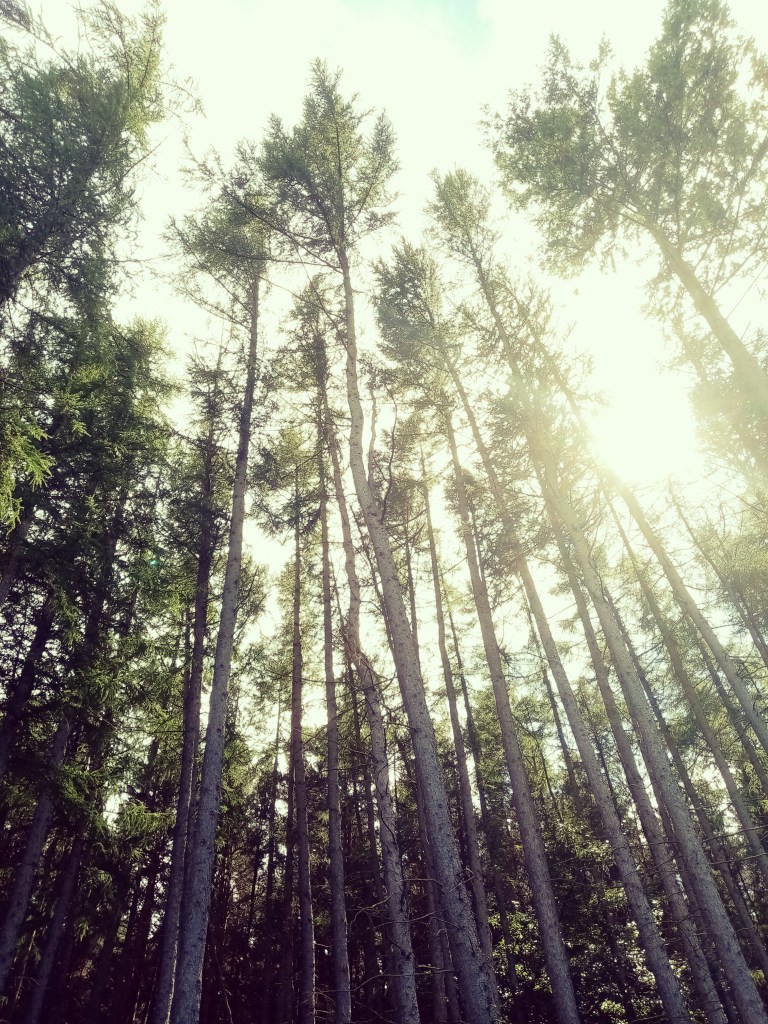
These two pictures were taken at the weekend, just outside of the market town Hexham, in the county of Northumberland, England. And when I say just outside, I mean less than a ten minute walk from the historic Abbey in the town’s market square – there really isn’t much by way of suburbs here.

Sunlight peeking through the tops of this wonderful pine forest in Northumberland

The forest is managed; parts of it are felled for paper at the right time, while other sections regrow. This means that the trees are planted roughly in rows, with paths of varying difficulty throughout it’s floor. However, on the day we wandered around, our only companions were the birds flying overhead in the July sun, and the ants busying themselves in and out of the enormous ant hills in the forest.

Access to experiences such as this on my own doorstep are a reminder of how lucky we are in this part of the world, especially during the last four months of lockdown here in the UK. It has certainly helped ease my anxiety and frustration at not being able to move forward with the music projects I had planned for this summer – but more on those soon…

Black Lives Matter. No ifs, no buts.

Advice & Tips

We live in uncertain and challenging times.

It’s probably been hard to escape the news of George Floyd’s horrific murder in May this year, and the worldwide protests it has inspired.

Although the #BlackLivesMatter movement has been running for several years, it has certainly gained momentum. Perhaps half the world being in lockdown made sure we didn’t miss anything this time, as another unjust killing of a person of colour scrolled by on our new feed yet again…

As a white person, it’s worth recognising the (possibly unconscious) bias inherent in the system, which – despite a far from privileged upbringing – may well have provided me with a leg up from time to time.

How can we change this? Perhaps I’m not the best person to ask. Here’s an article by Dazed which explains how to be a better ally. It’s an important read, which features the main points summarised below:

  • Think twice before sharing violent videos
  • Confront racism when you see it
  • Take action
  • Acknowledge your privilege
  • Practice social distancing*

(*this final point comes because BAME people are more likely to contract or die from COVID19, the Corona virus still sweeping around the globe this summer)

I wholeheartedly encourage you to read the original article from Dazed in full. There’s also this longer article from Gal Dem, which is run and contributed to entirely by women of colour, which explains how non-white people of colour can help to dismantle anti-blackness.

Please read and share these articles.

Will anything change? Companies and trade bodies are in the stage of self-examination. The Musicians Union and British Association for Music Therapy are both looking at how they can do better. It’s our job to keep the pressure up until tangible changes start to become manifest.

Apart from that, ask lots of questions. Be curious. And most importantly, be kind.