A few years ago, I was hired to perform (quite specifically) Spanish guitar music at a wedding service. Amongst other choices was Leyenda (meaning ‘legend’). Originally written by Spanish composer Isaac Albêniz (1860-1909) for piano, but transcribed for guitar within Albêniz’s lifetime, Leyenda is one of the more well-known pieces in the classical guitar repertoire.
Isaac Albêniz (1860-1909), looking rather stylish in a portrait, circa1900
Typically, the opening section is played quite fast. Sometimes this makes it feel like an exercise in machismo by the performer, who may be working on the assumption that faster = more impressive to listen to.
However, the most famous transcription of this piece is by Andrés Segovia. Segovia is considered the Godfather of modern classical guitar, having mentored several well-known players in the generation that followed (including Australian guitarist John Williams and the UK’s own Julian Bream). Brazillian composer Heitor Villa-Lobos dedicated his Etudes for Classical Guitar (1929) to Segovia, whom he had kept in mind while composing them. Segovia had similar close working relationships with several other 20th Century composers, such as Federico Moreno Torroba, Mario Castelnuovo-Tedesco and Joaquin Rodrigo, and his transcriptions of certain works originally written for other instruments have become the standard in how they should be performed on guitar.
Hear the great man himself performing Leyenda on this YouTube video. You may notice that Segovia’s interpretation is slower than you might hear on most other recorded versions of this piece.
I’ve had some pretty interesting discussions with guitarists in the last few weeks and months regarding artistic interpretation. In almost all of these chats, the focus has been on the interpretation of the performer. However, what we hadn’t considered is the interpretation of the arranger. When I say arranger, I mean one who transcribes music for other musicians to perform, rather than a player making interpretive changes solely for their own performance.
Andrés Segovia (L) & Stanley Yates (R), two masters of interpretive guitar arrangements
Composer & arranger Stanley Yates created a new arrangement of Leyenda, which is still available to download for free via this link to his website. This version differs more from Segovia’s than you might expect. The chief differences for me are the absence of sixteenth triplets in the opening section, which was Segovia’s invention (be honest, how many of you knew that?!) and a few differences to the interval of certain ‘grace notes’.
The source for Yates’ arrangement is the original published piano work. He argues that he has attempted to stay true to the original piece without being pressured by the subsequent traditions of this piece which have grown over the last century. It is worth checking Yates’ arrangement out in order to see these differences for yourself and experience a piece many classical guitarists thought they knew intimately in a rather different light.
Interpretation, whether it is that of an arranger or the in-the-moment feelings of the performer, is key to making music more than mere sounding out notes written down by someone else. It plays a large part in how an audience experiences the piece; even subtle changes to a performance can alter how the listener might feel in response. I’ve long been fascinated with interpretation as a subject, and note with a small degree of frustration that it remains a factor of performance that often goes overlooked, sometimes by guitarists who really should know better.
This brief examination of Leyenda is but one example from which we can learn the importance of interpretation. I believe that neglecting to give it the consideration it deserves might end up becoming something which hinders your growth as a musician. Make of that what you will.
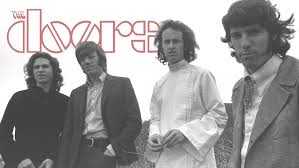
Loved by some, derided by others. You will have heard at least some of the music of The Doors.
Despite their short time together at their height, they left behind an impressive legacy. As with similar articles (such as my look at the wider impact of The Animals and The Bryds), I’ll try to keep it brief, focusing on the factors that I believe made The Doors unique and influential.
So, on the understanding that this is not a definitive history, let’s dive in…
A quick rise
The Doors were formed in Los Angeles in 1965 by vocalist Jim Morrison and keyboardist Ray Manzarek, initially under the name Rick & The Ravens with Manzarek’s brothers Rick and Jim. They soon changed their name to The Doors in honour of Aldous Huxley’s book The Doors of Perception, recording their first one demo along with drummer John Denmore. After brothers Ray and Jim left the group, the group, guitarist Robby Krieger joined the band and the classic lineup of The Doors was complete.
They very quickly became popular, despite having played few gigs. In the start of 1966, the band managed to secure a residency at The London Fog club on Sunset Strip by having all of their friends turn up to their initial trial gig and cheer loudly. This residency not only gave Morrison the chance to overcome his stage fright, but also provided an opportunity for the band to experiment with their songs, many of which appeared on their debut album the following year.
In May 1966, the group became the house band at the more prestigious Whiskey a Go-go club, supporting the visiting acts such as Van Morrison with his band Them. By August, The Doors had been signed to Elektra Records. They recorded their eponymous debut album the same month, released at the very start of 1967. Their follow up, Strange Days, was released in September of the same year. This started an impressive run which saw the band release one studio album every subsequent year, ending with LA Woman in April 1971.
(copyright Elektra Records)
A polarising frontman
Over the years, Morrison’s behaviour had become increasingly erratic and difficult for the ban to manage. He was already living in Paris by the time LA Woman was released, taking time out from the group to focus on his poetry. He was dead just three months later, likely of an accidental overdose on heroin (although no autopsy was performed to officially rule the cause of death).
I put out a poll on my social media pages to canvass for opinions on The Doors. It seemed that, by and large, those who said they didn’t like the group generally cited Morrison’s vocal delivery style lyrics, or his persona as the main reason. He seems to have become a love-him-or-hate-him figure in music history. For some, Morrison represented the epitome of a certain type of masculine sexuality. Several bedrooms have been adorned with posters featuring well-known pictures of Morrison, topless and brooding. which seemingly turned ob as many people as it turned off.
Furthermore, in passing away at such a young age, fans never had the opportunity to watch him grow old, or indeed display an change or sense of ongoing maturity in his work. What is left behind becomes immortalised, while Morrison himself became a legendary figure. His grave in Paris remains a popular tourist attraction for would-be Bohemians to congregate.
But what we’re the critics opinions of Morrison before he died? The music of The Doors left fans divided. Fiona Sturges claimed that “Lester Bangs was right when he described Morrison, the son of a US rear admiral, as ‘a drunken buffoon masquerading as a poet‘” (quoted in The Independent, 2012). Yet Bangs had the maturity in later years to recognise the legacy of Morrison on his peers:
Think about it. Without Jim Morrison no Patti, but what’s more or less no Iggy perhaps no Bryan Ferry in his least petit-bonbonned moments. Without Iggy, of course, no punk rock renaissance at all, which means obviously that Jim was the real father of all that noise
Similarly, the music was considered by some to be twee in places (with those fiddly organ lines) or even downright pretentious. Listening to their entire run of six albums highlights inconsistencies in style, but I’d argue that this was common for groups at the time. In a time of psychedelia and increasing experimentation in pop music, record executives seemed to have lost their sense of what would sell and what wouldn’t, and allowed some artists time – and often several albums – to find a formula that worked. The Doors were no exception to this, although I believe they stood out for a few reasons.
Grounded in the Blues, but not limited to them
Like many bands of the time, The Doors were rooted in the Blues as the bedrock of their sound. When he wanted to, Morrison could write lyrics that were reminiscent of blues men such as Muddy Waters or Howling Wolf,such as on Love Me Two Times or LA Woman, for two well-known examples.
Musically, many of the songs were grounded with blues-based riffs, common to other R&B acts of the time. It was the combination of electric blues with the more poetic elements to Morrison’s words, coupled with a sense of exploration and a willingness to add elements of jazz to their sound, which gave The Doors an edge over their contemporaries in the world of psychedelic rock.
No bass player?
No – not for their live performances, at least.
In the studio, Doors producer [name] felt that Manzarek’s left-hand organ bass notes didn’t cut through as well as the second of a plucked string, and a session bass player was called in. This started something of a tradition for the band, who had bass guitar on the vast majority of their recorded material while maintaining their bass-less quartet format onstage.
In most cases, the session bassists – including bit hitters such as Harvey Brooks (who had played on Dylan’s first electric album and subsequent live shows) and Jerry Scheff (who has played with everyone from The Everley Brothers to Elvis Presley’s Vegas band) – were given strict instructions on what to play. This often following the Blues-based riffs. Otherwise, they simply filled in the sonic space a little, leaving ample room for [keys] and [guitar] to take flight, often in surprisingly intricate ways (a full and fascinating read on the bass players working with The Doors can be found here).
Robby Krieger’s guitar style
The final element to be discussed is The Doors’ guitar player, Robby Krieger. Although the last member to join the band, his playing gave the group a certain ‘lift’, mixing various styles and moving beyond solely blues-based lead lines.
Before picking up the electric guitar, Krieger had studied flamenco, who requires a strong right hand picking technique. Elements of this can be heard throughout the band’s output, not only in overt references such as Spanish Caravan, but also in his jazz-rock solo on Light My Fire. Krieger also maintained the flamenco/classical tradition of playing fingerstyle, eschewing plectrums (is it that plectra?) for his entire career.
Krieger, circa 1965 (pic credit: Chris Walter)
As I sat down to research and write this article, I started to realise the extent to which Krieger had been an influence on my own lead guitar playing. However, I rarely cite him as an influence. This may due to our similarities in background; I too, was a classical guitar player long before I started on the electric guitar, and my first electric influences were blues players and the experimental artists of the nineteen-sixties.
It may also be that Krieger’s influence came indirectly, via the first ever tuition book I bought to help me learn lead guitar, Lead Guitar by Harvey Vinson (which is a whole thing in itself – expect an article all about it in the near future). Looking back through the example riffs in that book, most of them could easily have been lifted from Doors tunes. I even owned a cheap SG copy too, but that’s a story for another time…
Recommended listening
There’s something interesting to be found on all six of the band’s studio albums. It is worth giving them all a listen to see what jumps out for yourself. Having said that, I find that for me, their first two LPs The Doors and Strange Days (both 1967), as well as their final offering, LA Woman (1971), showcase the group at their finest.
As always, let me know what you think. I enjoy having discussions with readers who get in touch and would love to know your opinions on The Doors, Morrison’s legacy, Krieger’s technique and everything else. But for now, this is the end…
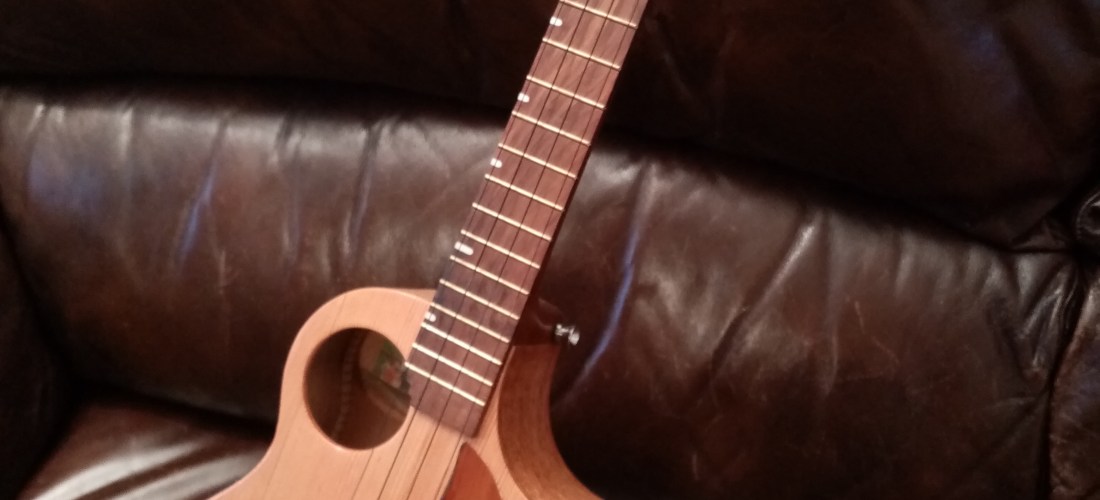
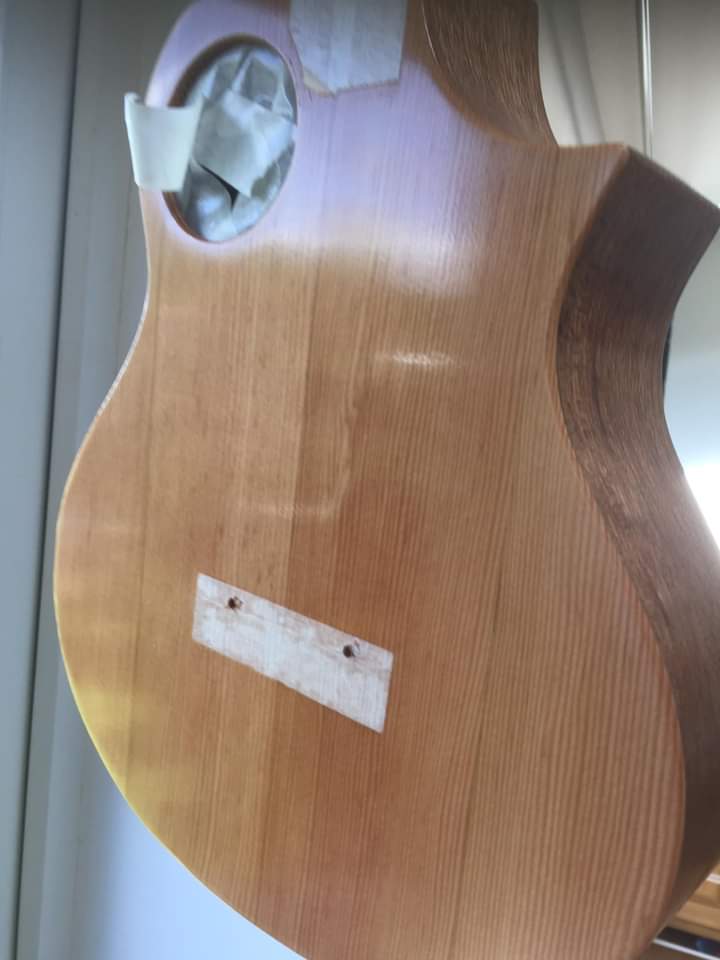
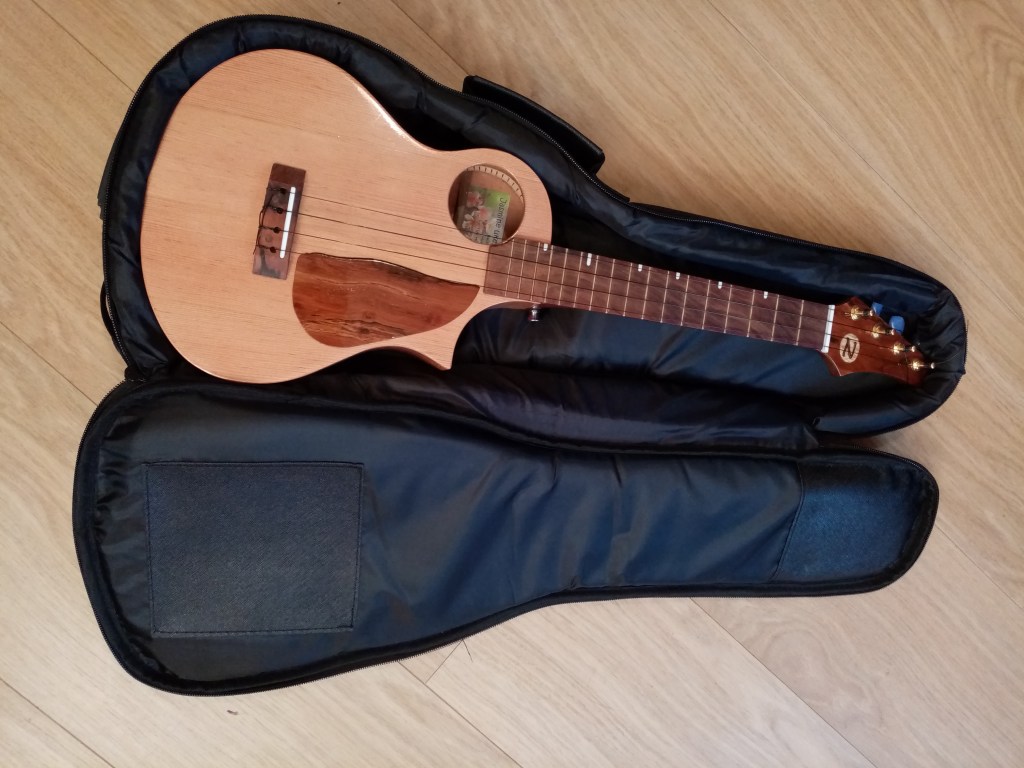
Last year, I commissioned another custom-built instrument. I was in the market for a ukulele I could take out to gigs, as my existing concert sized one did not have a pickup or preamp attached. Knowing Neil McHardy in Cumbria has built a few ukes recently, I asked if he would consider making a tenor sized electro-acoustic model for me. McHardy guitars operate from a village in Cumbria, making acoustic instruments out of recycled wood. Some of you may remember built his first ever classical guitar at my request, mainly out of an old table (you can read the full review by clicking here).
This time around, I was happy to let Neil design it pretty much however he wished. I am a fan of his signature offset sound holes, and my only stipulation was to include a preamp so the ukulele could be used for concerts and recording. As always, Neil sent regular updates on how the build was progressing (see pictures) and was always happy to impart gems of guitar and uke building knowledge.
The start of the build (credit: Neil McHardy)
Size matters
So what is the difference between a concert and tenor sized ukulele? A tenor is larger than a concert, sometimes up to four inches longer, but they are tuned the same. In fact, soprano, concert and tenor ukuleles can all be tuned the same (G4, C4, E4, A4). The main difference is volume and depth of bass response which the larger bodied instruments benefit from.
An example of the size and scale differences between different types of ukulele
With tenor ukuleles, some players also use a G string which sounds an octave lower (G3), effectively making he open strings sound exactly the same as the highest four strings of a guitar at the fifth fret. I can see how some players might find this easier, especially if they are migrating to the ukulele from the guitar. Personally, if I needed that sound, I’d put a capo on one of my guitars, so I have opted for the more traditional uke tuning.
Progress updates I received from Neil as the build continued (credit: Neil McHardy)
Specifications
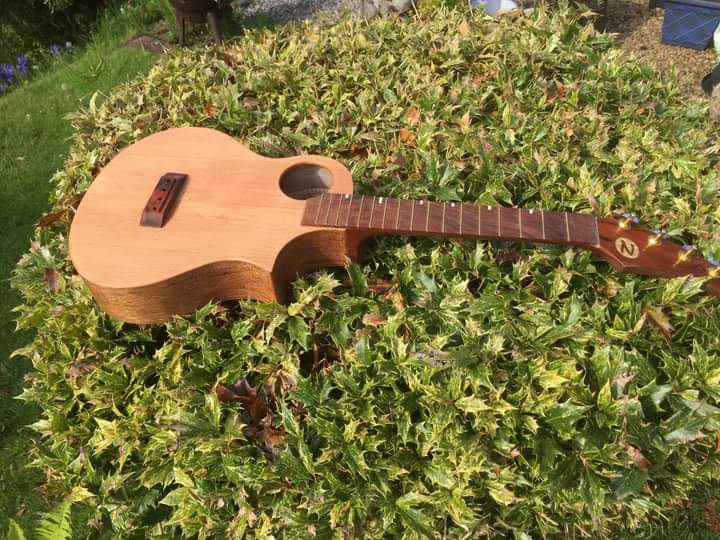
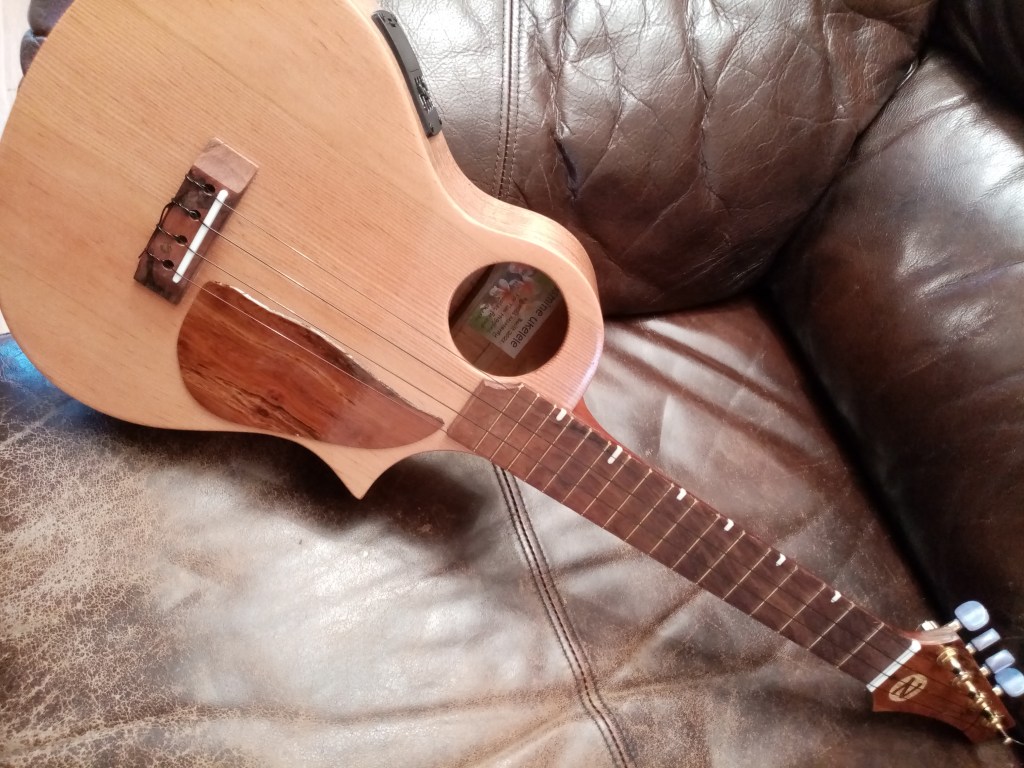
The finished instrument is made from recycled Douglas Fir and Spanish Cedar. The face plate and scratchplate (or golpe) are made from fallen trees Neil found on a walk, and feature the most stunning grain, on which Neil has placed the tuning pegs in a line (rather than two per side, as is traditional).
Finished at last(credit: Neil McHardy)
With the addition of a good value preamp (powered by an easily removable 9 volt battery), this new uke was fitted with strings and Neil contacted me to collect it.
I love the look of the grain on the golpe and faceplate, and was impressed with the instrument’s volume when strumming it unplugged for the first time. Plugged in, it sounded the same as it did acoustically, just with the potential to go a lot louder – which is exactly what I would expect.
Family photo with my previous McHardy build, my gorgeous classical guitar
Unfortunately, I haven’t had the chance to try it out onstage yet, but I plan to use it in an upcoming recording project (more details on that to follow). But when that material comes to the stage, this uke will be out on the road with me. I can’t wait.
As well as using Twitter to announce new projects, or update people on ongoing ones, I sometimes reminisce about ones from years ago, such as this one…
For some reason, I kept thinking of this, and on top of everything else I have planned (post-COVID), I’d quite like to explore what a power trio can do in terms of extended instrumentals (which aren’t based largely around improvisation); something more progressive in nature…
Having played in a rock trio format before, it can be a new challenge to fill the space adequately without the music sounding thin. Conversely, one has to avoid the temptation to stick to the more blues based method of sharing riffs, in union (or octaves) with the bass player.
Bear in mind that I currently have…
3 music therapy jobs
A solo classical(ish) EP to finish
Another Nick Gladdish Band album to finish & tour to plan
My next band project (world/blues/Latin) to start rehearsing
A music therapy case study series to complete by the autumn
A small portfolio of compositions to develop
…and we’re still in a time of lockdown here in the UK, with no concrete sign of progress regarding indoor gigs (although the news today implies that this might change very soon).
Still, if you want something doing, ask a busy person, right?
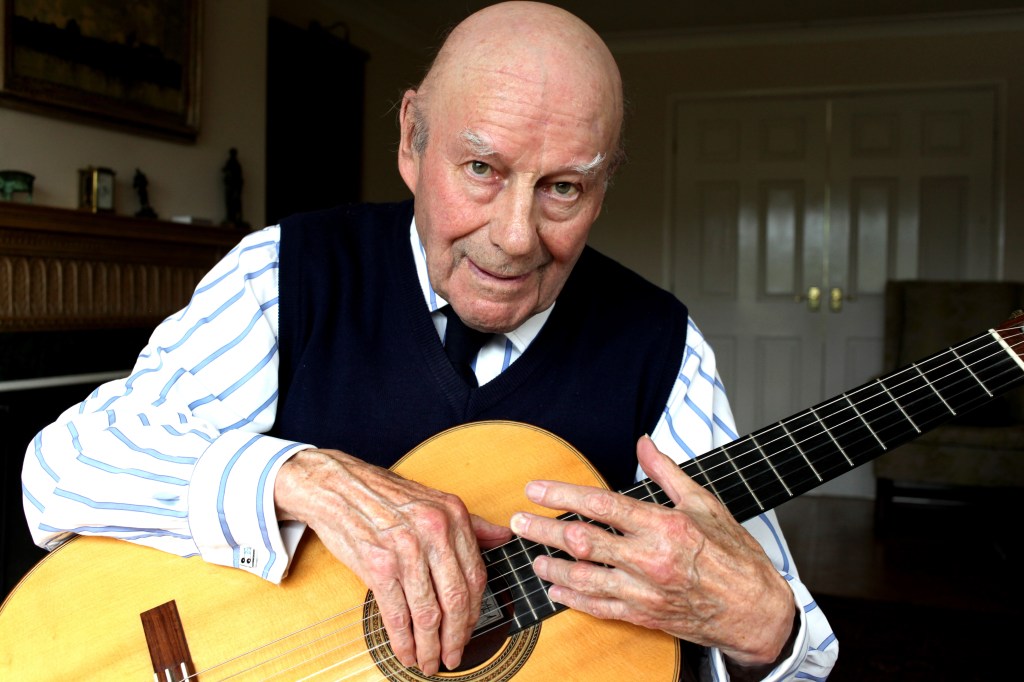
Not many classical guitar players are household names, either worldwide or here in the UK. Andres Segovia might be one, as a pioneer for performance of the instrument in it’s modern form. However, I’d suggest more people have heard of two of his more famous successors on the international performance stage. One is the very well-known Australian guitarist John Williams; the other, Julian Alexander Bream, who we learn has passed away at his Wiltshire home in the early hours of this morning, at the age of 87.
Julian Bream at home, 2014 (Credit: Eamonn McCabe for classicalguitarmagazine.com)
Born in London in 1933, Bream initially learned jazz , influenced by his father’s playing and Django Reinhardt. He was also offered a place at the Royal College of Music, aged just 12 years old, based on his piano playing. He later switched to the lute, and became a great champion for the instrument throughout his life, even as his focus shifted more and more towards classical guitar.
As well as his numerous transcriptions of lute pieces (such as those by Bach or Dowland) for guitar, Bream also performed many of the transcriptions left behind by Segovia, as well as the seminal guitar pieces composed by Francisco Tarrega. Known for his eye for detail, Bream’s virtuosity included an element of flexibility; a key example of this was that he did not maintain a consistent rigid right hand when playing (i.e., held at right angles to the stings), but made use of a more relaxed position, in order to achieve a greater variety in tone. This is something I do as well, because I, like Bream, am multi-genre guitarist. However, having been regularly admonished by my guitar tutor in my youth for holding an ‘improper’ right hand position, it was a relief to learn the one of the instrument’s masters did the same!
As Bream’s reputation increased, he was gifted pieces by composers as varied as “Britten, Walton, Tippett and Hans Werner Henze” (classical-music.com) and performed around the world. He also recorded TV specials, such as a series of four master classes on BBC television in the nineteen seventies, as well as segments for Channel 4 in the nineteen eighties. This no doubt helped him to become a household name for many, but he certainly never rested on his laurels. Even as an ‘elder stateman’ of the guitar, he apparently strove to improve himself. According to an interview given to The Guardian newspaper, Bream believed he was a better guitarist at the age of 70 than ever before!
Essential listening: A great place to start would be his two albums with John Williams, Together (1971) and Together Again (1974). Also, seek out his version of Joaquin Rodrigo’s Concierto de Aranjuez (with it’s famously emotive second movement).
Bream with lute (Credit: Avie Records)
Guitar students would do well to look at his crossovers into other styles, as well as his early lute work too, to get a more rounded picture of a hugely talented player, whose passing leaves a large hole in the classical guitar community.
Those of you who follow me on Twitter may be aware that I recently had a new classical guitar custom made for me by Neil McHardy Guitars in Cumbria. Here’s some details and a closer look…
McHardy’s eco-friendly mindset
Neil works alone and handbuilds his guitars to order. His offset sound hole design came from his father, who built guitars for the boys he used to teach, using old wood. Neil, a retired engineer, has kept the same overall design & philosophy, creating beautiful instruments out of old wood. Most of his guitars had previously been doors, floorboards or old workbenches. It goes against the mentality of many high-end luthiers, who prize certain ‘tonewoods’ over others. Believe me, these guitars sound brilliant & play as well (if not better) than their (considerably) more expensive rivals.
Unique in more ways than one
I first discovered Neil’s craftsmanship at the Sunbeams Music Centre in Penrith, which has a guitar donated by him amongst its collection. Intrigued by his philosophy of using recycled wood, I contacted him to ask if he had ever made a nylon-strung guitar. Neil told me he had not (all of his creations until then had been steel-strung acoustics), but was up for the challenge.
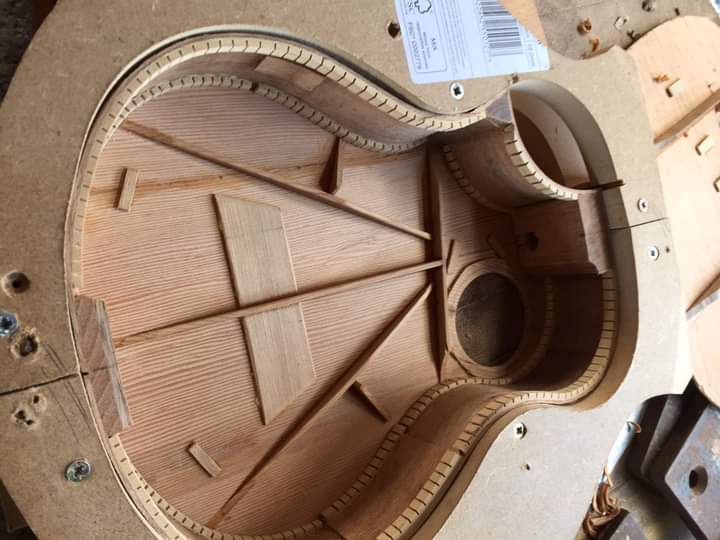
After lots of careful of research, Neil designed & built a guitar to my specifications. He also sent me regular work in progress pictures (below).
Special ‘fan’ bracing for support & resonance
Rosette made from spare wood chippings
AfricanEbony fingerboard with edge-mounted position markers
Bridge, made from leftover fingerboard ebony
White & ‘checkered’ binding on all sides
Cherry wood neck (from an old table, apparently)
Pictures courtesy of Neil McHardy (2019)
The finished product
Neil finished the guitar for me in late January, and it was great to finally have it in my hands to play. All of my requests & requirements had been met, from the thinner body depth to the input jack being placed separately from the bridge pin/end strap button. The offset soundhole does not effect volume, but rather allows for more vibration of the top. It also suits my more percussive style of playing better.
Specifications
Top: Red Cedar Back & Sides: Spanish Cedar Neck: Cherry, with a Beech stripe Fretboard & Bridge: African Ebony Head Facing & Golpe: American Walnut
Nut & Saddle: Camel Bone Pickup: Fishman ‘Presys’
Depth: 90mm at bottom, tapering to 70mm at top Width of lower bout: 370mm Length: 1,000mm Nut Width: 52mm (2″)
I’ve played this guitar for a couple of months now and still very pleased with it. The thinline body & offset soundhole create less conventional nylon-strung sound which is perfect for jazz and latin styles, while still retaining an intrinsic classical vibe.
Unplugged, it is loud enough to be heard, but the onboard mic/pickup combo is very versatile for both live performance and recording – I especially like being able to blend the ratio of microphone (just under the soundhole on the guitar’s upper bout) and pickup. Having a tuner on there means one less thing to forget to pack in my gigbag too!
I’m terms of how it looks, I think this guitar is a real stunner. To me, it mixes the best of classic Spanish guitar with elements of African design – particularly in the binding & rosette. Speaking of which, these are another feature unique to all McHardy Guitars, as they are pieced together from spare wood chippings. No two rosettes made by Neil look the same!
Stunning grain on this Red Cedar top
A highly polished Spanish Cedar back
Headstock & tuning pegs
Neil names each guitar after a species of flower
Close-up detail of the ‘Veronica Classical’
Playability
The action is low but clean, and the 52mm (2 inch) nut, the standard in classical guitar making, feels perfectly comfortable. Its thinline body make it easy to hold in the right position and the neck is well intonated. Big stretches aren’t a problem and full chords hold their tuning across the fretboard. In short, it feels as good to play as it sounds.
The electrics are simple to navigate and sound superb. I’ve already found two settings which will likely become my main voicings for this instrument.
One of a kind
When I first met Neil in his workshop, I noticed he had a collection of wooden circles on a string. These, he explained, were the cut-outs from the soundhole of every guitar he had ever made. He estimated there to be around 50 in total. All of them steel-strung six string acoustics, until mine.
However, it seems Neil continues to diversify and experiment. At time of writing, he was starting on his first ever twelve string, another requested build. I’m sure he’ll nail it as brilliantly ass he did with my nylon-strung axe.
In a follow up conversation, Neil mentioned one of his Facebook followers admiring photos of my finished guitar so much that he had started enquiring about his own. So perhaps this could be the start of a whole new range for Neil!
For more info…
If you asked about his work, Neil would tell you that he’s “just a man in a shed”. However, if you would like to see more of his guitars, or even discuss a future build of your own, then please do check him out via the Neil McHardy Guitars Facebook page – just don’t inundate the poor guy with requests for the Tim Higgins Signature Model!
This week, I’ve had the rare luxury of free time. Free time to pick up my guitar whenever I like and play. Not specifically for any particular goal, just to PLAY for the love of playing. It then occurred to me just how little I get to do this. Usually I pick up my guitars to practice or prepare for an upcoming show, or to learn new material. The rest of the time, I’m actually at a gig playing.
Using it as a great opportunity to go over my classical repertoire, I found it almost scary how much my discipline had slipped. Don’t get me wrong, I still play well and in a musically pleasing manner (in my opinion, anyway!) but there are ways of performing on guitar (with classical pieces in particular) which enhances the music and makes playing easier (not to mention lessening any strain and preventing injuries long term).
So this week, I have been delving into my old practice and warm up notes and dug out my old favourite, Pumping Nylon by Scott Tennant. For the classical guitarists out there who do not have this book, I strongly recommend you purchase it as soon as possible.
This book focuses solely on technique improvement for both hands (including thumb for the right hand). After the initial basics and starters, it progresses into joint techniques (working exercises for both hands together) and demonstrates a closer look into flamenco techniques. These not only go to strengthen your right hand, but to widen your overall playing ability. It also includes specially written study pieces to incorporate all the techniques it has taught.
Around fifteen years ago, I suffered a broken ring finger on my right hand. This has never fully regained it’s original strength (and as a result my days of regular classical guitar recitals are mostly behind me). The exercises in this book went a long way in helping my rebuild the muscle and bring my ability back, something I feared would never happen. Because of this, the right hand techniques and exercises int his book are of particular importance to me.
That’s the basic warm ups covered, but what about actually rehearsal starters? For me, as with many classical guitar players, the studies (or ‘Etudes’) of Francisco Tarrega and Fernando Sor provide plenty of examples for rehearsal focus, especially with right hand technique. It’s absolutely amazing the depth of ground these two teacher-composers (not to mention pioneering players) covered in advancing the technical study of the guitar. I cannot recommend them highly enough.
Alongside these, there are also the studies of Mauro Giuliani. Although his concert and recital pieces are widely known (in fact the staple of most player’s repertoire), his studies are often neglected. However, I would definitely suggest investing in a transcription of his complete studies. While not as technique-practice heavy as Sor (who, in contrast, is remembered historically more for his studies than his concert pieces), they present a more musically varying set and some new colour into your practice routine.
My standard practice routine (looking at my old notes from my true classical playing days) went roughly as follows:
5-10 mins warm ups (both hands, featuring exercises from Pumping Nylon and scale practice
Selected studies from Sor, Tarrega and Giuliani (2 or 3 from each, focusing on specific improvement areas)
Looking at any new pieces to learn; slow play-through; focus on tricky areas; attempt to play through without stopping (I would try not to spend more than 20-25 minutes on this to prevent fatigue or frustration – the piece can be returned to on the next day)
A better known piece which also requires mastering. Ideally play-through should be reached far more quickly
Another piece (already known) to ‘refresh’ the fingers (ideally this will also be an upcoming concert piece)
Free playing – At this point, I could have been rehearsing for up to an hour and a half, so this should be an old favourite or two which you know well, to act as a cool down. Be careful, though, to remain watchful on technique and accuracy, as this is more likely to slip on pieces you are over familiar with.
These, of course, are my tips only. I would however be delighted to hear from other guitarists and their tips/routines for warm-ups and rehearsals. You can contact me via the contact page on this site, or my social media (see links).















 Tim Higgins, Guitarist
You must be logged in to post a comment.