Snow (double haiku)

Poetry & Writing

Snow on the Dyke-backs

Prophesying its return

And see, it comes now

For those who might not know, the dyke-backs are the sides of the short hills or ditches which, in winter, never get direct sunlight. As a result, snow takes longer to melt on these small sections of Northumbrian landscape. Around here, is taken almost as a given that seeing the snow remain on the dyke-backs, when it has melted everywhere else, means that it will likely snow again before the weather improves and the world gets warmer on it’s path towards the spring.

And while it stays cold, the frost can do strangely wonderful feats to your car…

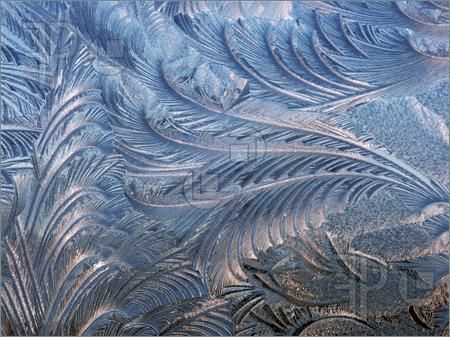
Frosting cold and white

Nature’s stencil on metal

Accidental art

Haiku for a second lockdown (from a keyworker’s perspective)

Poetry & Writing

Another lockdown

The weather is not as nice

I still have to work

Not much mention of nature in this one, but it’s dark by 4pm so I haven’t seen much of it!

I’ll try and write some better ones soon. Stay safe everybody!

Why is there so much poetry in my blogs now?

Poetry & Writing

You might have noticed that recent posts have featured poems (especially Haiku) rather than my usual guitar or music-related topics. Well, you don’t have to worry about this site turning away from it’s main focus. For one thing, my efforts aren’t very good!

Yet, in these uncertain times, I find myself composing small poems in my head and decided to try and write more of them down. I also recalled previous advice about writing one Haiku per day, in order to become better at distilling an idea into a short, succinct form. Now seemed as good of a time as any to put some of my poems out into the world, from those celebrating recent guitar purchases, or the bizarre thoughts that strike me while out walking. There were also a few other reasons, such as…

I’m not performing live at the moment

Due to COVID19, almost no one is gigging at the moment. Since March, I have managed one socially distanced gig in a garden with the Nick Gladdish Band, but otherwise have found myself with more free time on my hands, particularly on weekend evenings. All future gigs and musical projects are postponed. Also, not having much means (or space) to embark on live streaming or recording projects from home, I found my creative juices were becoming pent up, and seem to have manifested themselves via written ideas, rather than musical ones.

I decided not to be embarrassed about my poems any more

I recently discovered that a good friend has a passion for a very niche form of short story writing, which was as pleasing to learn as it was unexpected. The fact that I was happy for my friend made me realise that I shouldn’t have any shame in putting my own silly little rhymes and Haiku out into the world.

I enjoy writing them

Surely that’s the most important thing? I mentioned in my recent post about using the recent lockdown as a reminder to do the things you enjoy, when you can. For me, this is one of those things. Like a Sudoku, they serve to keep my sharp, in a creative sense, until I can start rehearsing my own musical compositions and playing gigs again.

This blog will still continue to be about guitar. music, music therapy and all sorts of arts-related subjects. Writing these articles are another way of channeling my creative urges, and if someone learns a little extra knowledge as a result, fantastic. In time, I will start to announce new tours, projects, albums, etc, as they start to emerge from our cultural hibernation – but expect to see the odd poem thrown in there as well, from time to time!

Hareshaw Lin & coins in trees

Poetry & Writing

At the weekend, we went up to Hareshaw Lin in Bellingham for a walk. It was lovely exploring this northwestern corner of Northumberland, following the short walk (less than two miles), along the ruins of a former iron foundry on the North River Tyne, to a waterfall (the Lin, in Old English). On our route, we noticed something unusual…

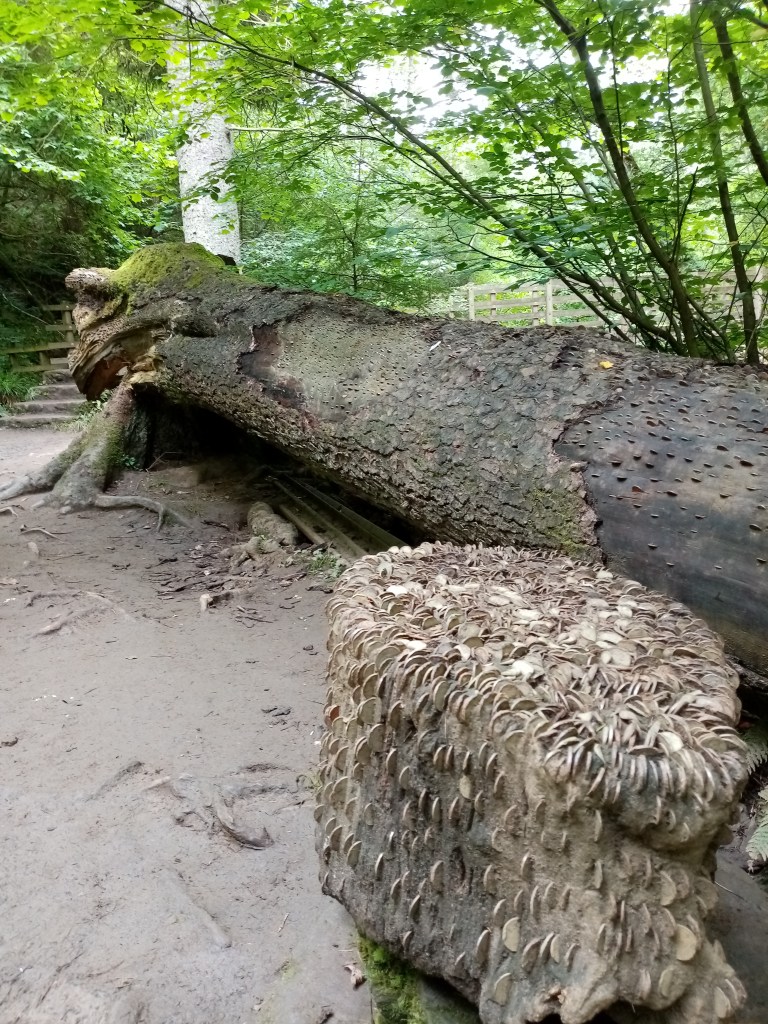
A tree stump (and fallen trunk, behind) with hundreds of coins inserted into the bark

Hundreds of coins inserted into the small slits of the bark of fallen trees. I noticed it in a few sidelong tree stumps, but it was most obvious on this large fallen tree and nearby stump (see above). I have no idea why this tradition started, but some of the coins look very well weathered, and I expect have been there for several years.

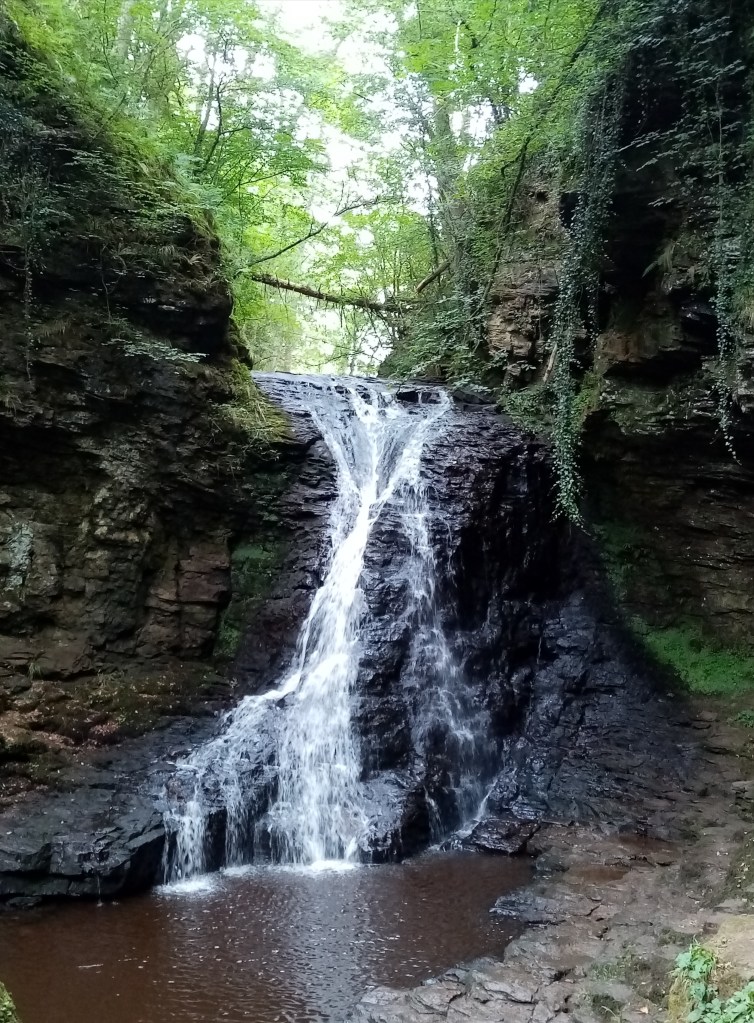
The waterfall itself was beautiful, a small oasis of it’s own within the woods (see below). Several younger people were diving into the pool at it’s base. Judging by how long it took them to resurface after diving, it must be quite deep in it’s centre, although there appears to be a lip of rocks around the pool’s circumference.

Hareshaw Lin – the word ‘Lin’ means ‘Waterfall’ in Old English

The foundry appears to have been washed away by a flood in the early years of the 20th century, and several more rocks swept downstream in a further flood in the 1960’s. The large stones which remain (many were taken to be used for local buildings) jut out the water to create numerous miniature weirs alongside our walking route. It’s a lovely spot, but was rather busy when we went, possibly because people see it as a good outdoor location in these socially distant times. Still, there are many worse ways to spend a Saturday afternoon…

Poem: A political ghost flew, ruining my view

Poetry & Writing

The wheat it rises fast by summer late

Honey yellow melting into rich gold

Yet now, streaking through the swaying barley

Comes ex-P.M. from Euro state of old

Fleeing worldly problems and past mistakes

With childish abandon and youth-lost glee

Surprised, then angry; next, aloud thinks I:

“Well, that’s stained this golden moment for me!”

Credit: news.ctgn.com

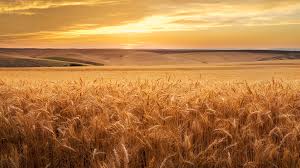
Somehow, this silly little poem (about former UK Prime Minister Theresa May running through one of the fields of wheat outside my home) felt best suited to the sonnet form (of somewhat loosely – see below).

For context, here is May’s past form, regarding running through fields of wheat.

Please don’t judge my efforts too harshly. It is my first attempt at writing in this form since secondary school (twenty years ago). I most definitely haven’t adhered to the ‘galloping’ rhythm of traditional Iambic Pentameter (5 pairs of syllables per lone, going weak-strong each time). This would have been a strict requirement for stage actors reciting these lines (usually as dialogue) in Elizabethan age plays, most famously those penned by William Shakespeare.

However, I’m not Shakespeare, Marlowe or any sonnet writer of any note, by any stretch – that much should be clear by now! I’m just a bored dad trying to get his youngest child (currently teething) to sleep by taking them out in the buggy for an evening walk…