The final piece of the album is now in place. Backing vocalist Shannon Powell has added her amazing talents to the new Nick Gladdish Band album.
Those of you who are unfamiliar with Shannon’s vocal prowess would do well to check out her project YUMA (a collaboration with NG Band drummer & producer John Timney)
Shannon Powell (of YUMA) recording harmony vocals for the new Nick Gladdish record
Cover art
Nick also revealed the main painting being used for the album cover, created by Kristin Designs…
Album cover artfor ‘Last One Get The Lights’
Next steps
We’ve already reviewed the ‘first pass’ of the mixed tracks, and discussed changes. The second attempt is currently ongoing, now with Shannon’s vocals added, which gives us the full picture. To my ears, these tracks need very little fixing now. Most of the big tweaks & redos have already been taken care of.
Once the mixing is finalised, the next step is mastering the overall album. After this, the first single can be released. Details to follow soon…
At the same time, the cover art and lyric booklet are being designed and formatted. However, this is a slightly less pressing issue because the album won’t be released until the start of 2021.
Last night, we got the final session of tracking done (on a new album for The Nick Gladdish Band), with a day left until lockdown #2 comes into effect across the UK.
Nick met drummer & producer John Timney at TRAXX Studios in North Tyneside for five hour. They didn’t just tracked all the vocal parts to the band songs. They also recorded the two solo songs which will ‘bookend’ the album.
Nick working hard in the studio (picture courtesy of John Timney)
Now comes the mixing…
I’ve already heard a few early mixes on a couple of the songs. Even in their rough, unmastered state, they sound rather promising. As always, I’ll keep you updated as the record progresses…
With a second full national lockdown upon us in a few day’s time, we had a very small window to finish the bulk of the tracking for Last One Get The Lights, the in-progress LP from the Nick Gladdish Band. John Timney (drums, engineering and production on this record) and I met at The Space rehearsal studios in Carlisle with some guitars, a laptop, and a sense of urgency which wasn’t entirely helpful…
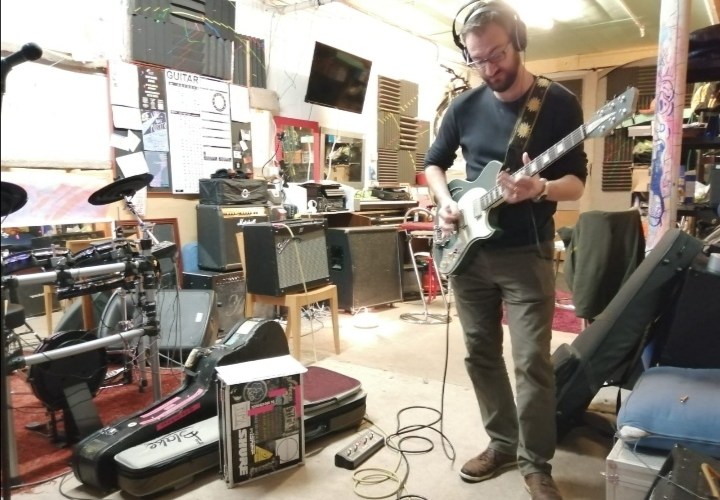
Recording lapsteel and 12-string acoustic at The Space, Carlisle (credit: John Timney)
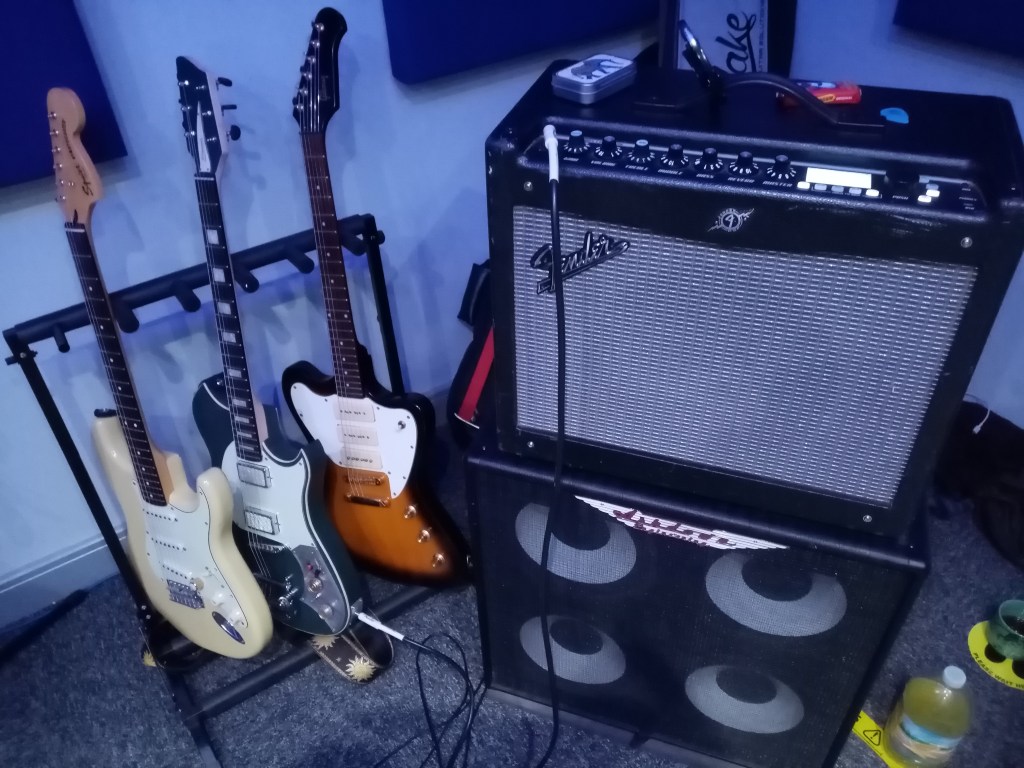
We managed to get several small bits done in just two hours. These included the few remaining rhythm/textural guitar parts, lead parts and full-on guitar solos over five different tracks. As well as borrowing John’s beautiful 12-string acoustic for a small part in one of the songs, I also used my Artisan lapsteel, Squier Strat and the new custom made Elderwood semi-hollow (read about that one here), all going through my Fender Mustang III amplifier. We might find there’s a few bits which need fixing, but if there is, we’ll have to wait until after lockdown!
Tomorrow, John will record the vocals (and a few other bits) with Nick back at Traxx Studios in North Tyneside (where the main chunk of the LP has been recorded, as documented in part one). Nick has lived with these songs for a most of this year, and in some cases even longer, so should be able to get the vast majority of them down tomorrow.
After that, it’s a case of adding Shannon’s backing vocals remotely, then mixing…
Still, at least we have all of lockdown to do that part!
More updates to follow, as and when they occur. Until then,take care of yourselves out there…
Last Thursday & Friday, I was back in the studio with the Nick Gladdish Band, as we finally started work on his new album Last One Get The Lights.
In normal times, this would have taken place in April, and by now, we’d be on another tour supporting the finished product. In fact, we already released the lead single Blurry Lines last last year (listen to it here). However, the pandemic and subsequent lockdowns have held everything up. More recently, we’ve been able to get back on track.
The process
To start with, Nick shared demos of the songs, and we started listening and thinking of suitable parts. A few weeks ago, we held two days of rehearsals where we tried out different things to see what worked. These were recorded as draft ‘rough cuts’ and the best arrangement shared amongst ourselves, so we could refine our parts further. It also gave me time to consider the best way to record the guitars, and which instruments to use.
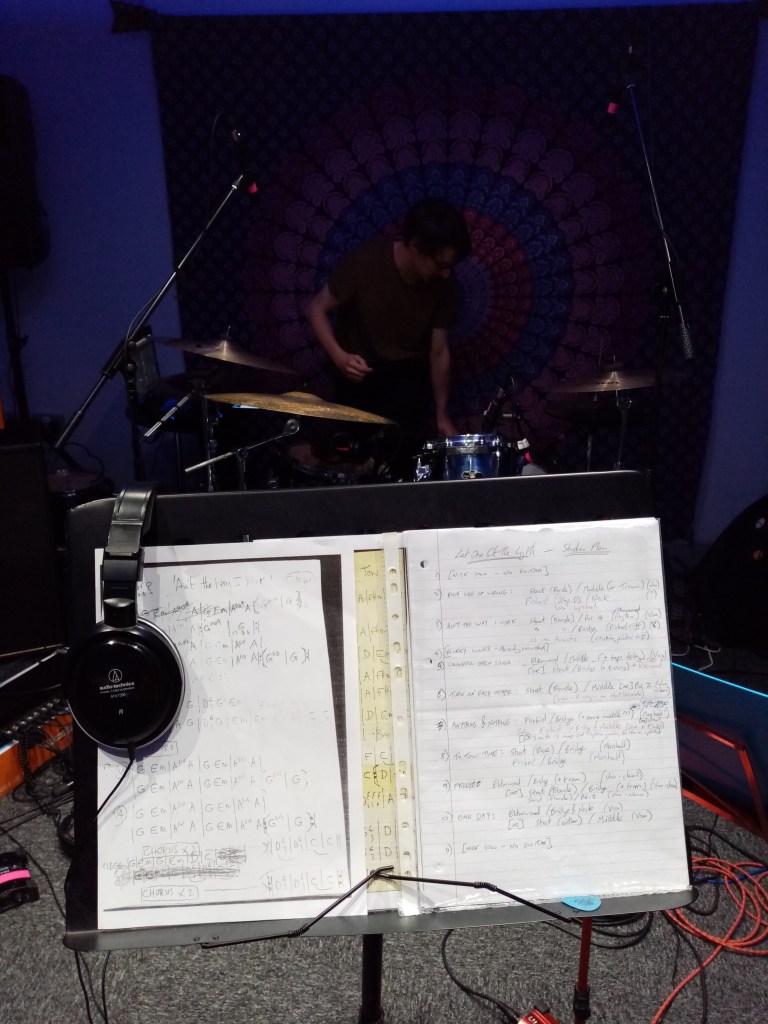
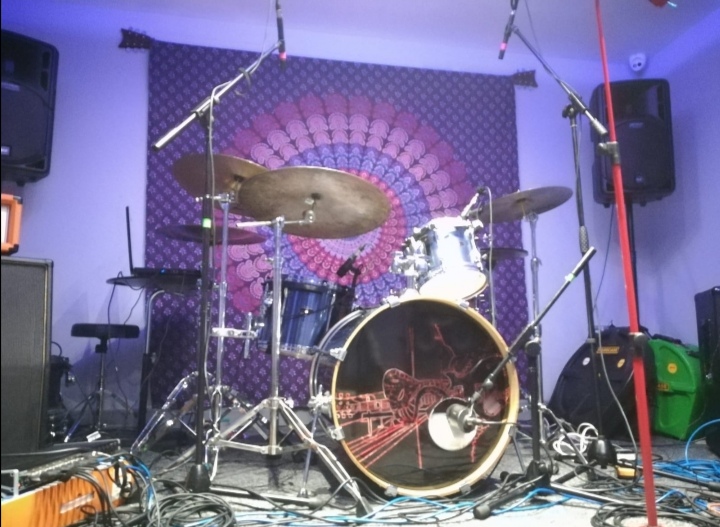
Here’s a few pictures from the two eight-hour days at Traxx Studios in North Tyneside. We spent these days recording the main backing tracks of drums, bass, most rhythm guitars, keys and guide vocals. The credits belong to everyone in the band (I’m not sure exactly who took which picture in some cases):
The whole recording process came together really quickly. In two days, we manged to get all the backing for the eight ‘full band’ tracks down, as well as additional rhythm guitar parts. Having rehearsed and arranged this set of songs in a live room setting, the guitar parts were quite simple to arrange and organise for tracking.
What happens next?
The initial plan was for John (Timney, drummer and engineer for this LP) to crew te rough mixes from what we had before we started on overdubs. However, the government’s announcement at the weekend, telling us we’ll be back in lockdown from Thursday, prompted a change of tack.
Instead, I will be going back into the studio with John to lay down all the guitar overdubs and solos tonight.
Tomorrow, Nick will record all of his vocals and a few additional piano & acoustic guitar parts. Shannon Powell, our backing singer at the live shows, will add her final parts remotely in the next week or so. That way, John has the whole period of lockdown to mix and master the record, and we can have the entire album finished in time for release at the start of 2021.
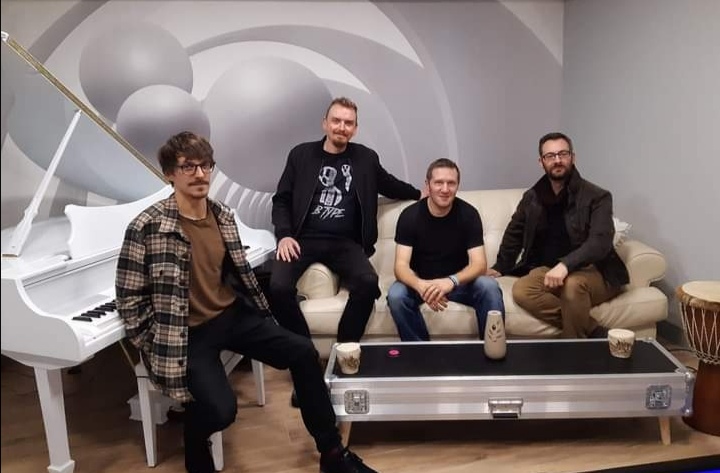
The Nick Gladdish Band. L-R: John Timney (drums, production), Adam Cornell (bass), Nick Gladdish (lead vocals, keyboards, acoustic guitar) and myself (guitars, lapsteel).
I’ll post some more pictures from tonight’s session, as well as further updates, in due course. Until next time…
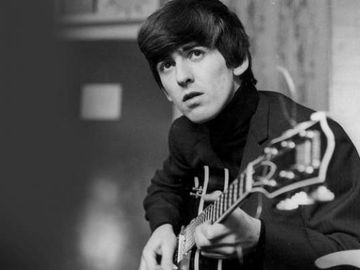
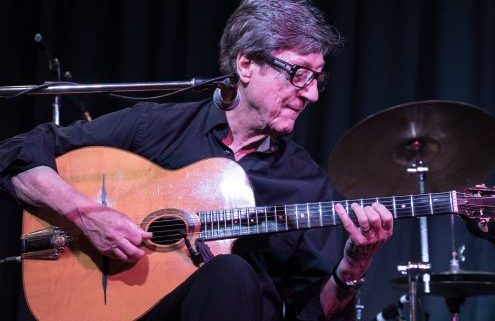
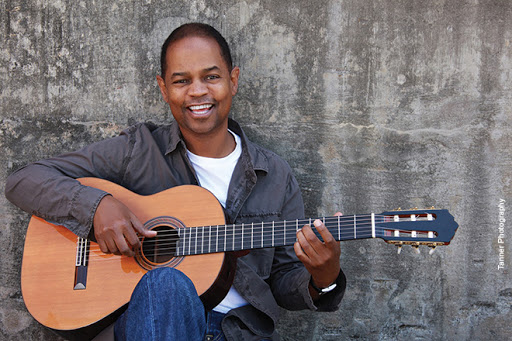
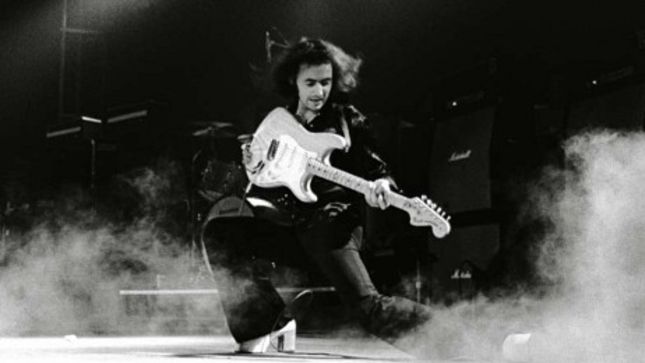
This is one of those exercises / challenges which circulates around Facebook from time to time (much like the one which inspired a previous post about ten albums which inspired me). This one asked guitarists to post photographs of ten guitar players who had been the greatest influence on their own playing.
I find these thought exercises difficult – challenging is the perfect word! I feel like I could post forty pictures and still have missed out a key influence on my playing, yet here we are, in no particular order…
George Harrison
Hank Marvin
BB King
Earl Klugh
Ritchie Blackmore
Steve Cropper
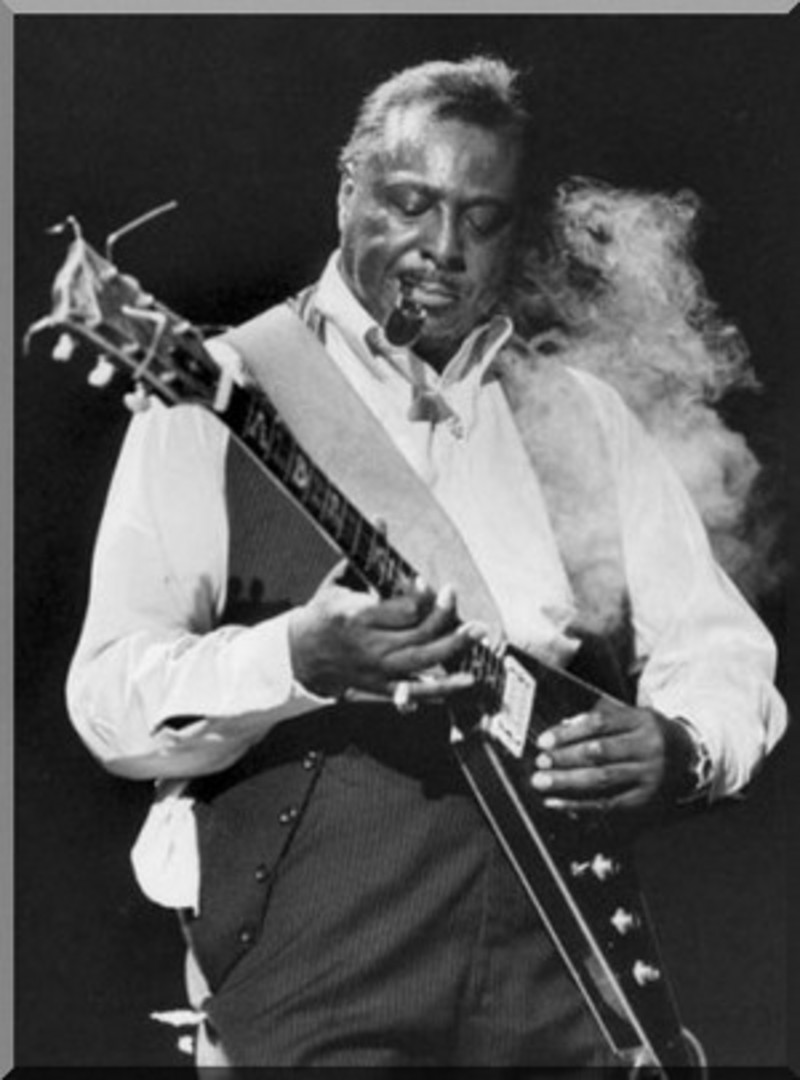
Albert King
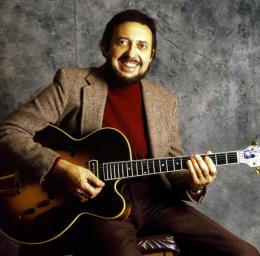
Barney Kessel
Grant Green
Steve Howe
What do these players have in common? Some are strikingly different. The key characteristics I gravitate towards in other musicians are…
Tasteful or melodic solos
Blending of musical genres
Dazzling showmanship / inspirational technique
…and all of the guitarists pictured above have one or more of these traits.
As always, these are just my opinions. I may well delve into my influences in more specific areas in a future article. But what are your biggest guitar influences? Get in touch or leave a comment to let me know!
As well as using Twitter to announce new projects, or update people on ongoing ones, I sometimes reminisce about ones from years ago, such as this one…
For some reason, I kept thinking of this, and on top of everything else I have planned (post-COVID), I’d quite like to explore what a power trio can do in terms of extended instrumentals (which aren’t based largely around improvisation); something more progressive in nature…
Having played in a rock trio format before, it can be a new challenge to fill the space adequately without the music sounding thin. Conversely, one has to avoid the temptation to stick to the more blues based method of sharing riffs, in union (or octaves) with the bass player.
Bear in mind that I currently have…
3 music therapy jobs
A solo classical(ish) EP to finish
Another Nick Gladdish Band album to finish & tour to plan
My next band project (world/blues/Latin) to start rehearsing
A music therapy case study series to complete by the autumn
A small portfolio of compositions to develop
…and we’re still in a time of lockdown here in the UK, with no concrete sign of progress regarding indoor gigs (although the news today implies that this might change very soon).
Still, if you want something doing, ask a busy person, right?
I once noticed a post on my Facebook page arguing in favour of what is called Scientific Tuning. This is where A4 (just below ‘middle C’) =432 Hz instead of 440 Hz, the modern standard to which all tuners automatically calibrate, and most of the music you hear is tuned to.
The post itself was of a kind I had seen before, and it featured the ‘tuning of the universe‘ argument. The idea that as our brains vibrate at 8 Hz, and the solar system vibrates at a perfect multiple of this, music pitch based around A=432 Hz has ‘greater resonance’ with the spheres and our own physiology. Some even use ‘representations’ of how water molecules and snowflakes look based on varying frequencies. What is especially interesting about some of these sites, other than some highly dubious arguments with little scientific backup, is their connection to a product – they invariably wish for you to ‘see the light’ about the ‘truth’ of 432 pitch, then buy their music recorded at this frequency! (Quick – it’s for the good of your wellbeing!)
I agree that we are tuned into the universe’s vibrations. As creatures which have evolved on this planet; made of matter which has been constantly recycled for thousands of millennia, long before before humans appeared. It could only ever be so. But our ears are incredibly complex and amazing instruments, capable of discerning minute pitch differences. We also have an in-built system for relative pitch (the sequencing of one sound connected to the preceding and following sound).
This is not only how we appreciate and enjoy music, but how we developed speech patterns as a species across the globe. It stands to reason, therefore, that the pitching of music is entirely relative. An out-of-tune guitar (with itself, as opposed to any other sounds) would sound unpleasant. This is because while one note in isolation is always on set pitch, a chord will include several pitches which are not quite correctly aligned, and therefore out-of-tune. The overall tuning of the instrument only matters when performing with another. Even then, the instruments only have to be in tune with each other to produce pleasing-sounding harmonies.
Another classic argument propagated by those opposed to the A=440 Hz tuning is that is was first proposed by Joseph Goebbels, Hitler’s propaganda chief. It is true that Goebbels commented on the effects of 440 tuning, but many had done so before. Several orchestras were already tuning closer to 440 than 432. The general tuning of ‘middle C’ seems to have risen slowly since the 18th century, highlighting the benefits of standardisation in pitch across the globe. This had already begun to happen before WWII, and was only officially standardised in the 1950’s, after the war had ended (Goebbels committed suicide in the final days of the European conflict). It was also increasingly commonplace for instrument manufacturers to use 440 tuning by the 1920s, as this blog states.
In terms of inducing ‘mass hysteria’, or even attempting to illicit a greater emotional response from a populace through music, 440 tuning would only work at large-scale events, with hundreds of people present, if not more. It could then be argued that the hysteria comes from the crowd (consider the almost war-like ‘crowd mentality’ witnessed and experienced at sporting events) rather than the music’s pitch itself. As social animals, we are designed to be ‘swept along’ by crowds and emotions. It is how we connect. Once again, everything is relative, and I can’t see any proof that the tuning of the music to a specific pitch is a useful means of social control, nor is it detrimental to human wellbeing.
Finally, there comes the acid test: Use a controlled experiment, playing listeners the same clip of music but tuned to different pitches. Professor in sound and acoustic research Terry Cox did this very experiment. His results found no preference whatsoever in listeners hearing music played at 432 Hz, compared to 440 Hz. You can hear the clips he used and read his full explanation and results here.
In conclusion, I agree there are good physic-based reasons that music pitched at A=432 Hz. should sound better. However, I strongly encourage you to worry about the bigger problems in life and enjoy music for what it is: the organisation of pitch and rhythm. These pitches, like physics, and indeed like the human condition, are all relative: They are not only what you make them, but what you interpret them to be.
I was recently tagged in a Facebook challenge by my friend David, in which you post 10 albums which have informed your early musical tastes.
I find things like this almost impossible. It’s so personal, but based on hundreds of musical memories. How do you select just ten LPs from years of discovering & listening to new music? So I made my criteria a little more specific, and chose ten records which, as well as being ones I listened to frequently, also served as early influences on my guitar playing & songwriting.
Because I’m focusing on my earliest influences, this list looks rather narrow. I’d like to think that my guitar playing influences, as well as my music listening tastes, are much more eclectic than this list would imply. But then, these are my earliest influences, rather than the wider world of music that these albums (and countless others not in this list) opened up to me.
In some cases I chose a favourite album by artists who could have filled a ‘top ten’ list all by themselves. I also decided to omit quite a few 90s choices which were heavy-rotation at the time, but didn’t accompany my out of the 90s, so to speak…
And because I’m looking at albums, I’ve not included any classical or folk pieces. Although they were a huge part of what I was playing on the guitar back then, just as now, I learned these pieces individually, rather than via any one particular LP – perhaps that’s a separate list of its own for a future post…
Likewise, jazz was a genre I started digging deeper into in my very late teens, so they while it has certainly influenced my playing, it didn’t happen until later. As such, only one jazz record makes an appearance on this particular list.
So what you see below is perhaps better catogorised as ten rock & pop albums which had a lasting influence on my guitar playing. Also, because it was really tricky narrowing down to just 10 choices, I’ve included a few contenders which nearly made the cut.
Strangely, some significant guitar influences don’t appear in these picks, for various reasons – not least because 10 albums isn’t enough! I think it’s because I view some guitar player’s work over their whole career (or live performances), rather than limited to just one record.
Anyway, here they are. The list is (very loosely) organised by chronology of when I discovered them, where my memory makes that possible. Enjoy!
The Shadows – 20 Golden Greats (1977)
The album that started it all. I was six years old and going through the ‘tennis racket guitar’ phase. My Dad suggested I listen to some “proper guitar music” and player this album to me (on cassette, naturally). There was no turning back. That famous clean Stratocaster tone was under my skin.
As I reached my teenage years I soon learned that The Shadows & their legendary lead guitarist Hank Marvin were far from fashionable, and I expect many young players may never have even heard of them. But one way or another, the landscape of popular music would be very different without their influence.
The Moody Blues – In Search of the Lost Chord (1968)
My father is to blame for this one too. He has all seven of the ‘classic’ Moodies albums (from 1967-72), and any one of them could have been chosen for inclusion here. Why Lost Chord? It best represents the mix of influences on my playing, featuring both fantastic acoustic & electric guitar work, as well as an abundance of non-rock instrumentation like sitar, flute and some of the best played mellotron in the history of popular music (it was this band’s keyboard player, Mike Pinder, who introduced the instrument to The Beatles).
Another element I’ve always enjoyed in the music of The Moody Blues is that they were a five-piece band with four singers. They divided up lead vocal duties equally, and performed some beautiful harmony arrangements. Meanwhile, the drummer (the only non-vocalist) wrote poetry which the band performed as spoken word on each album. Sometimes a little dated, but very experimental & extremely fun.
Close contenders: ‘Days of Future Passed’ (1967), ‘On the Threshold of a Dream’ (1969), ‘To Our Children’s Children’s Children’ (1969), ‘Question of Balance’ (1970), ‘Every Good Boy Deserves Favour’(1971) & ‘Seventh Sojourn’ (1972), all by The Moody Blues
The Beatles – Abbey Road (1969)
Of course The Beatles feature on this list. I chose this LP above some of their other groundbreaking albums (particularly the studio-bound later records) for two reasons. Firstly, the suite of sings which takes up most of side two of the record. Secondly, it features two of George Harrison’s best songs, Something & Here Comes The Sun.
Close contenders: ‘Sgt Pepper’s Lonely Hearts Club Band’ (1967) by The Beatles & ‘Pet Sounds’ (1966) by The Beach Boys
Blur – The Great Escape (1995)
Blur were always more than just a Britpop band. Their music had an air of adventure & experimentalism that simply wasn’t present in the work of their contemporaries. This album shows how observational pop songs could still have a grungy & left field edge to them. As well as this, guitarist Graham Coxon has left his mark on my approach to creating parts in a band with only one guitar player (and no keyboards for the most part) that go beyond the obvious but still fit the tunes perfectly.
Close contenders: Blur’s preceding album ‘Parklife’ (1994) & ‘Return to the Last Chance Saloon’ (1998) by The Bluetones
Deep Purple – Machine Head (1972)
This album’s most famous song (Smoke On The Water) tells the story of its own creation. It is also my least favourite track on this LP, most likely due to over-saturation (are you allowed to play it in guitar shops yet?) bit there’s riffs & solos aplenty on this gem. Guitarist Ritchie Blackmore undoubtedly influenced my early soloing style. I loved how his tone was almost clean, unlike every guitar player who followed in his wake. His single-note slide playing has also had on effect on the melodic approach I try to employ in my lap steel playing.
Close contenders: Aerosmith‘s ‘Toys in the Attic’ (1975) & ‘Back in Black’ (1980) by AC/DC
Gomez – Liquid Skin (1999)
Their debut album Bring It On won Gomez that year’s Mercury Music Award. This was their follow up, released the following year. Both albums are of a similar vein (coming so close together). I chose this one because I think I ever so slightly prefer the songs on this one. Alternative, inventive, experimental, but still melodic. And like the Moody Blues and The Beatles, this group had several leas singers and performed some sublime vocal harmonies.
Close contenders: ‘Bring It On’ (1998) by Gomez & ‘K’ (1996) by Kula Shaker
Sam & Dave – The Best of Sam & Dave (1969)
Classic soul tunes from the legendary Stax Records label. As great as Sam & Dave were as singers and performers, it’s the backing band which brings me back to this record time and time again. The Stax House band were Brooker T & The MGs, featuring Steve Cropper on guitar. Every song is an masterclass in creating parts which serve the song. Many of my own chops come directly from Cropper, especially his use of sliding sixths in his lead playing & fills. Check this record out – in fact, check out any album released by Stax in the sixties and early seventies.
Close contender: OtisRedding’s posthumous greatest hits ‘The Dock of the Bay – The Definitive Collection’ (1987) is another great example from Stax Records and features more amazing arrangements by Brooker T & The MGs
Led Zeppelin – Led ZeppelinI (1968)
Any Zep album could have ended up on this list, particularly their first four eponymous LPs (known as I, II, III & IV). But their debut record, recorded in just three days, was one I kept coming back to again and again as a teenager. The group were part of a wave of British acts turning the blues on it’s head, alongside the likes of Jimi Hendrix and Cream. But unlike, Led Zeppelin felt more like a meeting of equally talented musicians, and (no offence to Hendrix or Jack Bruce) they certainly had the best singer in the then-unknown Robert Plant. Powerful, beautiful, but ultimately, accessible got a fledgling guitarist.
Close contenders: ‘Disraeli Gears’ by Cream (1967) & ‘Tres Hombres’ by ZZ Top (1973)
B. B. King – Live at the Regal (1965)
Unlike many live albums, which cherry-pick the best examples from numerous dates, this release was taken from a recording of one show at Chicago’s Regal Theater, on the 21st of November, 1964. It captures B.B. on top form, backed by a large band of superb musicians. This record provides a masterclass in phrasing, demonstrating King’s economical & tasteful playing, each note dripping with the blues. Highlights include Sweet Little Angel and Help The Poor.
Close contender: ‘In Session’ by Albert King & Stevie Ray Vaughan (1983)
Kenny Burrell – Midnight Blue (1963)
This record is the epitome of cool jazz. It sounds like it was recorded in the wee small hours, and it probably was. I’ve dedicated a recent post entirely to Burrell, who’s playing has just enough blues to make this jazz record accessible to a novice such as I was in my teenage years.
Close contender: ‘Julie Is Her Name’ (1955) by Julie London
Special mentions should also go to Queen’s Greatest Hits (I & II), because my family sometimes had a car growing up, and these albums were standard issue with all cars back then…
As always, I’d love to hear your thoughts on this list, as well as your own. Get in touch in the usual way! Until next time…

















 Tim Higgins, Guitarist
You must be logged in to post a comment.