Examples of using intervals in guitar playing, part 1: thirds, sixths and tenths

Advice & Tips

Single line lead guitar playing is great. But when you have six strings and four fingers to hold them down, why limit your playing to one note at a time? Throughout the history of guitar, players have used two notes (or more) at once, resulting in something halfway between a single note line and a full guitar chord. We do this for a few reasons:

  • It adds depth (useful in trio settings, for example)
  • To create a certain feel (which we will touch upon below)
  • To imply a chord through highlighting certain scale tones
  • To make certain phrases stand out

What is an interval?

An interval is he distance between two notes, in terms of pitch. Thinking of the C major scale (visualize the white keys on a piano), the root note (C) is 1, and the next note (D) is therefore 2, so the interval between C and D is known as a 2nd. More specifically, it is called a major 2nd because it is a whole tone away from C (whereas Db, only a semitone higher, is known as a minor 2nd). The next note in the C major scale would be E, which is called a major third (and Eb is the minor 3rd). I won’t bog us down in theory for this article, but if you need a more in-depth explanation, check out this video from Victoria Williams of mymusictheory.com.

It’s possible to use any interval when playing, especially lead lines. However, some are more effective than others. In this article, I’m going to stick to three types of interval: thirds, sixths and tenths, along with a few well-known examples in music. Go give some of these a listen and see if you can spot the intervals in use.

Thirds

Common in any music with a Spanish in Latin twist, particularly on acoustic guitar. Try going up and down a major scale by playing each note with another note ‘two places higher’ in the scale on the next string up. For example, starting with a C by fretting the G string at the fifth fret, you ‘think up two notes’, skipping D, and playing E by fretting the B string at the fifth fret. The next note in the scale (D) would be played at the same time as F. Going up the fret board/scale, the notes should match up above each other like this:

  • EFGABCDE (thirds)
  • CDEFGABC (base notes of the C major scale)
Picture Credit: GUITARHABITS.com

Check out this useful video by Pete Farrugia, which covers thirds and sixths in greater detail (see below).

It is also the most commonly used interval for twin guitar harmonies, such as:

  • Thin Lizzy – The Boys Are Back In Town (recurring twin lead line after the choruses)
  • The Eagles – Hotel California (harmony lines at the very end, during fade-out)

Sixths

One of my personal favourites, which I use a lot in my guitar playing. Sixths are essentially an inverted third, where the base note (eg, C) is played highest (such as one the E string at the 8th fret), while the harmony note (E or Eb) is played two strings lower (in this case, the G string, at the 9th fret for E, or the 8th fret for Eb).

Picture Credit: NZMusician.com

They can highlight major and minor chords, and sound great when you slide into them up and down the scales you’re using, as well as chromatically (think of the stereotypical blues ‘ending’). They’re great for soul playing too, implying a chord or scale with only two notes (as with tenths – see below). I’m not alone in this – examples exist across the various genres that the guitar is used for, including:

  • Steve Cropper’s guitar intro to the classic Sam & Dave song Soul Man
  • Chuck Berry on the intro to You Never Can Tell

Steve Cropper’s guitar playing uses this time and time again, on many classic recordings from Otis Redding to The Blues Brothers. He had a knack for finding the right guitar line that complimented the songs he played on, without overpowering them, and rightly deserves his own article looking into his style in greater detail (watch this space)!

Tenths

Tenths are essentially thirds, but with an additional octave between the two notes. This has the interesting effect of creating the impression of a chord, while still leaving a sense of space. It is the interval used in the opening phrase of the well-known classical guitar standard Lagrima. Here’s a chart to demonstrate where the tenth harmony for Bb (played alongside a D, two notes then one additional octave higher) across the guitar fretboard:

Picture Credit: PlayTheAxe.com

There has been a few examples of this in big singles recently. In each case, t tenths are used for the main guitar park in the songs:

  • Scar Tissue by The Red Hot Chilli Peppers
  • Love Yourself by Justin Bieber
  • Hold Back The River by James Bay

Tenths are also used in jazz. They provide a nice open-sounding stretch which is easy to play on guitar; they implied the chordal harmony while still leaving space for other instruments.

In summary

One thing that all three of these interval types have in common is their ability to reflect a major or minor chord. I think of them as the same interval, using a base note of C as an example again:

  • Third: C, played with an E (2 tones higher)
  • Sixth: An inverted third; C is played with an E a sixth lower (4 tones)
  • Tenth: A third, plus one additional octave between both notes; C, plus E (8 tones higher)

Each has it’s own feel and characteristic, and they are not always as interchangeable as you might think. Try playing around with them, across major and minor scales, then in your solos, and let me know how you get on!

Coming next: Part two of this subject will focus on intervals which can utilised over major and minor chords – fourths and fifths.

Lessons learned from lockdown

Advice & Tips

This year has seen the most use of the word ‘unprecedented’ that I have ever seen, and probably for good reason.

Do what you can now, and if you can’t do it now, plan for later

Getting started on something can often be hard. During lockdown, I’ve found myself exhausted after a full day of childcare, and in those few rare moments I had for me, working on a new composition seemed ridiculous.

Do what you can, in small steps. In fact…

Make a list

List what your daily tasks are, as well as goals for the medium term (i.e., the next few weeks) and long term (post-lockdown, or even post-COVID altogether). It will help you focus, and evaluate what is important.

List making sure was already an occasional habit of mine, mainly because I am aware of my own poor short-term memory. Going forward, I’ll be sticking to daily lists, as they seem to have made me more productive than when I worked from home in pre-pandemical times.

Speaking of lists…

Bring back the ‘weekly shop’

We must have gotten out of the habit of doing the ‘big shop’ only once a week. Lockdown forced us back into this habit, and although it somehow felt more expensive at first, it seems to be better value across the week, especially when it was harder to nip out on a whim for a treat. Give it a try, if you can, and see how it works for you.

Don’t compare yourself to others

Whether it’s FOMO (fear of missing out) or a kind of professional jealousy when another person seems to be working fine at home – you know, the one with all the recording gear in their spare room (or their parents) and no children.

Social media only shows you what people want you to see. Most of the time, it only shows what those people think everyone else wants or expects to see.

Some of it is real. Some of it is less than genuine. All of it is someone else, in a different set of circumstances (however slight that might appear).

Beware of fatigue

Some of my friends have been locked down at home by themselves, working from one room during day, then zoning out in front of the TV in the evening. They told me that even committing to an online quiz via Zoom felt like too much effort. Staring at a screen all day, even for leisure or socially distant socialising, is incredibly tiring. Give yourself time to reset, and do absolutely nothing. Just remember when you do…

Don’t be to hard on yourself

If the fatigue did’t get you, the guilt surely did – right?

This is connected to my earlier heading, Don’t compare yourself to others, but it’s worth looking at again from a slightly different angle.

We’re going through unprecedented times. No one in our lifetime has experienced this, on this scale, before. Survive. Look after yourself and those around you. Don’t feel guilty for doing less.

In fact, don’t feel guilty at all for how you are managing to get through a pandemic.

Do what you love, if you can (and if you can’t make a plan for doing it in the future)

You might have noticed that a few of my recent posts have been short Hailku form poems, or observations from walks with my family. I enjoy writing them. Since I can’t perform live at the moment, they give me some creative output while everything else is on hold.

If you have recently discovered a new passion, embrace it and enjoy it. Share it with the world. And if COVID19 is stopping you from doing what you love and enjoy (as it has for me with my love of playing guitar live), make another list; this time, make it a plan to get your passion up and running again soon, once all of this is – hopefully – a distant memory of an unpleasant time, now disappearing.

Best of luck, and let me know how you get on! Also, let me know what lessons you have learned from the last few months of lockdown by leaving a comment or getting in touch via my usual channels – I look forward to chatting to you!

Black Lives Matter. No ifs, no buts.

Advice & Tips

We live in uncertain and challenging times.

It’s probably been hard to escape the news of George Floyd’s horrific murder in May this year, and the worldwide protests it has inspired.

Although the #BlackLivesMatter movement has been running for several years, it has certainly gained momentum. Perhaps half the world being in lockdown made sure we didn’t miss anything this time, as another unjust killing of a person of colour scrolled by on our new feed yet again…

As a white person, it’s worth recognising the (possibly unconscious) bias inherent in the system, which – despite a far from privileged upbringing – may well have provided me with a leg up from time to time.

How can we change this? Perhaps I’m not the best person to ask. Here’s an article by Dazed which explains how to be a better ally. It’s an important read, which features the main points summarised below:

  • Think twice before sharing violent videos
  • Confront racism when you see it
  • Take action
  • Acknowledge your privilege
  • Practice social distancing*

(*this final point comes because BAME people are more likely to contract or die from COVID19, the Corona virus still sweeping around the globe this summer)

I wholeheartedly encourage you to read the original article from Dazed in full. There’s also this longer article from Gal Dem, which is run and contributed to entirely by women of colour, which explains how non-white people of colour can help to dismantle anti-blackness.

Please read and share these articles.

Will anything change? Companies and trade bodies are in the stage of self-examination. The Musicians Union and British Association for Music Therapy are both looking at how they can do better. It’s our job to keep the pressure up until tangible changes start to become manifest.

Apart from that, ask lots of questions. Be curious. And most importantly, be kind.

Ukulele playing: pick or fingers?

Advice & Tips

One question I was asked fairly regularly by ukulele students in the past was:

Which is better for playing ukulele – fingers or pick*?

This blog post will hopefully go some way to explain why both are equally viable options. There – if you came to this article solely for reassurance on your preferred method of playing, I’ve saved you the hassle of reading any further!

[*NB – when I say ‘pick’, I of course mean a plectrum, like those used for guitar playing. If you’re here to learn about the kind if pick you dig holes with, you’re very much in the wrong place!]

If you’re looking for more information on picks, this rather informative article here from liveukulele.com may prove to be of use. But for now, let’s dive into our two options…

Pick (plectrum)

A pick is an easy option to start with, as even the nylon strings if a ukulele (as opposed to the steel strings used on a typical acoustic guitar) can have an effect on your fingers; this is particularly true of your nails and cuticles (the skin directly under your finger nails). You also get a louder, more direct sound when using a regular guitar plectrum, which are generally made of plastic or synthetic materials such as nylon & tortex (fake tortoise shell).

If you’re used to picking & strumming a guitar, you don’t have to make any changes to your right hand style at all. Although the same could be said if you’re primarily a fingerstyle player…

Fingerpicking

If you’re adept at fingerpicking guitar, you’ll be completely at home on the ukulele. In fact, it has two strings less, which should make it easier! I often find myself using my thumb for the G & C strings (the two closest to your face) and only making use of my index and middle finger for the E & A strings respectively.

I’ve also noticed that I perform finger rakes with any finger, and use my thumb in a greater variety of ways. Also, any guitar picking technique, from muting to string slapping & body tapping, all work equally well on a uke. If anything, my ukulele picking technique is more akin to how I play flamenco guitar!

Finally, you may notice that the tone of a fingerpicked uke is less harsh than when plucked with a pick. It’s certainly possible to obtain a greater range of sounds by adjusting which part of your fingers and nails pluck or strike the strings than could be managed with a plectrum.

Is there a middle way?

Well, yes. There are a few alternatives. Firstly, there’s felt plectrums. These are fairly common in ukulele playing and provide three ease of using a pick without the harsher tone. However, they’re less useful for more intricate playing, such as plucking individual strings.

There’s also a type of pick which sits on your fingers, popular in bluegrass styles.

Thumb & finger picks, popular in bluegrass banjo & guitar playing

These thumb & finger picks originated banjo playing, and offer the attack of a plectrum while still using fingerstyle hand & finger movement. Having said that, they do take a bit of getting used to! Many players use only the thumb pick in combination with their fingers. I’d recommend experimenting to see what works best for you.

But which is better?

As always in articles of this nature, I can’t give you a definitive answer, other than telling you my personal preference. For me, I don’t use picks at all in ukulele playing. I prefer the tone & versatility of using my fingers. But that’s just me – I encourage you to try both and see which one feels right for you.

Finally, don’t worry about sounding amazing if you’re new to trying a new playing style. Consider what feels most comfortable, and what has the best potential for you to continue improving in your playing. Let me know how you get on!

Reblog: Ukulele tuning problems

Advice & Tips

Another reblog, this time from early 2016. For some reason, this article has been widely read in Indonesia and the Philippines (according to my stats on WordPress). Either many people route their Internet through these countries, or they have a serious ukulele addiction (or tuning problem)! Either way, hello and thanks for reading – feel free to comment and share these articles!

So you’ve bought your first ukulele & learned a few chords. But now you’ve noticed that it’s gone out of tune. No matter, you have a tuner, you tune up. Done. But after a pretty short time, it’s out of tune again. Why?

I get this query a lot from new ukulele students. Just as they are getting started with their first steps into music-making on this instrument, they become frustrated with it’s apparent lack of tuning stability.

New ukuleles come with new strings, which haven’t been ‘played in’. Just like a new set of strings of a guitar, they need to be ‘stretched’. As ukulele strings are made from nylon, which is a very flexible material, this is even more apparent.

The quickest way to to this is following these basic steps:

  • Tune your ukulele
  • Take a hold of the strings & gently pull them up, away from the fingerboard, repeating across a few different parts of the string (see an example video here)
  • Re-tune the ukulele
  • Repeat steps 2 & 3 until re-tuning is no longer required

Hey presto! problem solved! Your ukulele should now not only remain stable after playing, but also hold it’d tuning better when travelling (though extreme changes in temperature will still cause the strings to expand and contract).

This video is one of many available online to help you better visualize what I mean by stretching the strings. It’s not as difficult as you might think!

(pic courtesy of ukulelemusichawaii.com)

Other things to remain mindful of:

While stretching the strings is by far the most common solution to fixing a consistently out of tune uke, you may still notice occasional tuning issues. Perhaps simple, mostly open chords sound correct, but those with three or four fretted notes, or barre chords, have one or two out of tune strings when played. More perplexing, this can happen when the open strings are still correctly tuned up.

The problem? In this case, it’s intonation.

Provided you have a decent instrument, where the frets are set up and spaced correctly (watch out for the false economy of the bottom range ‘budget models’), then this can easily be fixed by paying close attention to how you fret the notes.

You may find, on new or more interestingly shaped chords, that you are pressing down too hard on certain strings, pushing that note slightly out of tune with the rest of the chord. Some positions might require you to stretch or bend a finger in a way which means it is not sitting behind the fret as per the standard method. This too, can be fixed with a little bit of practice, and a small amount of mindfulness.

Happy Uke-ing!

Advice for young musicians

Advice & Tips

While in the process of editing and revising my WordPress site, I’ve one across a few older articles which might be of interest to some readers. In particular, those of us who are practising or recording more at home during the COVID19 lockdown [still in place this month] might find something they can take away from this blog, first published in 2015.

New articles and a few more reblogs coming in the next week or so. Until then, stay safe – Tim

We all know how it is. You want to prove yourself and show the world (and your peers) that you ‘have what it takes’ to work in music; Self assured and not in need of any advice of pointers from anyone else. How would they know your ‘story’ anyway? How could someone advise you when your style, your sound, your ‘voice’, is unique to you.

True, confidence can be a great asset to our chosen profession. Even in an industry where we work together because it’s the fundamental nature of how music operates, it can get lonely out there sometimes. But a false confidence, or bluff, will leave you alienated and likely to make the same sorts of mistakes thousands of musicians have made before you.

So swallow your pride, take a seat, and listen to a few words of wisdom from those who have made music work – and pay – for themselves.

Keybaord player and composer Ben Folds wrote some advice a few years ago on his Facebook page. Boiled down to the essentials, I found three things especially true:

Work on finding your own voice

However much you try, you will always be you. Stop trying to be anyone else and accept this fact. Once you have come to terms with this, work on being the best ‘you’ that you can be.

Learn your technique, then forget it

Learn as much as you can, as widely as you can. Read about it & practise it. Then follow the advice of the previous point and learn to present these techniques in your own, unique way.

Before you can express yourself in words, you first have to learn the language; it’s vocabulary & grammar. But think of how many books & poems were all the more interesting for their yearning up of the rules? The same applies to music first. However, to reach this point, you need to know which rules you are breaking…

Don’t try to force people into liking you or your music

There will always be people out there who find what you do interesting, provided you are doing it well, and playing from the heart. don’t bend over backwards trying to commercialise your sound, compromising your music in the process. The audience will come to you, so just persist at it.

This is even more true in our digital age – search for good advice on putting you material online. You should never have to pay to do this, due to the high number of platforms out there. It might be slow at first, but you will eventually reap the fruits of your hard work.

NobleViola.com also features a really interesting article entitled 10 things I wish I knew when I was a young musician which, while echoing the sentiments of Folds, adds the following gems:

Practicing isn’t a matter of how many hours you put in, but how many good hours you put in. It’s quality, not quantity.

Your body is also your instrument – learn how it works and take care of it.
Being professional is a 24 hour job.
Keep busy, and do a variety of things. Diversify as much as you can.
Love what you do – and remember to nurture that love.

As Pat Metheny says on his website, “for me, after everything, the only thing that finally remains really true is the feeling that at the end of the day, I know that I played really good, or I didn’t; or that I made some progress and understand something that I didn’t understand at the beginning of the day; or I didn’t. This, to me, is the real currency of what it is to have a life as a musician”.

Well said, Pat.

As always, comments and responses are more than welcome. Feel free to check out my previous articles too! Enjoy the rest of your week & happy playing!

Tonerider pickups Vs Squier Classic Vibe Pickups

Advice & Tips, Guitars & Gear

This article has been one of my most viewed pieces, as fans of Squier guitars try to get to the bottom of a pickup mystery. I heard of it being shared on forums discussing the link between Squire’s Classic Vibe range and Tonerider pickups. However, I also recently learned of an important update, so have returned to this post to bring it up to date.

This article was first published in May 2020, and was updated in November 2024.

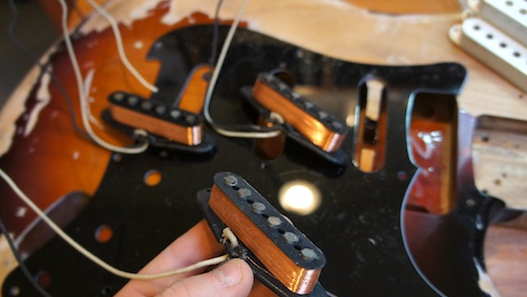
A few years ago, I was in the process of changing the pickups in my two Stratocasters. One, my blonde Squier Vintage Modified (pictured below), was fitted out with custom pickups handmade for me by Rohdan Pickups in the USA. These were made using Alnico III magnets in the neck and middle pups, the same as the very first run of Fender Strats in 1954. The bridge was a mix of Alnico V & II, for better definition, without the harsh trebley bite.

strats

My three Strats, before I sold the red one (top) or changed the pickups in the other two…

For the other guitar, my trusty Mexican HSS Strat (the blue one, pictured above), I only needed replacement neck and middle pickups. I was playing with different groups with less emphasis on heavy rock, and needed something more versatile. I’m still really happy with the Seymour Duncan ’59 humbucker in the bridge (this is usually a Les Paul replacement/upgrade, and has a great tone for classic rock). Having loved the sound of one of my other Strats, a Squier CV, or ‘Classic Vibe’ (Simon Neil signature model, based on a CV 60’s model), I started researching it’s pickups online. I thought I might get an idea of where to look for similar-sounding pups to install in my Mexican Strat. However, in my search, I happened upon an interesting, and ultimately money-saving, discovery…

Tonerider Pickups

Tonerider make replacement pickup sets for Strats and Teles. They appear to operate out of Squier’s main factory and sound as similar to the pickups used in Squier’s Classic Vibe guitar range as to lead most people to believe they are the stock pups built into the instrument.

An excellent article by Tidy Words seemed to confirm what many Squier players had long suspected, and which Tonerider set was (allegedly!) being used in which guitar:

  • CV 50’s Strat – Tonerider Surfaris
  • CV 60’s Strat – Tonerider Classic Blues
  • CV signature Strat (Simon Neil signature, etc) – Tonerider Vintage Classics

For full details, you can see the full article here.

tonerider

Picture courtesy of Worth Point.

However, this only appears true for Squier Classic Vibe guitars made before 2019 in China

According to Fuzz Faced, Squire CV production tool place in the Grand Reward factory, based in the Guang Dong province of Southern China. Tonerider pickups were made in the same factory, leading to the noticeable similarities in construction and sound between their pickups and the stock CV ones.

Squire moved production of the Classic Vibe range to Indonesia in 2019, as a means of lowering costs and avoiding US import tarrifs on goods manufactured in China. As a result, these newer guitars are no longer made in the same factory as Tonerider pickups. So what might have been true of a pre-2019 CV is much less likely now.

However, the sound of a CV 50s Strat made in China is the same is one made in Indonesia. Their pickup voicings remain almost identical to models of Tonerider pickup available.

The takeaway message…

If you have a Squire Classic Vibe guitar, don’t rush to upgrade it with Tonerider pickups. They are, for all intents and purposes, already in there! And frankly, if you’ve bought a CV guitar to get the overall ‘vibe’ of a certain era in Fender’s history, the stock (Tonerider-sounding) pickups do a great job, and don’t need replacing in the first place! These guitars are well built and in terms of sound, playability and build quality, give the ‘real’ Fenders a run for their money – at a fraction of the price!

On the other hand, if you like the Strat you have, but it’s not from the Classic Vibe range, and want to improve the pickups, you could do a lot worse than the Tonerider range. Check out their full range of Strat pickups here.

How did it work out for me?

I bought a City Limits single coil set from Tonerider for the Mexican HSS Strat. These use Alnico V magnets, and are aiming for the ‘Texas Blues’ sound Fender Strats do so well – think ‘SRV’ and you’ll have a fairly good idea what I mean.

city-limits-new

Picture courtesy of Tonerider.com

These pickups worked brilliantly for blues, rock, funk, jazz and everything else I threw at it. However, I found the difference between the sound of my two Strats to be an issue (as one guitar serves as backup for the other onstage), so I switched the bridge pickup to a more original-sounding single-coil, and decided to put in a new, fully balanced set. Having grown to prefer the sound of my blonde Strat, I opted for Tonerider’s Alnico-3 Surfari set. I also made the ‘tele mod’, making it possible to select the bridge and neck pickups at the same time. Now I have that wonderfully airy but funky Telecaster sound, making for a very versatile guitar which pairs much better with my blonde Strat.

I hope this has been helpful, and clears up any misunderstanding about the Squier CV range. As always let me know your thoughts, and good luck in your buying choices!

Warm up & practice recommendations

Advice & Tips

This week, I’ve had the rare luxury of free time. Free time to pick up my guitar whenever I like and play. Not specifically for any particular goal, just to PLAY for the love of playing. It then occurred to me just how little I get to do this. Usually I pick up my guitars to practice or prepare for an upcoming show, or to learn new material. The rest of the time, I’m actually at a gig playing.

Using it as a great opportunity to go over my classical repertoire, I found it almost scary how much my discipline had slipped. Don’t get me wrong, I still play well and in a musically pleasing manner (in my opinion, anyway!) but there are ways of performing on guitar (with classical pieces in particular) which enhances the music and makes playing easier (not to mention lessening any strain and preventing injuries long term).

So this week, I have been delving into my old practice and warm up notes and dug out my old favourite, Pumping Nylon by Scott Tennant. For the classical guitarists out there who do not have this book, I strongly recommend you purchase it as soon as possible.

91or8zjkZOL.jpg

This book focuses solely on technique improvement for both hands (including thumb for the right hand). After the initial basics and starters, it progresses into joint techniques (working exercises for both hands together) and demonstrates a closer look into flamenco techniques. These not only go to strengthen your right hand, but to widen your overall playing ability. It also includes specially written study pieces to incorporate all the techniques it has taught.

Around fifteen years ago, I suffered a broken ring finger on my right hand. This has never fully regained it’s original strength (and as a result my days of regular classical guitar recitals are mostly behind me). The exercises in this book went a long way in helping my rebuild the muscle and bring my ability back, something I feared would never happen. Because of this, the right hand techniques and exercises int his book are of particular importance to me.

That’s the basic warm ups covered, but what about actually rehearsal starters? For me, as with many classical guitar players, the studies (or ‘Etudes’) of Francisco Tarrega and Fernando Sor provide plenty of examples for rehearsal focus, especially with right hand technique. It’s absolutely amazing the depth of ground these two teacher-composers (not to mention pioneering players) covered in advancing the technical study of the guitar. I cannot recommend them highly enough.

Alongside these, there are also the studies of Mauro Giuliani. Although his concert and recital pieces are widely known (in fact the staple of most player’s repertoire), his studies are often neglected. However, I would definitely suggest investing in a transcription of his complete studies. While not as technique-practice heavy as Sor (who, in contrast, is remembered historically more for his studies than his concert pieces), they present a more musically varying set and some new colour into your practice routine.

My standard practice routine (looking at my old notes from my true classical playing days) went roughly as follows:

  • 5-10 mins warm ups (both hands, featuring exercises from Pumping Nylon and scale practice
  • Selected studies from Sor, Tarrega and Giuliani (2 or 3 from each, focusing on specific improvement areas)
  • Looking at any new pieces to learn; slow play-through; focus on tricky areas; attempt to play through without stopping (I would try not to spend more than 20-25 minutes on this to prevent fatigue or frustration – the piece can be returned to on the next day)
  • A better known piece which also requires mastering. Ideally play-through should be reached far more quickly
  • Another piece (already known) to ‘refresh’ the fingers (ideally this will also be an upcoming concert piece)
  • Free playing – At this point, I could have been rehearsing for up to an hour and a half, so this should be an old favourite or two which you know well, to act as a cool down. Be careful, though, to remain watchful on technique and accuracy, as this is more likely to slip on pieces you are over familiar with.

These, of course, are my tips only. I would however be delighted to hear from other guitarists and their tips/routines for warm-ups and rehearsals. You can contact me via the  contact page on this site, or my social media (see links).

Good luck and happy practicing!

Want your music to be heard? Pick a genre!

Advice & Tips

I love artists who create works that cross the boundaries of genre, style, and in some cases, medium. Most people do.

Others, of course, are faithful purists to their favourite genre. But for the rest of us who take our influences from all manner of avenues, how do we categorise our music?

There’s a good argument that genres are only useful to music journalists and lazy audiences. Why should everything be boxed up and potentially limited by increasingly narrower definitions? However, the key argument for explaining how your music sounds is simple: to build an audience.

Pick a genre (or three)

Truth be told, there is strong chance that your music could probably be catogorised under one of these common genres:

  • Classical
  • Jazz
  • Rock/Pop
  • Soul
  • Hip Hop
  • Gospel
  • Country
  • World/roots
  • Metal
  • Blues
  • Indie

These terms are wide catch-all umbrellas, into which various sub-genres fall – just think of all the different kinds of Classical music or Jazz which exist! Try zooming out and imagining where you’d expect to find your music in a retail store. If you feel your music crosses between these larger genres, use more than one – but no more than three.

There exists another category, increasingly referred to as a genre, called singer-songwriter. This usually refers to a pop or indie artist performing acoustically. If that’s you, say so. If you’re in a band and you don’t know where you sit on the scale of rock to pop, and fear losing potential listeners, perhaps stick to the safe option, and go with Indie?

Of course, it can work the other way too. For every Gospel/Soul artist, there will be one solely residing in the musical world of Minimalist Math-Rock. In which case…

Find your niche

Picture credit: Fossbytes.com

The above image (from an interesting article you can read here) barely scratches the surface of the wide, weird & wonderful world of sub-genres.

You might worry about being too niche when describing your sound, but each of these categories has a huge number of fans around the world. If you insist on being ultra-specific when describing your music, you might as well to tap into existing markets such as these…

Remember: You don’t have to stay in one genre forever

The best artists started out doing one style, usually very well, and growing from there. The Beatles were a ‘beat’ group (guitar pop rooted in rhythm & blues), but they soon went far beyond this. Even the famously ever-changing David Bowie’s first few albums from the sixties were of the classic singer-songwriter + band vibe. Without a base to jump from, you can’t expect to get much further than where you are right now.

True, the music industry is very different now. Artists aren’t given the opportunity to find their voice over the course of several albums. But there is still the option of playing live* to an audience, as well as other bands on the bill.

(*or, should I say, there WILL be the opportunity to play live again once we are all out of lockdown – TH, writing in April 2020)

Regular gigging allows you to work on your songs and develop your sound with each passing gig. It should also bring you into contact with new fans, who will be able to describe your music (in terms of genre) much more efficiently than you may be able to yourself. You never know, they might even invent a brand new sub-genre just for you!