Reblog: Ukulele tuning problems

Advice & Tips

Another reblog, this time from early 2016. For some reason, this article has been widely read in Indonesia and the Philippines (according to my stats on WordPress). Either many people route their Internet through these countries, or they have a serious ukulele addiction (or tuning problem)! Either way, hello and thanks for reading – feel free to comment and share these articles!

So you’ve bought your first ukulele & learned a few chords. But now you’ve noticed that it’s gone out of tune. No matter, you have a tuner, you tune up. Done. But after a pretty short time, it’s out of tune again. Why?

I get this query a lot from new ukulele students. Just as they are getting started with their first steps into music-making on this instrument, they become frustrated with it’s apparent lack of tuning stability.

New ukuleles come with new strings, which haven’t been ‘played in’. Just like a new set of strings of a guitar, they need to be ‘stretched’. As ukulele strings are made from nylon, which is a very flexible material, this is even more apparent.

The quickest way to to this is following these basic steps:

  • Tune your ukulele
  • Take a hold of the strings & gently pull them up, away from the fingerboard, repeating across a few different parts of the string (see an example video here)
  • Re-tune the ukulele
  • Repeat steps 2 & 3 until re-tuning is no longer required

Hey presto! problem solved! Your ukulele should now not only remain stable after playing, but also hold it’d tuning better when travelling (though extreme changes in temperature will still cause the strings to expand and contract).

This video is one of many available online to help you better visualize what I mean by stretching the strings. It’s not as difficult as you might think!

(pic courtesy of ukulelemusichawaii.com)

Other things to remain mindful of:

While stretching the strings is by far the most common solution to fixing a consistently out of tune uke, you may still notice occasional tuning issues. Perhaps simple, mostly open chords sound correct, but those with three or four fretted notes, or barre chords, have one or two out of tune strings when played. More perplexing, this can happen when the open strings are still correctly tuned up.

The problem? In this case, it’s intonation.

Provided you have a decent instrument, where the frets are set up and spaced correctly (watch out for the false economy of the bottom range ‘budget models’), then this can easily be fixed by paying close attention to how you fret the notes.

You may find, on new or more interestingly shaped chords, that you are pressing down too hard on certain strings, pushing that note slightly out of tune with the rest of the chord. Some positions might require you to stretch or bend a finger in a way which means it is not sitting behind the fret as per the standard method. This too, can be fixed with a little bit of practice, and a small amount of mindfulness.

Happy Uke-ing!

Advice for young musicians

Advice & Tips

While in the process of editing and revising my WordPress site, I’ve one across a few older articles which might be of interest to some readers. In particular, those of us who are practising or recording more at home during the COVID19 lockdown [still in place this month] might find something they can take away from this blog, first published in 2015.

New articles and a few more reblogs coming in the next week or so. Until then, stay safe – Tim

We all know how it is. You want to prove yourself and show the world (and your peers) that you ‘have what it takes’ to work in music; Self assured and not in need of any advice of pointers from anyone else. How would they know your ‘story’ anyway? How could someone advise you when your style, your sound, your ‘voice’, is unique to you.

True, confidence can be a great asset to our chosen profession. Even in an industry where we work together because it’s the fundamental nature of how music operates, it can get lonely out there sometimes. But a false confidence, or bluff, will leave you alienated and likely to make the same sorts of mistakes thousands of musicians have made before you.

So swallow your pride, take a seat, and listen to a few words of wisdom from those who have made music work – and pay – for themselves.

Keybaord player and composer Ben Folds wrote some advice a few years ago on his Facebook page. Boiled down to the essentials, I found three things especially true:

Work on finding your own voice

However much you try, you will always be you. Stop trying to be anyone else and accept this fact. Once you have come to terms with this, work on being the best ‘you’ that you can be.

Learn your technique, then forget it

Learn as much as you can, as widely as you can. Read about it & practise it. Then follow the advice of the previous point and learn to present these techniques in your own, unique way.

Before you can express yourself in words, you first have to learn the language; it’s vocabulary & grammar. But think of how many books & poems were all the more interesting for their yearning up of the rules? The same applies to music first. However, to reach this point, you need to know which rules you are breaking…

Don’t try to force people into liking you or your music

There will always be people out there who find what you do interesting, provided you are doing it well, and playing from the heart. don’t bend over backwards trying to commercialise your sound, compromising your music in the process. The audience will come to you, so just persist at it.

This is even more true in our digital age – search for good advice on putting you material online. You should never have to pay to do this, due to the high number of platforms out there. It might be slow at first, but you will eventually reap the fruits of your hard work.

NobleViola.com also features a really interesting article entitled 10 things I wish I knew when I was a young musician which, while echoing the sentiments of Folds, adds the following gems:

Practicing isn’t a matter of how many hours you put in, but how many good hours you put in. It’s quality, not quantity.

Your body is also your instrument – learn how it works and take care of it.
Being professional is a 24 hour job.
Keep busy, and do a variety of things. Diversify as much as you can.
Love what you do – and remember to nurture that love.

As Pat Metheny says on his website, “for me, after everything, the only thing that finally remains really true is the feeling that at the end of the day, I know that I played really good, or I didn’t; or that I made some progress and understand something that I didn’t understand at the beginning of the day; or I didn’t. This, to me, is the real currency of what it is to have a life as a musician”.

Well said, Pat.

As always, comments and responses are more than welcome. Feel free to check out my previous articles too! Enjoy the rest of your week & happy playing!

Tonerider pickups Vs Squier Classic Vibe Pickups

Advice & Tips, Guitars & Gear

This article has been one of my most viewed pieces, as fans of Squier guitars try to get to the bottom of a pickup mystery. I heard of it being shared on forums discussing the link between Squire’s Classic Vibe range and Tonerider pickups. However, I also recently learned of an important update, so have returned to this post to bring it up to date.

This article was first published in May 2020, and was updated in November 2024.

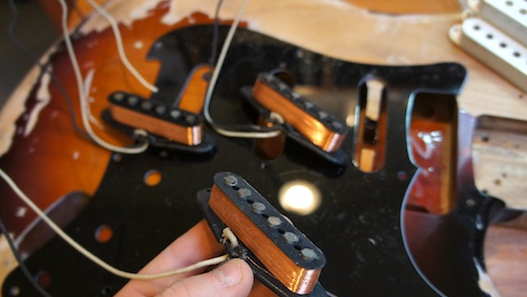
A few years ago, I was in the process of changing the pickups in my two Stratocasters. One, my blonde Squier Vintage Modified (pictured below), was fitted out with custom pickups handmade for me by Rohdan Pickups in the USA. These were made using Alnico III magnets in the neck and middle pups, the same as the very first run of Fender Strats in 1954. The bridge was a mix of Alnico V & II, for better definition, without the harsh trebley bite.

strats

My three Strats, before I sold the red one (top) or changed the pickups in the other two…

For the other guitar, my trusty Mexican HSS Strat (the blue one, pictured above), I only needed replacement neck and middle pickups. I was playing with different groups with less emphasis on heavy rock, and needed something more versatile. I’m still really happy with the Seymour Duncan ’59 humbucker in the bridge (this is usually a Les Paul replacement/upgrade, and has a great tone for classic rock). Having loved the sound of one of my other Strats, a Squier CV, or ‘Classic Vibe’ (Simon Neil signature model, based on a CV 60’s model), I started researching it’s pickups online. I thought I might get an idea of where to look for similar-sounding pups to install in my Mexican Strat. However, in my search, I happened upon an interesting, and ultimately money-saving, discovery…

Tonerider Pickups

Tonerider make replacement pickup sets for Strats and Teles. They appear to operate out of Squier’s main factory and sound as similar to the pickups used in Squier’s Classic Vibe guitar range as to lead most people to believe they are the stock pups built into the instrument.

An excellent article by Tidy Words seemed to confirm what many Squier players had long suspected, and which Tonerider set was (allegedly!) being used in which guitar:

  • CV 50’s Strat – Tonerider Surfaris
  • CV 60’s Strat – Tonerider Classic Blues
  • CV signature Strat (Simon Neil signature, etc) – Tonerider Vintage Classics

For full details, you can see the full article here.

tonerider

Picture courtesy of Worth Point.

However, this only appears true for Squier Classic Vibe guitars made before 2019 in China

According to Fuzz Faced, Squire CV production tool place in the Grand Reward factory, based in the Guang Dong province of Southern China. Tonerider pickups were made in the same factory, leading to the noticeable similarities in construction and sound between their pickups and the stock CV ones.

Squire moved production of the Classic Vibe range to Indonesia in 2019, as a means of lowering costs and avoiding US import tarrifs on goods manufactured in China. As a result, these newer guitars are no longer made in the same factory as Tonerider pickups. So what might have been true of a pre-2019 CV is much less likely now.

However, the sound of a CV 50s Strat made in China is the same is one made in Indonesia. Their pickup voicings remain almost identical to models of Tonerider pickup available.

The takeaway message…

If you have a Squire Classic Vibe guitar, don’t rush to upgrade it with Tonerider pickups. They are, for all intents and purposes, already in there! And frankly, if you’ve bought a CV guitar to get the overall ‘vibe’ of a certain era in Fender’s history, the stock (Tonerider-sounding) pickups do a great job, and don’t need replacing in the first place! These guitars are well built and in terms of sound, playability and build quality, give the ‘real’ Fenders a run for their money – at a fraction of the price!

On the other hand, if you like the Strat you have, but it’s not from the Classic Vibe range, and want to improve the pickups, you could do a lot worse than the Tonerider range. Check out their full range of Strat pickups here.

How did it work out for me?

I bought a City Limits single coil set from Tonerider for the Mexican HSS Strat. These use Alnico V magnets, and are aiming for the ‘Texas Blues’ sound Fender Strats do so well – think ‘SRV’ and you’ll have a fairly good idea what I mean.

city-limits-new

Picture courtesy of Tonerider.com

These pickups worked brilliantly for blues, rock, funk, jazz and everything else I threw at it. However, I found the difference between the sound of my two Strats to be an issue (as one guitar serves as backup for the other onstage), so I switched the bridge pickup to a more original-sounding single-coil, and decided to put in a new, fully balanced set. Having grown to prefer the sound of my blonde Strat, I opted for Tonerider’s Alnico-3 Surfari set. I also made the ‘tele mod’, making it possible to select the bridge and neck pickups at the same time. Now I have that wonderfully airy but funky Telecaster sound, making for a very versatile guitar which pairs much better with my blonde Strat.

I hope this has been helpful, and clears up any misunderstanding about the Squier CV range. As always let me know your thoughts, and good luck in your buying choices!