
You’ve probably played a Cort guitar before, without even realising it.
The Korean firm is one of the largest guitar building companies in the world. Yet most of their operations are to serve as contractors, building the lower-budget guitars of several major brands over the last few decades, including Ibanez, Squier, Schecter, PRS, Musicman and G&L, to name but a few.
So guitars sold under their own name should be treated with respect, considering the expertise and resources behind their creation. Their CJ range of acoustic guitars are a good value alternative for players on a tighter budget and offer high quality instruments at a more than reasonable price.
For me, I need a guitar I can take out to live shows that will perform without me feeling anxious about it getting damaged. My Taylor acoustic’s endpin jack is coming loose again, despite several attempts at repairing this issue (never, ever buy a guitar where the jack input is part of the strap button – in my experience, it pays to keep these two important elements separate), so I have taken the decision to retire this guitar from regular gigging. I found the CJ Retro available on sale and loved the vintage aesthetic, and here we are…

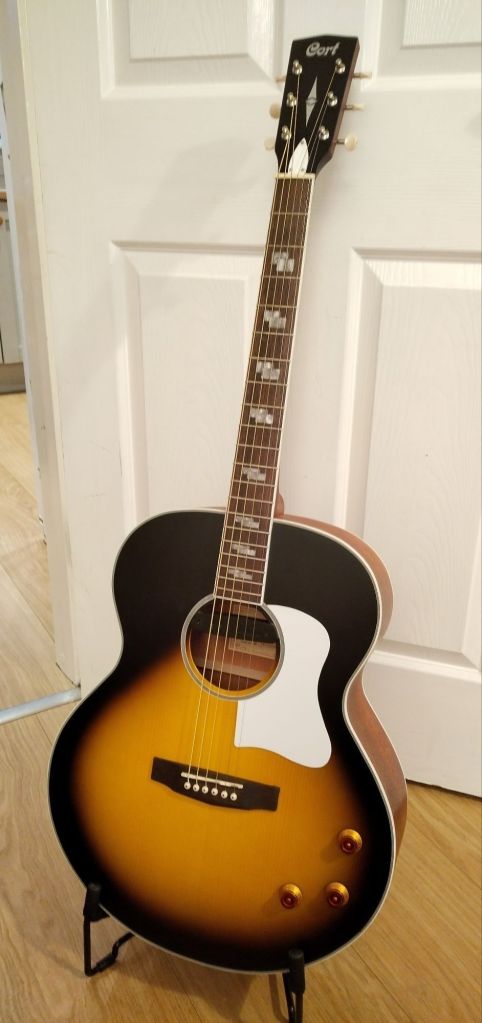
The CJ Retro seems designed to put you roughly in mind of the Gibson J-160E acoustics famously played by John Lennon and George Harrison. Lennon in particular made use of his J-160 throughout his career, and the fact that his guitar was also all-laminate didn’t stop it from becoming the acoustic you hear on countless classic Beatles songs. The CJ is a different shape (a jumbo compared to the J-160E’s dreadnought shape), and with the soundhole-mounted pickup, it also projects a vibe harking back to the earliest days of pickup-equipped guitars (think Charlie Christian).
Specifications & dimensions
The CJ Retro is a jumbo-sized electro acoustic guitar at a budget price. Instead of a solid top, this guitar is constructed entirely out of laminated woods, so the sound won’t mature in the same way as a more expensive acoustic. But laminates have their own positive qualities, being more resistant to the elements than a solid top guitar – useful for regular gigging, especially if you play a lot of outdoor shows.
Here’s the basic specs & dimensions:
- Top: Laminated Spruce
- Back & sides: Laminated Mahogany
- Fretboard & bridge: Merbau
- Nut width: 43mm / 1 & 11/16th in
- Scale length: 648mm / 25.5 in
- Pickup: Fishman® Neo-D Humbucker (over soundhole)
- Electronics: Fishman® VTB EQ passive system (Volume, Treble, Bass)
- Length: 105cm / 41.5 in
- Lower bout: 42cm / 16.5 in
- Upper bout: 32cm / 12.5 in
- Depth: 12.5 cm / 5 in
(all measurements are approximate).
The white double binding is well done and matches the simple single-ply pick guard. The off-white tuning pegs (attached to open gears on the back of the 3-a-side headstock) compliment the vintage feel of the matte sunburst finish and dual, overlapping rectangle position markers.
You can read the full blurb and specs on the Cort Guitars website.
First impressions
This is a loud guitar that projects well. The new set of strings which the guitar came with still have that treble-heavy ‘zing’ that needs playing out, but this all-laminate jumbo box certainly moves the airwaves.
It feels comfortable to play. The matte finish feels like the satin fimish found on some electric guitar necks and invites fluid movement. The neck shape itself feels comfortable and the frets have been well finished (no sharp edges here).
One thing I hadn’t noticed prior to purchase was the lack of a second strap button, meaning one end of the strap would have to be strung around the headstock. However, installing a second button on the treble side of the neck joint (with a small amount of careful drilling) allowed me to attach the strap here. This meant that playing felt a little more naturally ergonomic for me when standing up.


Sounds & playability
This really is one of the loudest acoustic guitars I’ve ever played. The combination of it’s jumbo size and the bright strings make for an instrument that cries out to be strummed, whether it’s big open chords or comping more complex jazz voicings. The strings are well balanced and all notes ring clear. This remains the case when fingerpicking, which sounds wonderful on this guitar. For single line playing, the Cort offers a midrange bite that’s perfect for bluesy leads (think acoustic Clapton).
Plugged in, the guitar’s acoustic ‘zing’ is a little muted but still present. Through a PA, this guitar sounds a little boxy, like the archtops of the 30s and 40s, which is a result of the position of the pickup (as opposed to the traditional place, inside the guitar, under the bridge). The treble and bass controls have a wide range and do a good job of rounding this out, although it took me little experimentation to tune my ears into the sound I wanted.
Final verdict
I didn’t need to worry too much about onstage monitoring with this guitar, as it is more than loud enough for me to hear it live acoustically while playing. The Cort has performed admirably at several shows already, and recieved compliments for it’s appearance and sound.
My main gripe is the difference in sound between the guitar’s natural acoustic tone and the pickup. Although this served as an advantage when I took it along to a recent studio date. At the overdubs session in question, I used the CJ to add a solo and harmonies to a song with a laid back, country rock feel. Here, the neutral sounding plugged-in tone of this guitar provided the engineer and producer with a natural sonic base they can shape and sculpt to fit the sound they’re looking for.
Overall, there could be improvements, but at this price, there’s little to complain about. The build quality is exceptional and I now have a guitar I am happy to take out to shows of all shapes and sizes.
Seek one out and see for yourself.


 Tim Higgins, Guitarist
You must be logged in to post a comment.