I an article earlier this year, I weighed-up which two guitars in my collection would be the ultimate top two – the two I could take along to any gig any be comfortable they would cover (almost) any style of music being played. This is especially useful for me at studio dates, where surprise requests can often occur, and I don’t usually have capacity to take my entire guitar collection along to every session!
In the end, after examining different types of guitar (differentiated largely by their pickups), I concluded that – for me – one of my Stratocasters and a p90-type guitar (in my case this Gould Stormbird) made a winning combination in terms of tones and range of genres. With these two, I could cover everything from jazz and funk to classic rock and noisy indie, and everything in-between.
But what if you could only take one guitar out? Which one would it be?
In the original post, I sang the praises of the 335-type guitar, which only just missed out on making it into the ‘top two’. I love my own 335 copy, but I felt more confident taking a Strat to a gig with multiple (or unknown) genres on the go, mainly because the single-pickup solid body cleans up better, is far less prone to feedback onstage (especially when playing heavier styles), and offers more tonal options. Also, I think the fact that I’ve played Strats since I was sixteen likely played a part in my thought process. I sometimes take a job where I don’t know exactly what I’ll be asked to play until I arrive, so familiarity with an instrument I trust is crucial.
However, I might have been a little unfair to the 335, and feel like I’ve changed my opinion in the last few months. I’ve certainly been using one as my main guitar for 80% of my gigs this year so far, and it performed perfectly at my most recent studio bookings – but would I be happy with it as my only guitar for any gig?
Let’s look at the three types of guitar by pickup type again, with a summary of what I use them for, as well as a few examples of where I use them professionally.
Single-coil solid body guitars (Strat, Tele, Danelectro, etc)
Classic guitar tones – bright and clear with lots of twang or spank to their sound Sound great overdriven, but retain some of their original character Sit well in a mix with other instruments/guitars Reliable, solid instruments which are easy to mod Perfect for: pop, funk, country, blues, rock, indie Can be noisy, especially in high-gain settings
P90 solid body guitars (Stormbird, Some PRS models, some Teles, etc)
Beefed-up version of a classic single-coil sound Beautifully warm, yet still clear, distorted sound Great ‘best of both worlds’ between a single-coil and humbucking pickup Covers most styles (but volume has to be rolled back slightly for cleaner sounds) Can be very noisy in certain settings
Humbucker solid body guitars (Les Paul, SG, PRS)
The classic overdriven guitar sound, warm but aggressive Warm, full sound for jazz (with the volume rolled back a little) Perfect for: Rock of all types, jazz and blues Not as good as single-coils for those iconic glassy clean sounds
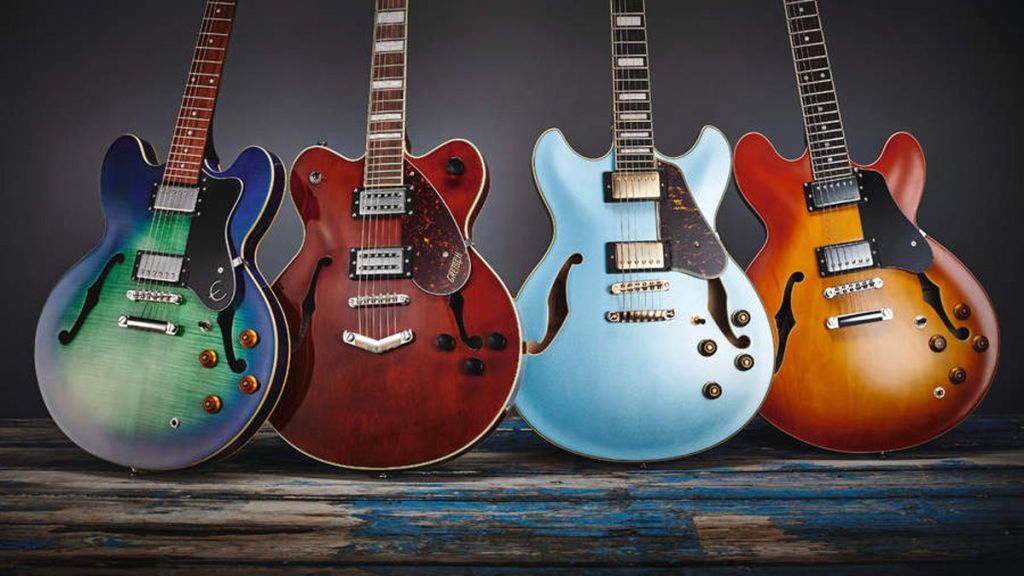
A humbucking guitar with a slightly airier sound Lighter than a Les Paul (to save your poor back!) Capable to playing most styles imaginable Perfect for: jazz, funk, soul, blues, classic rock Neck & Bridge pickups together gives a wonderful funk tone Prone to feedback onstage, especially in higher-gain settings
Picture credit: Music Radar
Final thoughts
Which would I choose? I still couldn’t say for certain. It depends so much on the gig in question, but if I wasn’t sure what I was going to asked to play, I expect it would be the Strat or the 335 I’d be reaching for. I guess it comes down to a choice between a solid body or (semi) hollow bodied guitar; whether I’m seeking the thicker snap of the Strat, or the airier sound of the 335.
And of course, bear in mind that we’ve only been discussing electric guitar options here – if I was really unsure about the requirements for a studio date, I’d have an acoustic packed into the car too!
But what about you? Obviously, what works for me doesn’t necessarily work for everyone, which is why I’d love to hear your thoughts – get in touch!
When looking up reviews if new guitars, I often come across the acronym GAS, or Gear Acquisition Syndrome. This humorous shorthand phrase sums up the seemingly inante drive in many guitarists to buy more equipment, from amps and effects pedals to, of course, guitars.
But how many guitars do we really need? Can one setup (be that one guitar, plus a backup, or two guitars used equally) be used in a wide variety of styles and genres?
For many guitarists working in more than one band, this feels like an impossible question – perhaps only slightly easier to answer than asking what one guitar would easily cover all bases for every type of gig you play?
Let’s work on the assumption that most players cross genres in one way or another, and begin with a few opening questions…
How many different genres do you play? And how varied are they?
If you only play one style of rock, metal or punk, then this might be quite simple. Similarly, if you rarely stray out of jazz or soul, you likely have couple of guitars which provide all the sounds and textures you are looking for, and fit the sound of your groups quite well. But what if you’re expected to hop from one extreme to another on different gigs – or even (such as some cruise ship or theatre pit musician gigs) in the course of one gig? Do your guitars cover as many options as possible?
Which guitars in your collection are the most practical?
For most of us, stage space is at a premium, so it’s unreasonable (and widely impractical) to bring four or five guitars to an average show.
Most of the working musicians I know (myself included) soon find themselves reaching for the same two or three guitars in their armoury, confident that these instruments deliver the goods time and again at any gig they bring it to. These instruments are usually well set up and hold their tune reliably, and are often not the most expensive or luxurious instrument option. As lovely as that vintage jazz hollow-body from the 1930s is, it only really does one sound well, and the rest of the time would be sitting there waiting to get knocked over and damaged beyond repair! (it probably feeds back like no one’s business in a live setting, too!)
To sum up, a few questions to consider…
Could this guitar play an entire show?
Is it reliable & comfortable enough to play for long periods of time?
Am I crippled with fear of it getting damaged?
These are the factors we have consider in making a choice such as this. Now let’s look at some of the obvious contenders…
Single-coil guitars (e.g., Stratocaster or Telecaster)
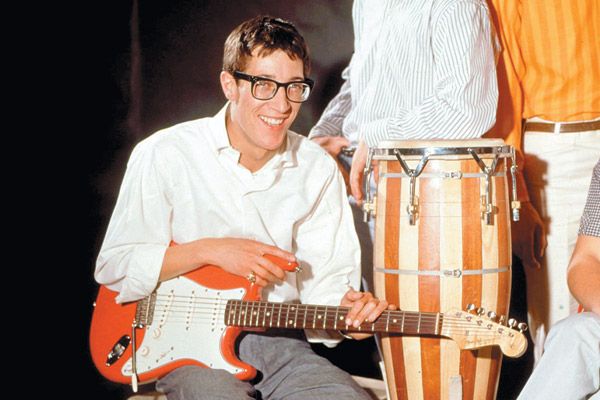
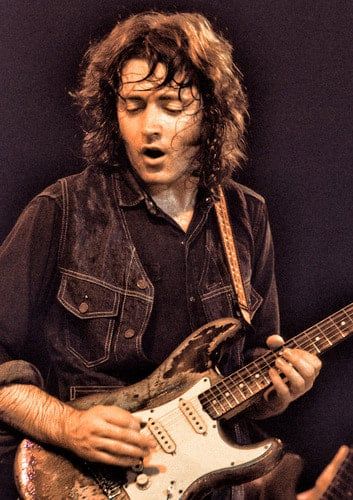
Generally the lowest output pickups (although there’s a world of variations out there), single-coils have been fitted as standard on Fender Stratocasters and Telecasters since they first appeared on the market in the early 1950s. Played clean, these have a wonderful clear sound, and with a little push from the amp or overdrive pedals, breakup beautifully. They aren’t best suited to heavier styles of music, but they perform brilliantly in almost everything else. Think of Buddy Holly and Hank Marvin inspiring millions of future guitar players with the original Strats, as well as the countless players who pushed the instrument beyond expectations such as Jimi Hendrix. For blues, look at Buddy Guy’s searing attack or Stevie Ray Vaughn’s much-too-imitated blues sound (pushing the neck pickup of his Strats through a Tubescreamer pedal)…
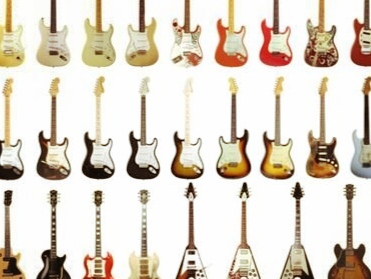
Some of the Strat players who have left a significant influence on how we approach the electric guitar. All of them finding their unique voice on the same instrument (Clockwise from top right: Hank Marvin, Buddy Guy, Nile Rogers, Stevie Ray Vaughan, Mark Knopfler, Rory Gallagher, Jimi Hendrix, Buddy Holly)
Telecasters have had a similarly lasting effect on music history, from the early country musicians and Dylan ‘going electric’ with one in 1965, to it’s emergence as a reliable solid body jazz instrument and the soulful stylings of Stax and Blues Brothers legend Steve Cropper. And let’s not forget that the Telecaster was often the unsung hero in the studio, used on more sessions and hit records than you might imagine – Jimmy Page used one to record pretty much all of Led Zeppelin’s debut album!
Of course, there are far more than Strats and Teles in the world of single-coil guitars. Danelectro make use of their unique ‘lipstick’ pickups, as well as all the weird and wonderful guitars which came out of Japan and Eastern Europe during the 1960s and 1970s. But the guitars made by Fender were by far the market leaders this area, and even if it’s not a Strat or Tele on that record you love, if it’s a single-coil sound, it’s most likely inspired by one.
I’ve been a Stratocaster player since I was sixteen years old, using them for everything from funk & soul to classic rock, with loads of blues and indie-rock in-between. It’s hard to keep count, but I’ve probably had at least ten different Strats in my possession (not all at the same time, I hasten to add!), and I keep coming back to them for a number of reasons, but that clear single-coil sound is chief amongst them.
Both of my current Strats are fitted with alnico iii (3) magnets, like the very first Strats produced in 1954 (although they soon switched to Alnico V and have stuck with them ever since). The 3’s are slightly lower output and vintage sounding, breaking up nicely through a slightly driven amp, and still retaining crisp clarity when paired with a classic Marshall overdrive sound. One of them (the orange one, above right) also features a button to engage the neck and bridge pickups at the same time, giving me the so-called Tele mod, and allowing me the sounds of both guitars in one. A lot of my function gigs in recent have involved numerous switches in musical style, and these two guitars do a great job of handing whatever I throw at them.
Humbucking guitars (e.g., Les Paul, SG, 335)
Humbuckers are, in essence, two single-coils wound together. The two magnets combined create a higher output sound, and their opposing polarity cancels out the 60-cycle hum which occurs in single-magnet pickups, hence the name hum-bucker. These two factors make humbuckers ideal for heaver guitar sounds, from classic rock to metal and beyond. The original humbuckers tended o sound a little ‘dark’ at lower gain settings, but this (along with their inherent noise-cancelling properties) made them an ideal choice for jazz guitarists, and they remain so to this day.
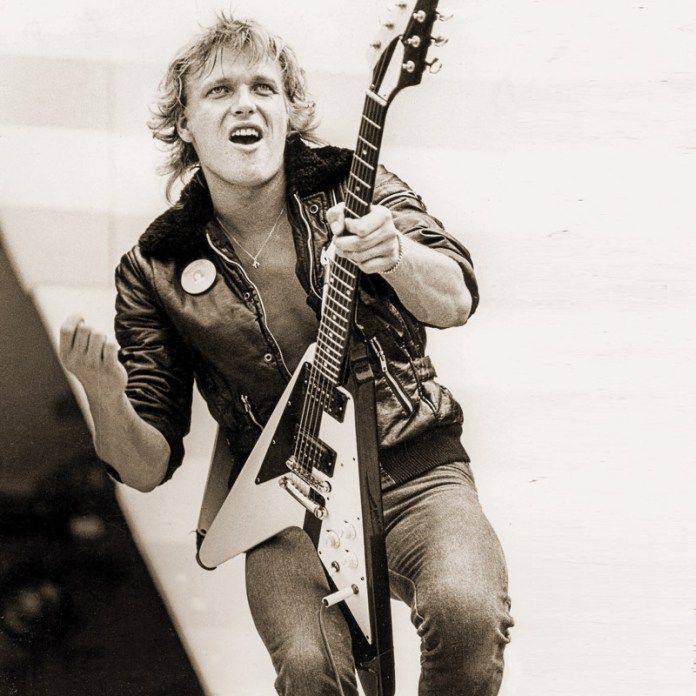
Examples of different guitarists who have used humbucking guitars in a wide array of genres, from jazz & blues to metal & avant-garde (Clockwise from top right: BB King, Frank Zappa, Michael Schenker, Billy Gibbons, Peter Green, Wes Montgomery)
Semi-hollow guitars (such as the 335 style Harley Benton, below left) offer a great hybrid for playing jazz, funk and soul, as well as dirtier blues, rock, pop and indie.
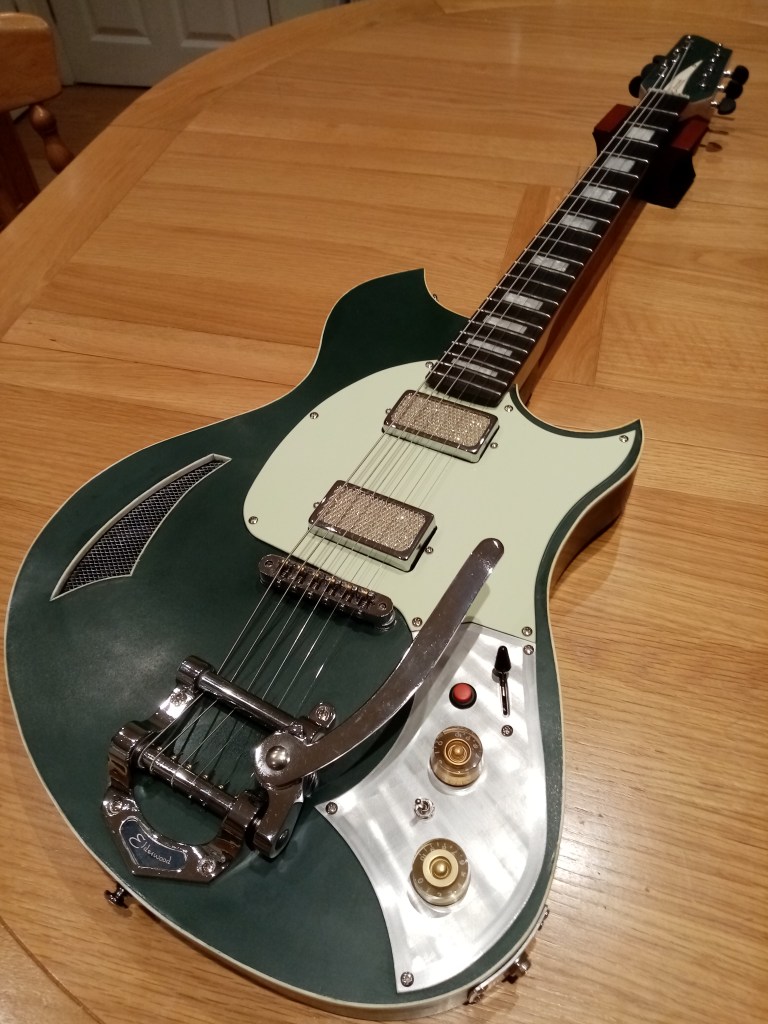
Both of my humbucker-equipped guitars (the Harley Benton and my custom Elderwood, above right), have the option to split the coils, giving a single-coil sound when needed. This is a really useful option, although the split sound is a little too ‘thin’ sounding to use too often; sometimes it’s better to wind back the volume slight on a full humbucker, or find a pickup that’s a good halfway point between a single-coil and humbuckng pickup…
P90 guitars
P90s sit somewhere between the clarity of a single-coil and the power of a humbucker, meaning that they can be a useful cover-all option for gigs that require both heavier and gentler sounds. With careful listening and judicious use of the volume control, you should have the full gamut of sounds available. It’s also worth noting that quite a lot of the classic pop & rock music you love was in fact recorded with p90-equiped guitars – although that’s a story for another time…
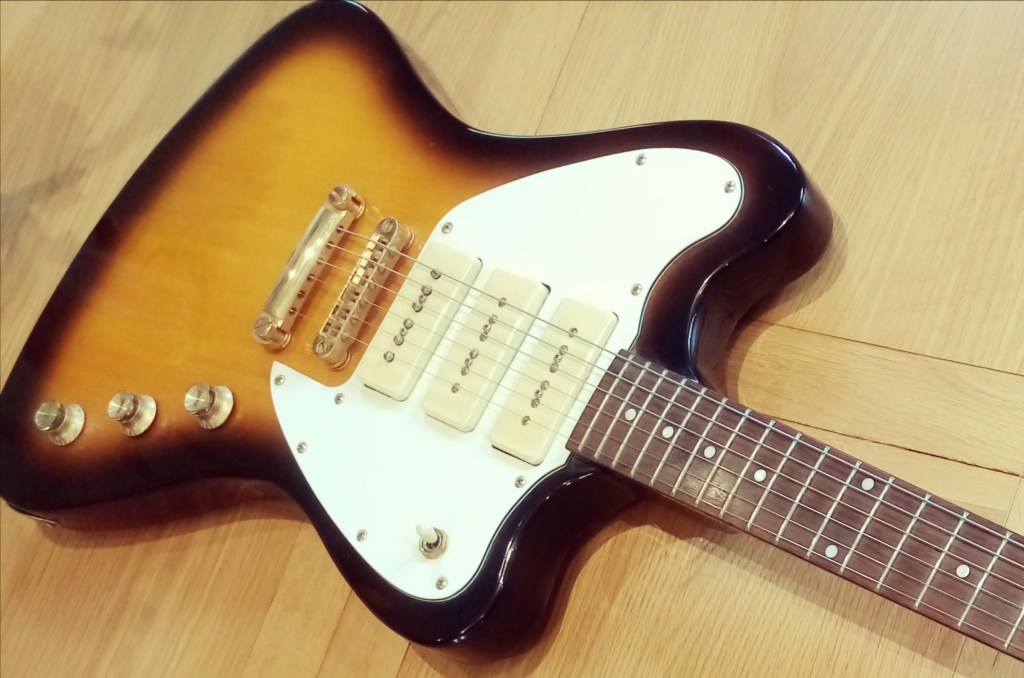
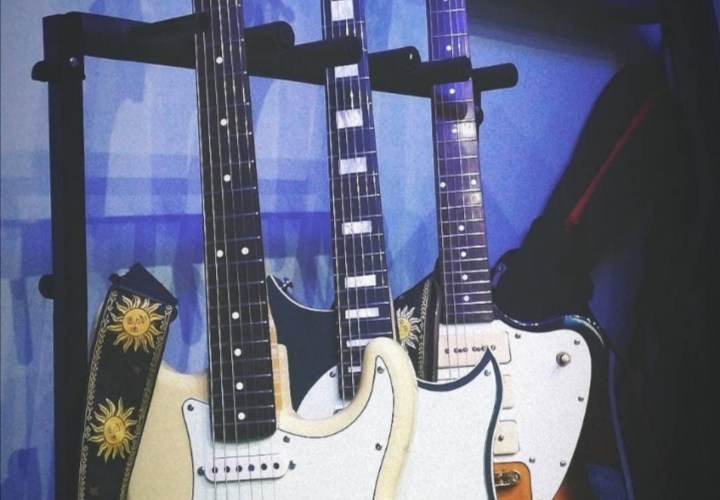
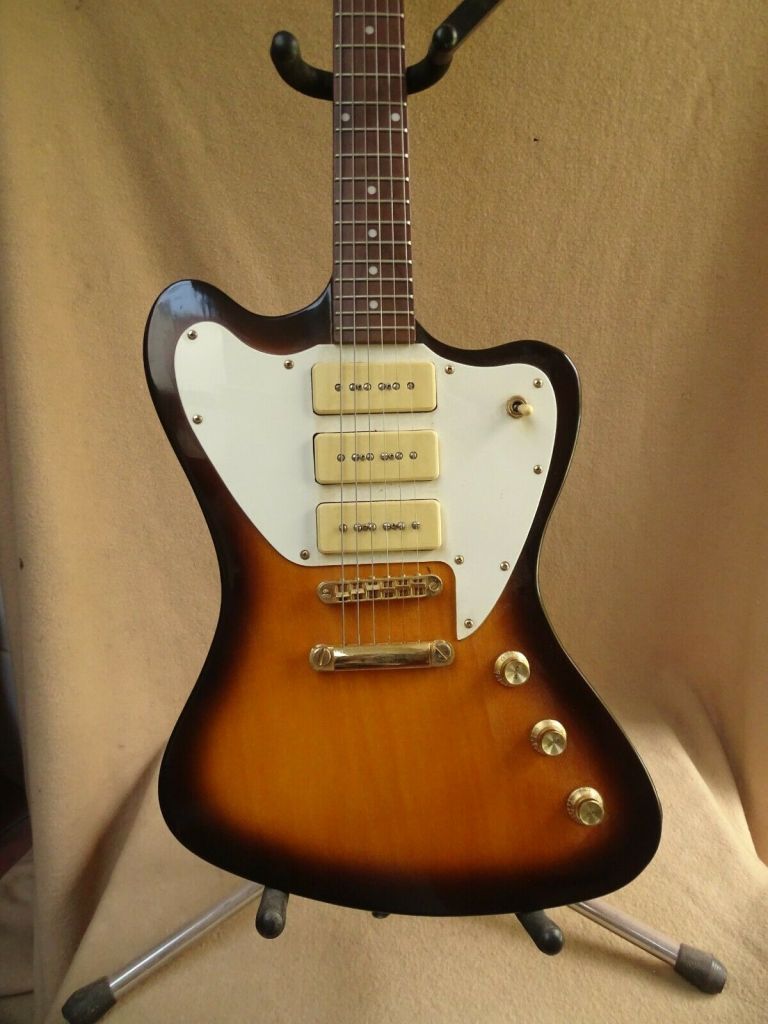
I have a triple p90 Gould Stormbird (a copy of a non-reverse Firebird with Entwhistle pickup) which acts as my main guitar for one of my original projects (dirty psychedelic funk), as well as the backup to my Strats and humbucking guitars, at a range of shows. These pickups clean up wonderfully and can produce enough grit for the styles of music I regularly play.
Gould Stormbird, based on a Gibson non-reverse Firebird, with three p90 pickups
One of the main drawbacks to a p90 is that they can be quite noisy, even more so than with single-coil pickups, due to their increased output. This is especially apparent in venues with lots of mixed lighting circuits (such as stage lights with timers and dimmers), so you have to be ready to mute your sound between songs. Is it worth it? In my opinion, yes. I currently only have one p90 guitar, and it’s become so essential to my rig that I need to look at getting another p90 guitar to act as a spare in case anything goes wrong with this one…
So what are my ultimate two?
Let me start by saying I think every guitarist should at least try out a 335-style guitar. They are incredibly versatile and comfortable instruments, capable of covering a wide range of bases. If I was ever in the position where I could only take one guitar to a session (be it live or in the studio), I think a 335 (or in my case, the HB-35 Plus) would be my safest bet.
However, in terms of covering the most styles possible while remaining comfortable and reliable, I would choose one of my Strats and the p90-loaded Gould. Between these two guitars, I can go from clean to quite heavy, with a high degree of note clarity, and little (if any) risk of onstage feedback. Both axes are well built and well setup solid bodied instruments that rarely present any issues while working. Although I’m sure I’d find myself missing the 335 before too long…
Final thoughts
Of course, these are my opinions, based on my own experience and current work. As always, I’d love to hear from you – what two guitars would you take out as your cover-all-bases setup?
I’ve noticed a few decent-looking guitars going for sale on eBay recently. In the past, I’ve picked up a few great instruments and amps, including the Strat which was my main touring guitar for a decade, as well as two Fender Mustang floor units, which I use for live work most of the time nowadays. However, buying something online, especially a musical instrument you haven’t played, or even held, can be a risky business. I therefore try to set an ‘absolute maximum’ price which I won’t go over. This is price is normally quite low, meaning I should be able to at least earn a small profit on any guitars I decide to move on – but it does mean I’m not usually the ‘winning bidder’ when interesting pieces catch my attention.
That is, until I saw this gem…
What is it?
This guitar is modeled on the Gibson non-reverse Firebird III, one of Gibson’s early forays into the offset market, only flipping the body to be a mirror image of the shape in the above picture, hence the term reverse. From 1965 to 1969, Gibson offered a non-reverse version, in a much more Jazzmaster style shape. The ‘III’ in the name is a reference to the guitar having three P90 pickups, unlike the two mini humbuckers on previous Firebird models. Because these non-reverse bodied, three pickup guitars were only available for around four years, they are considered highly collectible and even ones in poor condition go for thousands of pounds.
However, I knew from the price I paid for it alone that this guitar was not a real Gibson. Once it had been delivered, it was clear that the ‘Gibson’ logo on the headstock is actually a decal, added after the original purchase (although some of these copies were actually supplied with stickers such as this, or alternative truss rod covers that read ‘Gibson’, so perhaps it came with the instrument). An original Gibson of this style from the mid to late sixties would have looked slightly different, too – chrome hardware, black pickup covers and probably a Firebird decal somewhere on the pickguard. But I have to say, I quite like the gold hardware, and I’ve always preferred cream/aged white pickup covers, especially on retro-styled guitars such as these.
So who made it?
In my initial research, the Japanese manufacturer Tokai looked the most likely suspect. Tokai, along with Ibanez, were famous for their ‘lawsuit guitars’ in the seventies; the lawsuit occurred because they were making better Les Pauls than Gibson were (the 70s saw huge reductions in quality from both Gibson and Fender guitars, making the Japanese rip-offs much more appealing, and better value). Tokai have certainly released their own take on the Firebird design, but after a little more digging, I discovered that this model is the GouldStormbird. The almost completely unknown Gould brand are seemingly British-based, but put together in China, probably in the early 2000s, and possibly feature the talents of UK pickup legend Alan Entwistle behind the scenes. Very promising…
Is it any good?
Heck, yes. It sounds amazing, and reinforces my belief that sometimes, one is merely paying extra money for the right name on the headstock. This guitar plays really well, hangs nicely on a strap and has a good vintage-feel neck (i.e., it’s thicker than many modern guitars). The guitar’s budget P90 pickups sound as good as any other I have played, and the control layout of three-way toggle switch (neck / neck & bridge / bridge), shared volume for neck & bridge pickup, plus a separate volume control for the middle P90, allows for seven different pickup configurations, all of which can be tweaked by how you decide to blend pickups together. The master tone control appears to taper smoothly as well – rare for what is clearly a budget guitar. P90s sit somewhere between humbuckers and single-coil pickups in terms of output and ‘beefiness’, and I certainly get a ‘Strat on steroids’ vibe from this guitar. I love the sound of this guitar played clean, through a Fender Deluxe or Twin Reverb style amp as well as a more retro-styled dirty sound – a Fender Bass man plus a vintage tremelo effect sounded wonderfully evocative…
Could this instrument become my main guitar for soul work, replacing my main all-rounder, my vintage-voiced blonde Stratocaster?
There was one slight fault. The frets don’t seem to be the best quality, and a few were coming away slightly, causing bends to choke at certain points on the neck. I noticed the same issue might be happening in a few other places, so I sent the guitar off to my tech guy for a partial refret, which thankfully didn’t cost too much. Upon it’s return, the notes all sing beautifully, especially with those P90s…
Three great sounding P90s, giving seven different pickup combinations – and that gorgeous sunburst finish…
Pros and cons
Pros
Great build quality
Amazing triple P90 sound
Gorgeous sunburst finish (and general retro styling)
A really classy twist on the classic Jazzmaster shape
Great copy of an otherwise unattainable guitar
Neutrals
Neck might be too chunky for some (but just right for me)
Cons
Needed a partial refret
Resale value won’t be that high if I decide to sell it on
All in all, I think I’ve grabbed a bargain! Especially from a random purchase on eBay. At least it’ll give me a new toy to play with while I wait for my new custom guitar to be completed (more on that later this year…)
Welcome back to theGreat Guitarists series. We’re continuing along a jazz theme for now, with a sometimes underrated master of understated single line guitar soloing…
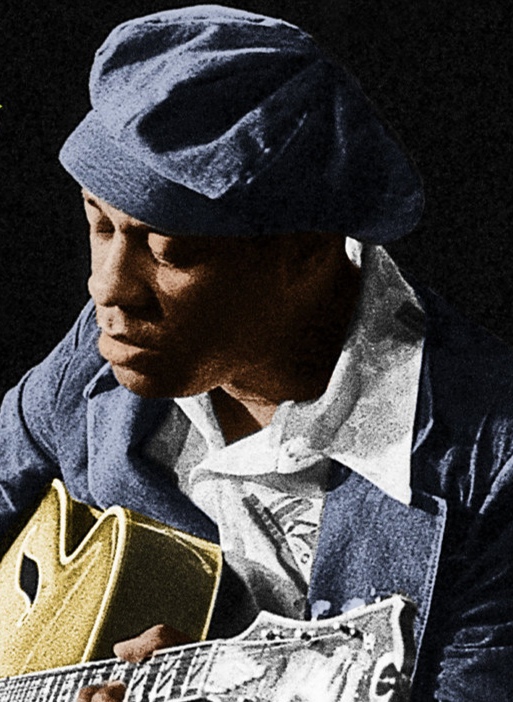
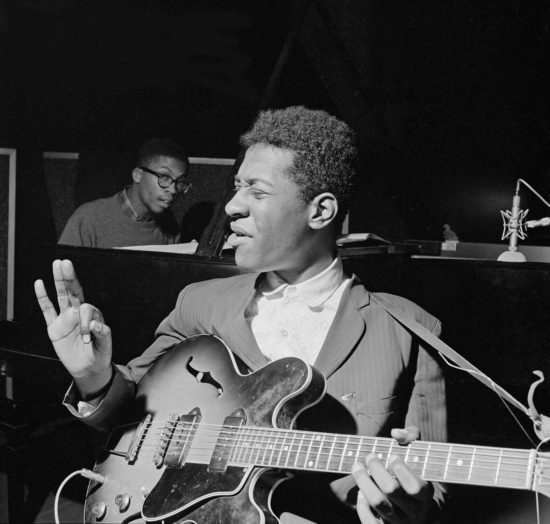
Grant Green
Green was born in St. Louis, Missouri, in 1935, and died in 1979, aged just 43. In his all-too-short career, he played on hundreds of records, including numerous solo titles – almost thirty cuts for Blue Note Records alone. Many of these were played as part of an organ trio (organ, guitar, drums) in a style known as Soul Jazz. This style was sometimes sniffed at by jazz purists, but has since gone on to be something of a cherished gem, and ripe pickings for sampling, especially in hip ho and acid jazz (Read Jorge Cervera’s defence of Grant Green and soul jazz here).
Although less well known than some of his contemporaries, such as Wes Montgomery, his friend George Benson and his main guitar influence Charlie Christian, Green nonetheless possessed a highly recognisable guitar sound, which can be heard in the playing of many guitarists today, myself included. Indeed, his mix of blues, soul and hard bop licks over a funky back beat has become the quintessential sound of upbeat jazz guitar playing.
Equipment and guitar sound
Green most famously used a Gibson ES-330, which is essentially the same shape as the brand’s better-known 335, but with P90 single coil pickups (not unlike an Epiphone Casino). Later on in his career, he played a Gibson L7, Epiphone Emperor and custom-made D’Aquisto guitars, all of which featured similar P90 style pickups. This type of pickup was one of the first kinds added to hollowbody guitars, and Green obviously enjoyed the full, clear sound they provided.
Interestingly, for a guitar player known for his fluid single line style, Green was known to roll the treble and bass entirely off on his amplifiers, to better emphasise the midrange for more bite and attack in his tone – try it with a P90 neck pickup, and see if you can recreate Green’s sound!
Essential listening
Idle Moments (1963) is a great place to start. It’s a slow, contemplative masterclass in cool jazz guitar,and one of my favourite jazz guitar records, along with Midnight Blue by Kenny Burrell (more about that here).
There’s a couple of good options for live cuts, but the recently released collection Funk in France, From Paris to Antibes (1969-1970) (2018, Resonance) captures Green at his best. A few of the tracks see the trio lineup complimented by none other than the legendary Barney Kessel, which makes it essential listening for me!
It’s also worth seeking out some of Greenvs funkier efforts, such as… He also made an interesting album of Latin music (The Latin Bit from 1963, on Blue Note again), in which the main theme (the ‘heads’) were played in the usual samba or bossa nova style, but the solos are swung – give it a listen and make of it what you will!
As a sideman, he played on hundreds of recording sessions. Among my personal favourites are Herbie Hancock’s My Point Of View (1963, Blue Note) and Art Blakey’s Hold On I’m Coming (1966, Limelight). However, each record in Green’s expansive discography features great playing and lead lines that we guitarists would benefit from adding to our repertoire!
Just as Green (and countless other great jazz guitarists) did with Charlie Christian’s recordings, listen, learn, then find a way of making it your own…











 Tim Higgins, Guitarist
You must be logged in to post a comment.