High Sun burns the blooms
Midsomer passes in heat
Giving. And taking.

High Sun burns the blooms
Midsomer passes in heat
Giving. And taking.

Cow Parsley grown tall
Scent of roadside wild garlic
Drowned Spring yields lush greens
…at least, this has certainly been the case here in Northumberland. Here, an incredibly wet April and May have finally given way to a gloriously hot and sunny June.
Both the cultivated and wild plant life have all responded well. I have even heard one keen gardener tell me that his Himalayan Blue Poppy has flowered for the first time in thirty years! Clearly this is the combination of months of rain to sunshine it requires!
What are your garden stories? Leave a comment or drop me a message. Until next time…

Snow on the Dyke-backs
Prophesying its return
And see, it comes now
For those who might not know, the dyke-backs are the sides of the short hills or ditches which, in winter, never get direct sunlight. As a result, snow takes longer to melt on these small sections of Northumbrian landscape. Around here, is taken almost as a given that seeing the snow remain on the dyke-backs, when it has melted everywhere else, means that it will likely snow again before the weather improves and the world gets warmer on it’s path towards the spring.
And while it stays cold, the frost can do strangely wonderful feats to your car…
Frosting cold and white
Nature’s stencil on metal
Accidental art

Heather on the hill
No sound but the radio
Cows amongst the green

At the weekend, we went up to Hareshaw Lin in Bellingham for a walk. It was lovely exploring this northwestern corner of Northumberland, following the short walk (less than two miles), along the ruins of a former iron foundry on the North River Tyne, to a waterfall (the Lin, in Old English). On our route, we noticed something unusual…
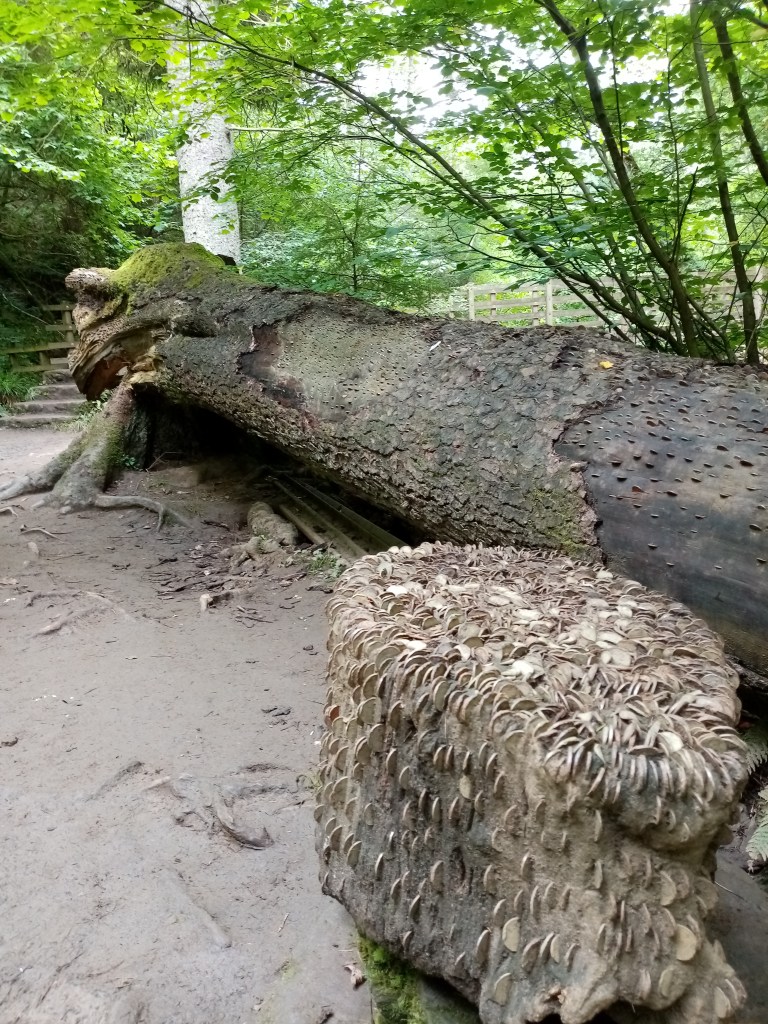
Hundreds of coins inserted into the small slits of the bark of fallen trees. I noticed it in a few sidelong tree stumps, but it was most obvious on this large fallen tree and nearby stump (see above). I have no idea why this tradition started, but some of the coins look very well weathered, and I expect have been there for several years.
The waterfall itself was beautiful, a small oasis of it’s own within the woods (see below). Several younger people were diving into the pool at it’s base. Judging by how long it took them to resurface after diving, it must be quite deep in it’s centre, although there appears to be a lip of rocks around the pool’s circumference.
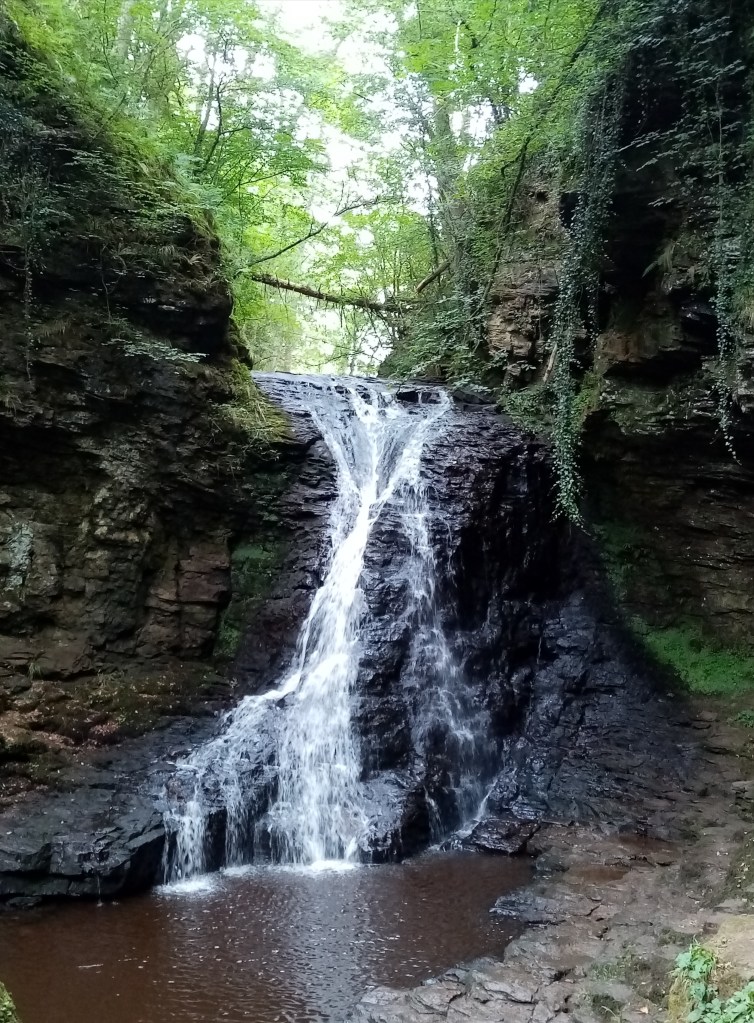
The foundry appears to have been washed away by a flood in the early years of the 20th century, and several more rocks swept downstream in a further flood in the 1960’s. The large stones which remain (many were taken to be used for local buildings) jut out the water to create numerous miniature weirs alongside our walking route. It’s a lovely spot, but was rather busy when we went, possibly because people see it as a good outdoor location in these socially distant times. Still, there are many worse ways to spend a Saturday afternoon…

I once took part in some writing seminars with a local author, who suggested writing a Haiku a day. In their opinion, the short form of this style of poetry (three lines of 5-7-5 syllables) was a great way to practice the distillation of a thought or mood into a very short set of phrases.
Here is one that developed in my mind as I finally roused in the shower:
I’m up for the day
Six A.M. on a weekend
Both children are up
But then I realised that there was no reference to nature, so this is not a Haiku in the classic sense.
The general ‘rules’ for a traditional Haiku are loosely as follows:
I might attempt more Haiku poems in future. I remember finding the exercise useful, even if I am a little out of practice nowadays.
In the meantime, you can learn more about the Haiku form here…

It is said that a walk in the woods is a great way to recharge your mind and revive a weary soul. I think we’ve all needed a little more of that during the last few months.
These two pictures were taken at the weekend, just outside of the market town Hexham, in the county of Northumberland, England. And when I say just outside, I mean less than a ten minute walk from the historic Abbey in the town’s market square – there really isn’t much by way of suburbs here.

The forest is managed; parts of it are felled for paper at the right time, while other sections regrow. This means that the trees are planted roughly in rows, with paths of varying difficulty throughout it’s floor. However, on the day we wandered around, our only companions were the birds flying overhead in the July sun, and the ants busying themselves in and out of the enormous ant hills in the forest.
Access to experiences such as this on my own doorstep are a reminder of how lucky we are in this part of the world, especially during the last four months of lockdown here in the UK. It has certainly helped ease my anxiety and frustration at not being able to move forward with the music projects I had planned for this summer – but more on those soon…

 Tim Higgins, Guitarist
You must be logged in to post a comment.