As well as using Twitter to announce new projects, or update people on ongoing ones, I sometimes reminisce about ones from years ago, such as this one…
For some reason, I kept thinking of this, and on top of everything else I have planned (post-COVID), I’d quite like to explore what a power trio can do in terms of extended instrumentals (which aren’t based largely around improvisation); something more progressive in nature…
Having played in a rock trio format before, it can be a new challenge to fill the space adequately without the music sounding thin. Conversely, one has to avoid the temptation to stick to the more blues based method of sharing riffs, in union (or octaves) with the bass player.
Bear in mind that I currently have…
3 music therapy jobs
A solo classical(ish) EP to finish
Another Nick Gladdish Band album to finish & tour to plan
My next band project (world/blues/Latin) to start rehearsing
A music therapy case study series to complete by the autumn
A small portfolio of compositions to develop
…and we’re still in a time of lockdown here in the UK, with no concrete sign of progress regarding indoor gigs (although the news today implies that this might change very soon).
Still, if you want something doing, ask a busy person, right?
Not many classical guitar players are household names, either worldwide or here in the UK. Andres Segovia might be one, as a pioneer for performance of the instrument in it’s modern form. However, I’d suggest more people have heard of two of his more famous successors on the international performance stage. One is the very well-known Australian guitarist John Williams; the other, Julian Alexander Bream, who we learn has passed away at his Wiltshire home in the early hours of this morning, at the age of 87.
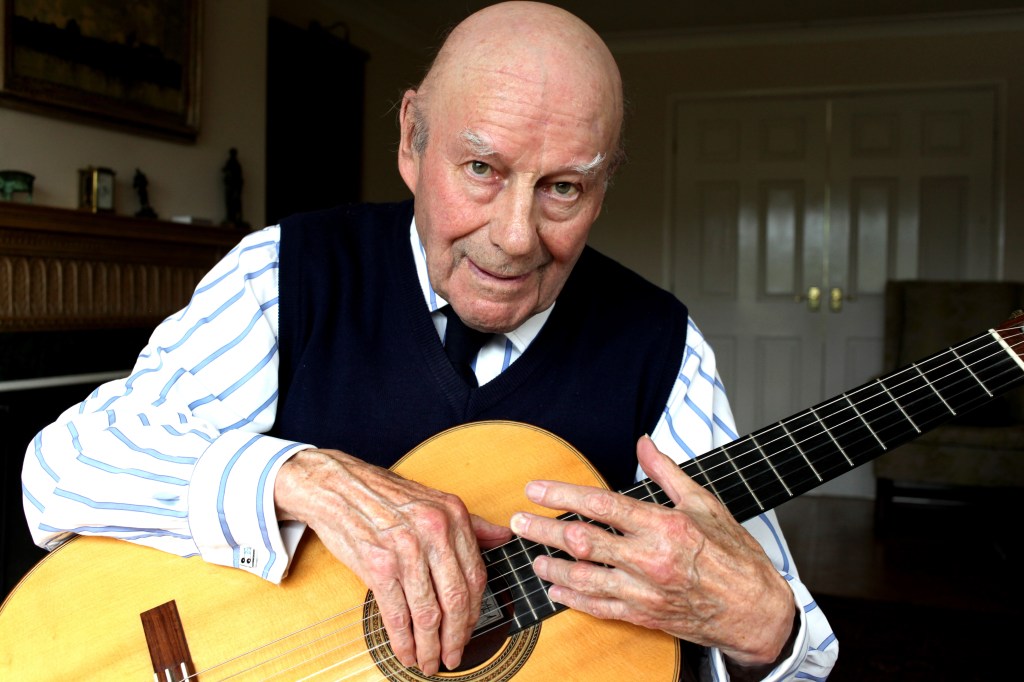
Julian Bream at home, 2014 (Credit: Eamonn McCabe for classicalguitarmagazine.com)
Born in London in 1933, Bream initially learned jazz , influenced by his father’s playing and Django Reinhardt. He was also offered a place at the Royal College of Music, aged just 12 years old, based on his piano playing. He later switched to the lute, and became a great champion for the instrument throughout his life, even as his focus shifted more and more towards classical guitar.
As well as his numerous transcriptions of lute pieces (such as those by Bach or Dowland) for guitar, Bream also performed many of the transcriptions left behind by Segovia, as well as the seminal guitar pieces composed by Francisco Tarrega. Known for his eye for detail, Bream’s virtuosity included an element of flexibility; a key example of this was that he did not maintain a consistent rigid right hand when playing (i.e., held at right angles to the stings), but made use of a more relaxed position, in order to achieve a greater variety in tone. This is something I do as well, because I, like Bream, am multi-genre guitarist. However, having been regularly admonished by my guitar tutor in my youth for holding an ‘improper’ right hand position, it was a relief to learn the one of the instrument’s masters did the same!
As Bream’s reputation increased, he was gifted pieces by composers as varied as “Britten, Walton, Tippett and Hans Werner Henze” (classical-music.com) and performed around the world. He also recorded TV specials, such as a series of four master classes on BBC television in the nineteen seventies, as well as segments for Channel 4 in the nineteen eighties. This no doubt helped him to become a household name for many, but he certainly never rested on his laurels. Even as an ‘elder stateman’ of the guitar, he apparently strove to improve himself. According to an interview given to The Guardian newspaper, Bream believed he was a better guitarist at the age of 70 than ever before!
Essential listening: A great place to start would be his two albums with John Williams, Together (1971) and Together Again (1974). Also, seek out his version of Joaquin Rodrigo’s Concierto de Aranjuez (with it’s famously emotive second movement).
Bream with lute (Credit: Avie Records)
Guitar students would do well to look at his crossovers into other styles, as well as his early lute work too, to get a more rounded picture of a hugely talented player, whose passing leaves a large hole in the classical guitar community.



 Tim Higgins, Guitarist
You must be logged in to post a comment.