As the rain sets in here in the UK, for what looks like a prolonged period, it seems that summer is well and truly over.
The last few months have been pretty busy, so I thought I’d quickly let you in on what I’d been up to…
…aside from the usual, that is
My main working week is still taken up with the music therapy service I provide in a range of settings. Most of my therapy work is with children and young people, and one of the best things about my job is seeing how music helps to communicate feelings which, for some of my clients, can be hard to articulate with words. It makes the more difficult aspects about this work (such as the seemingly endless stream of reports) worthwhile.
Wedding season is coming to an end
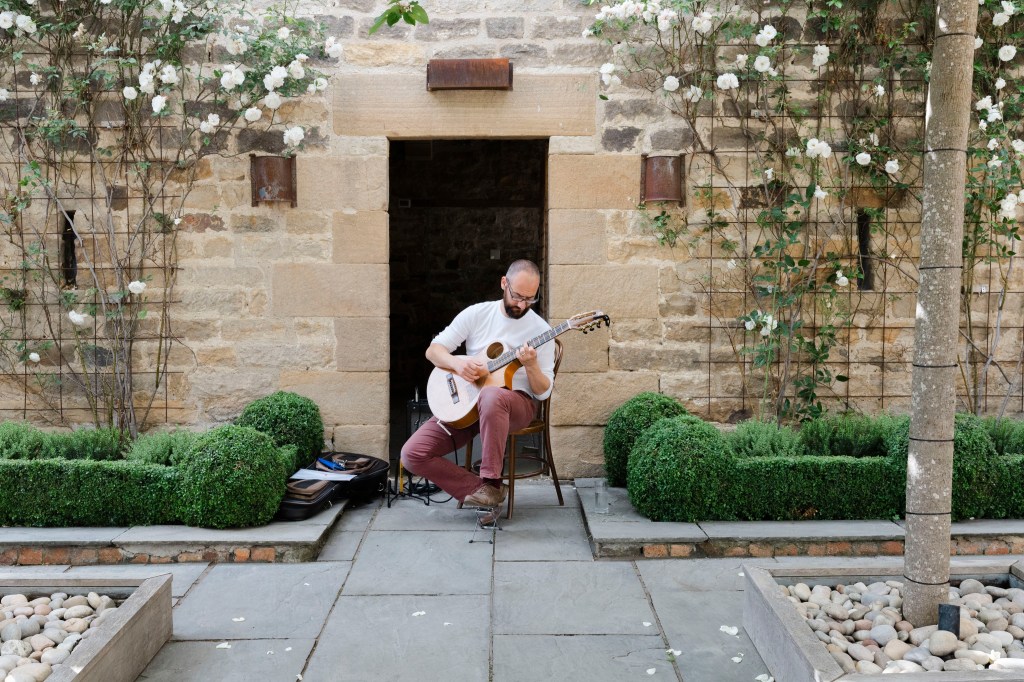
In terms of live music, it is the covers bands that continue to make up majority of my professional output. However, I enjoyed playing more solo guitar gigs, performing at wedding services and receptions.
Credit: Imogenkate Photography (2023).
It’s nice to see this type of work coming back through into my diary again. After Covid, I feared that live classical guitar may have been an expense too far for couples planning their big day, but this summer has thankfully proven my fears to be unfounded. I’ve already got several dates in my diary for 2024 (if you are looking for a solo guitarist for your own big day please get in touch via my contact page).
Nick Gladdish is recording his next LP
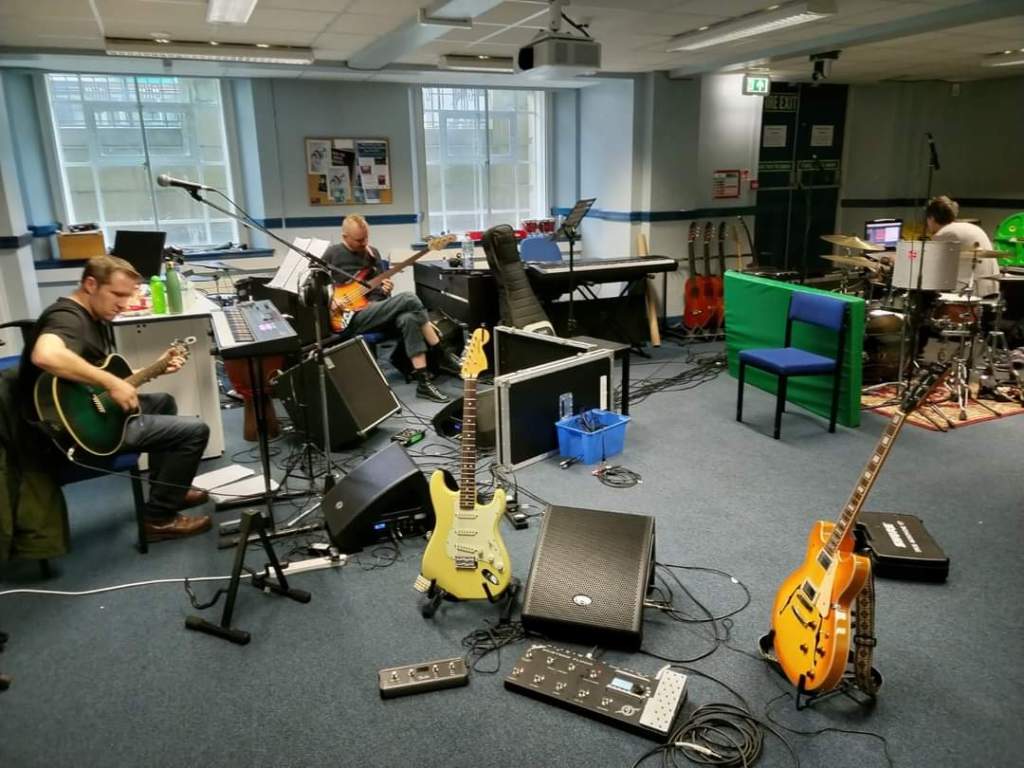
In August, Nick called his usual crew into the studio to lay down baking tracks for his new album, he follow-up to 2021’s Last One Get The Lights. Although we all (Nick included) expected this record to feel like a companion piece to LOGTL, we soon discovered a slightly more rock-orientated edge to the arrangements. This may be a result of the tighter arrangements, as Nick told us he was consciously trying to keep the tunes on this record shorter than his usual fare. With John Timey back in the joint producer/drummer chair, and the brilliant Adam Cornell on bass guitar, this felt like one of the smoothest recording sessions I’ve ever been involved with.
NG Band in-studio.Positive feedback?
The results so far are promising; ten pop-rock songs about love, loss, disillusionment and corruption. I certainly enjoyed writing and layering rhythm guitar tracks. There’s not many guitar solos this time around, but there is some interesting experimentation going on, from drowning out the end of one song in multi-tracked guitar feedback, to a bluesy ukulele solo on the opening track! Next come the overdubs, editing and mastering…
New original project finally ready to launch
Finally, despite various obstacles thrown at me, I am pleased to announce that I have a new original music project about to start performing live. Solcade began as an outlet for music I was writing which didn’t fit anywhere else – too jazzy, bluesy or indeed too varied for many of the ensembles I have been working with.
After recruiting a stable five-piece lineup, the project quickly became much more of a democratic process, and the music is all the better as a result. With each member having an equal credit in writing and arranging, everyone involved has been bringing their ‘A game’ and making some amazing contributions. If you’re a fan of psychedelic funk, Jazz, soul and rythym & blues, then watch this space for upcoming details about our forthcoming debut record (likely scheduled for completion & release in 2025).
We have some live shows coming up in the autumn, too. Follow us on Instagram to hear the latest updates.
But what have you been up to?
Let me know! Also, I’m planning on writing a Q&A article so if you have any guitar, composition, music therapy or psychotherapy-based questions, get in touch and I may well include it!
July the 31st this year marks the 92nd birthday of Kenny Burrell, who, unlike many of the greats I feature in my Great Guitarists series, is still with us!
Such an occasion is enough of an excuse to revisit his classic cut from 1963, Midnight Blue (if an excuse is even needed)…
Amongst the most famous blues guitar players, there are the so-called Three Kings of the Blues. All unrelated despite the shared surname, these three guitar players helped to define the sound of modern blues guitar.
We have already looked at Albert King and how his unorthodox technique and biting sound left a huge influence on later guitar megastars such as Jimi Hendrix, Buddy Guy and Stevie Ray Vaughan (to name just three). This time, we will focus on the man who is – quite probably – the most influential blues guitarist of all time: B.B. King.
Much of King’s influence is indirect, but the vast majority of guitar superstars in the 1960s and 1970s owe a debt to this man’s melodic and simple, yet incredibly emotional and effective, style of lead guitar playing. He was also a brilliant singer, working in duet with his own guitar playing, like the singer-guitarists of the early blues period, but bringing the genre into the modern electric era with a wonderfully soulful edge.
(Credit: Mike Moore)
Early years
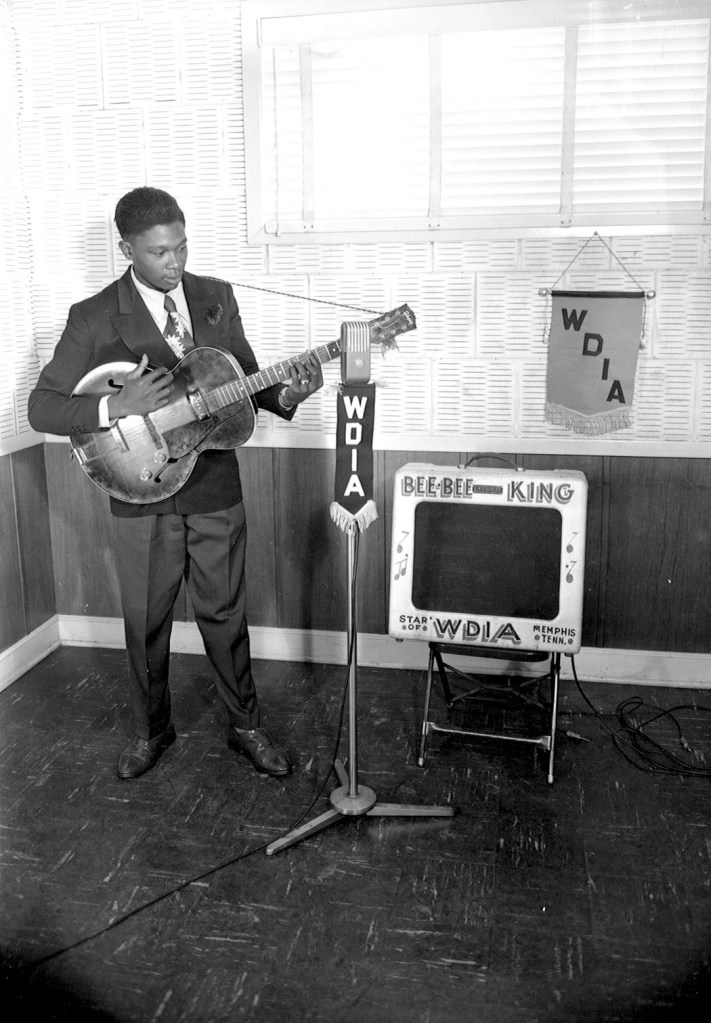
Riley B. King was born on the 16th of September, 1925, on a cotton plantation in Leflore County, Mississippi. In his teens, King sang in a local gospel choir and learned his first few guitar chords from the preacher at his church. He spent his late teens working as a tractor driver and as a guitar player for a popular touring choir, performing at religious services across Mississippi. But after hearing Delta Blues on the radio, King aspired to become a radio musician. Following a move to Memphis, King began to realise this dream, performing on various radio shows and eventually landing his own on the station WDIA. Here he soon garnered the nickname “Beale Street Blues Boy”, which was shortened to “Blues Boy”, eventually becoming the “B.B.” he was known by for the rest of his career.
It was during his stint at WDIA that King first met T-Bone Walker, later stating “Once I’d heard him for the first time, I knew I’d have to have [an electric guitar] myself”. Aside from the Delta Blues and T-Bone Walker, King’s early blues influences were singer-guitarists such as Blind Lemmon Jefferson and Leadbelly. He was also influenced by early jazz guitarists Charlie Christian and Django Reinhardt.
What these players had in common was a knack for beautiful single-line guitar melodies, and an ability to work with singers and other instrumentalists in a ‘question and answer’ style which King would later perform with himself, singing his songs and responding to his vocal lines with a guitar lick.
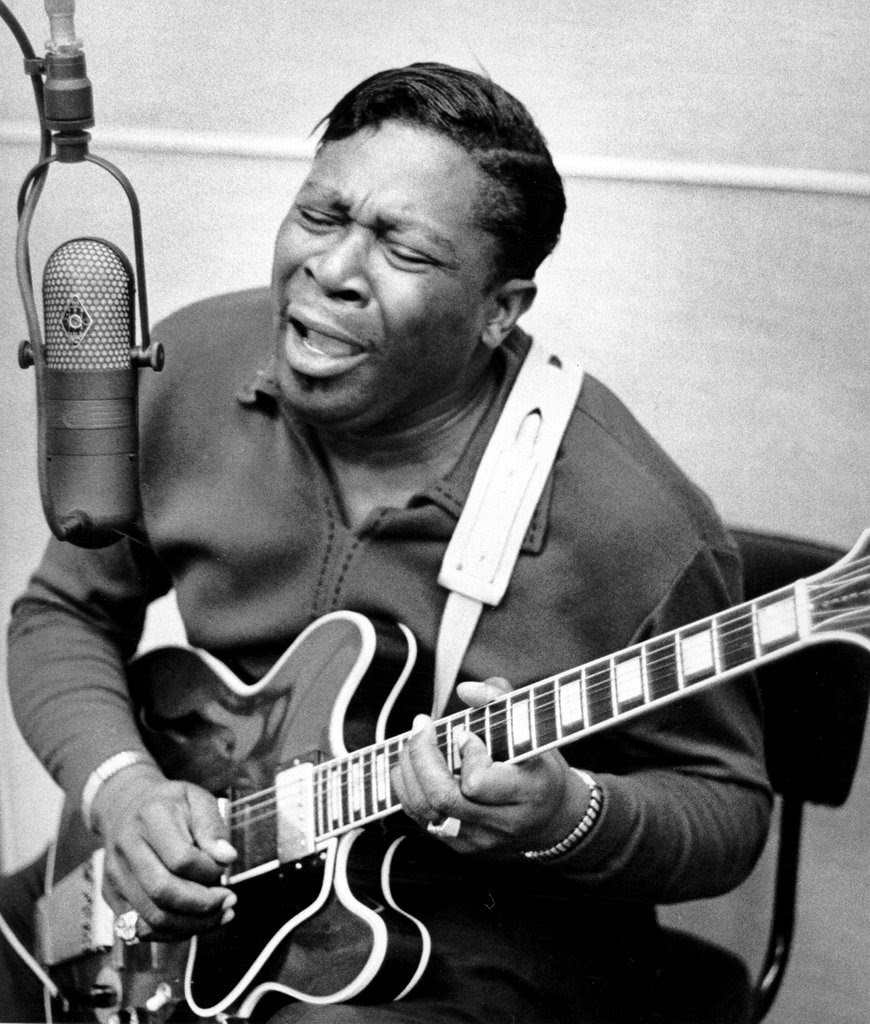
(Credit:Colin Escott/Michael Ochs Archives)(Credit: Gilles Petard/Redferns) (Credit: Michael Ochs Archives)King through the early years of his career (clockwise from top left): mid-40’s with a Gibson ES-5; In 1950 with Telecaster; And in 1960 with ‘Lucille’
Finding success
King became popular on the Beale Street blues scene in Memphis, performing with other well-known acts of the time, such as lifelong friend Bobby Bland. He cut some early records with Sam Phillips, who later founded Sun Records (and discovered Elvis Presley), but these did not chart too well. However, he soon had a number one record on the Billboard Rhythm & Blues chart with 3 O’clock Blues in 1952. This was followed by a run of successful blues singles which helped King become a well-known name on the national blues touring circuit.
During the 1960s, King received the nod of approval from a singer he much admired, Frank Sinatra. Sinatra had arranged for King to play at the main clubs in Las Vegas. King credited Sinatra for opening doors to black entertainers who otherwise were very rarely, if ever, given the chance to play these venues.
Water from the white fountain didn’t taste any better than from the black fountain
BB King, quoted in Esquire, 2006
By the end of the 1960s, groups associated with the so-called British Invasion (see below) allowed King to reach a larger audience than before, through exposure to white audiences. This included opening for The Rolling Stones on their US tour of 1969.
BB King never abandoned the blues. But his biggest breakthrough hit, The Thrill is Gone, released in 1969, showed that the blues could be framed in a more modern, funk & soul-based setting that left room for King’s equally soulful singing and lead guitar voices. Although the song had been written in the early 1959s, King’s rendition, the first time he incorporated strings into his arrangements, earned him a Grammy Award for Best Male R&B Vocal Performance in 1970 and became his signature song.
The 1970s saw King release similarly soul-blues singles such as Hummingbird and I Like to Live the Love. For the latter of these songs, the studio version of which feels like a classic soul record, but here’s a slightly faster version from a concert King gave in Zaire (now known as The Democratic Republic of the Congo) in 1974 – look out for legendary session guitarist Larry Carlton on backing guitar:
Video credit: GravyLimited/YouTube
King’s music included elements of funk, soul, gospel and jazz, all combined to create a unique style which many bluesman continue to emulate to this day. By the 1980s, King was already an Elder Statesman of the blues, and the LPs he released over the decades from here until his passing in 2015 were largely albums of duets, featuring a veritable Who’s Who of stars from the world of the blues and beyond.
Influence
Early on, King transcended his musical shortcomings — an inability to play guitar leads while he sang and a failure to master the use of a bottleneck or slide favored by many of his guitar-playing peers — and created a unique style that made him one of the most respected and influential blues musicians ever.
Although his urbanisation of the blues brought forth some detractors, King’s economy of style proved influential on many of his peers, not least the generation of guitar players who followed him, such as Buddy Guy. Jimi Hendrix was also a big fan of King, incorporating some of his licks into his eclectic vocabulary of psychedelic blues playing.
However, King’s greatest influence came from across the pond in the United Kingdom. While blues artists were not getting much airtime on mainstream radio in the US, young guitar players in Blighty were eager to snap up any blues records which came across the Atlantic. The resulting generation of guitarists redefined the sound of the blues, taking their bands back across to the US and finding great success. Groups such as The Rolling Stones (with guitarists Keith Richards, Brian Jones and later, Mick Taylor, who who displayed BB King’s influence the most overtly), The Yardbirds (which featured, at varying times, legendary guitarists Eric Clapton, Jeff Beck and Jimmy Page) and Fleetwood Mac (Peter Green) were just some of the British bands who followed the success of The Beatles, and helped US audiences rediscover their own elder statesmen of the blues, such as King.
Yet King’s influence didn’t end with the generation which followed. He recorded the rock-based duet When Love Comes To Town with U2 on their 1988 album Rattle and Hum. The arena-filling bluesman of the moment, Joe Bonamassa, puts his success down to a meeting with King when he was just twelve years old, leading the young guitarist to act as an opening act for King, from which he has grown an illustrious career of his own. The groove from King’s 1970 song Chains and Things was a huge inspiration for Gary Clark Jr. The track was also sampled by hip hop artists such as 50 Cent and Ice Cube.
Credit: BB King Official YouTube Channel
Looking back from the history of guitar, blues or otherwise, from the mid-20th century to date, you’d be hard-pressed to find a guitar player who doesn’t owe King a debt f thanks, be it directly or indirectly. It has even been said that a young Elvis Presley was a fan, long before he helped create a newer, uptempo version of the blues known as Rock’n’Roll…
Equipment
All this passion and soul, not to mention influence, from a disarmingly simple setup. Although early photos sometimes show King playing a Gibson ES-5, most of initial singles with RPM were in fact recorded on a Fender Esquire, the forerunner to the Telecaster.
However, by the 1960s, King had switched to the guitar he is most associated with, the Gibson 335.
(Credit: Gibson)
The semi-hollow design allowed space for King’s lead lines to ‘sing’ a little.more freely, but in an era of loud onstage volumes, it also meant the guitar was prone to feedback. To counter this, King used to stuff the f-hole with material to cut down on feedback. Eventually, Gibson began making him his own signature model 335 without f-holes. All of these guitars have since been known as Lucille, following an incident where a fire was caused at a show, all started over a woman of the same name.
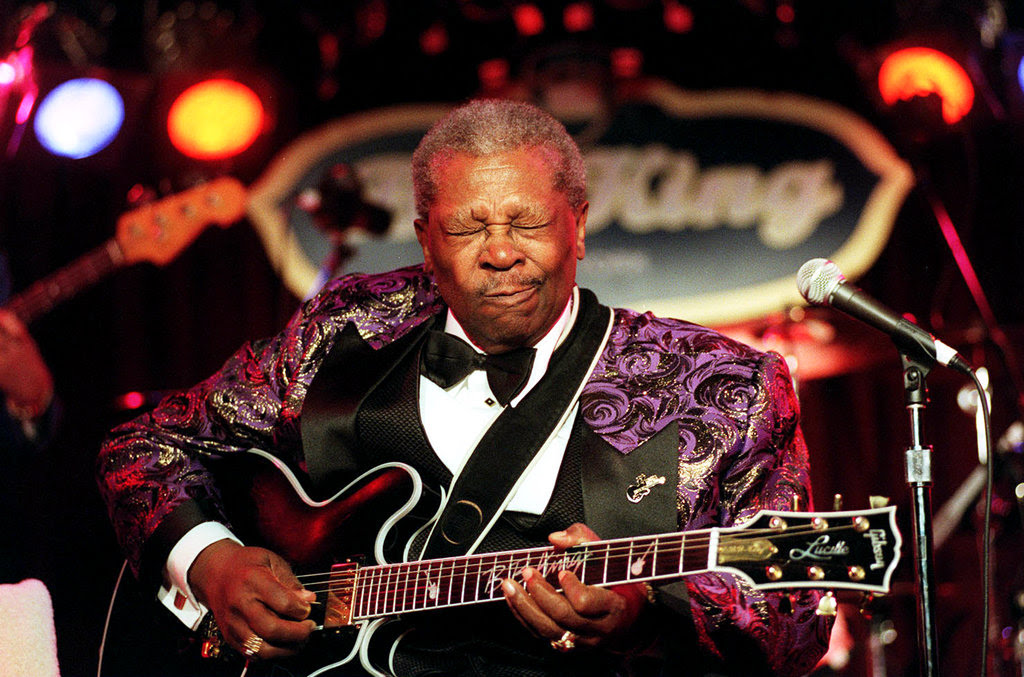
(Credit: Associated Press)(Credit: Steve Berman/The New York Times)King with versions of his signature Gibson ‘Lucille’ guitars, in 1980 (left) & 2000(right)
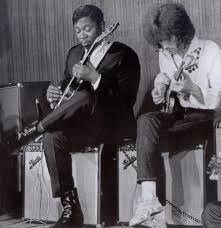
For amplification, King favoured the sound of a Fender Twin. King has stated his belief that Fender amps were “the best ever made”, in terms of sound and durability.
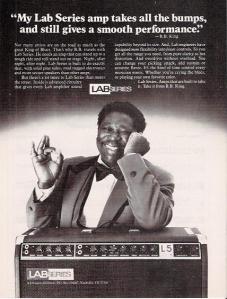
King and Eric Clapton sitting on their Fender Twin amplifiers in the late 1960s (left); Lab Series advert from the 1980s (right).
During the seventies and eighties, King also used a Lab Series L5 2×12″ combo amp. This was probably an upgrade of sorts on the Twin, while still retaining the tone King loved and was renowned for.
Recommended listening
There are plenty of records to choose from, spanning the entirety of King’s long career. You won’t go wrong with any of his releases, but for a taste of his early singles, check out The Modern Recordings: 1950-1951. These tracks (including rare alternate takes of his original 45rpm releases) most strongly showcase the jazzy influence of T-Bone Walker in King’s melodic guitar playing.
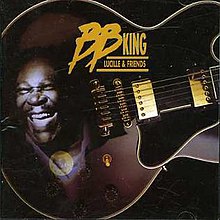
In terms of King’s collaboration albums, there’s plenty to choose from. Lucille and Friends (1995), Deuces Wild (1997) and B.B. King & Friends: 80 (2005) feature a wealth of well produced blues duets with the cream of the rock and blues worlds, recovering songs from King’s repertoire. King also recorded albums of Louis Jordan covers, as well as records and live albums with the singer Bobby Bland. However, his 200p release with Eric Clapton, Riding With The King, shows both guitar players on top form.
However, the quintessential B.B. King record, and one that I believe is essential listening for any blues guitarist, is his 1965 release Live At The Regal, a concert recording from a show at The Regal Theatre in Chicago on the 21st of November, 1964. Hailed as one of the greatest blues albums of all time, this record showcases King at his finest, and is one of the records which helped to shape me as a guitarist. Highly recommended.
As always, I’d love to hear your thoughts. King was a prolific live performer, so if you were ever lucky enough to see the master at work onstage, do get in touch to share your experiences. Until next time…
Loved by some, derided by others. You will have heard at least some of the music of The Doors.
Despite their short time together at their height, they left behind an impressive legacy. As with similar articles (such as my look at the wider impact of The Animals and The Bryds), I’ll try to keep it brief, focusing on the factors that I believe made The Doors unique and influential.
So, on the understanding that this is not a definitive history, let’s dive in…
A quick rise
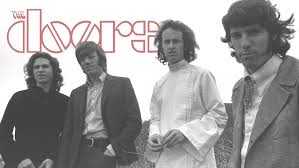
The Doors were formed in Los Angeles in 1965 by vocalist Jim Morrison and keyboardist Ray Manzarek, initially under the name Rick & The Ravens with Manzarek’s brothers Rick and Jim. They soon changed their name to The Doors in honour of Aldous Huxley’s book The Doors of Perception, recording their first one demo along with drummer John Denmore. After brothers Ray and Jim left the group, the group, guitarist Robby Krieger joined the band and the classic lineup of The Doors was complete.
They very quickly became popular, despite having played few gigs. In the start of 1966, the band managed to secure a residency at The London Fog club on Sunset Strip by having all of their friends turn up to their initial trial gig and cheer loudly. This residency not only gave Morrison the chance to overcome his stage fright, but also provided an opportunity for the band to experiment with their songs, many of which appeared on their debut album the following year.
In May 1966, the group became the house band at the more prestigious Whiskey a Go-go club, supporting the visiting acts such as Van Morrison with his band Them. By August, The Doors had been signed to Elektra Records. They recorded their eponymous debut album the same month, released at the very start of 1967. Their follow up, Strange Days, was released in September of the same year. This started an impressive run which saw the band release one studio album every subsequent year, ending with LA Woman in April 1971.
(copyright Elektra Records)
A polarising frontman
Over the years, Morrison’s behaviour had become increasingly erratic and difficult for the ban to manage. He was already living in Paris by the time LA Woman was released, taking time out from the group to focus on his poetry. He was dead just three months later, likely of an accidental overdose on heroin (although no autopsy was performed to officially rule the cause of death).
I put out a poll on my social media pages to canvass for opinions on The Doors. It seemed that, by and large, those who said they didn’t like the group generally cited Morrison’s vocal delivery style lyrics, or his persona as the main reason. He seems to have become a love-him-or-hate-him figure in music history. For some, Morrison represented the epitome of a certain type of masculine sexuality. Several bedrooms have been adorned with posters featuring well-known pictures of Morrison, topless and brooding. which seemingly turned ob as many people as it turned off.
Furthermore, in passing away at such a young age, fans never had the opportunity to watch him grow old, or indeed display an change or sense of ongoing maturity in his work. What is left behind becomes immortalised, while Morrison himself became a legendary figure. His grave in Paris remains a popular tourist attraction for would-be Bohemians to congregate.
But what we’re the critics opinions of Morrison before he died? The music of The Doors left fans divided. Fiona Sturges claimed that “Lester Bangs was right when he described Morrison, the son of a US rear admiral, as ‘a drunken buffoon masquerading as a poet‘” (quoted in The Independent, 2012). Yet Bangs had the maturity in later years to recognise the legacy of Morrison on his peers:
Think about it. Without Jim Morrison no Patti, but what’s more or less no Iggy perhaps no Bryan Ferry in his least petit-bonbonned moments. Without Iggy, of course, no punk rock renaissance at all, which means obviously that Jim was the real father of all that noise
Similarly, the music was considered by some to be twee in places (with those fiddly organ lines) or even downright pretentious. Listening to their entire run of six albums highlights inconsistencies in style, but I’d argue that this was common for groups at the time. In a time of psychedelia and increasing experimentation in pop music, record executives seemed to have lost their sense of what would sell and what wouldn’t, and allowed some artists time – and often several albums – to find a formula that worked. The Doors were no exception to this, although I believe they stood out for a few reasons.
Grounded in the Blues, but not limited to them
Like many bands of the time, The Doors were rooted in the Blues as the bedrock of their sound. When he wanted to, Morrison could write lyrics that were reminiscent of blues men such as Muddy Waters or Howling Wolf,such as on Love Me Two Times or LA Woman, for two well-known examples.
Musically, many of the songs were grounded with blues-based riffs, common to other R&B acts of the time. It was the combination of electric blues with the more poetic elements to Morrison’s words, coupled with a sense of exploration and a willingness to add elements of jazz to their sound, which gave The Doors an edge over their contemporaries in the world of psychedelic rock.
No bass player?
No – not for their live performances, at least.
In the studio, Doors producer [name] felt that Manzarek’s left-hand organ bass notes didn’t cut through as well as the second of a plucked string, and a session bass player was called in. This started something of a tradition for the band, who had bass guitar on the vast majority of their recorded material while maintaining their bass-less quartet format onstage.
In most cases, the session bassists – including bit hitters such as Harvey Brooks (who had played on Dylan’s first electric album and subsequent live shows) and Jerry Scheff (who has played with everyone from The Everley Brothers to Elvis Presley’s Vegas band) – were given strict instructions on what to play. This often following the Blues-based riffs. Otherwise, they simply filled in the sonic space a little, leaving ample room for [keys] and [guitar] to take flight, often in surprisingly intricate ways (a full and fascinating read on the bass players working with The Doors can be found here).
Robby Krieger’s guitar style
The final element to be discussed is The Doors’ guitar player, Robby Krieger. Although the last member to join the band, his playing gave the group a certain ‘lift’, mixing various styles and moving beyond solely blues-based lead lines.
Before picking up the electric guitar, Krieger had studied flamenco, who requires a strong right hand picking technique. Elements of this can be heard throughout the band’s output, not only in overt references such as Spanish Caravan, but also in his jazz-rock solo on Light My Fire. Krieger also maintained the flamenco/classical tradition of playing fingerstyle, eschewing plectrums (is it that plectra?) for his entire career.
Krieger, circa 1965 (pic credit: Chris Walter)
As I sat down to research and write this article, I started to realise the extent to which Krieger had been an influence on my own lead guitar playing. However, I rarely cite him as an influence. This may due to our similarities in background; I too, was a classical guitar player long before I started on the electric guitar, and my first electric influences were blues players and the experimental artists of the nineteen-sixties.
It may also be that Krieger’s influence came indirectly, via the first ever tuition book I bought to help me learn lead guitar, Lead Guitar by Harvey Vinson (which is a whole thing in itself – expect an article all about it in the near future). Looking back through the example riffs in that book, most of them could easily have been lifted from Doors tunes. I even owned a cheap SG copy too, but that’s a story for another time…
Recommended listening
There’s something interesting to be found on all six of the band’s studio albums. It is worth giving them all a listen to see what jumps out for yourself. Having said that, I find that for me, their first two LPs The Doors and Strange Days (both 1967), as well as their final offering, LA Woman (1971), showcase the group at their finest.
As always, let me know what you think. I enjoy having discussions with readers who get in touch and would love to know your opinions on The Doors, Morrison’s legacy, Krieger’s technique and everything else. But for now, this is the end…
Albert Nelson (1923-1992) is one of the most influential blues guitar players of the mid-29th century, at the height of the Blues’ electric period, and one of the early exponents of the modern blues. But you probably know him better by his stage name, Albert King.
He took the stage moniker of King due to the success of another popular blues guitarist, B.B. King. In fact, it is believed he even passed himself off as a cousin of B.B.’s early in his career in order to raise his profile and get more gigs!
Despite the somewhat cheeky start, both B.B. and Albert, together with Freddie King (also no relation to either of the other two), are now.often referred to collectively as The Three Kings of the Blues, given their enormous influence on countless guitar players both in the next generation of players and among their contemporaries.
Breakthrough Success
King had played with other artists (including as a drummer for Blues Legend Jimmy Reed, for a brief time) as well as leading his own band on the blues club circuit in Illinois in the USA. However, it wasn’t until he moved to Memphis and signed to Stax Records that he started to have a successful run of single releases. King believed that it was his decision to play blues songs in an upbeat, soul-based style which proved crucial to his success. He recorded with the Stax House band, Brooker T and the MGs (featuring none other than Steve Cropper on rhythm guitar), as well the Memphis Horns. Stax singer-songwriter Isaac Hayes also contributed piano to the sessions alongside organist Brooker T. Jones.
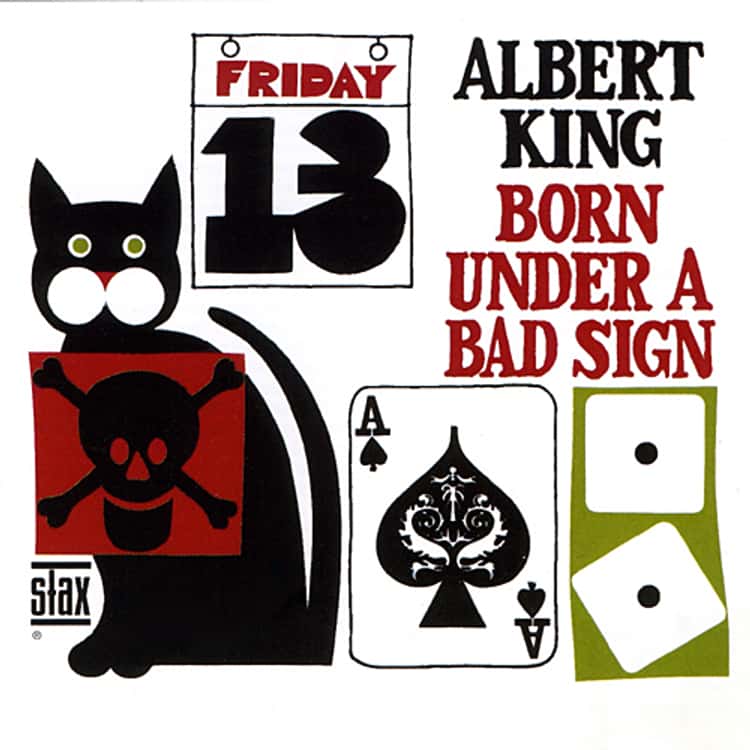
Eleven of the Stax singles, recorded over five seasons from March 1966 to June 1967, were complied and released as the album Born Under a Bad Sign in 1967. The album became a reference point for guitar players such as Eric Clapton, and the title track from the album became King’s signature song (also covered by Clapton with his late sixties blues-rock supergroup Cream).
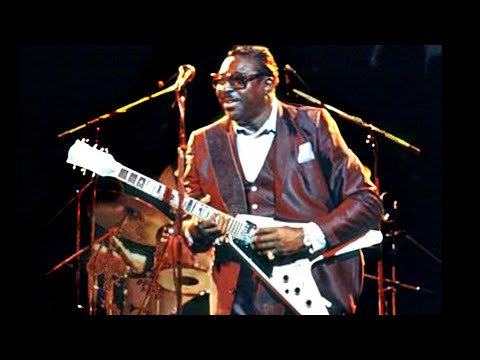
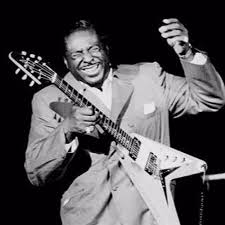
King performing live across the years.
Unorthodox technique
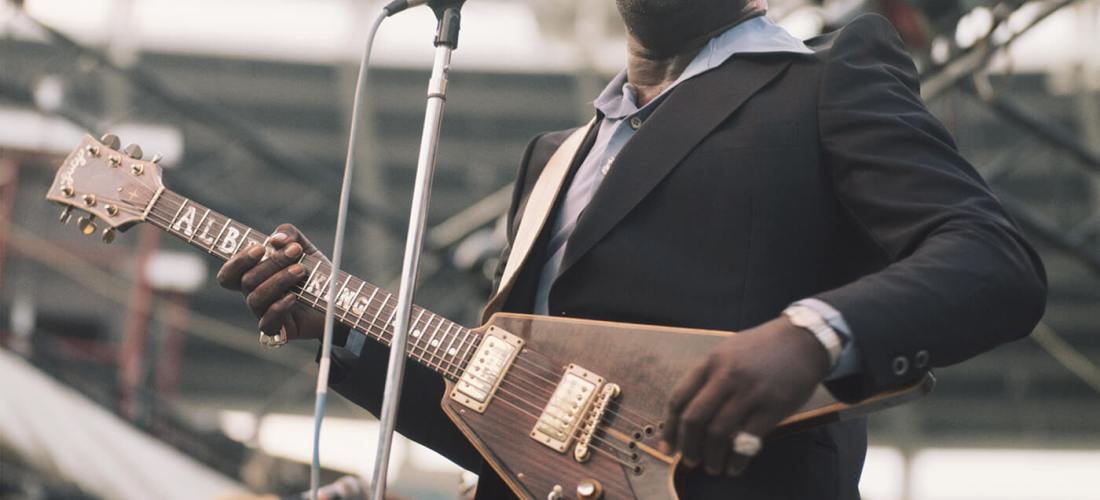
Albert King was known as the “Velvet Bulldozer” due to his soulful voice, which contrasted his large physical frame (standing 6’4″ tall). He was left-handed but opted to play a (standard) right-handed guitar upside down. The guitar he is most associated with is Gibson’s Flying V (see pictures), or custom-built guitars based on this model. It’s unusual ‘V’ shape made it much easier to play left-handed without anything getting in the way (Hendrix occasionally used one too, likely for the same reason). King strung his guitars the opposite way to the ‘standard’ layout, with the thinnest/highest sounding string at the top – he was literally playing a ‘standard’ guitar upside down.
Another ‘upside down’ element to King’s technique can be found in the way he bends his notes. His large hands bent the strings by pulling them downwards, towards the floor. Some players (like Jeff Beck, I believe) have remarked on this, saying it allows for greater control of the pitch. In King’s case, he was able to raise the pitch by over two tones of he wanted to. He was also able to comfortably bend several strings at once, a technique much-copied since.
King’s unique style has been identified as a key element in the playing styles of Eric Clapton, Jimi Hendrix, Buddy Guy, Albert Collins, Mike Bloomfield and in particular, Stevie Ray Vaughan, who cited King as his primary influence.
King largely played on the three highest-sounding strings of his guitars, usually playing variations on the same musical phrases. But it was the numerous different ways that he was able to phrase the same simple blues licks; his huge string bends; and the harsh, stinging ‘attack’ he utilised in his playing, which gave King his unique sound.
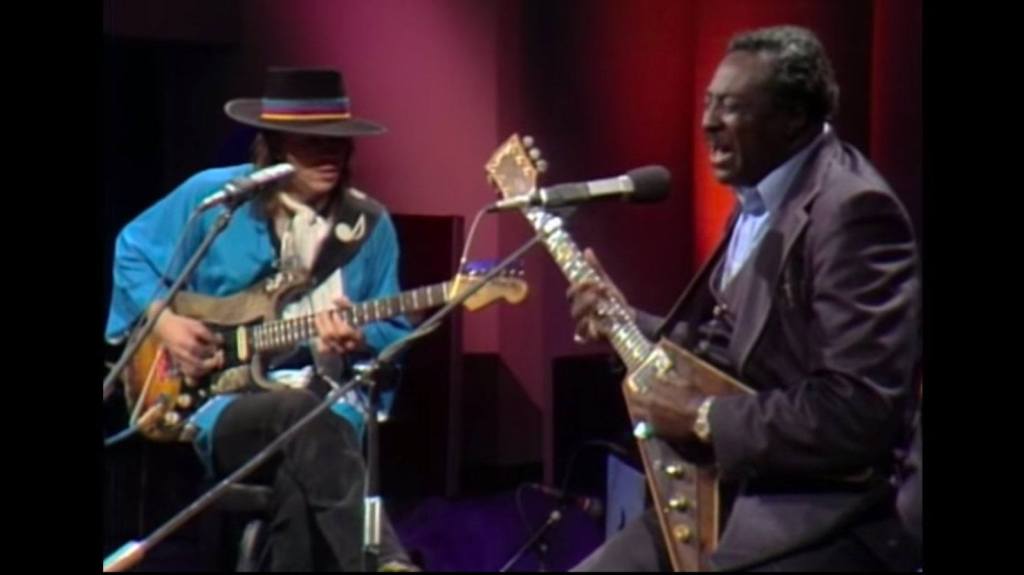
King with Stevie Ray Vaughan (left) recording the In Session TV special/album (1983).
Guitar Tuning
There remains to this day an ongoing debate about how exactly King tuned his guitar – yet another unorthodox element to his style. Rather than use the standard guitar tuning (low to high: EADGBE), King made use of a more unusual tuning, believed to be either (low to high): CBEF#BE (according to Steve Cropper, who recorded with King and produced some of his records), or CFCFAD (according to Dan Erlewine, who built custom guitars for King later in his career). He may have switched between both options and others.
In either case, since King only played lead, he did not have to contend with the difficult chord shaped these tunings would have thrown up. It is likely he found them useful for easily finding his root note and being able to execute his particular repertoire of blues licks across a greater range of the fretboard.
Recommended listening
Aside from Born Under a Bad Sign (1967), I’d suggest checking out King’s love album Live Wire / Blues Power (1969), which features cuts taken from a three-night stint at the Filmore West.
Also worth listening to is In Session, the audio record of a TV special from 1983, but only released in 1999. In Session is a collaboration between King, who leads processing as the ‘old master’ and the then up-and-coming blues guitar superstar (and Albert King disciple) Stevie Ray Vaughan. As well as hearing both guitar players trade licks, the record also includes a few brief moments of ‘chat’ between the two which adds to the atmosphere of the project.
Left to right: King, B.B. King, Eric Clapton & Stevie Ray Vaughan sharing a joke backstage.
If you are looking to learn how to get the most out of less in your lead guitar playing, you could do far worse than listen to King’s sharp but tasteful playing. As always, let me know what you think, and keep an eye out for future articles on the other two ‘Kings of the Blues’, coming very soon…
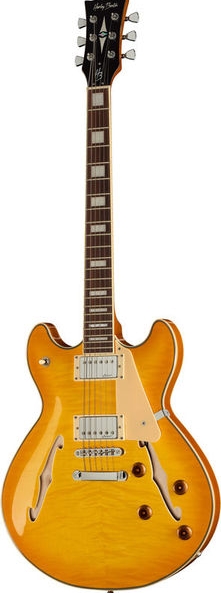
At the end of last year, I acquired a new second-hand guitar. It even shipped with a hard case included as part of the sale! The guitar in question is a budget 335-style copy, made by Harley Benton, the in-house grand for the German musical instrument retailing giant Thomann. Or rather, I should say the Harley Benton HB-35 Plus…
What does plus mean?
Harley Benton already have the HB-35, their budget version of a 335-style guitar. Selling for just £175, they get good reviews and are an affordable way to try out Semi-hollow guitars for the first time. The HB-35 Plus retails at approximately £220 new, but has features which mark it out as a considerable upgrade on it’s cheaper sibling.
So what does that extra £45 get you? Block inlays, for a start, which look very classy. You also get more specialised vintage-voiced humbucking pickups (which can be split for a single-coil sound) and an arched maple top (hence the plus top moniker) in fancier colour options, such as the lemon drop colour reviewed here.
Image from Harley Benton’s website – note the original placement of the pickup selector
I love this colour, which appears more of a light orange-yellow to my eyes.
Furthermore, it seems that the nut is slightly more narrow (42mm to the original HB-35’s 43mm) and a slightly more curved fingerboard (12″ radius, compared to the older model’s 13.5″ or thereabouts), making this guitar feel a little more like the classic ‘jazz boxes’ of old.
Specifications & build quality
Having bought this guitar from another player, I received an instrument which had already been set up, and indeed, modified. This means I don’t know how this guitar would have arrived ‘from the box’, although I hear that like most guitars, a simple set up would be enough to get it in shape.
The guitar I received felt well balanced across the fretboard and is really comfortable to play. The classic Gibson scale length feels familiar and the neck is comfortable in my hand. In fact, it feels like they have copied the dimensions of the classic 335 very closely, which is no bad thing.
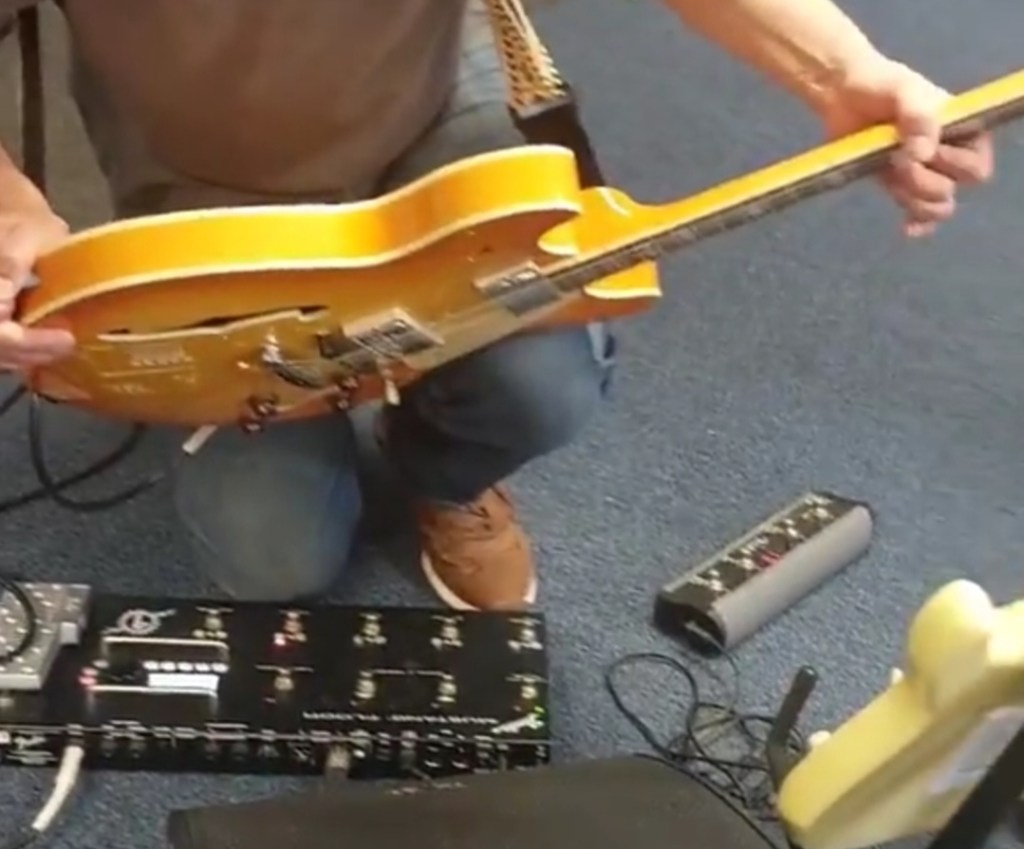
What’s more, the previous owner had moved the pickup selector switch from the top shoulder (where you would find it on a Les Paul) to a sit with the other controls, which is much more typical on a 335-style guitar. The only negative is that the original hole is still there (it was covered with a giant sticker when it arrived, which I quickly and carefully removed).
Here are the full specs of the guitar, according the Harley Benton:
Semi-hollow design with mahogany sustain block (Entandrophragma cylindricum)
Maple body with AAAA flamed maple archtop
Set-in maple neck
Pau Ferro fretboard with block fretboard inlays
Fretboard radius: 12 inches
22 medium jumbo Frets
Scale: 24.75 inches
Nut width: 42 mm
2 Roswell LAF Alnico-5 vintage-style humbucker pickups
2 Volume controls with push/pull function for split coil
Individual tone controls for each pickup
3-Way pickup toggle switch
Tune-O-Matic bridge
The main thing on my list to change, and indeed the only upgrade I feel this guitar needs, is to swap the plastic nut for one made of bone. I’ll probably get round to doing this later in the year, and for now it’s working fine and holding its tuning well.
How does it sound?
Before even plugging into an amp, this guitar sounds good (and surprisingly loud) completely acoustic, which is useful for playing at home.
Plugged in – it sounds exactly as a 335 should.
Played clean, single notes and chords ring out loud & clear, sounding even across the entire fretboard. The pickups, combined with the tone controls, allow for everything from jazz and blues to soul, pop, country and an almost Gretsch-like Chet Atkins vibe. Using the push-pull volume to split the humbuckers down to single-coils beings out an airier version of a Telecaster sound.
Throwing a little overdrive in makes this a very enjoyable guitar to play. As well as offering grittier takes on all the styles and sounds mentioned above, you also get some of the best classic rock tones out there. Add more distortion and it continues to sound very good and play incredibly well. The semi-hollow body allowing gentle feedback which helps add to note sustain.
Putting the HB-35+ through it’s paces at home
This guitar not only took any style I threw at it in its stride, but excelled across the board, even in higher-gain settings. Admittedly, I don’t play the more extreme metal genres, but even then, if you can work out the likely feedback issue, I have a feeling this guitar would surprise you…
Does it hold up well at live shows?
Since acquiring this guitar at the end of autumn last year, I’ve gigged it pretty regularly. It performed brilliantly when I put it through its paces at a recent soul review show, covering Steve Cropper style licks and jazzier solos and choral work. With one of my main covers acts, this quickly became my first choice guitar, covering everything from jangle and early 60s pop to classic rock, punk and Britpop, all in the space of one show. It is comfortable both to play and also to wear standing up for two hours.
Ask most professional session guitarists what the best ‘cover all bases’ guitars are, for studio work and live, and they will probably tell you to have a 335 handy. Obviously, this applies to any decent 335-style guitar, if not the gold standard Gibson original. But it certainly makes sense to snap up this significantly cheaper tribute, especially when it looks classy sounds fantastic and plays so well. It may be that they take a little post-purchase work to reach the decent playing standard I seem to have, but in my opinion, it’s worth it.
This guitar surprised me. I’d heard really good things about Harley Benton, but I still wasn’t prepared to be blown away as much as I was by this guitar. I’ve used it in various settings and with several different acts in the last couple of months, covering styles from Kuti to Kasabian and BB to The Buzzcocks, and I’m very impressed with how it’s handled everything I’ve thrown at it.
Nowadays, the term ‘budget guitar’ doesn’t mean the same as it did twenty or even ten years ago, and shouldn’t arouse the kind of stigma which cling to those older, poorly constructed guitars. The quality on this instrument is very high, and I can’t stress enough just how fantastic those Roswell pickups sound!
After years (decades, even) of using Stratocasters as my main go-to guitar while others have come and gone from my collection, I might have found another guitar that I love just as much. I might even have to buy another of these, just in case something happens to this one – which at this price point, is an affordable prospect.
2022 has come to a close and I’ve had a stinking cold and been on the verge of losing my voice for the last few days. My final gig of the year was a New Year’s Eve show with Nick Gladdish, where I luckily don’t have to do much singing!
Next year brings more gigs of various kinds, on top of my ongoing Music Therapy work. I’m also looking forward to getting back into the studio to rehearse and record my old pal Nick’s next album at the start of 2023.
Speaking of studio time, next year will also see a couple of new projects from me, including a few releases of original instrumental material, both for solo guitar (under the working title Sketches) as well as some jazzier stuff with a small group of friends (still working out the details for that one). These pieces have been clogging up my drafts folder for ages, so I plan to record and release them before the end of 2023, meaning that I never have to think about them again!
I’ll keep you all updated via this blog. I’ll also try to keep up the musical articles, including more entries to the Great Guitarists series. In addition, keep an eye out for my round up of my favourite books read in 2022, coming sometime this month.
So enjoy the rest of your festive season, look after each other, and all the very best for the coming New Year. See you at a gig soon…
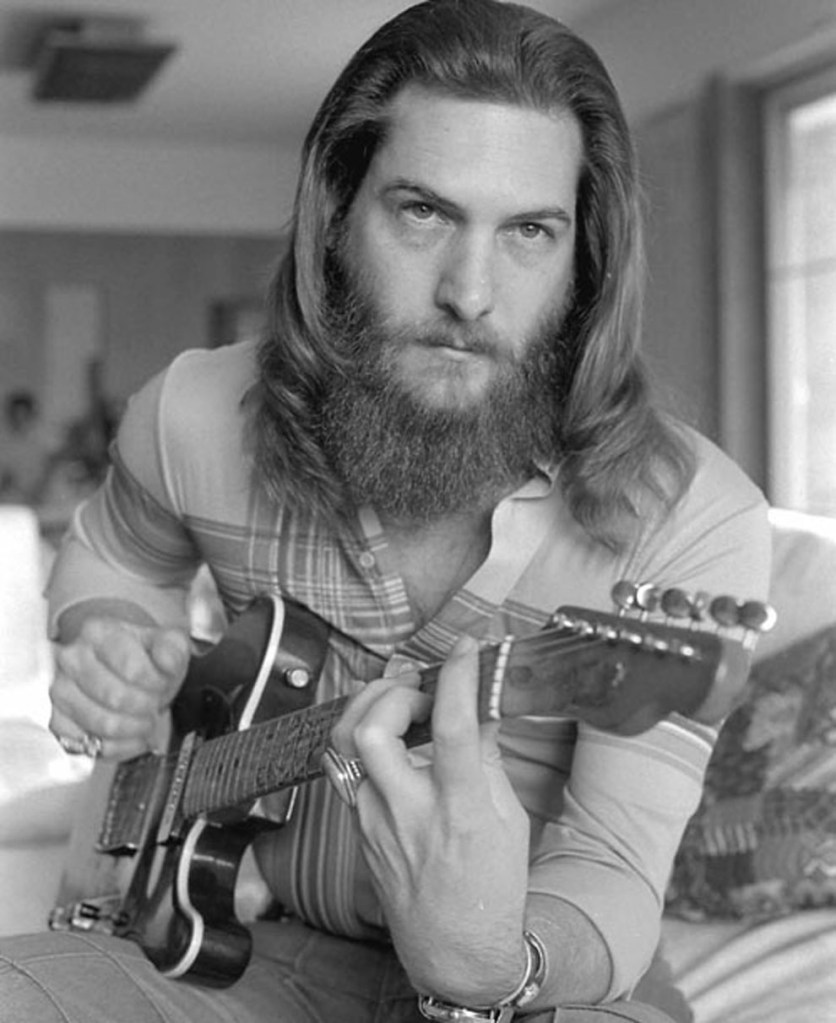
The Great Guitarists series is back, and we’re restarting with one of my all-time favourite guitar Players, Steve ‘The Colonel’ Cropper.
Even if you don’t recognise the name from the cult classic musical comedy The Blues Brothers, you will have heard Cropper’s songs and guitar playing on countless records, playing alongside some of the greatest soul singers of the 20th century.
Steve Cropper with his favoured guitar, the Fender Telecaster.
Cropper was as a member of Brooker T & the MGs, who also included Al Jackson Jr. on drums, Brooker T himself on organ & piano, and Cropper’s childhood friend Donald ‘Duck’ Dunn on bass (Dunn was also featured in The Blues Brothers). The group had hits with instrumental tracks such as Green Onions and Soul Limbo (the one used as the BBC’s theme music for their Cricket coverage).
Brooker T & The MGs (left to right: Al Jackson Jr, Steve Cropper, Brooker T & Donald Dunn).
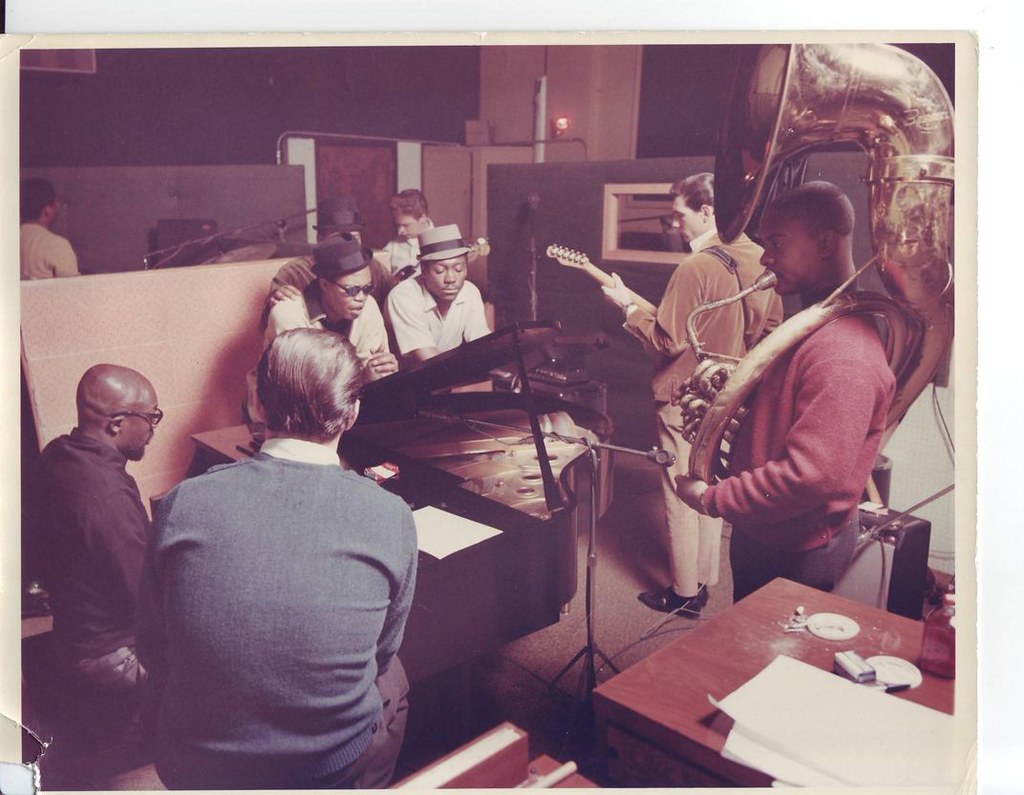
The MGs were also the core in-studio ‘house band’ at Stax Records, Memphis, providing the backing (and often creating the arrangements) for virtually all of their recordings from the mid-sixties to the early seventies. All those hits you know by Otis Redding, Sam & Dave, Eddie Floyd and countless others? The MGs, with Steve, are in all of them…
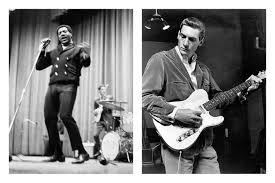
Clockwise from top left: Cropper onstage with Otis Redding; Cropper with his white Tele;In the studio with Sam & Dave; and with Aretha Franklin.
As if that wasn’t enough, Cropper also co-wrote In the Midnight Hour with Wilson Pickett, Knock on Wood with Eddie Floyd and (Sittin’ on) The Dock of the Bay, the famous posthumous hit for Otis Redding. Some of these records were also co-produced by Cropper.
After leaving Stax, Cropper went on to play on Ringo Starr’s and John Lennon’s solo records, as well as produce albums for other artists, notably the Blues guitar legend Albert King. Then, in the late seventies, he was recruited into the Blues Brothers, the act for which he might be best recognised.
The Blues Brothers released two albums, two feature films (both of which included soundtrack albums) and embarked on a handful of tours between the late seventies and the early 2000s. Their influence on bringing rhythm & blues to a wider audience cannot be understated, not least by introducing a new generation of moviegoers and listeners to artists such as John Lee Hooker, Ray Charles, Sam & Dave and many more. Yet even in a band comprising a veritable who’s who of soul musicians, Cropper still stands out.
Cropper (left) with The Blues Brothers Band.
In most of these settings, Cropper is welding a Fender Telecaster or (more recently) Telecaster-like models, such as his Peavy signature model from the late 90s. His playing – and the guitars he played on – provide a full, but not dominating, sound. From simple but effective chord work, to riffs that often doubles up against bass lines, his style of Memphis Soul remains highly imitated. In his lead work, his frequent use of sixths (read more about these here) can be heard to great effect on the intro to Sam & Dave’s hit Soul Man.
Recommend listing
Pick up any classic cut from the Stax label from the mid to late sixties and Cropper is probably on there. Then of course, there is the soundtrack to The Blues Brothers. There are even complications of Cropper’s best-known work available. It doesn’t take much work to find him!
In all cases, listen carefully to his rhythm choice, and note how he leaves space for the singer and other instrumentalists. As for solos, he could certainly play good ones when he needed to but only when they were necessary.
After commissioning my custom ukulele (which you can read more about here), I was more or less set in terms of the instruments I needed with my current musical projects. There was just one guitar which wasn’t quite right…
My oldest Stratocaster hasn’t seen much of the stage recently, and not just because of playing less gigs due to various lockdowns, etc. The action had felt off, and it seemed to be because of the bridge, or rather the saddles. After twenty-two years, the small screws in the saddles had corroded to the point that strings could not be raised high enough for my liking.
I contacted Elderwood Guitars (who built my beautiful semi-hollow guitar) to discuss repairs. I also decided to make a few changes while this axe was in the shop…
What’s new?
I don’t really have the need for an HSS guitar nowadays, so used this opportunity to have the bridge humbucker replaced with a Tonerider Vintage Blues single coil. This would better match the two City Limits pickups in the neck and middle positions. Barrie at Elderwood was able to change the pick guard and place the bridge pickup within the larger cavity in the guitar (cut out for the original humbucker).
I also asked for the ‘Tele mod’, i.e., a switch which allows me to activate the bridge pickup in any position, effectively giving my seven different pickup combinations, including the lovely sounding neck & bridge pairing. This is one sound Telecasters have always had that was not available on a standard Strat.
With a switch taking the place of the second tone control (the remaining tone control becoming a master for all three pickups), I now had a guitar that could provide this, as well as the classic ‘quack’ from the out-of-phase Strat positions (2 & 4) – the best of both worlds, in my mind (and to my ears).
Finally, I figured that since these modifications would result in a different sounding guitar, perhaps it ws worthwhile refreshing the instrument visually as well. The old Midnight Blue finish had certainly acquired its fair share of chips and dents over the years. Barrie smoothed these out before hand painting the guitar in a burnt orange hue, which you can see below…
Before (left) and after (right) shots of my oldest Strat (pic courtesy Elderwood Guitars)
To me, it looks very similar to the orangey shade of older, worn down fiesta red guitars. It lends a classic vibe to my oldest Strat – the oldest guitar in my collection, in fact. The vintage feel is aided by the off-white pickup covers and scratchplate.
How does it sound?
It sounds like a classic 60s Strat or Tele, depending on your pickup choices. The neck & bridge combination has widened the sonic pallette of this guitar, making it my main choice for soul, funk and rhythm & blues gigs – or as in the video above, for slightly overdriven funky licks. Another great job by Barrie!
What are the best mods you’ve made to your guitars? Get in touch and let me know!
Hi all and welcome to 2022! You may have noticed that things have been a little quiet on this blog for the last few months. This is for a number of reasons, but don’t panic – I’m fine, just incredibly busy! Expect more posts in this new year, as well as updates on exciting new projects I’ve been working on. In the meantime, here’s a slightly rejigged post on New Year’s resolutions from a few years back. I hope you enjoy it! Until next time...
As a general rule, I don’t believe in New Year’s resolutions. My philosophy is that changes can be made at any time, so why wait until January?
However, there is something about the end of a year which causes us all to reflect on the previous twelve months and start focusing on our plans for the next twelve. For us working musicians, this would usually mean that we have reached the end of one of our peak times, the ‘Christmas Party Season’. For over a decade (pre-pandemic), I ended the year with a NYE gig. However, for obvious reasons, things have been a little quieter by comparison, which gives us time to ponder on the gigs we’ve enjoyed, what we didn’t enjoy, and what we hope to change for the new year.
So, with that in mind, here are a few of my suggestions for guitar-related resolutions for musicians looking to grow as better musicians in the coming year:
Learn a new style
Always wanted to start learning those jazz chord voicings? Perhaps you keep meaning to work on your reggae & ska rhythm playing? Or your country picking? Blues slide? The list goes on…
Take the time to work on these new genres & styles of playing. We are very fortunate to live in a time where we can access a world of free tutorials on the Internet, or videos in YouTube. However, don’t rule out the possibility of taking lessons to focus on specific areas – working one to one with an experienced guitar tutor does wonders for improving your playing!
Mix things up
Learning a style doesn’t mean you have to abandon all you know & travel the world playing strictly Django/gypsy jazz for the rest of your life (though I imagine there are plenty of worse ways to live)!
Have you found that the majority if your playing has been on acoustic guitar? Trying swapping to electric more often (or vice versa). Do you always practise at the same time of day? If possible, can you change to a different time? Your brain operates differently throughout the day – you may well find yourself going down very different musical avenues simply by switching from a morning to an afternoon practice session.
Sometimes learning to play a song you are very familiar with in a new style works brilliantly in helping your playing. Not only do you freshen up material which might be getting a bit stale, but you’ll have a safer means of exploring new options in your guitar playing.
One area of guitar playing I can’t recommend highly enough is solo performance. By this, I don’t mean the lead guitar solo in a song, but playing the melody, harmony, rhythms, etc on one unaccompanied guitar. It’s something a piano player wouldn’t think twice about, but I’m frequently amazed at how many guitarists simply haven’t tried it properly! If you’re unsure about how to start doing this, there are several books, online tutorials (like this blog!), and of course YouTube videos to help inspire you. Which brings us nicely in to…
Widen your horizons
Music is a language. Even when playing on your own, you are creating sounds for yourself to hear, effectively taking to yourself. But there’s only so long you can do that before you end up going round in circles, or going crazy!
Set yourself the following challenge for the year: discover a new artist each month. Learn from what you hear. Take examples of their playing & try to incorporate it into your own. It can only make you a better guitarist! The beauty of this is that you don’t have to focus on other guitar players. In fact, it might be better not to! Many of the jazz & Blues guitarists I admire take inspiration for their improvisational playing from horn players, translating their melodies & ideas into their own instrument. Try it!
It also helps to get out amongst other musicians, jam, join or start a new band, particularly in a new style. It also goes further than this – always wanted to sing while playing? Start! Learning a new instrument? Do it! The best way out of a rut is to climb upwards!
Get your music ‘out there’
…And if you’re meeting new musicians & launching new projects, you’re already doing this. Go to more live gigs and make sure you perform live yourself more often (when you can), especially new and original music. I know all too well how easy it is to get stuck in one ‘world’ for longer than you might like, finding it hard to make the time to do other things, but I promise it’s worth the effort.
Remember to have fun while you’re out there expanding your guitar playing horizons!
To finish off, allow me to wish you all the very best of health & happiness for the New Year! Let’s make 2022 – like every year – a great year for music, for the guitar, and for you!
Please do get in touch to tell me what your own guitar/music new year resolutions are, and stay in touch to let me know how you’re getting on with them! Tim xx




















 Tim Higgins, Guitarist
You must be logged in to post a comment.