I an article earlier this year, I weighed-up which two guitars in my collection would be the ultimate top two – the two I could take along to any gig any be comfortable they would cover (almost) any style of music being played. This is especially useful for me at studio dates, where surprise requests can often occur, and I don’t usually have capacity to take my entire guitar collection along to every session!
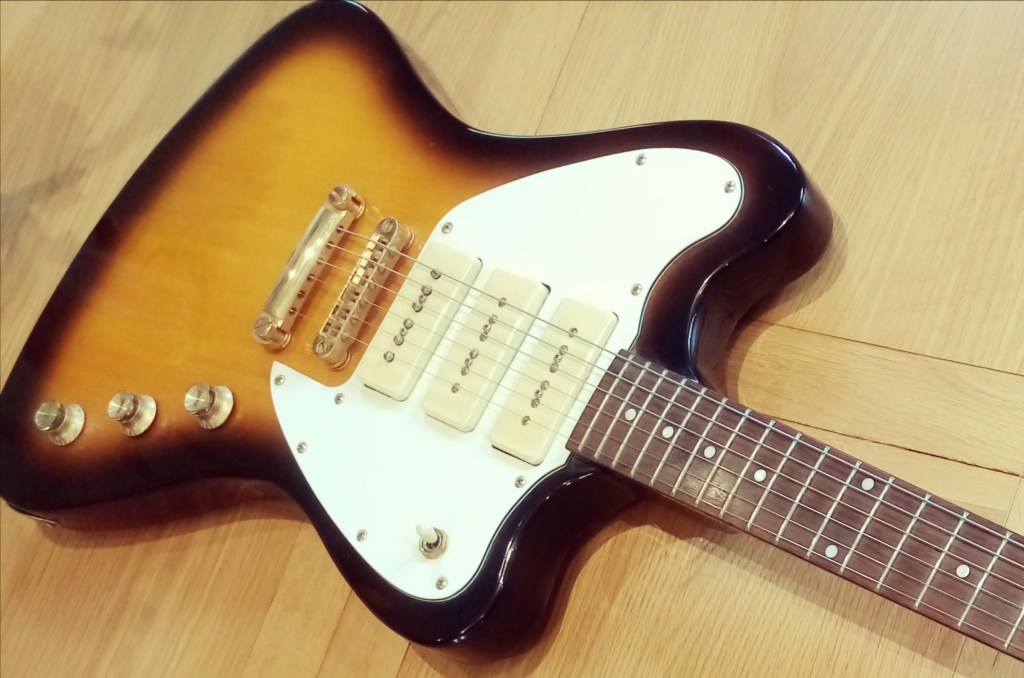
In the end, after examining different types of guitar (differentiated largely by their pickups), I concluded that – for me – one of my Stratocasters and a p90-type guitar (in my case this Gould Stormbird) made a winning combination in terms of tones and range of genres. With these two, I could cover everything from jazz and funk to classic rock and noisy indie, and everything in-between.
But what if you could only take one guitar out? Which one would it be?
In the original post, I sang the praises of the 335-type guitar, which only just missed out on making it into the ‘top two’. I love my own 335 copy, but I felt more confident taking a Strat to a gig with multiple (or unknown) genres on the go, mainly because the single-pickup solid body cleans up better, is far less prone to feedback onstage (especially when playing heavier styles), and offers more tonal options. Also, I think the fact that I’ve played Strats since I was sixteen likely played a part in my thought process. I sometimes take a job where I don’t know exactly what I’ll be asked to play until I arrive, so familiarity with an instrument I trust is crucial.
However, I might have been a little unfair to the 335, and feel like I’ve changed my opinion in the last few months. I’ve certainly been using one as my main guitar for 80% of my gigs this year so far, and it performed perfectly at my most recent studio bookings – but would I be happy with it as my only guitar for any gig?
Let’s look at the three types of guitar by pickup type again, with a summary of what I use them for, as well as a few examples of where I use them professionally.
Single-coil solid body guitars (Strat, Tele, Danelectro, etc)
Classic guitar tones – bright and clear with lots of twang or spank to their sound Sound great overdriven, but retain some of their original character Sit well in a mix with other instruments/guitars Reliable, solid instruments which are easy to mod Perfect for: pop, funk, country, blues, rock, indie Can be noisy, especially in high-gain settings
P90 solid body guitars (Stormbird, Some PRS models, some Teles, etc)
Beefed-up version of a classic single-coil sound Beautifully warm, yet still clear, distorted sound Great ‘best of both worlds’ between a single-coil and humbucking pickup Covers most styles (but volume has to be rolled back slightly for cleaner sounds) Can be very noisy in certain settings
Humbucker solid body guitars (Les Paul, SG, PRS)
The classic overdriven guitar sound, warm but aggressive Warm, full sound for jazz (with the volume rolled back a little) Perfect for: Rock of all types, jazz and blues Not as good as single-coils for those iconic glassy clean sounds
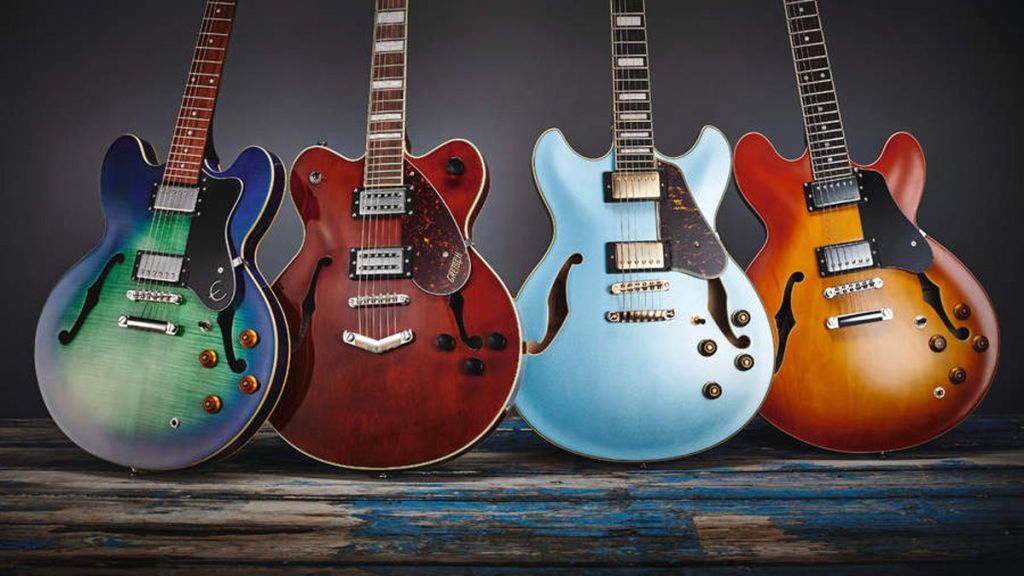
A humbucking guitar with a slightly airier sound Lighter than a Les Paul (to save your poor back!) Capable to playing most styles imaginable Perfect for: jazz, funk, soul, blues, classic rock Neck & Bridge pickups together gives a wonderful funk tone Prone to feedback onstage, especially in higher-gain settings
Picture credit: Music Radar
Final thoughts
Which would I choose? I still couldn’t say for certain. It depends so much on the gig in question, but if I wasn’t sure what I was going to asked to play, I expect it would be the Strat or the 335 I’d be reaching for. I guess it comes down to a choice between a solid body or (semi) hollow bodied guitar; whether I’m seeking the thicker snap of the Strat, or the airier sound of the 335.
And of course, bear in mind that we’ve only been discussing electric guitar options here – if I was really unsure about the requirements for a studio date, I’d have an acoustic packed into the car too!
But what about you? Obviously, what works for me doesn’t necessarily work for everyone, which is why I’d love to hear your thoughts – get in touch!
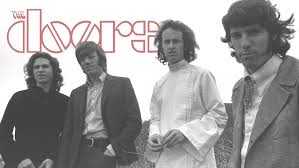
Loved by some, derided by others. You will have heard at least some of the music of The Doors.
Despite their short time together at their height, they left behind an impressive legacy. As with similar articles (such as my look at the wider impact of The Animals and The Bryds), I’ll try to keep it brief, focusing on the factors that I believe made The Doors unique and influential.
So, on the understanding that this is not a definitive history, let’s dive in…
A quick rise
The Doors were formed in Los Angeles in 1965 by vocalist Jim Morrison and keyboardist Ray Manzarek, initially under the name Rick & The Ravens with Manzarek’s brothers Rick and Jim. They soon changed their name to The Doors in honour of Aldous Huxley’s book The Doors of Perception, recording their first one demo along with drummer John Denmore. After brothers Ray and Jim left the group, the group, guitarist Robby Krieger joined the band and the classic lineup of The Doors was complete.
They very quickly became popular, despite having played few gigs. In the start of 1966, the band managed to secure a residency at The London Fog club on Sunset Strip by having all of their friends turn up to their initial trial gig and cheer loudly. This residency not only gave Morrison the chance to overcome his stage fright, but also provided an opportunity for the band to experiment with their songs, many of which appeared on their debut album the following year.
In May 1966, the group became the house band at the more prestigious Whiskey a Go-go club, supporting the visiting acts such as Van Morrison with his band Them. By August, The Doors had been signed to Elektra Records. They recorded their eponymous debut album the same month, released at the very start of 1967. Their follow up, Strange Days, was released in September of the same year. This started an impressive run which saw the band release one studio album every subsequent year, ending with LA Woman in April 1971.
(copyright Elektra Records)
A polarising frontman
Over the years, Morrison’s behaviour had become increasingly erratic and difficult for the ban to manage. He was already living in Paris by the time LA Woman was released, taking time out from the group to focus on his poetry. He was dead just three months later, likely of an accidental overdose on heroin (although no autopsy was performed to officially rule the cause of death).
I put out a poll on my social media pages to canvass for opinions on The Doors. It seemed that, by and large, those who said they didn’t like the group generally cited Morrison’s vocal delivery style lyrics, or his persona as the main reason. He seems to have become a love-him-or-hate-him figure in music history. For some, Morrison represented the epitome of a certain type of masculine sexuality. Several bedrooms have been adorned with posters featuring well-known pictures of Morrison, topless and brooding. which seemingly turned ob as many people as it turned off.
Furthermore, in passing away at such a young age, fans never had the opportunity to watch him grow old, or indeed display an change or sense of ongoing maturity in his work. What is left behind becomes immortalised, while Morrison himself became a legendary figure. His grave in Paris remains a popular tourist attraction for would-be Bohemians to congregate.
But what we’re the critics opinions of Morrison before he died? The music of The Doors left fans divided. Fiona Sturges claimed that “Lester Bangs was right when he described Morrison, the son of a US rear admiral, as ‘a drunken buffoon masquerading as a poet‘” (quoted in The Independent, 2012). Yet Bangs had the maturity in later years to recognise the legacy of Morrison on his peers:
Think about it. Without Jim Morrison no Patti, but what’s more or less no Iggy perhaps no Bryan Ferry in his least petit-bonbonned moments. Without Iggy, of course, no punk rock renaissance at all, which means obviously that Jim was the real father of all that noise
Similarly, the music was considered by some to be twee in places (with those fiddly organ lines) or even downright pretentious. Listening to their entire run of six albums highlights inconsistencies in style, but I’d argue that this was common for groups at the time. In a time of psychedelia and increasing experimentation in pop music, record executives seemed to have lost their sense of what would sell and what wouldn’t, and allowed some artists time – and often several albums – to find a formula that worked. The Doors were no exception to this, although I believe they stood out for a few reasons.
Grounded in the Blues, but not limited to them
Like many bands of the time, The Doors were rooted in the Blues as the bedrock of their sound. When he wanted to, Morrison could write lyrics that were reminiscent of blues men such as Muddy Waters or Howling Wolf,such as on Love Me Two Times or LA Woman, for two well-known examples.
Musically, many of the songs were grounded with blues-based riffs, common to other R&B acts of the time. It was the combination of electric blues with the more poetic elements to Morrison’s words, coupled with a sense of exploration and a willingness to add elements of jazz to their sound, which gave The Doors an edge over their contemporaries in the world of psychedelic rock.
No bass player?
No – not for their live performances, at least.
In the studio, Doors producer [name] felt that Manzarek’s left-hand organ bass notes didn’t cut through as well as the second of a plucked string, and a session bass player was called in. This started something of a tradition for the band, who had bass guitar on the vast majority of their recorded material while maintaining their bass-less quartet format onstage.
In most cases, the session bassists – including bit hitters such as Harvey Brooks (who had played on Dylan’s first electric album and subsequent live shows) and Jerry Scheff (who has played with everyone from The Everley Brothers to Elvis Presley’s Vegas band) – were given strict instructions on what to play. This often following the Blues-based riffs. Otherwise, they simply filled in the sonic space a little, leaving ample room for [keys] and [guitar] to take flight, often in surprisingly intricate ways (a full and fascinating read on the bass players working with The Doors can be found here).
Robby Krieger’s guitar style
The final element to be discussed is The Doors’ guitar player, Robby Krieger. Although the last member to join the band, his playing gave the group a certain ‘lift’, mixing various styles and moving beyond solely blues-based lead lines.
Before picking up the electric guitar, Krieger had studied flamenco, who requires a strong right hand picking technique. Elements of this can be heard throughout the band’s output, not only in overt references such as Spanish Caravan, but also in his jazz-rock solo on Light My Fire. Krieger also maintained the flamenco/classical tradition of playing fingerstyle, eschewing plectrums (is it that plectra?) for his entire career.
Krieger, circa 1965 (pic credit: Chris Walter)
As I sat down to research and write this article, I started to realise the extent to which Krieger had been an influence on my own lead guitar playing. However, I rarely cite him as an influence. This may due to our similarities in background; I too, was a classical guitar player long before I started on the electric guitar, and my first electric influences were blues players and the experimental artists of the nineteen-sixties.
It may also be that Krieger’s influence came indirectly, via the first ever tuition book I bought to help me learn lead guitar, Lead Guitar by Harvey Vinson (which is a whole thing in itself – expect an article all about it in the near future). Looking back through the example riffs in that book, most of them could easily have been lifted from Doors tunes. I even owned a cheap SG copy too, but that’s a story for another time…
Recommended listening
There’s something interesting to be found on all six of the band’s studio albums. It is worth giving them all a listen to see what jumps out for yourself. Having said that, I find that for me, their first two LPs The Doors and Strange Days (both 1967), as well as their final offering, LA Woman (1971), showcase the group at their finest.
As always, let me know what you think. I enjoy having discussions with readers who get in touch and would love to know your opinions on The Doors, Morrison’s legacy, Krieger’s technique and everything else. But for now, this is the end…
In this installment, a singer and guitar player who took the blues, folk and gospel and created what could arguably be considered the forerunner to rock’n’roll…
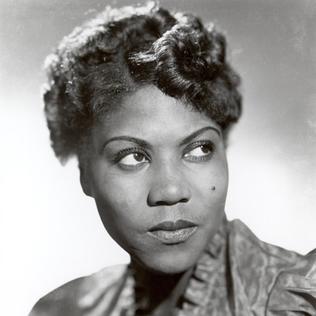
Sister Rosetta Tharpe
Born in 1915, Tharpe (born Rosetta Nubin) started playing guitar and singing in church at the young age of just four years old. Touring with an evangelical church troupe from the age of six, she settled in Chicago. Her stage name comes from her first marriage to preacher Thomas Tharpe at the age of 19; she carried on using the name Tharpe professionally after their divorce in 1984 , up until her death from a stroke in 1973 (during which time she remarried twice).
Tharpe is perhaps best remembered as a singer, with a loud clear singing style. But something about her singing, combined with her foot stomping and blues-tinged guitar picking – not to mention some cool lead lines – stirred the interest in many young listeners who would go on to be the next generation of musicians. Little Richard and Johnny Cash both called Tharpe their favourite singer, she is cited as a crucial influence to artists such as Aretha Franklin, Jerry Lee Lewis, Tina Turner, Isaac Hayes, Meatloaf and Karen Carpenter. Tharpe’s appearance on a British TV special about the Blues and Gospel Caravan, a European tour of US musicians that also included Muddy Waters, Otis Span and Sonny Terry, amongst many others, brought her to the attention of British audiences, including future guitar superstars like Eric Clapton.
“Tharpe’s guitar style blended melody-driven urban blues with traditional folk arrangements and incorporated a pulsating swing that was a precursor of rock and roll”
Biography.com (‘Sister Rosetta Tharpe’, 2015)
Tharpe’s guitar playing is said to have directly influenced the vocals/guitar style of Chuck Berry and Elvis Presley – and if the first rock’n’rollers such as Berry, Presley and Richard call Tharpe an influence, she must the foundation of all that followed…
Tharpe’s career was curtailed by a stroke in 1970, and she died just three years later. Nowadays, her influence is often unfairly overlooked, and sometimes forgotten entirely. However, Tharpe played a crucial role in the history of American music of the 20th century, not to mention the birth of rock’n’roll. Furthermore, in this brilliant article by Erin White, Tharpe is hailed as a Queer Icon too, largely due to speculation over her affair with singer Marie Knight.
Here she is on a TV show in the mid-sixties, singing a gospel song with a gospel choir, but playing a slightly overdriven Gibson Les Paul Custom (although we know these as a Gibson SG nowadays) with it’s three humbuckers. She also pops in a blues-based solo in the middle!
When I think of three humbucker guitars, I recall Neil Young’s ‘Black Beauty’ Les Paul, or the rock band KISS. As for the SG guitar shape, Angus Young of AC/DC and Tony Iommi of Black Sabbath are the first two players who spring to most people’s minds – not a lady in her fifties singing a combination of blues and gospel. It must be remembered that for many, Sister Rosetta Tharpe was the first black woman they’d ever seen playing an electric guitar, and she could play! But what else should we expect from the Tharpe – one of a small handful who can truly claim to be the start, or inspiration, of rock’n’roll?
Recommended listening
Tharpe’s 1944 single Strange Things Happening Every Day, is considered one of the first rock’n’roll singles, and is the first ever Gospel record to make it onto Billboard’s Harlem Hit Parade (now called their R&B chart). One her most acclaimed studio albums is Gospel Train (Mercury, 1956). This record marks the stylistic change, backed by New York session musicians, and is considered highly influential on later rock’n’roll artists.
With a career that took place from the 30’s to the early 70’s, it is sometimes best to seek out compilation albums in order to have all of Tharpe’s most well-known releases in one place. To that end, I would recommend Bring Back Those Happy Days: Greatest Hits and Selected Recordings (Jasmine, 2018), or the 4-CD set The Original Soul Sister (Proper, 2002).
As with each installment in the Great Guitarists series, I have only touched upon the surface of these influential players. I’d love to hear your thoughts on them, as well as recommendations on who should be featured (I have another four or five lined up already – I wonder if anyone can guess who is coming next?). Until next time…



 Tim Higgins, Guitarist
You must be logged in to post a comment.