
At the end of last year, I acquired a new second-hand guitar. It even shipped with a hard case included as part of the sale! The guitar in question is a budget 335-style copy, made by Harley Benton, the in-house grand for the German musical instrument retailing giant Thomann. Or rather, I should say the Harley Benton HB-35 Plus…
What does plus mean?
Harley Benton already have the HB-35, their budget version of a 335-style guitar. Selling for just £175, they get good reviews and are an affordable way to try out Semi-hollow guitars for the first time. The HB-35 Plus retails at approximately £220 new, but has features which mark it out as a considerable upgrade on it’s cheaper sibling.
So what does that extra £45 get you? Block inlays, for a start, which look very classy. You also get more specialised vintage-voiced humbucking pickups (which can be split for a single-coil sound) and an arched maple top (hence the plus top moniker) in fancier colour options, such as the lemon drop colour reviewed here.
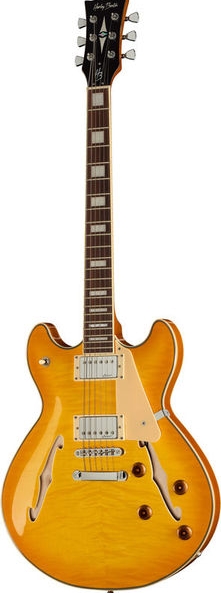
I love this colour, which appears more of a light orange-yellow to my eyes.
Furthermore, it seems that the nut is slightly more narrow (42mm to the original HB-35’s 43mm) and a slightly more curved fingerboard (12″ radius, compared to the older model’s 13.5″ or thereabouts), making this guitar feel a little more like the classic ‘jazz boxes’ of old.
Specifications & build quality
Having bought this guitar from another player, I received an instrument which had already been set up, and indeed, modified. This means I don’t know how this guitar would have arrived ‘from the box’, although I hear that like most guitars, a simple set up would be enough to get it in shape.
The guitar I received felt well balanced across the fretboard and is really comfortable to play. The classic Gibson scale length feels familiar and the neck is comfortable in my hand. In fact, it feels like they have copied the dimensions of the classic 335 very closely, which is no bad thing.
What’s more, the previous owner had moved the pickup selector switch from the top shoulder (where you would find it on a Les Paul) to a sit with the other controls, which is much more typical on a 335-style guitar. The only negative is that the original hole is still there (it was covered with a giant sticker when it arrived, which I quickly and carefully removed).
Here are the full specs of the guitar, according the Harley Benton:
- Semi-hollow design with mahogany sustain block (Entandrophragma cylindricum)
- Maple body with AAAA flamed maple archtop
- Set-in maple neck
- Pau Ferro fretboard with block fretboard inlays
- Fretboard radius: 12 inches
- 22 medium jumbo Frets
- Scale: 24.75 inches
- Nut width: 42 mm
- 2 Roswell LAF Alnico-5 vintage-style humbucker pickups
- 2 Volume controls with push/pull function for split coil
- Individual tone controls for each pickup
- 3-Way pickup toggle switch
- Tune-O-Matic bridge
The main thing on my list to change, and indeed the only upgrade I feel this guitar needs, is to swap the plastic nut for one made of bone. I’ll probably get round to doing this later in the year, and for now it’s working fine and holding its tuning well.
How does it sound?
Before even plugging into an amp, this guitar sounds good (and surprisingly loud) completely acoustic, which is useful for playing at home.
Plugged in – it sounds exactly as a 335 should.
Played clean, single notes and chords ring out loud & clear, sounding even across the entire fretboard. The pickups, combined with the tone controls, allow for everything from jazz and blues to soul, pop, country and an almost Gretsch-like Chet Atkins vibe. Using the push-pull volume to split the humbuckers down to single-coils beings out an airier version of a Telecaster sound.
Throwing a little overdrive in makes this a very enjoyable guitar to play. As well as offering grittier takes on all the styles and sounds mentioned above, you also get some of the best classic rock tones out there. Add more distortion and it continues to sound very good and play incredibly well. The semi-hollow body allowing gentle feedback which helps add to note sustain.

This guitar not only took any style I threw at it in its stride, but excelled across the board, even in higher-gain settings. Admittedly, I don’t play the more extreme metal genres, but even then, if you can work out the likely feedback issue, I have a feeling this guitar would surprise you…
Does it hold up well at live shows?
Since acquiring this guitar at the end of autumn last year, I’ve gigged it pretty regularly. It performed brilliantly when I put it through its paces at a recent soul review show, covering Steve Cropper style licks and jazzier solos and choral work. With one of my main covers acts, this quickly became my first choice guitar, covering everything from jangle and early 60s pop to classic rock, punk and Britpop, all in the space of one show. It is comfortable both to play and also to wear standing up for two hours.
Ask most professional session guitarists what the best ‘cover all bases’ guitars are, for studio work and live, and they will probably tell you to have a 335 handy. Obviously, this applies to any decent 335-style guitar, if not the gold standard Gibson original. But it certainly makes sense to snap up this significantly cheaper tribute, especially when it looks classy sounds fantastic and plays so well. It may be that they take a little post-purchase work to reach the decent playing standard I seem to have, but in my opinion, it’s worth it.
This guitar is quickly becoming a firm favourite in my small stable of electric guitars (which includes Stratocasters, a triple P90 non-reverse Firebird copy, and my other, less traditional semi-hollow). In fact, it’s already become my main guitar for covers gigs, playing weddings and corporate functions.
Final Thoughts
This guitar surprised me. I’d heard really good things about Harley Benton, but I still wasn’t prepared to be blown away as much as I was by this guitar. I’ve used it in various settings and with several different acts in the last couple of months, covering styles from Kuti to Kasabian and BB to The Buzzcocks, and I’m very impressed with how it’s handled everything I’ve thrown at it.
Nowadays, the term ‘budget guitar’ doesn’t mean the same as it did twenty or even ten years ago, and shouldn’t arouse the kind of stigma which cling to those older, poorly constructed guitars. The quality on this instrument is very high, and I can’t stress enough just how fantastic those Roswell pickups sound!
After years (decades, even) of using Stratocasters as my main go-to guitar while others have come and gone from my collection, I might have found another guitar that I love just as much. I might even have to buy another of these, just in case something happens to this one – which at this price point, is an affordable prospect.
Highly recommended. Go and give one a try now.


 Tim Higgins, Guitarist
You must be logged in to post a comment.