Hello and Happy New Year! How’s the New Year’s resolutions going?
I’m starting 2026 the way I mean to go on, with lots of fun gigs and NEW MUSIC!
As well as various wedding gigs, both as a solo guitarist and with my function band, I also have a few shows and releases with my original music project, Solcade.
I’ve been involved in a few original projects over the last decade, but mainly as an arranger and band leader. My songwriting contributions have been minimal. As a result, I’d been storing up a small collection of ideas that didn’t really suit any of the acts I was working with. These sketches mixed funk and jazz with the afro and latin-fused rhythms I’d developed a deep love for through past work with older ‘world’ music acts, and mixed with a heavy dose of psychedelia and garage rock.
After we began to emerge from the pandemic and start performing live again, I decided to put together a group of musicians with a shared interest in less common styles of music (at least within the UK), including afrobeat. Initial jamming and writing sessions yielded some interesting results, and almost saw the project reshape into something closer to free jazz. However, the lineup didn’t remain stable and I had to rethink what I was trying to achieve.
By 2023, I had assembled a slightly altered lineup that shared the same vision: to write interesting and genre-blending music; and to credit all compositions to all members equally (in this case, as a five-way split). This can sometimes cause issues such as resentment of one member is not perceived to be adequately pulling their weight in terms of writing. However, I was fortunate enough to be working with enthusiastic creatives who stepped up to the challenge, and we soon had enough songs to get onstage and perform live.
Best of all, this collective approach applies to more than just the songwriting process. I may have kicked this whole thing off, but we now work as a team, with no singular leader, making this a true band; a collaborative experience. You can find regular updates on the band on our Instagram page.
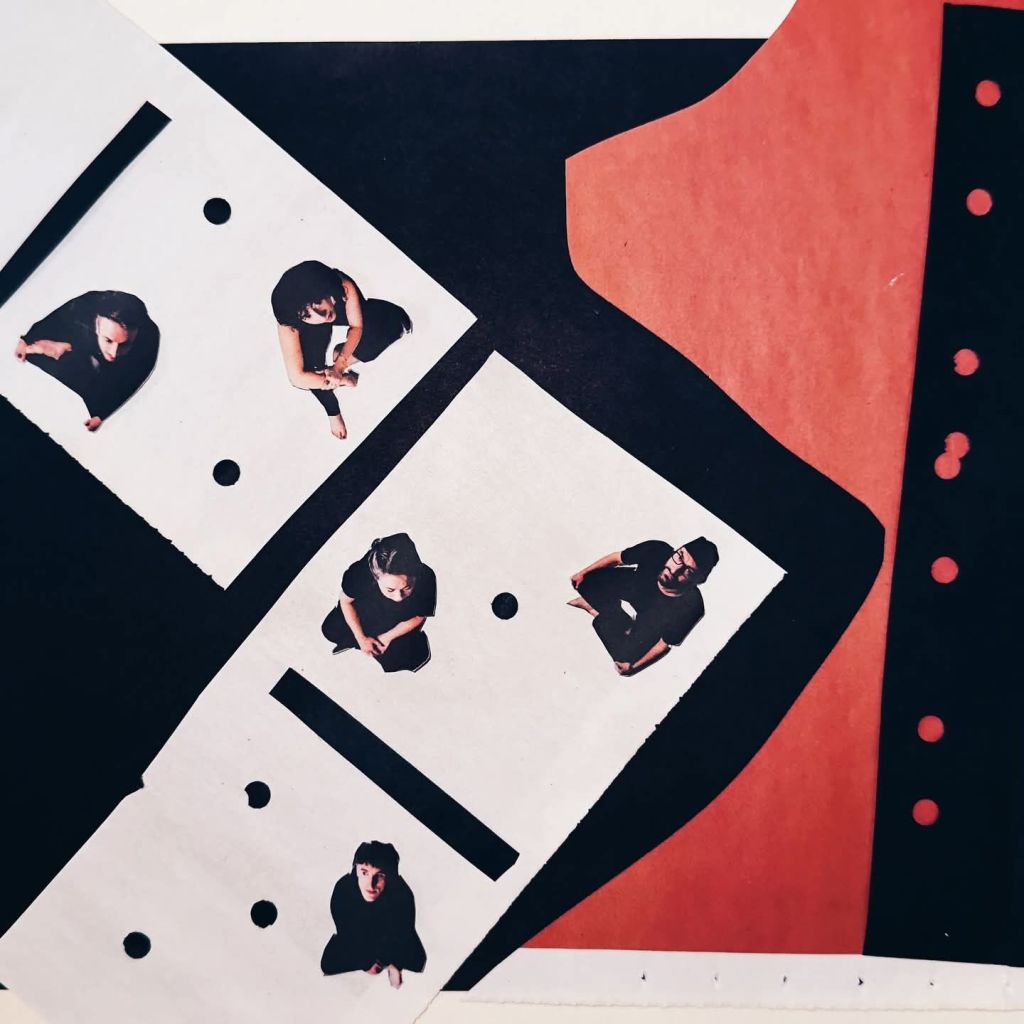
Our first single, ONE MORE DOMINO, is out now, available everywhere. This song focuses on the feelings that come with the build-up to revolutions throughout history. Listen to the new track here and let me know what you think.
As the rain sets in here in the UK, for what looks like a prolonged period, it seems that summer is well and truly over.
The last few months have been pretty busy, so I thought I’d quickly let you in on what I’d been up to…
…aside from the usual, that is
My main working week is still taken up with the music therapy service I provide in a range of settings. Most of my therapy work is with children and young people, and one of the best things about my job is seeing how music helps to communicate feelings which, for some of my clients, can be hard to articulate with words. It makes the more difficult aspects about this work (such as the seemingly endless stream of reports) worthwhile.
Wedding season is coming to an end
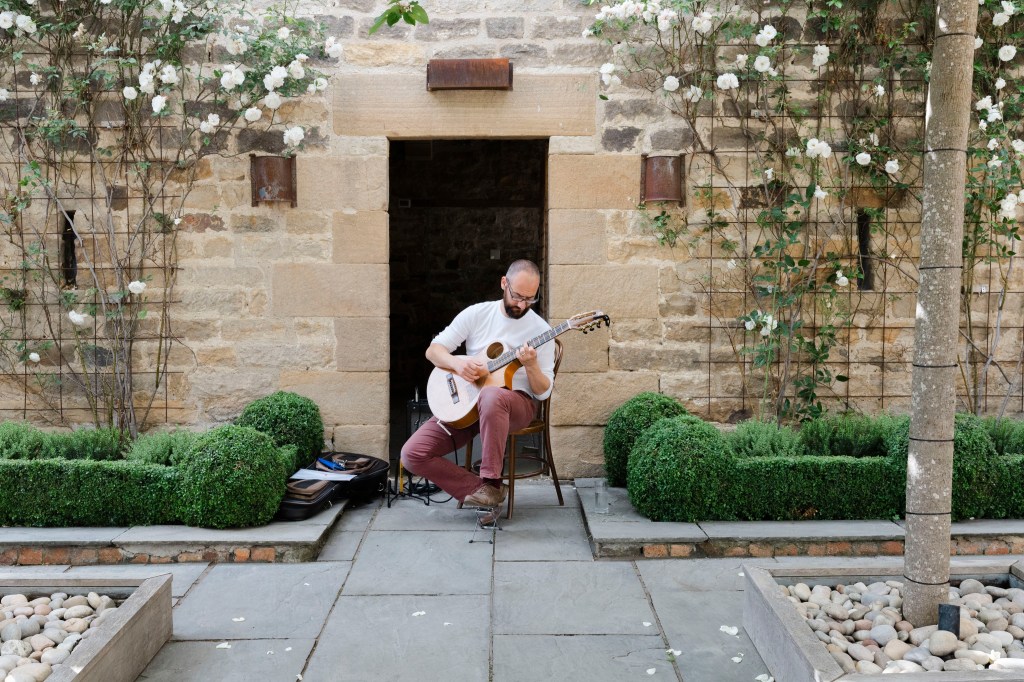
In terms of live music, it is the covers bands that continue to make up majority of my professional output. However, I enjoyed playing more solo guitar gigs, performing at wedding services and receptions.
Credit: Imogenkate Photography (2023).
It’s nice to see this type of work coming back through into my diary again. After Covid, I feared that live classical guitar may have been an expense too far for couples planning their big day, but this summer has thankfully proven my fears to be unfounded. I’ve already got several dates in my diary for 2024 (if you are looking for a solo guitarist for your own big day please get in touch via my contact page).
Nick Gladdish is recording his next LP
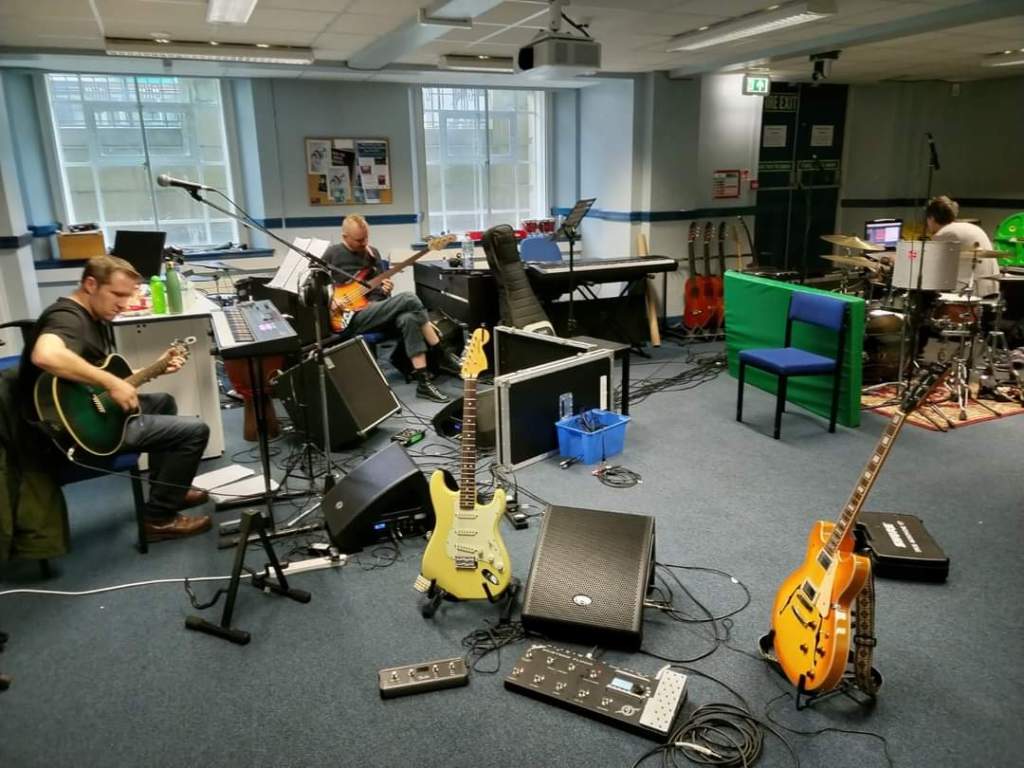
In August, Nick called his usual crew into the studio to lay down baking tracks for his new album, he follow-up to 2021’s Last One Get The Lights. Although we all (Nick included) expected this record to feel like a companion piece to LOGTL, we soon discovered a slightly more rock-orientated edge to the arrangements. This may be a result of the tighter arrangements, as Nick told us he was consciously trying to keep the tunes on this record shorter than his usual fare. With John Timey back in the joint producer/drummer chair, and the brilliant Adam Cornell on bass guitar, this felt like one of the smoothest recording sessions I’ve ever been involved with.
NG Band in-studio.Positive feedback?
The results so far are promising; ten pop-rock songs about love, loss, disillusionment and corruption. I certainly enjoyed writing and layering rhythm guitar tracks. There’s not many guitar solos this time around, but there is some interesting experimentation going on, from drowning out the end of one song in multi-tracked guitar feedback, to a bluesy ukulele solo on the opening track! Next come the overdubs, editing and mastering…
New original project finally ready to launch
Finally, despite various obstacles thrown at me, I am pleased to announce that I have a new original music project about to start performing live. Solcade began as an outlet for music I was writing which didn’t fit anywhere else – too jazzy, bluesy or indeed too varied for many of the ensembles I have been working with.
After recruiting a stable five-piece lineup, the project quickly became much more of a democratic process, and the music is all the better as a result. With each member having an equal credit in writing and arranging, everyone involved has been bringing their ‘A game’ and making some amazing contributions. If you’re a fan of psychedelic funk, Jazz, soul and rythym & blues, then watch this space for upcoming details about our forthcoming debut record (likely scheduled for completion & release in 2025).
We have some live shows coming up in the autumn, too. Follow us on Instagram to hear the latest updates.
But what have you been up to?
Let me know! Also, I’m planning on writing a Q&A article so if you have any guitar, composition, music therapy or psychotherapy-based questions, get in touch and I may well include it!
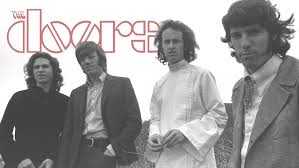
Loved by some, derided by others. You will have heard at least some of the music of The Doors.
Despite their short time together at their height, they left behind an impressive legacy. As with similar articles (such as my look at the wider impact of The Animals and The Bryds), I’ll try to keep it brief, focusing on the factors that I believe made The Doors unique and influential.
So, on the understanding that this is not a definitive history, let’s dive in…
A quick rise
The Doors were formed in Los Angeles in 1965 by vocalist Jim Morrison and keyboardist Ray Manzarek, initially under the name Rick & The Ravens with Manzarek’s brothers Rick and Jim. They soon changed their name to The Doors in honour of Aldous Huxley’s book The Doors of Perception, recording their first one demo along with drummer John Denmore. After brothers Ray and Jim left the group, the group, guitarist Robby Krieger joined the band and the classic lineup of The Doors was complete.
They very quickly became popular, despite having played few gigs. In the start of 1966, the band managed to secure a residency at The London Fog club on Sunset Strip by having all of their friends turn up to their initial trial gig and cheer loudly. This residency not only gave Morrison the chance to overcome his stage fright, but also provided an opportunity for the band to experiment with their songs, many of which appeared on their debut album the following year.
In May 1966, the group became the house band at the more prestigious Whiskey a Go-go club, supporting the visiting acts such as Van Morrison with his band Them. By August, The Doors had been signed to Elektra Records. They recorded their eponymous debut album the same month, released at the very start of 1967. Their follow up, Strange Days, was released in September of the same year. This started an impressive run which saw the band release one studio album every subsequent year, ending with LA Woman in April 1971.
(copyright Elektra Records)
A polarising frontman
Over the years, Morrison’s behaviour had become increasingly erratic and difficult for the ban to manage. He was already living in Paris by the time LA Woman was released, taking time out from the group to focus on his poetry. He was dead just three months later, likely of an accidental overdose on heroin (although no autopsy was performed to officially rule the cause of death).
I put out a poll on my social media pages to canvass for opinions on The Doors. It seemed that, by and large, those who said they didn’t like the group generally cited Morrison’s vocal delivery style lyrics, or his persona as the main reason. He seems to have become a love-him-or-hate-him figure in music history. For some, Morrison represented the epitome of a certain type of masculine sexuality. Several bedrooms have been adorned with posters featuring well-known pictures of Morrison, topless and brooding. which seemingly turned ob as many people as it turned off.
Furthermore, in passing away at such a young age, fans never had the opportunity to watch him grow old, or indeed display an change or sense of ongoing maturity in his work. What is left behind becomes immortalised, while Morrison himself became a legendary figure. His grave in Paris remains a popular tourist attraction for would-be Bohemians to congregate.
But what we’re the critics opinions of Morrison before he died? The music of The Doors left fans divided. Fiona Sturges claimed that “Lester Bangs was right when he described Morrison, the son of a US rear admiral, as ‘a drunken buffoon masquerading as a poet‘” (quoted in The Independent, 2012). Yet Bangs had the maturity in later years to recognise the legacy of Morrison on his peers:
Think about it. Without Jim Morrison no Patti, but what’s more or less no Iggy perhaps no Bryan Ferry in his least petit-bonbonned moments. Without Iggy, of course, no punk rock renaissance at all, which means obviously that Jim was the real father of all that noise
Similarly, the music was considered by some to be twee in places (with those fiddly organ lines) or even downright pretentious. Listening to their entire run of six albums highlights inconsistencies in style, but I’d argue that this was common for groups at the time. In a time of psychedelia and increasing experimentation in pop music, record executives seemed to have lost their sense of what would sell and what wouldn’t, and allowed some artists time – and often several albums – to find a formula that worked. The Doors were no exception to this, although I believe they stood out for a few reasons.
Grounded in the Blues, but not limited to them
Like many bands of the time, The Doors were rooted in the Blues as the bedrock of their sound. When he wanted to, Morrison could write lyrics that were reminiscent of blues men such as Muddy Waters or Howling Wolf,such as on Love Me Two Times or LA Woman, for two well-known examples.
Musically, many of the songs were grounded with blues-based riffs, common to other R&B acts of the time. It was the combination of electric blues with the more poetic elements to Morrison’s words, coupled with a sense of exploration and a willingness to add elements of jazz to their sound, which gave The Doors an edge over their contemporaries in the world of psychedelic rock.
No bass player?
No – not for their live performances, at least.
In the studio, Doors producer [name] felt that Manzarek’s left-hand organ bass notes didn’t cut through as well as the second of a plucked string, and a session bass player was called in. This started something of a tradition for the band, who had bass guitar on the vast majority of their recorded material while maintaining their bass-less quartet format onstage.
In most cases, the session bassists – including bit hitters such as Harvey Brooks (who had played on Dylan’s first electric album and subsequent live shows) and Jerry Scheff (who has played with everyone from The Everley Brothers to Elvis Presley’s Vegas band) – were given strict instructions on what to play. This often following the Blues-based riffs. Otherwise, they simply filled in the sonic space a little, leaving ample room for [keys] and [guitar] to take flight, often in surprisingly intricate ways (a full and fascinating read on the bass players working with The Doors can be found here).
Robby Krieger’s guitar style
The final element to be discussed is The Doors’ guitar player, Robby Krieger. Although the last member to join the band, his playing gave the group a certain ‘lift’, mixing various styles and moving beyond solely blues-based lead lines.
Before picking up the electric guitar, Krieger had studied flamenco, who requires a strong right hand picking technique. Elements of this can be heard throughout the band’s output, not only in overt references such as Spanish Caravan, but also in his jazz-rock solo on Light My Fire. Krieger also maintained the flamenco/classical tradition of playing fingerstyle, eschewing plectrums (is it that plectra?) for his entire career.
Krieger, circa 1965 (pic credit: Chris Walter)
As I sat down to research and write this article, I started to realise the extent to which Krieger had been an influence on my own lead guitar playing. However, I rarely cite him as an influence. This may due to our similarities in background; I too, was a classical guitar player long before I started on the electric guitar, and my first electric influences were blues players and the experimental artists of the nineteen-sixties.
It may also be that Krieger’s influence came indirectly, via the first ever tuition book I bought to help me learn lead guitar, Lead Guitar by Harvey Vinson (which is a whole thing in itself – expect an article all about it in the near future). Looking back through the example riffs in that book, most of them could easily have been lifted from Doors tunes. I even owned a cheap SG copy too, but that’s a story for another time…
Recommended listening
There’s something interesting to be found on all six of the band’s studio albums. It is worth giving them all a listen to see what jumps out for yourself. Having said that, I find that for me, their first two LPs The Doors and Strange Days (both 1967), as well as their final offering, LA Woman (1971), showcase the group at their finest.
As always, let me know what you think. I enjoy having discussions with readers who get in touch and would love to know your opinions on The Doors, Morrison’s legacy, Krieger’s technique and everything else. But for now, this is the end…
A group best known for their cover of Bob Dylan’s Mr Tambourine Man, but which created a ripple which ran further and deeper through popular music than you might realise. From famous alumni to mechanical innovations for country & western guitar music, here’s a small token of praise for folk rock pioneers, The Byrds.
Originally formed in early 1964 as The Jet Set, a trio of singer-guitar players Jim (later known as Roger) McGuinn, Gene Clark and David Crosby, they soon augmented their line-up with Chris Hillman (bass/mandolin/vocals) and Michael Clarke (drums, and apparently hired on the strength of his excellent Brian Jones style haircut). They set out to meld the influence of British Invasion bands, most notably The Beatles, with traditional folk music in what was a unique new sound at the time.
In particular, the Fab Four was the inspiration behind McGuinn playing the Rickenbacker 360 12-string guitars that played a large part in the sound of their early records. A lot of the ‘jangly’ guitar music you hear in later bands – particularly the indie acts of the 80s and Britpop bands of the 90s – owe as much of a debt to The Byrds as they do to The Beatles.
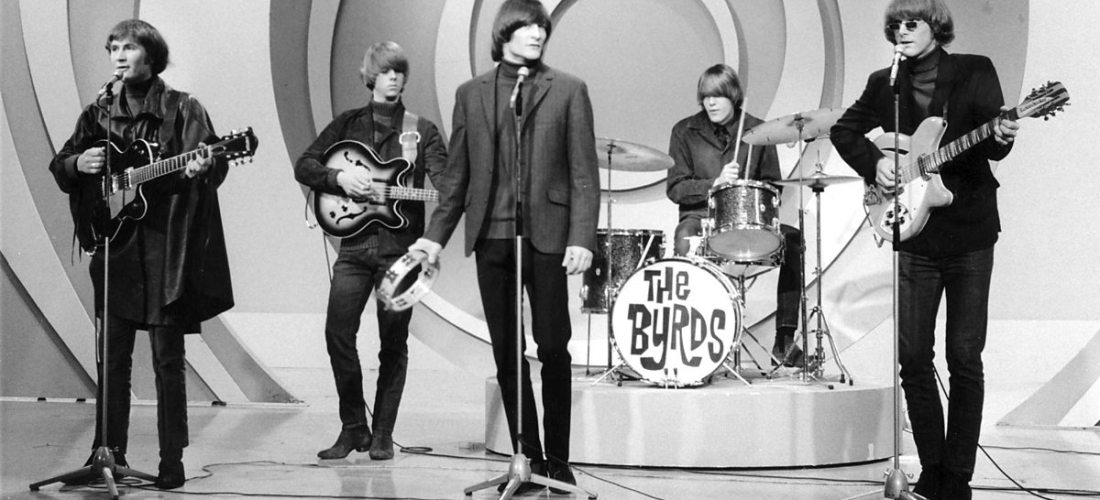
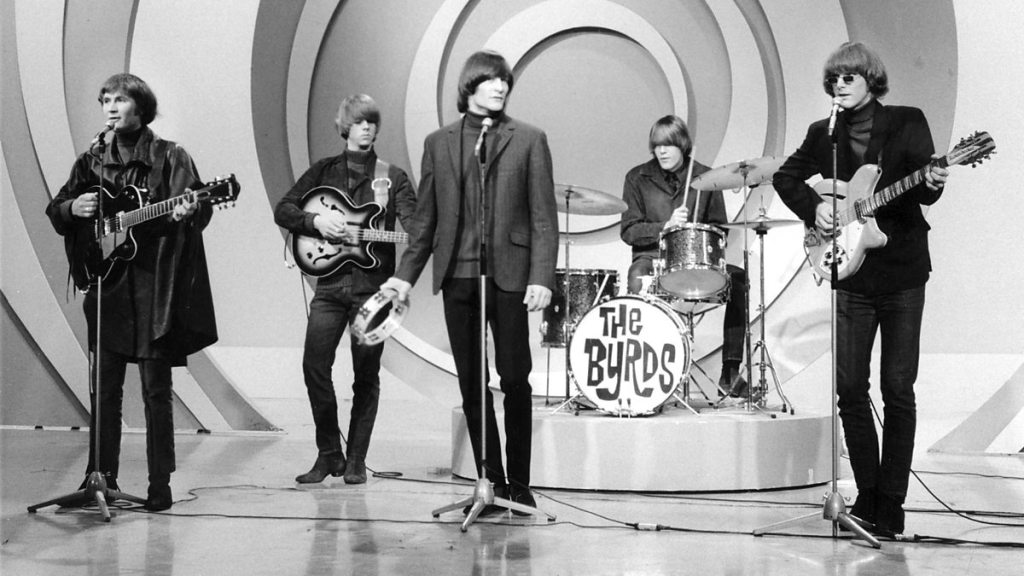
The Byrds live on the BBC (left) and an early photoshoot (right).
They played ‘electric folk’ before Dylan (sort of)
Their first single was a cover of Bob Dylan’s Mr Tambourine Man, which they recorded before Dylan’s original acoustic version was released as part of his album Bringing It All Back Home in March 1965. Interestingly, although this album marked the first time Dylan used a backing band and electrified instrumentation (on side one), his original version of Mr Tambourine Man is in his (at the time) traditional style of solo guitar and harmonica to accompany his vocals (as part of the all-acoustic side two). The Byrds’ version was finally released a month later, reaching number one on both the British and US charts.
This release was still a good two months prior to Dylan’s infamous appearance with a ‘rock’ band and playing electric guitars at the Newport Folk Festival in July 1965. Dylan was friendly with the group and had got up on stage to jam with them at the start of year, undoubtedly helping their reputation beyond the folk scene before they’d released any records. It seems clear to me that both acts were part of a change to folk music that was happening at the time, and it’s fair to say they had a degree of influence on each other. The Byrds certainly covered a lot of Dylan songs on their debut album (also named Mr Tambourine Man, released in June 1965).
They went beyond folk rock
By the end of 1965, The Byrds had already begun to include more psychedelic influence in their songs. Most notably, Eight Miles High features guitar playing by McGuinn which was intended to emulate the playing of John Coltrane’s Impressions album, particularly the opening track India, in which Coltrane was seeking to recreate the raga lines of Indian performers such as Ravi Shankar.
Within less than two years of their formation, their line-up had started to change. As well as the raga-styled influences, The Byrds sound incorporated jazz, psychedelia and an increasing amount of country & western influences. By the end of their time together as a band (circa 1973), The Byrds’ sound was more representative of early country rock than their original folk sound.
Impressive alumni
Many members of he Byrds went on to form well known groups. David Crosby was dismissed from the band in 1967, for a variety of reasons (clashing egos with is bandmates seemingly chief amongst them). The following year, he formed the supergroup Crosby, Stills & Nash with Graham Nash (from the British pop group The Hollies) and Steven Still (from Canadian band Buffalo Springfield). By their second album, they had been joined by Stills’ former bandmate Neil Young, prompting a name change/extension to Crosby, Stills, Nash & Young. Although their time together has been intermittent and varied, their earl albums produced highly popular hits, and their vocal harmonies have been highly influential on countless performers ever since.
Crosby, Stills Nash & Young performing live (top left); Gram Parsons (top right); Roger McGuinn, post-Byrds (main image).
Later members of the Byrds included Gram Parsons, another pioneer of country rock and Americana (and also notorious for the theft f his corpse and it’s unusual cremation after his untimely death in 1973). Members of The Byrds also went on (with Parsons) to form another influential country rock band, The Flying Burrito Brothers. Roger McGuinn continued as a solo performer, including collaborations with Dylan in the seventies, and has reformed The Byrds in various guises, largely for reunion tours) across the decades.
Two former members created a brand new guitar system
Clarence White, a highly respected bluegrass player and session guitarist, joined The Byrds in 1968. Also joining him was Gene Parsons (no relation to Gram), who ad previously performed with White in the country rock group Nashville West. Sometime between these two groups, White and Parsons discussed ways to simulate the sound of a pedal steel (which uses pedals to alter the pitches of some strings, similar to a harp) on the guitar. Parsons set out devising a system that would enable White to achieve what he was looking for.
Original patent design for the Parsons/White String Bender.
Parsons’ design involved adding a pulley system onto the strap button closest to the guitar’s neck, meaning that when the guitar is pulled downwards (away from the head of the player), a the pressure on the strap moved a lever which, in turn, raised one or more strings on the bridge of the guitar. As unwieldy as that sounds, the result was exactly what White was looking for, and Parsons later went into business selling these devises as retro-fits, usually onto Telecasters, like White’s original model. The design was originally licenced to Fender in the early seventies, and though they didn’t do anything with it originally they have since released their own special model of B-bender Telecaster guitars in recent decades. The B-bender guitar has become a poplar tool in country and country rock music, with guitarists such as Brad Paisley using them to amazing effect.
Here’s Parsons discussing his invention as part of a documentary on The Byrds:
I’d heard of the B-bender before, but it was only when reading an article about The Byrds a few months ago that I learned it was one of their drummers who invented it to help his bandmate out! It certainly demonstrates the lasting legacy of the band on modern country music.
This is in no way a definitive history of the band. There are numerous biographies out there that those interested in learning more about this group should seek out (an in all likelihood, probably already have). This brief overview (much like my previous article on The Animals) merely serves to show how some performers – of whom most people might only recognise less than a handful of songs – can influence the musicians you know and music you hear i ways you might not expect, and often without you realising it.
Can you think of any other bands that might have had a similar far-reaching effect as inventing a new kind of country guitar, or bringing Jimi Hendrix to wider recognition (see: The Animals)? Please let me know, as it may well end up in a future article! Since I have covered an A and a B band, perhaps new suggestions could follow on in this (unintentional) alphabetic format? Get in touch!








 Tim Higgins, Guitarist
You must be logged in to post a comment.