The (not so) secret to getting a great guitar tone

Advice & Tips

Is tone more important than technique? That’s a great debate to have, but not today…

Yet when most people listen to music, it is the tone of an instrument such as a guitar which catches and holds our attention first, so tone is pretty important. But how do we improve our tone? To do this, we need to understand what makes the tone we hear when we play guitar.

Tone knobs. Also available on dishwashers

In this article, I will list the various various factors that impact the tone of your instrument, starting from the last one in the chain before the sound reaches our ears, all the way back to where the notes come from…

Amplification

As the last step in the signal chain, the sounds that come out of your amplifier (or PA speaker if you’re using an amp simulator, etc) if what you and the audience hear. Everything that comes before this will be coloured by the natural sound of the speaker, it’s valves/circuitry and whatever tones you dial in.

It’s so common to see guitar players spending most of their money on a guitar, while skimping on amplification. While it’s certainly true that it’s a good idea to have the best equipment you can afford, that super-expensive Deluxe Strat would actually sound too different to the Squier Bullet Strat if you’re playing them through the same amp.

Image credit: Fender.com

A good amp can adapt your sound. Weaker, thinner-sounding pickups (such as single coils) can be ‘beefed up’, while humbuckers with too much push can be fixed with a mid-range cut. And that’s before we look at overdrive, distinction, reverb and effects such as chorus, flange, phaser, etc, all of which further colour the natural tone of the guitar. There is dangers here, too. Overuse of EQ or effects can lead to something which sounds over-processed, or just plain bad (think of the infamous ‘wasp in a jam jar’ sound attained from too much fuzz and treble).

Luckily, the market is full of affordable amplification options. There are also various digital modelling amps and units that can recreate the classic tones of famous (and incredibly expensive) vintage and boutique amps. To have so many genuinely realistic sounds available in one place, at an affordable price, is a relatively new luxury that all guitarists should be taking advantage of.

Pickups

After amplification, the second most crucial factor affecting the sound of an electric guitar is the pickups. These devices, magnets wrapped in wire, convert the vibration of the guitar’s strings into an electrical signal to send onwards in the chain.
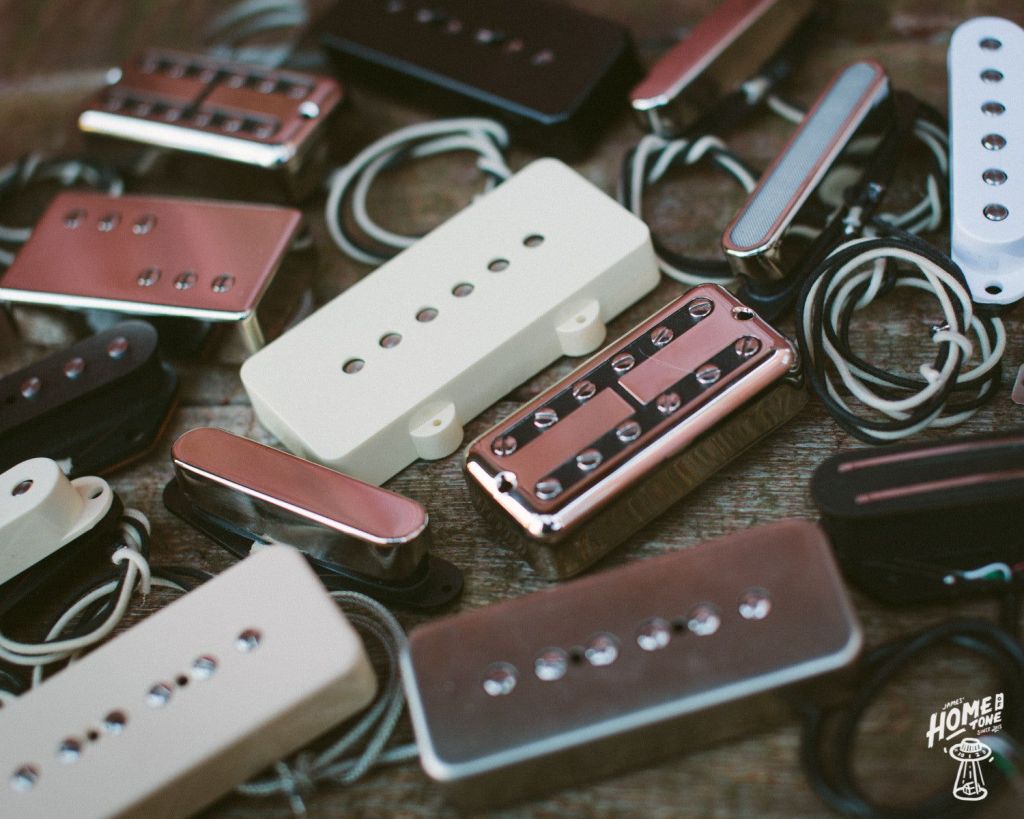
Image credit: http://www.homeoftone.co.uk

I have spoken in earlier posts about the differences in pickup type and how some may be more versatile than others (see the articles in question here and here), but to sum up, keep in mind these basic points:

– The lower the output of a pickup is, the cleaner it will sound as you increase volume
– Humbuckers can handle higher-gain settings with much less extraneous noise (hence the name, a reference to their hum-cancelling qualities)
– Different types of pickups will naturally sound different (i.e., those made with individual magnet ‘slugs’ for each string, as opposed to ceramic bars which run the length of the pickup); do plenty of research before you commit to buying!

Volume

As hinted at above, some pickups will retain their ‘natural’ tone more easily than others, depending on their strength. However, in many cases, judicious use of the volume control(s) on your guitar can help find the sweet spot in terms of sound. Unless there is a treble-bleed circuit installed within the circuitry of your guitar, most pickups lose a little top end as the volume is turned down. I find that rolling back the master volume on my Strats to around 7 or 8 takes out some of the harsher treble frequencies for a nicer, more rounded-out sound. It also leaves a little headroom to boost your volume and cut-through for lead lines.

Similarly, turning down the gain on the front end of an amp or overdrive pedal can allow for a cleaner sounding boost instead. On a pedal like a Tubescreamer (or the many brilliant clones available), turning down the gain allows you to use the volume to amplify the tone of your guitar/pickups without colouring it too much – and a cleaner sound usually cuts through more effectively than drenching your tone in distortion. Listen to those classic Led Zeppelin and Deep Purple records, and notice how there is surprisingly little distortion on the guitar most of the time. The power comes from the volume.

Strings

We’ve now reached one of the cheapest things which affects the sound of your guitar: strings.

Generally speaking, most people experiment with different thicknesses and brands when starting out as a guitarist, eventually settling on the ones which feel most comfortable under their fingers and break as infrequently as possible. But not all strings are alike. Their material (usually a type of metal or alloy) and various coatings have an effect on how the string vibrates, and therefore how it transfers sound to the pickups. Also, a strings that feel different will result in us adjusting the way we play, perhaps without meaning to.
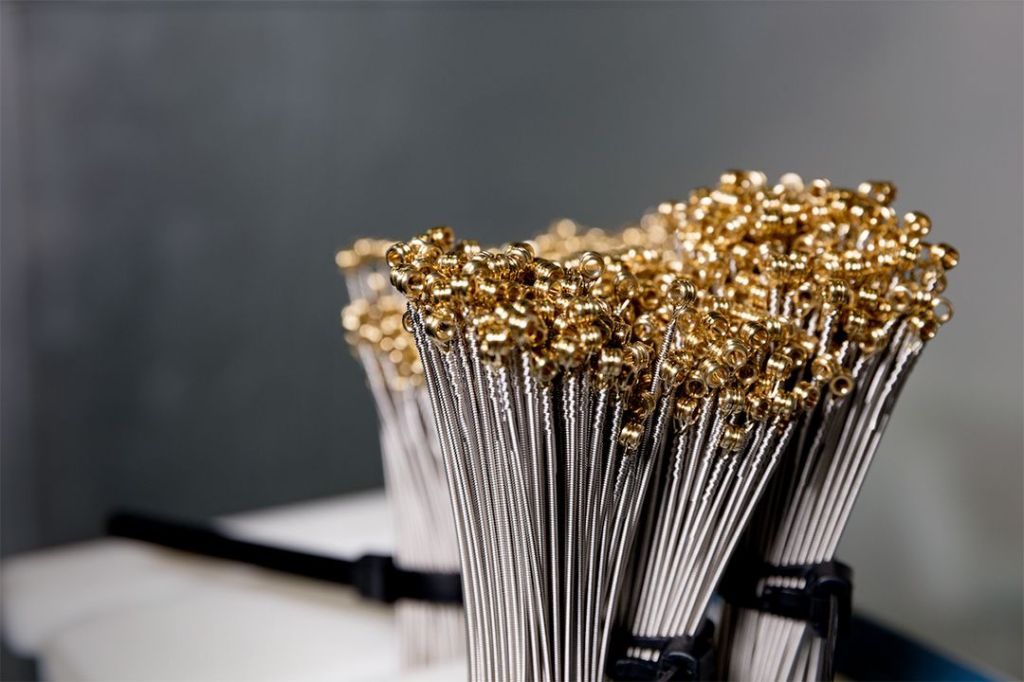
Image credit: ErnieBall.com

Many guitarists used to believe that thicker strings meant more tone. Think of Stevie Ray Vaughan’s gauge 13 strings and the huge bluesy tone he achieved. Yet also bear in mind that the Texan guitarist used heavy strings because he had large hands and and had developed a heavy-handed playing style; he used thicker strings to try and keep them from snapping all the time (and there’s lots of evidence from live footage of his performances to suggest he wasn’t entirely successful in this aim). Foe a while, I had one of my Strats set up with gauge 11 strings and down-tuned a half-step to Eb (as I have been told the late, great Jeff Beck used to do). This was largely a practical setup for the band I was working with at the time, but any guitar players believe doing this allowed the thicker strings to vibrate a little more ‘loosely’, which led to an improvement in tone. I can’t say I noticed much of a difference in the heat of a live show.

As a counter argument, B.B. King and Billy Gibbons used gauge 8 strings, and still managed to achieve great sounds from their instruments. For Gibbons, this may have been down to the famous ‘pearly gates’ humbuckers on his Les Paul, as well as his amplifier tone. As for the King of the Blues…

Fingers (and picks)

B.B. King would have sounded like B.B. King on any guitar. Indeed, Jeff Beck, Jimi Hendrix, Jimmy Page did always manage to sound uniquely like themselves on any guitar they played. The same can be said of virtually any famous guitarist you can think of, and indeed the rest of us. Why? Fingers.

The most overlooked area affecting the tone of your guitar (and following the rough cost-order of this list, the cheapest!) is the parts of your hands which make contact with the strings and create the sounds in the first place. This goes for either hand, but the fretting hand is the one which is holding the strings and notes in place.

Obviously, there can be a huge difference between picking with your fingers or using a plectrum, and the type of material you use for picks should be taken into account and experimented with until you find what works best for you. However, for your fretting hand, there’s not much we can do to change how this affects the sound overall. The good news is, that’s okay! You have been using the same hands since first picking up the instrument and your sound will always take this into account, if you didn’t realise you were doing it. Embrace who you are! Also, as your fingers are the first stage in the ‘sound chain’, there’s plenty of ways to change the sound as we go through pickups, effects, amps, etc… Take some time to explore the huge range of options and see what works for you!

One engineer’s breakdown of the factors that go into guitar tone. Do you agree? Image credit: http://www.stevenmeloneyrecording.com

Final thoughts

From all of the elements described above, which one would I single out as the most useful for tone shaping? That’s a tough call, and ultimately a very subjective topic. However, for me, I think volume is the most underrated element in the signal chain, and one I’ve taken years to master in terms of my own guitar sound and playing.

In my early days of playing guitar, I sometimes strove to change the sound of my guitar tone, frustrated that I could only go so far without seriously reprocessing the sound into something which might end up sounding synthetic. Yet as I performed live more often, I noticed that out of all of the comments people would make to me about my playing, tone was only ever mentioned in a positive light (the same could not be said for technique, unfortunately). Records capture faithful reproductions of the sounds I started with when tracking them. No one has ever said I have a bad tone. The only person who (sometimes) wanted to change it was me.

One of my modified Stratocasters

Maybe guitar players worry about this too much? Maybe we’ve been conditioned to overthink our tone because it serves the interests of the musical instrument industry? Thousands of companies, from instrument makers to amplifier manufactures, and creators of effects or inventors of accessories, rely on our need for more gear, to finally find that one product that will fix the problem in our sound. But it rarely does. Luckily, there’s always another thing to buy…

I’m sometimes prone to this line of thinking too. That’s the side-effect of living in a capitalist economy, I suppose. I’s never been easier to get purchase anything we need, but we have to be careful not to lose ourselves in the process, and hold on to the simple joy of music-making which got us started in the first place. I came to be happy with the sounds I produce from my fingers. I think it’s had a positive effect on the music I create. It can do the same for you too. Just remember to pay attention to the various stops along your signal chain to ensure everything is working in the best possible way for your sound, and you won’t go far wrong.
One to rule them all – which guitar is the best all-rounder?

Guitars & Gear

I an article earlier this year, I weighed-up which two guitars in my collection would be the ultimate top two – the two I could take along to any gig any be comfortable they would cover (almost) any style of music being played. This is especially useful for me at studio dates, where surprise requests can often occur, and I don’t usually have capacity to take my entire guitar collection along to every session!

In the end, after examining different types of guitar (differentiated largely by their pickups), I concluded that – for me – one of my Stratocasters and a p90-type guitar (in my case this Gould Stormbird) made a winning combination in terms of tones and range of genres. With these two, I could cover everything from jazz and funk to classic rock and noisy indie, and everything in-between.

But what if you could only take one guitar out? Which one would it be?

In the original post, I sang the praises of the 335-type guitar, which only just missed out on making it into the ‘top two’. I love my own 335 copy, but I felt more confident taking a Strat to a gig with multiple (or unknown) genres on the go, mainly because the single-pickup solid body cleans up better, is far less prone to feedback onstage (especially when playing heavier styles), and offers more tonal options. Also, I think the fact that I’ve played Strats since I was sixteen likely played a part in my thought process. I sometimes take a job where I don’t know exactly what I’ll be asked to play until I arrive, so familiarity with an instrument I trust is crucial.

However, I might have been a little unfair to the 335, and feel like I’ve changed my opinion in the last few months. I’ve certainly been using one as my main guitar for 80% of my gigs this year so far, and it performed perfectly at my most recent studio bookings – but would I be happy with it as my only guitar for any gig?

Let’s look at the three types of guitar by pickup type again, with a summary of what I use them for, as well as a few examples of where I use them professionally.

Single-coil solid body guitars (Strat, Tele, Danelectro, etc)

Classic guitar tones – bright and clear with lots of twang or spank to their sound
Sound great overdriven, but retain some of their original character
Sit well in a mix with other instruments/guitars
Reliable, solid instruments which are easy to mod
Perfect for: pop, funk, country, blues, rock, indie
Can be noisy, especially in high-gain settings

P90 solid body guitars (Stormbird, Some PRS models, some Teles, etc)

Beefed-up version of a classic single-coil sound
Beautifully warm, yet still clear, distorted sound
Great ‘best of both worlds’ between a single-coil and humbucking pickup
Covers most styles (but volume has to be rolled back slightly for cleaner sounds)
Can be very noisy in certain settings

Humbucker solid body guitars (Les Paul, SG, PRS)

The classic overdriven guitar sound, warm but aggressive
Warm, full sound for jazz (with the volume rolled back a little)
Perfect for: Rock of all types, jazz and blues
Not as good as single-coils for those iconic glassy clean sounds

Humbucker semi-hollow guitars (335, Elderwood, etc)

A humbucking guitar with a slightly airier sound
Lighter than a Les Paul (to save your poor back!)
Capable to playing most styles imaginable
Perfect for: jazz, funk, soul, blues, classic rock
Neck & Bridge pickups together gives a wonderful funk tone
Prone to feedback onstage, especially in higher-gain settings

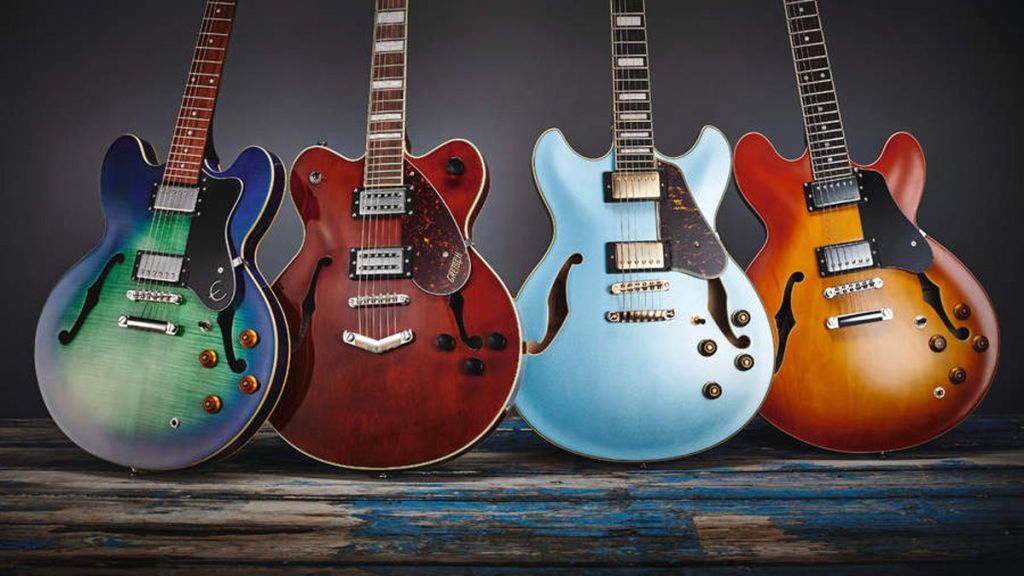
Picture credit: Music Radar

Final thoughts

Which would I choose? I still couldn’t say for certain. It depends so much on the gig in question, but if I wasn’t sure what I was going to asked to play, I expect it would be the Strat or the 335 I’d be reaching for. I guess it comes down to a choice between a solid body or (semi) hollow bodied guitar; whether I’m seeking the thicker snap of the Strat, or the airier sound of the 335.

And of course, bear in mind that we’ve only been discussing electric guitar options here – if I was really unsure about the requirements for a studio date, I’d have an acoustic packed into the car too!

But what about you? Obviously, what works for me doesn’t necessarily work for everyone, which is why I’d love to hear your thoughts – get in touch!

No room for Show Ponies – Could you manage all of your gigs with just two guitars?

Guitars & Gear

And if so, which two?

When looking up reviews if new guitars, I often come across the acronym GAS, or Gear Acquisition Syndrome. This humorous shorthand phrase sums up the seemingly inante drive in many guitarists to buy more equipment, from amps and effects pedals to, of course, guitars.

But how many guitars do we really need? Can one setup (be that one guitar, plus a backup, or two guitars used equally) be used in a wide variety of styles and genres?

For many guitarists working in more than one band, this feels like an impossible question – perhaps only slightly easier to answer than asking what one guitar would easily cover all bases for every type of gig you play?

Let’s work on the assumption that most players cross genres in one way or another, and begin with a few opening questions…

How many different genres do you play? And how varied are they?

If you only play one style of rock, metal or punk, then this might be quite simple. Similarly, if you rarely stray out of jazz or soul, you likely have couple of guitars which provide all the sounds and textures you are looking for, and fit the sound of your groups quite well. But what if you’re expected to hop from one extreme to another on different gigs – or even (such as some cruise ship or theatre pit musician gigs) in the course of one gig? Do your guitars cover as many options as possible?

Which guitars in your collection are the most practical?

For most of us, stage space is at a premium, so it’s unreasonable (and widely impractical) to bring four or five guitars to an average show.

Most of the working musicians I know (myself included) soon find themselves reaching for the same two or three guitars in their armoury, confident that these instruments deliver the goods time and again at any gig they bring it to. These instruments are usually well set up and hold their tune reliably, and are often not the most expensive or luxurious instrument option. As lovely as that vintage jazz hollow-body from the 1930s is, it only really does one sound well, and the rest of the time would be sitting there waiting to get knocked over and damaged beyond repair! (it probably feeds back like no one’s business in a live setting, too!)

To sum up, a few questions to consider…

Could this guitar play an entire show?

Is it reliable & comfortable enough to play for long periods of time?

Am I crippled with fear of it getting damaged?

These are the factors we have consider in making a choice such as this. Now let’s look at some of the obvious contenders…

Single-coil guitars (e.g., Stratocaster or Telecaster)

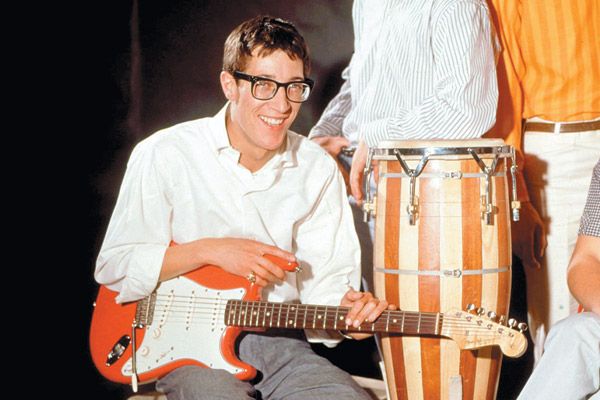
Generally the lowest output pickups (although there’s a world of variations out there), single-coils have been fitted as standard on Fender Stratocasters and Telecasters since they first appeared on the market in the early 1950s. Played clean, these have a wonderful clear sound, and with a little push from the amp or overdrive pedals, breakup beautifully. They aren’t best suited to heavier styles of music, but they perform brilliantly in almost everything else. Think of Buddy Holly and Hank Marvin inspiring millions of future guitar players with the original Strats, as well as the countless players who pushed the instrument beyond expectations such as Jimi Hendrix. For blues, look at Buddy Guy’s searing attack or Stevie Ray Vaughn’s much-too-imitated blues sound (pushing the neck pickup of his Strats through a Tubescreamer pedal)…

Telecasters have had a similarly lasting effect on music history, from the early country musicians and Dylan ‘going electric’ with one in 1965, to it’s emergence as a reliable solid body jazz instrument and the soulful stylings of Stax and Blues Brothers legend Steve Cropper. And let’s not forget that the Telecaster was often the unsung hero in the studio, used on more sessions and hit records than you might imagine – Jimmy Page used one to record pretty much all of Led Zeppelin’s debut album!

Of course, there are far more than Strats and Teles in the world of single-coil guitars. Danelectro make use of their unique ‘lipstick’ pickups, as well as all the weird and wonderful guitars which came out of Japan and Eastern Europe during the 1960s and 1970s. But the guitars made by Fender were by far the market leaders this area, and even if it’s not a Strat or Tele on that record you love, if it’s a single-coil sound, it’s most likely inspired by one.

I’ve been a Stratocaster player since I was sixteen years old, using them for everything from funk & soul to classic rock, with loads of blues and indie-rock in-between. It’s hard to keep count, but I’ve probably had at least ten different Strats in my possession (not all at the same time, I hasten to add!), and I keep coming back to them for a number of reasons, but that clear single-coil sound is chief amongst them.

Both of my current Strats are fitted with alnico iii (3) magnets, like the very first Strats produced in 1954 (although they soon switched to Alnico V and have stuck with them ever since). The 3’s are slightly lower output and vintage sounding, breaking up nicely through a slightly driven amp, and still retaining crisp clarity when paired with a classic Marshall overdrive sound. One of them (the orange one, above right) also features a button to engage the neck and bridge pickups at the same time, giving me the so-called Tele mod, and allowing me the sounds of both guitars in one. A lot of my function gigs in recent have involved numerous switches in musical style, and these two guitars do a great job of handing whatever I throw at them.

Humbucking guitars (e.g., Les Paul, SG, 335)

Humbuckers are, in essence, two single-coils wound together. The two magnets combined create a higher output sound, and their opposing polarity cancels out the 60-cycle hum which occurs in single-magnet pickups, hence the name hum-bucker. These two factors make humbuckers ideal for heaver guitar sounds, from classic rock to metal and beyond. The original humbuckers tended o sound a little ‘dark’ at lower gain settings, but this (along with their inherent noise-cancelling properties) made them an ideal choice for jazz guitarists, and they remain so to this day.

Semi-hollow guitars (such as the 335 style Harley Benton, below left) offer a great hybrid for playing jazz, funk and soul, as well as dirtier blues, rock, pop and indie.

Both of my humbucker-equipped guitars (the Harley Benton and my custom Elderwood, above right), have the option to split the coils, giving a single-coil sound when needed. This is a really useful option, although the split sound is a little too ‘thin’ sounding to use too often; sometimes it’s better to wind back the volume slight on a full humbucker, or find a pickup that’s a good halfway point between a single-coil and humbuckng pickup…

P90 guitars

P90s sit somewhere between the clarity of a single-coil and the power of a humbucker, meaning that they can be a useful cover-all option for gigs that require both heavier and gentler sounds. With careful listening and judicious use of the volume control, you should have the full gamut of sounds available. It’s also worth noting that quite a lot of the classic pop & rock music you love was in fact recorded with p90-equiped guitars – although that’s a story for another time…

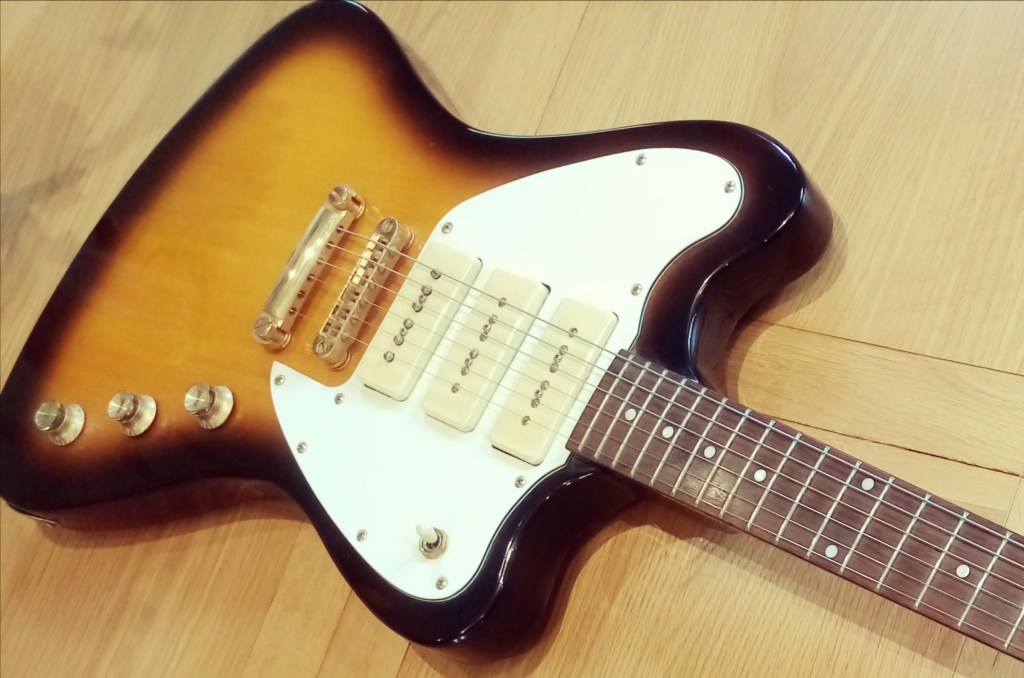
I have a triple p90 Gould Stormbird (a copy of a non-reverse Firebird with Entwhistle pickup) which acts as my main guitar for one of my original projects (dirty psychedelic funk), as well as the backup to my Strats and humbucking guitars, at a range of shows. These pickups clean up wonderfully and can produce enough grit for the styles of music I regularly play.

One of the main drawbacks to a p90 is that they can be quite noisy, even more so than with single-coil pickups, due to their increased output. This is especially apparent in venues with lots of mixed lighting circuits (such as stage lights with timers and dimmers), so you have to be ready to mute your sound between songs. Is it worth it? In my opinion, yes. I currently only have one p90 guitar, and it’s become so essential to my rig that I need to look at getting another p90 guitar to act as a spare in case anything goes wrong with this one…

So what are my ultimate two?

Let me start by saying I think every guitarist should at least try out a 335-style guitar. They are incredibly versatile and comfortable instruments, capable of covering a wide range of bases. If I was ever in the position where I could only take one guitar to a session (be it live or in the studio), I think a 335 (or in my case, the HB-35 Plus) would be my safest bet.

However, in terms of covering the most styles possible while remaining comfortable and reliable, I would choose one of my Strats and the p90-loaded Gould. Between these two guitars, I can go from clean to quite heavy, with a high degree of note clarity, and little (if any) risk of onstage feedback. Both axes are well built and well setup solid bodied instruments that rarely present any issues while working. Although I’m sure I’d find myself missing the 335 before too long…

Final thoughts

Of course, these are my opinions, based on my own experience and current work. As always, I’d love to hear from you – what two guitars would you take out as your cover-all-bases setup?

Refreshing my Strat (and adding a Tele mod)

Guitars & Gear

After commissioning my custom ukulele (which you can read more about here), I was more or less set in terms of the instruments I needed with my current musical projects. There was just one guitar which wasn’t quite right

My oldest Stratocaster hasn’t seen much of the stage recently, and not just because of playing less gigs due to various lockdowns, etc. The action had felt off, and it seemed to be because of the bridge, or rather the saddles. After twenty-two years, the small screws in the saddles had corroded to the point that strings could not be raised high enough for my liking.

I contacted Elderwood Guitars (who built my beautiful semi-hollow guitar) to discuss repairs. I also decided to make a few changes while this axe was in the shop…

What’s new?

I don’t really have the need for an HSS guitar nowadays, so used this opportunity to have the bridge humbucker replaced with a Tonerider Vintage Blues single coil. This would better match the two City Limits pickups in the neck and middle positions. Barrie at Elderwood was able to change the pick guard and place the bridge pickup within the larger cavity in the guitar (cut out for the original humbucker).

I also asked for the ‘Tele mod’, i.e., a switch which allows me to activate the bridge pickup in any position, effectively giving my seven different pickup combinations, including the lovely sounding neck & bridge pairing. This is one sound Telecasters have always had that was not available on a standard Strat.

With a switch taking the place of the second tone control (the remaining tone control becoming a master for all three pickups), I now had a guitar that could provide this, as well as the classic ‘quack’ from the out-of-phase Strat positions (2 & 4) – the best of both worlds, in my mind (and to my ears).

Finally, I figured that since these modifications would result in a different sounding guitar, perhaps it ws worthwhile refreshing the instrument visually as well. The old Midnight Blue finish had certainly acquired its fair share of chips and dents over the years. Barrie smoothed these out before hand painting the guitar in a burnt orange hue, which you can see below…

Before (left) and after (right) shots of my oldest Strat (pic courtesy Elderwood Guitars)

To me, it looks very similar to the orangey shade of older, worn down fiesta red guitars. It lends a classic vibe to my oldest Strat – the oldest guitar in my collection, in fact. The vintage feel is aided by the off-white pickup covers and scratchplate.

How does it sound?

It sounds like a classic 60s Strat or Tele, depending on your pickup choices. The neck & bridge combination has widened the sonic pallette of this guitar, making it my main choice for soul, funk and rhythm & blues gigs – or as in the video above, for slightly overdriven funky licks. Another great job by Barrie!

What are the best mods you’ve made to your guitars? Get in touch and let me know!

Elderwood Guitar review: my custom-made semi-hollow

Guitars & Gear

I have never owned a semi-hollow guitar before, despite having played 335 style and ‘thinline’ guitars on several occasions. This year, I had the budget to rectify this, but with so many great options out there, I was undecided on where to invest my hard-earned money.

Enter Elderwood Guitars, a one-man operation based in Carlisle, in the north of Cumbria. I had seen a few Elderwood models for sale in a guitar shop in Newcastle, and a couple of players I know spoke highly of these instruments. Barrie, the man behind Elderwood Guitars, makes it his mission to create the guitar of your dreams at a more affordable price. You are involved in all aspects of the layout and design of your instrument, which is largely made up from recycled wood.

You may remember another guitar built for me, a nylon-strung classical guitar, which was also crafted by a solo luthier in Cumbria and made form recycled wood (and if not, you can read about that guitar by clicking here).

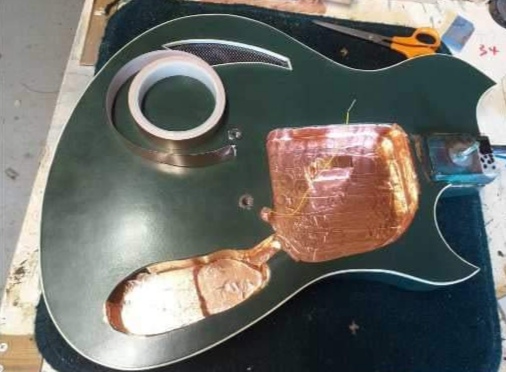
The two main principles of making something beautiful from old wood, as well as being able to design the guitar to my own specifications, was something which greatly appealed to me. To that end, I found myself in conversation with Barrie near the start of lockdown, and soon we went back-and-forth with ideas and draft designs. Rather than going for a more straightforward 335-style design, I was inspired by some of the beautiful high-end creations of small guitar companies such as Kauer. In the end, the final design looked like this:

The fifth & final draft of my custom design. Picture courtesy of Elderwood Guitars

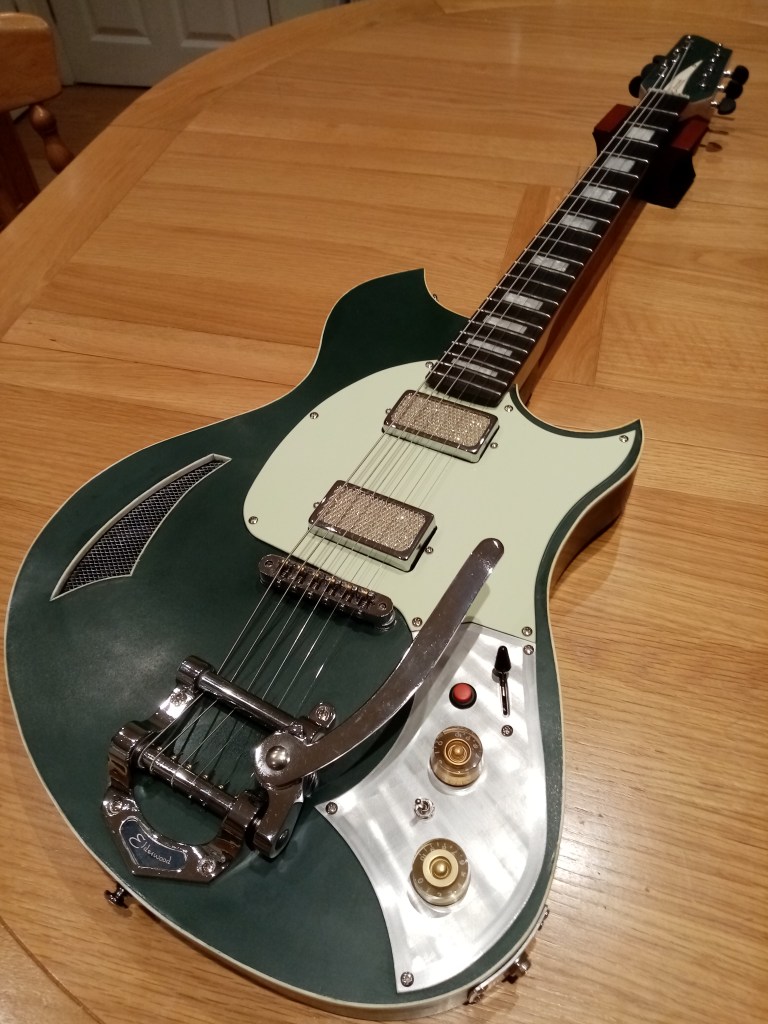
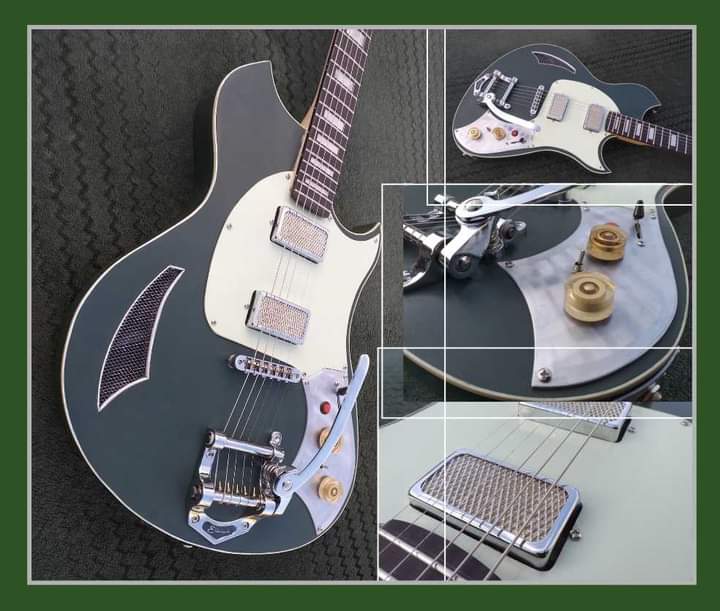
My guitar would be an offset semi-hollow with a serious vintage feel to it. The two humbuckers and sound hole on the upper half would be covered in a gold foil/mesh, and the neck would feature block markers. For the finish, I requested as close to British Racing Green as he could manage, with cream for the pickguard, binding and truss rod cover, likening the overall colouring style to that of a classic Mini Cooper. You don’t see many green guitars and I have always wanted one. Now I just had to wait for it to be completed (although since lockdown meant that I wasn’t gigging, I was in no hurry).

Over the next few months, I received occasional updates from Barrie which always got me salivating:

Barrie checked back to confirm my preferences for pickups, tremelo, control layout, as well as general updates on progress. He seemed to be having a busy summer but as each guitar was finished and presented on his Facebook page, they continued to look and sound as high quality as I had been told they’d be.

At last it was ready to collect in early October, and it did not disappoint…

Specifications

  • Offset semi-hollow body, made from recycled pine
  • Maple neck, with rosewood fingerboard featuring block position markers
  • 3-a-side headstock
  • Bigsby-style vibrato system and ‘roller saddle’ bridge
  • 2 x Vanson ’57 Alnico II humbuckers
  • 1 x volume & 1 x tone control
  • 3-way pickup selector switch, plus mini-switch for coil-tapping
  • Push button to bypass volume control (see below)
  • Side-mounted jack socket (secured by four screws for greater stability)

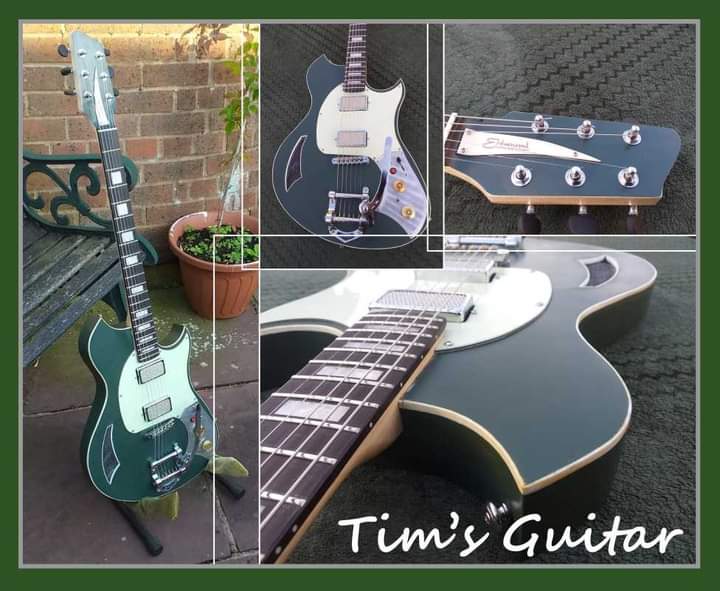
This guitar certainly looks the part. The green finish contrasts beautifully with the pickguard and copper coloured control knobs. After sharing the images above on my Facebook page, I was inundated with questions and compliments about the it. It’ll certainly make a visual impact at gigs (whenever they start back up again).

Sounds

Acoustically, this guitar is much louder than my other electrics. It’s interesting just how much difference the resonance of a semi-hollow together with the sound hole, can make. The matched PAF-style humbuckers give you all the tones you would expect from an early Les Paul, but with more airiness due to the mainly hollow body. These humbuckers are made by Vanson, a budget brand readily available on websites such as Amazon. Barrie shares my sentiment that one shouldn’t have to, and doesn’t need to, pay over the odds for a combination of magnets and copper wiring. I had said early on in the design process that I was happy with ‘budget’ pickups on this guitar, and they certainly sound as good as anything the big name brands churn out!

The bridge pickup provides everything I need, from classic rock crunch to an almost rockabilly style twang – the Bigsby certainly comes to the fore here. The neck pickup gives up warm jazz tones on a clean amp with the tone rolled back, and splitting the humbucker into ‘single coil mode’, I’m able to get a sound remarkably similar to a Strat or Tele in this position, which is no bad thing as far as I’m concerned. With both pickups engaged, I’m in my beloved funk and soul territory, great for rhythm playing and bluesy licks. Not only that, but it feels like BB King’s trademark singing lead tone is virtually built-in to this instrument.

Is it any good?

Oh yes, it’s very good. I love it! I’ve certainty enjoyed playing it so far, both through my amps and unplugged. It sits perfectly on a strap and the neck is comfortably chucky, like a true vintage instrument (which is exactly how I like it).

My only hurdle so far has been getting used to the Bigsby-style vibratio. I don’t use the vibratio arms on my Stratocasters, but as well as the right hand aspect, Bigsby units are notoriously tricky to keep in tune. However, this is something that can only be changed through practice and getting used to using it, rather than anything wrong with the guitar itself. Nonetheless, Barrie’s aftermarket service has been top drawer, offering all sorts of advice on how to get the most from the unit, as well as tips on maximisng tuning stability.

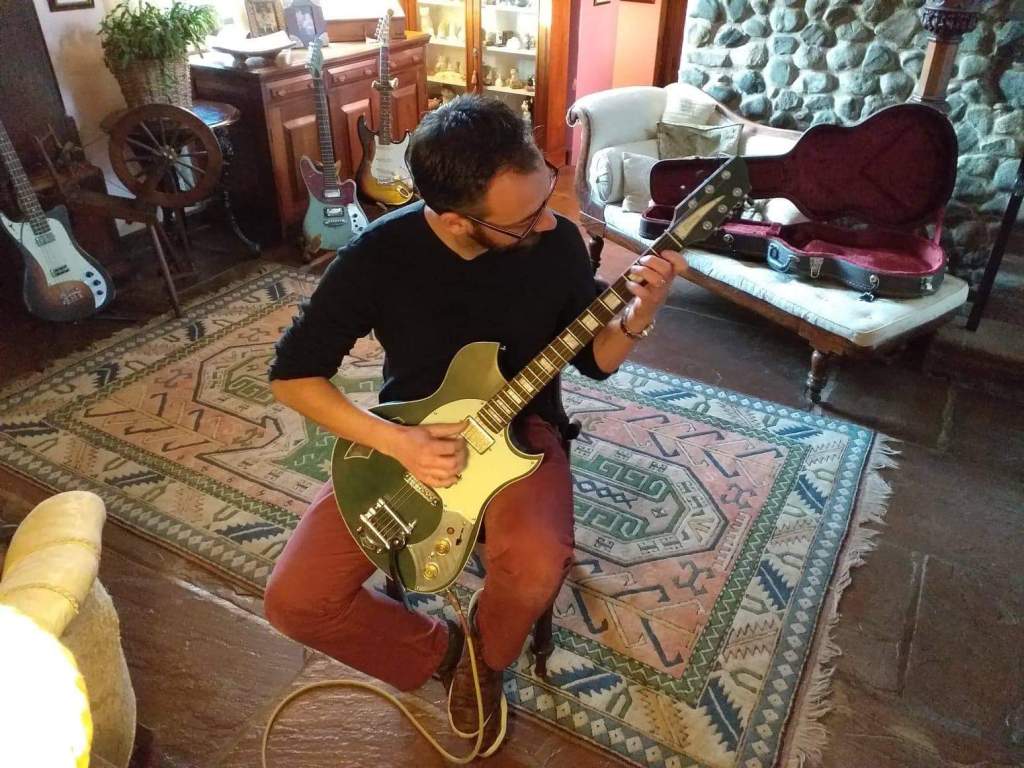
Finally collecting the new axe. Picture courtesy of Elderwood Guitars

I expect to be in the studio again in the coming weeks, recording a new LP with the Nick Gladdish Band, and this guitar will be coming along with me. I’ll share links to sounds and videos of this guitar in that (or any) setting as and when they become available…

If you are interested in your own custom-made guitar, Barrie can be contacted directly through Elderwood Guitar’s Facebook page. I’d recommend that you take a look through the numerous creations he has made, and make sure you have a good idea of what you are looking for when you drop him a line. Once you do, you will meet an affable and courteous man dedicated to making the best instruments he can, at a price point open to all of us – and that, like his guitars, is truly something to be admired.

Tonerider pickups Vs Squier Classic Vibe Pickups

Advice & Tips, Guitars & Gear

This article has been one of my most viewed pieces, as fans of Squier guitars try to get to the bottom of a pickup mystery. I heard of it being shared on forums discussing the link between Squire’s Classic Vibe range and Tonerider pickups. However, I also recently learned of an important update, so have returned to this post to bring it up to date.

This article was first published in May 2020, and was updated in November 2024.

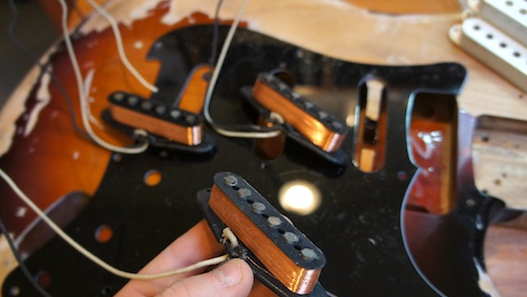
A few years ago, I was in the process of changing the pickups in my two Stratocasters. One, my blonde Squier Vintage Modified (pictured below), was fitted out with custom pickups handmade for me by Rohdan Pickups in the USA. These were made using Alnico III magnets in the neck and middle pups, the same as the very first run of Fender Strats in 1954. The bridge was a mix of Alnico V & II, for better definition, without the harsh trebley bite.

strats

My three Strats, before I sold the red one (top) or changed the pickups in the other two…

For the other guitar, my trusty Mexican HSS Strat (the blue one, pictured above), I only needed replacement neck and middle pickups. I was playing with different groups with less emphasis on heavy rock, and needed something more versatile. I’m still really happy with the Seymour Duncan ’59 humbucker in the bridge (this is usually a Les Paul replacement/upgrade, and has a great tone for classic rock). Having loved the sound of one of my other Strats, a Squier CV, or ‘Classic Vibe’ (Simon Neil signature model, based on a CV 60’s model), I started researching it’s pickups online. I thought I might get an idea of where to look for similar-sounding pups to install in my Mexican Strat. However, in my search, I happened upon an interesting, and ultimately money-saving, discovery…

Tonerider Pickups

Tonerider make replacement pickup sets for Strats and Teles. They appear to operate out of Squier’s main factory and sound as similar to the pickups used in Squier’s Classic Vibe guitar range as to lead most people to believe they are the stock pups built into the instrument.

An excellent article by Tidy Words seemed to confirm what many Squier players had long suspected, and which Tonerider set was (allegedly!) being used in which guitar:

  • CV 50’s Strat – Tonerider Surfaris
  • CV 60’s Strat – Tonerider Classic Blues
  • CV signature Strat (Simon Neil signature, etc) – Tonerider Vintage Classics

For full details, you can see the full article here.

tonerider

Picture courtesy of Worth Point.

However, this only appears true for Squier Classic Vibe guitars made before 2019 in China

According to Fuzz Faced, Squire CV production tool place in the Grand Reward factory, based in the Guang Dong province of Southern China. Tonerider pickups were made in the same factory, leading to the noticeable similarities in construction and sound between their pickups and the stock CV ones.

Squire moved production of the Classic Vibe range to Indonesia in 2019, as a means of lowering costs and avoiding US import tarrifs on goods manufactured in China. As a result, these newer guitars are no longer made in the same factory as Tonerider pickups. So what might have been true of a pre-2019 CV is much less likely now.

However, the sound of a CV 50s Strat made in China is the same is one made in Indonesia. Their pickup voicings remain almost identical to models of Tonerider pickup available.

The takeaway message…

If you have a Squire Classic Vibe guitar, don’t rush to upgrade it with Tonerider pickups. They are, for all intents and purposes, already in there! And frankly, if you’ve bought a CV guitar to get the overall ‘vibe’ of a certain era in Fender’s history, the stock (Tonerider-sounding) pickups do a great job, and don’t need replacing in the first place! These guitars are well built and in terms of sound, playability and build quality, give the ‘real’ Fenders a run for their money – at a fraction of the price!

On the other hand, if you like the Strat you have, but it’s not from the Classic Vibe range, and want to improve the pickups, you could do a lot worse than the Tonerider range. Check out their full range of Strat pickups here.

How did it work out for me?

I bought a City Limits single coil set from Tonerider for the Mexican HSS Strat. These use Alnico V magnets, and are aiming for the ‘Texas Blues’ sound Fender Strats do so well – think ‘SRV’ and you’ll have a fairly good idea what I mean.

city-limits-new

Picture courtesy of Tonerider.com

These pickups worked brilliantly for blues, rock, funk, jazz and everything else I threw at it. However, I found the difference between the sound of my two Strats to be an issue (as one guitar serves as backup for the other onstage), so I switched the bridge pickup to a more original-sounding single-coil, and decided to put in a new, fully balanced set. Having grown to prefer the sound of my blonde Strat, I opted for Tonerider’s Alnico-3 Surfari set. I also made the ‘tele mod’, making it possible to select the bridge and neck pickups at the same time. Now I have that wonderfully airy but funky Telecaster sound, making for a very versatile guitar which pairs much better with my blonde Strat.

I hope this has been helpful, and clears up any misunderstanding about the Squier CV range. As always let me know your thoughts, and good luck in your buying choices!