R.I.P. Julian Bream (1933-2020), a giant in the world of classical guitar

Great Guitarists

Not many classical guitar players are household names, either worldwide or here in the UK. Andres Segovia might be one, as a pioneer for performance of the instrument in it’s modern form. However, I’d suggest more people have heard of two of his more famous successors on the international performance stage. One is the very well-known Australian guitarist John Williams; the other, Julian Alexander Bream, who we learn has passed away at his Wiltshire home in the early hours of this morning, at the age of 87.
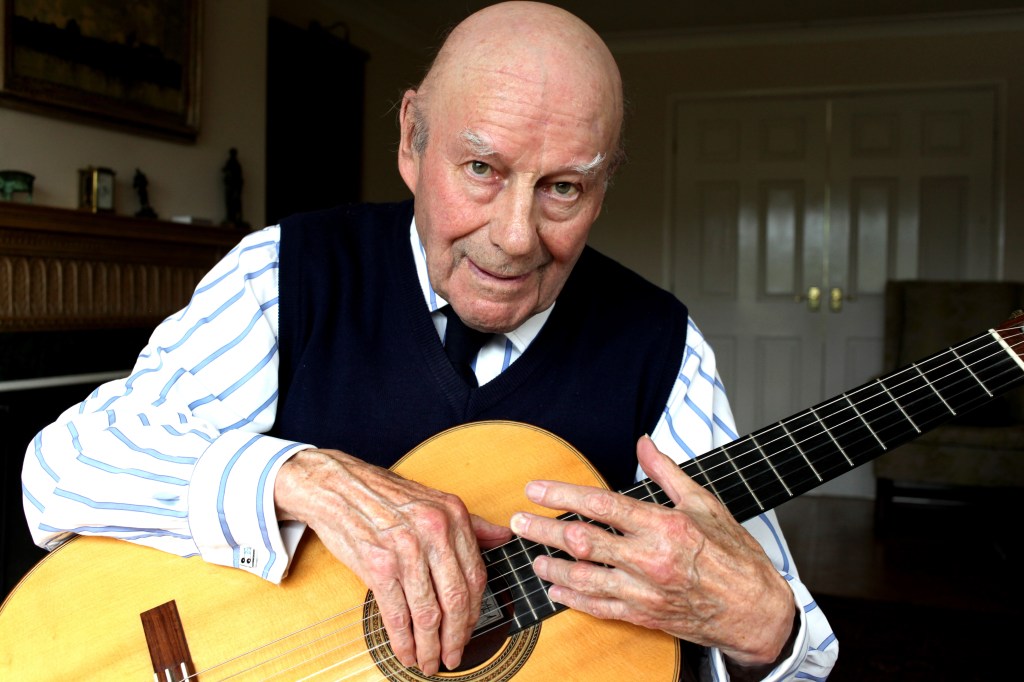
Julian Bream at home, 2014 (Credit: Eamonn McCabe for classicalguitarmagazine.com)

Born in London in 1933, Bream initially learned jazz , influenced by his father’s playing and Django Reinhardt. He was also offered a place at the Royal College of Music, aged just 12 years old, based on his piano playing. He later switched to the lute, and became a great champion for the instrument throughout his life, even as his focus shifted more and more towards classical guitar.

As well as his numerous transcriptions of lute pieces (such as those by Bach or Dowland) for guitar, Bream also performed many of the transcriptions left behind by Segovia, as well as the seminal guitar pieces composed by Francisco Tarrega. Known for his eye for detail, Bream’s virtuosity included an element of flexibility; a key example of this was that he did not maintain a consistent rigid right hand when playing (i.e., held at right angles to the stings), but made use of a more relaxed position, in order to achieve a greater variety in tone. This is something I do as well, because I, like Bream, am multi-genre guitarist. However, having been regularly admonished by my guitar tutor in my youth for holding an ‘improper’ right hand position, it was a relief to learn the one of the instrument’s masters did the same!

As Bream’s reputation increased, he was gifted pieces by composers as varied as “Britten, Walton, Tippett and Hans Werner Henze” (classical-music.com) and performed around the world. He also recorded TV specials, such as a series of four master classes on BBC television in the nineteen seventies, as well as segments for Channel 4 in the nineteen eighties. This no doubt helped him to become a household name for many, but he certainly never rested on his laurels. Even as an ‘elder stateman’ of the guitar, he apparently strove to improve himself. According to an interview given to The Guardian newspaper, Bream believed he was a better guitarist at the age of 70 than ever before!

Essential listening: A great place to start would be his two albums with John Williams, Together (1971) and Together Again (1974). Also, seek out his version of Joaquin Rodrigo’s Concierto de Aranjuez (with it’s famously emotive second movement).

Bream with lute (Credit: Avie Records)

Guitar students would do well to look at his crossovers into other styles, as well as his early lute work too, to get a more rounded picture of a hugely talented player, whose passing leaves a large hole in the classical guitar community.

Rest in peace, Julian.

Advice for young musicians

Advice & Tips

While in the process of editing and revising my WordPress site, I’ve one across a few older articles which might be of interest to some readers. In particular, those of us who are practising or recording more at home during the COVID19 lockdown [still in place this month] might find something they can take away from this blog, first published in 2015.

New articles and a few more reblogs coming in the next week or so. Until then, stay safe – Tim

We all know how it is. You want to prove yourself and show the world (and your peers) that you ‘have what it takes’ to work in music; Self assured and not in need of any advice of pointers from anyone else. How would they know your ‘story’ anyway? How could someone advise you when your style, your sound, your ‘voice’, is unique to you.

True, confidence can be a great asset to our chosen profession. Even in an industry where we work together because it’s the fundamental nature of how music operates, it can get lonely out there sometimes. But a false confidence, or bluff, will leave you alienated and likely to make the same sorts of mistakes thousands of musicians have made before you.

So swallow your pride, take a seat, and listen to a few words of wisdom from those who have made music work – and pay – for themselves.

Keybaord player and composer Ben Folds wrote some advice a few years ago on his Facebook page. Boiled down to the essentials, I found three things especially true:

Work on finding your own voice

However much you try, you will always be you. Stop trying to be anyone else and accept this fact. Once you have come to terms with this, work on being the best ‘you’ that you can be.

Learn your technique, then forget it

Learn as much as you can, as widely as you can. Read about it & practise it. Then follow the advice of the previous point and learn to present these techniques in your own, unique way.

Before you can express yourself in words, you first have to learn the language; it’s vocabulary & grammar. But think of how many books & poems were all the more interesting for their yearning up of the rules? The same applies to music first. However, to reach this point, you need to know which rules you are breaking…

Don’t try to force people into liking you or your music

There will always be people out there who find what you do interesting, provided you are doing it well, and playing from the heart. don’t bend over backwards trying to commercialise your sound, compromising your music in the process. The audience will come to you, so just persist at it.

This is even more true in our digital age – search for good advice on putting you material online. You should never have to pay to do this, due to the high number of platforms out there. It might be slow at first, but you will eventually reap the fruits of your hard work.

NobleViola.com also features a really interesting article entitled 10 things I wish I knew when I was a young musician which, while echoing the sentiments of Folds, adds the following gems:

Practicing isn’t a matter of how many hours you put in, but how many good hours you put in. It’s quality, not quantity.

Your body is also your instrument – learn how it works and take care of it.
Being professional is a 24 hour job.
Keep busy, and do a variety of things. Diversify as much as you can.
Love what you do – and remember to nurture that love.

As Pat Metheny says on his website, “for me, after everything, the only thing that finally remains really true is the feeling that at the end of the day, I know that I played really good, or I didn’t; or that I made some progress and understand something that I didn’t understand at the beginning of the day; or I didn’t. This, to me, is the real currency of what it is to have a life as a musician”.

Well said, Pat.

As always, comments and responses are more than welcome. Feel free to check out my previous articles too! Enjoy the rest of your week & happy playing!

Warm up & practice recommendations

Advice & Tips

This week, I’ve had the rare luxury of free time. Free time to pick up my guitar whenever I like and play. Not specifically for any particular goal, just to PLAY for the love of playing. It then occurred to me just how little I get to do this. Usually I pick up my guitars to practice or prepare for an upcoming show, or to learn new material. The rest of the time, I’m actually at a gig playing.

Using it as a great opportunity to go over my classical repertoire, I found it almost scary how much my discipline had slipped. Don’t get me wrong, I still play well and in a musically pleasing manner (in my opinion, anyway!) but there are ways of performing on guitar (with classical pieces in particular) which enhances the music and makes playing easier (not to mention lessening any strain and preventing injuries long term).

So this week, I have been delving into my old practice and warm up notes and dug out my old favourite, Pumping Nylon by Scott Tennant. For the classical guitarists out there who do not have this book, I strongly recommend you purchase it as soon as possible.

91or8zjkZOL.jpg

This book focuses solely on technique improvement for both hands (including thumb for the right hand). After the initial basics and starters, it progresses into joint techniques (working exercises for both hands together) and demonstrates a closer look into flamenco techniques. These not only go to strengthen your right hand, but to widen your overall playing ability. It also includes specially written study pieces to incorporate all the techniques it has taught.

Around fifteen years ago, I suffered a broken ring finger on my right hand. This has never fully regained it’s original strength (and as a result my days of regular classical guitar recitals are mostly behind me). The exercises in this book went a long way in helping my rebuild the muscle and bring my ability back, something I feared would never happen. Because of this, the right hand techniques and exercises int his book are of particular importance to me.

That’s the basic warm ups covered, but what about actually rehearsal starters? For me, as with many classical guitar players, the studies (or ‘Etudes’) of Francisco Tarrega and Fernando Sor provide plenty of examples for rehearsal focus, especially with right hand technique. It’s absolutely amazing the depth of ground these two teacher-composers (not to mention pioneering players) covered in advancing the technical study of the guitar. I cannot recommend them highly enough.

Alongside these, there are also the studies of Mauro Giuliani. Although his concert and recital pieces are widely known (in fact the staple of most player’s repertoire), his studies are often neglected. However, I would definitely suggest investing in a transcription of his complete studies. While not as technique-practice heavy as Sor (who, in contrast, is remembered historically more for his studies than his concert pieces), they present a more musically varying set and some new colour into your practice routine.

My standard practice routine (looking at my old notes from my true classical playing days) went roughly as follows:

  • 5-10 mins warm ups (both hands, featuring exercises from Pumping Nylon and scale practice
  • Selected studies from Sor, Tarrega and Giuliani (2 or 3 from each, focusing on specific improvement areas)
  • Looking at any new pieces to learn; slow play-through; focus on tricky areas; attempt to play through without stopping (I would try not to spend more than 20-25 minutes on this to prevent fatigue or frustration – the piece can be returned to on the next day)
  • A better known piece which also requires mastering. Ideally play-through should be reached far more quickly
  • Another piece (already known) to ‘refresh’ the fingers (ideally this will also be an upcoming concert piece)
  • Free playing – At this point, I could have been rehearsing for up to an hour and a half, so this should be an old favourite or two which you know well, to act as a cool down. Be careful, though, to remain watchful on technique and accuracy, as this is more likely to slip on pieces you are over familiar with.

These, of course, are my tips only. I would however be delighted to hear from other guitarists and their tips/routines for warm-ups and rehearsals. You can contact me via the  contact page on this site, or my social media (see links).

Good luck and happy practicing!