Hello and Happy New Year! How’s the New Year’s resolutions going?
I’m starting 2026 the way I mean to go on, with lots of fun gigs and NEW MUSIC!
As well as various wedding gigs, both as a solo guitarist and with my function band, I also have a few shows and releases with my original music project, Solcade.
I’ve been involved in a few original projects over the last decade, but mainly as an arranger and band leader. My songwriting contributions have been minimal. As a result, I’d been storing up a small collection of ideas that didn’t really suit any of the acts I was working with. These sketches mixed funk and jazz with the afro and latin-fused rhythms I’d developed a deep love for through past work with older ‘world’ music acts, and mixed with a heavy dose of psychedelia and garage rock.
After we began to emerge from the pandemic and start performing live again, I decided to put together a group of musicians with a shared interest in less common styles of music (at least within the UK), including afrobeat. Initial jamming and writing sessions yielded some interesting results, and almost saw the project reshape into something closer to free jazz. However, the lineup didn’t remain stable and I had to rethink what I was trying to achieve.
By 2023, I had assembled a slightly altered lineup that shared the same vision: to write interesting and genre-blending music; and to credit all compositions to all members equally (in this case, as a five-way split). This can sometimes cause issues such as resentment of one member is not perceived to be adequately pulling their weight in terms of writing. However, I was fortunate enough to be working with enthusiastic creatives who stepped up to the challenge, and we soon had enough songs to get onstage and perform live.
Best of all, this collective approach applies to more than just the songwriting process. I may have kicked this whole thing off, but we now work as a team, with no singular leader, making this a true band; a collaborative experience. You can find regular updates on the band on our Instagram page.
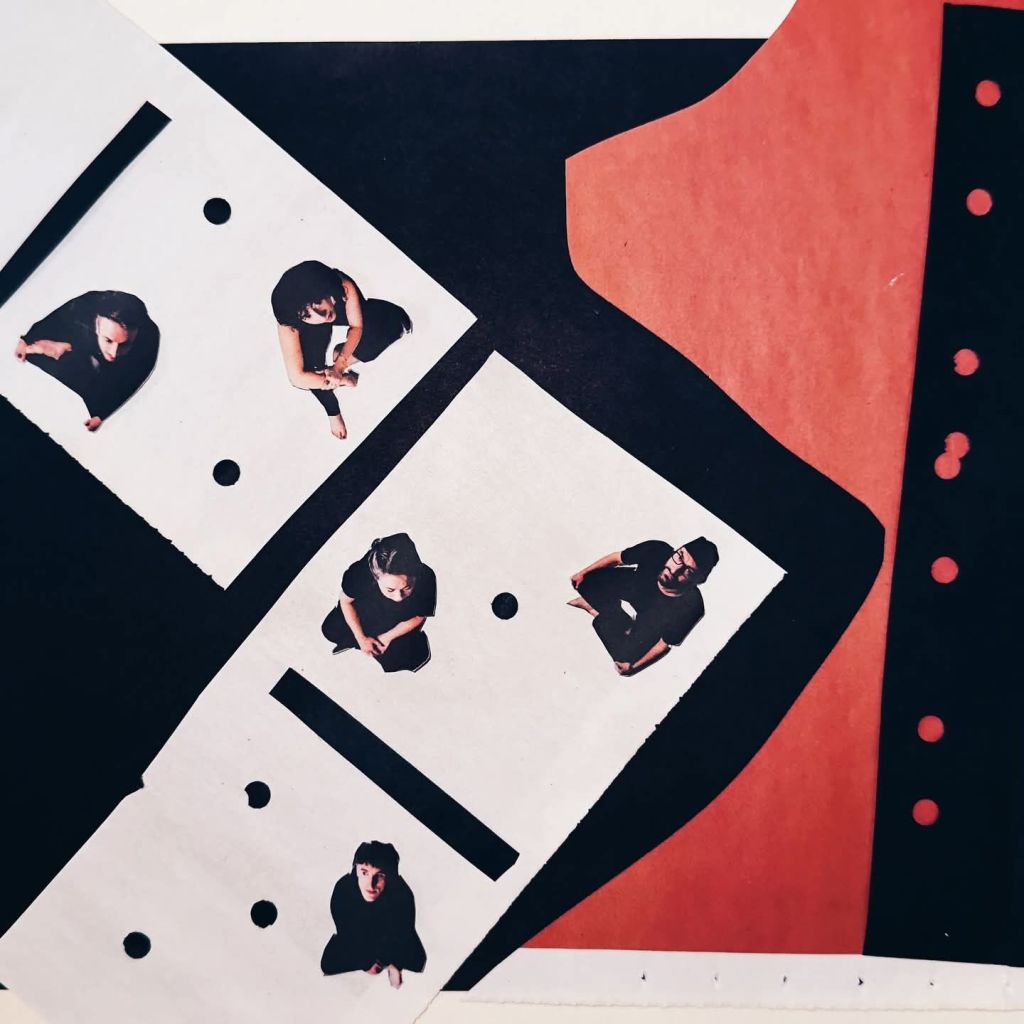
Our first single, ONE MORE DOMINO, is out now, available everywhere. This song focuses on the feelings that come with the build-up to revolutions throughout history. Listen to the new track here and let me know what you think.
In previous posts, I have asked what the best all-rounder guitar might be. I mentioned various types of guitar, eventually settling on a 335 style guitar such as my Harley Benton HB-35 Plus.
I also praised the Stratocaster, another guitar I have more than one of, in various forms. I certainly mentioned the Telecaster, but when I read the articles back, I feel like I was unfair to the first ever commercially produced electric guitar. Why?
The answer is probably because I have hardly played one in comparison to Strats or other guitars. And while over a dozen Strats have passed through my guitar collection in the last quarter of a century, I have never owned a Telecaster of any kind.
The more I think about it, the more striking that is, especially when considering how many of my favourite guitar players used Teles. These include guitarists from literally every genre you can imagine, including (but not remotely limited to):
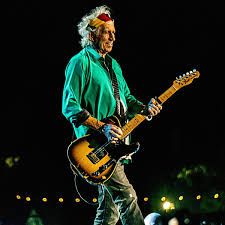
Keith Richards (The Rolling Stones)
Steve Cropper (legendary guitarist on some of the world’s best known soul recordings)
Jimmy Page (who recorded Led Zeppelin’s debut album entirely on a paisley telecaster)
Roy Buchanan (influencial sideman known as ‘the guitarists’ guitarist’s guitarist’)
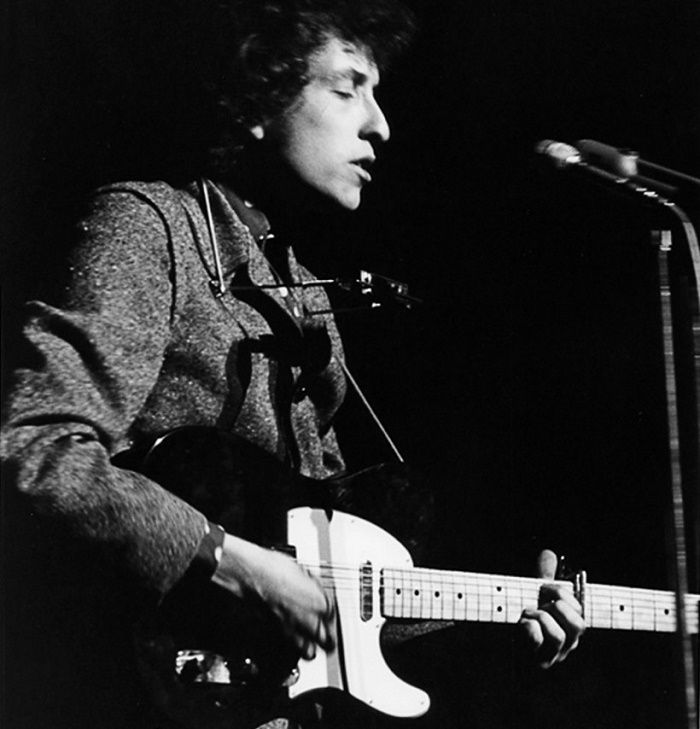
Bob Dylan (who infamously went electric at a folk festival by plugging in a Telecaster)
George Harrison (in the later years of The Beatles, including during their legendary rooftop concert)
Tommy Tedesco (legendary session guitarist)
Bill Frizell, Mike Stern & Julian Lage (amazing Tele-playing jazz guitarists)
James Burton (Elvis Presley)
Bruce Springsteen (The Boss)
Joe Strummer (The Clash)
PJ Harvey (lauded British singer-songwriter)
Andy Summers (The Police)
Graham Coxon (Blur)
Chrissie Hyde (The Pretenders)
Jonny Greenwood (Radiohead)
Rick Parfitt & Francis Rossi (Status Quo)
Muddy Waters & Albert Collins (blues legends)
Mike Campbell (Tom Petty and the Heartbreakers; Fleetwood Mac)
Tom Morello (Rage Against The Machine; Audioslave)
Waylon Jemnings (country legend)
Matt Bellamy (Muse)
Mike Bloomfield (blues & session guitarist who worked with Dylan, among others)
Jeff Buckley (revered singer-songwriter)
Anna Calvin (three times Mercury-nominated artist)
Richie Kotzen (Poison; Mr Big)
Jerry Donahue (insanely talented country-fusion string bender)
Brad Paisley (one of several amazing country guitarists wielding Teles)
…and did you know Hendrix used a Telecaster (borrowed from his bass player, Noel Redding) to record the solo to Purple Haze?
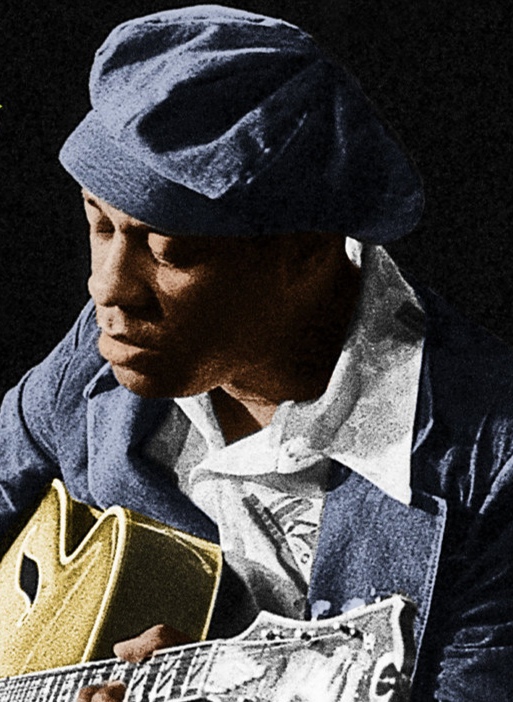
A handful of famous Telecaster players. Clockwise from top left: Bruce Springsteen, PJ Harvey, Bob Dylan, Muddy Waters, Keith Richards, Prince.
It goes without saying that the above list is by no means exhaustive, and also that many of the artists listed above used other guitars. However, the vast majority of them relied on a Telecaster for their most seminal recordings or the bulk of their live work – as have so many others.
So why haven’t I?
I think I started off by buying a Stratocaster as my first proper guitar, and fell in love. I became a Strat Guy, and in many ways, remain one. It’s the guitar in the hands of many of my earliest guitar heroes and was the dream guitar of my teenage years. And as I have said previously, the Stratocaster is an incredibly versatile guitar. But I wonder if this has led me to overlook Telecasters as a result?
Perhaps it’s time to change that. Any recommendations for the best value Telecaster to buy? I’ve a few in mind, but I’d love to hear your thoughts.
And of course, if/when I eventually get to put a Tele through it’s paces, I’ll report back…
Following my last article on the recently passed Herbie Flowers, it felt fitting to return to some of the behind-the-scenes musicians in the next instalment of my (ever-so-intermittent) Great Guitarists series. I have already shone a light on some of my personal favourites, including Steve Cropper and Barney Kessel, and this time I’m focusing on another sideman who played on so many sessions he had the nickname “Mr 2500”, Cornell Dupree (1942-2011).
There’s not many guitarists, even in the session world, whose credits include such a diverse range of artists, from Barbara Streisand and Mariah Carey to jazzers Herbie Mann and Sonny Stitt, as well as rockers Joe Cocker and Ian Hunter.
Born Cornell Luther Dupree Jr in Fort Worth, Texas. His career began in Texas, having decided to learn guitar after seeing Jonny ‘Guitar’ Watson in concert. While playing in local bands, he will have undoubtedly encountered and opened shows for other well-known and respected Texan artists such as T-Bone Walker, Lowell Fulson, Albert Collins, Lightning Hopkins, as well as country stars such as Roger Miller and Ray Price.
In the early 1960s, Dupree was called to New York by saxophone player King Curtis (whom he had known from their days in Fort Worth) to join him in his band The Kingpins. This group were a joined a few years later by a second guitarist – a certain James Marshall Hendrix…
Left to right: King Curtis, Cornell Dupree, and JimiHendrix performing with The Kingpins
In a band without a keys player the two guitarists worked together to fill out the band’s sound; Hendrix quickly taking on soloing duties while Dupree filled out the rhythm section. While Hendrix was dismissed from the band in 1965 (for being too loud, too flashy and often late to gigs), Dupree stayed with King Curtis, both onstage and in the studio, up until the band leader’s death in 1971.
Dupree made is first foray into session work in the mid-sixties, while still in the Kingpins. He spent much of the next decade and a half as a much called upon ember for Atlantic Records’ in-house studio band. In the the 1970s alone, his playing graces the albums of artists such as Aretha Franklin, Grover Washington Jr., Donny Hathaway, Miles Davis, Lulu, Herbie Mann, B.B. King, Freddie King, Billy Cobham, Paul Simon and many, many more.
Atlantic Records producer Jerry Wexler stated (in the liner notes to Dupree’s 1994 solo record Bop’n’Blues) that Dupree’s ability to play lead and rhythm at the same time meant that only one guitarist was required to provide what was needed. Thanks to recommendations from former bandmates such as bassist Chuck Rainey, Dupree soon gained a reputation as the only guitarist a producer might need.
Amongst all this, Dupree not only found time to release over a dozen solo records, but also founded the jazz fusion group Stuff. Stuff were a who’s who of session musicians including bassist Gordon Edwards, Richard Tee on keys and Steve Gadd on drums and fellow session guitarist Eric Gale. Their appearance at the 1976 Montreux Jazz Festival is available as a concert video and LP (see one of the tunes, Stuff’s Stuff, below), showcasing these players at the top of their game.
Stuff live at Montreux, 1976
In later years, Dupree continued to perform despite declining health. He can be seen at the end of the Bill Wither documentary Still Bill playing ‘Grandma’s Hands’ with Withers while using an oxygen tank to aid his breathing. He died in 2011 while waiting for a lung transplant as a result of emphysema.
Playing style
As a soul-based guitar player, much of Dupree’s playing used a clean sound with minimal effects, except for a touch of reverb, in most cases. This allows his playing to shine through without becoming overly dominant in the mix. His style demonstrates that blues and gospel-based pattern of question & answer, where one melodic phase acts as a short opening statement (of less than a bar in length), before being ‘replied to’ by another phrase of similar length.
His choral work makes use of the sort of flickering embellishments familiar to use through Jimi Hendrix making extensive use of them (along with Curtis Mayfield and others). In Dupree’s case, they always feel very tastefully executed, and seem to leave ample space for the artist (usually a vocalist) whom he is backing. In this sense, he is following the golden rule of the sideman: to make the featured artist sound good.
Stuff; the all-session jazz fusion supergroup
An integral part of Dupree’s lead guitar style is his use of sliding sixth to augment and enhance the chords he was soloing over. For those who are unsure about sixths, you can find my explainer on sixths and similar intervals here. Steve Cropper was a big proponent of this technique, and like Dupree, one of the guitarists I kept hearing on soul records time and again, without really knowing who these backing musicians were until I was older and starting to dig deeper into this side of my own guitar playing.
Equipment
Although reported to have started out on a Les Paul, then a Les Paul TV Special (a stripped down, P90-equipped version of the Les Paul), Dupree appears to be mainly pictured with a modified telecaster (another common element he shares with Cropper). He is often shown in older pictures with a white/faded blonde model, with a third DeArmond style pickup added in the middle position. This addition meant the pickguard could not be refitted onto the guitar, so Dupree appears to have filled in the screw holes with rivets. It certainly makes for a distinctive look!
A recreation of Dupree’s long-time telecaster (with added bird artwork not on the original guitar) by Scero Guitars
In 2002, Yamaha made a Cornell Dupree artist model Pacifica, using their telecaster-style ash body with a one piece bolt-on maple neck. This signature model had the same atypical pickup configuration that Dupree had been using for decades on his modded Telecaster. The Pacifica came with a neck humbucker and Seymour Duncan ‘Hot Rails’ in the bridge position, controlled by a three-way switch to toggle between them, but not a rivet to be seen!
Dupree with his Yamaha signature Pacifica
There was also an alnico V single coil in the middle, which could be added to any selection via it’s dedicated on/off switch. I’ve seen this mod on the guitars of a few professionals, particularly those who like to get the most sounds out of just one guitar (something I have written about before). Indeed, I’ve modded a few of my own guitars to ensure a similar level of flexibility and range of sounds (read about some of my mods here).
What can Cornell Dupree teach us?
Dupree was the master of economy of style, never overplaying. I guess that’s one of the reasons he was always asked back to more sessions; he knew how to serve the song. Another factor is his clear professionalism. As with Herbie Flowers, showing up, acting professional, and learning to anticipate the producers needs is a key element to a successful career as a session player.
While his former bandmate Hendrix might be more recognisable, having made a wonderful career on his own terms (and in his own time, it seems), Dupree seemed content to remain slightly off-centre stage. As a result, he had a long and varied career. Indeed, although Hendrix is undoubtedly the more seen, I’d argue that Dupree – thanks to his appearances on thousands of recordings by some of the music’s biggest-selling artists – may actually be the more heard of the two. In my mind, that’s quite the achievement.
It almost seems too obvious to even require mentioning, but it’s the best advice I was ever given as a young musician:
Do less, and do it well
If in doubt, leave it out goes the old adage about instrumental soloing. It equally applies to composition as well – but what else is improvisation, if not instantaneous composition?
Think about what you’re trying to say, and be sure to communicate that message in a way listeners will be able to understand.
Imagine trying to listen to someone give a lecture, but the speaker in question spoke incredibly fast and never paused for breath. It’s exhausting to listen to. And sometimes, when you are trying to be get your point across, it can be better to say less.
This is why all those flashy million-notes-per-second solos are generally only preferred by other musicians. The best solos carry a song without filling the entire sonic pallete, leaving room for the listener to hear the context in which the solo exists.
“The most important thing I look for in a musician is whether he knows how to listen”
Duke Ellington
The great jazz improvisers such ad Miles Davies referred to this as ‘hot space’ and valued it as highly as – if not higher than – the notes being played in solos.
However, that’s not to say that the noodling doesn’t have its place. Of course it does. It’s certainly true that speed and long, winding melody lines have their place, but they need to be used sparingly, like spices which might otherwise overpower the dish when you’re cooking.
Naturally, there’s no clearly defined correct way to improvise. The whole point of improvisation is we literally making it up as we go along! Go out there and take risks – just leave room for everybody else!
July the 31st this year marks the 92nd birthday of Kenny Burrell, who, unlike many of the greats I feature in my Great Guitarists series, is still with us!
Such an occasion is enough of an excuse to revisit his classic cut from 1963, Midnight Blue (if an excuse is even needed)…
In this, the tenth installment of my Great Guitarists series, I’m a little ashamed to say we have only looked at male guitar players so far. So, to round off my first ‘dectet’ of influential guitar players (and keeping in a jazz theme, like the previous installments), let me introduce to you Mary Osborne…
Picture Credit: Gretsch, 1959
Osborne was born into a musical family in North Dakota, 1921. Both her parents were musicians and her father’s barbershop was a known gathering place for local players. Already playing live by the time she was a teenager, Osborne was influenced by the playing of early jazz pioneers Django Reinhardt and Eddie Lang. However, it was Charlie Christian who first captivated her, and mentored her for a while, fine tuning her great sense of swing.
Osborne’s career ranged from trios (her own, and the Winifred McDonnell Trio near the start of her professional career), as well as some work as a sideman (or sidewoman) for the likes of Buddy Rogers, Joe Venuti (whose act included vocalists Kay Starr and The Andrews Sisters), amog many others. In the first of two spells in New York, she was the guitarist in Minton’s house band, where bebop was invented during the jams the legends of jazz had there. Her career continued throughout her life, and she was still performing live up until her death in 1992, at the age of seventy.
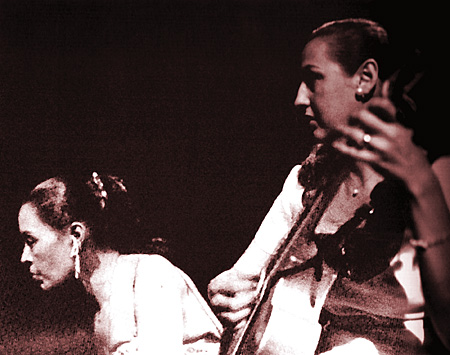
Osborne (R), with Billie Holiday (L), 1958. Picture Credit: Nancy Miller Elliot
Equipment
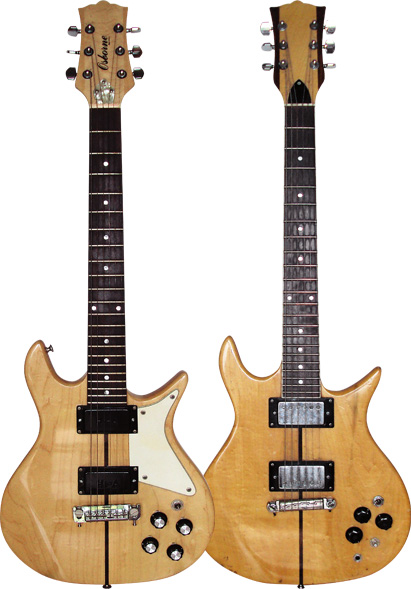
Osborne purchased the same model of Gibson archtop that Charlie Christian played – the ES-150, an early version of the classic archtop ‘jazz boxes’ we know and love today. It came with a large spruce body and a single-coil pickup near the neck, itself containing a large magnet that helped deliver good definition and attack. She later played other guitars by Gibson, as well as models by Gretsch, such as the White Falcon. In the 1970’s, Osborne founded her own guitar company, Osborne Sound Laboratories, formed from the ashes of the Mosrite Guitar Company (whom her husband had worked for at the end of the 1960’s). Osborne Sound Laboratories made amplifiers personally tested by Mary herself, as well as a selection if interesting instruments (including funky looking solid bodies such as in the picture below). Sadly, they couldn’t penetrate the market due to the dominance of the big manufactures, such as Fender (despite their well-known quality issues in this decade) and the company folded in 1980.
Osborne Sound Laboratories guitars from the 1970’s. Picture Credit: VintageGuitar.com
Recommended listening
Osborne’s 1959 LP A Girl And Her Guitar (Warwick) stands testament to her talents in a golden era for jazz guitar. Her later record Now And Then (Stash, 1981) shows a player who survived longer than most of her contemporaries, and continued to play beautifully.
Also, check out The Mighty Two (1963, Roulette), an LP by the two legendary drummers Louis Bellson and Gene Krupa. Although this was conceived as an instructional album for budding drummers, several tracks feature six musicians accompanying both drummers through nine of the songs on the record. As well as featuring Osborne on guitar, you can hear Milt Hinton (bass), Joe Wilder and Joe Newman (trumpet), Phil Woods (alto sax), Dick Hymen (piano) and Tyree Glenn (trombone) – something of a who’s who in sidemen for the time. The ensemble playing is tight, and the entire LP is a unique artefact of jazz history.
Welcome back to this overview of intervals in guitar playing! In part one, we looked at thirds, sixths and tenths. In this follow up article, we will be taking a brief look at fourths and fifths. Both of these intervals can be used more ambiguously, as they remain the same in the context of a major or minor chord (when sticking to notes in diatonic scale, at least – more on that later). Because of this fact, they can utilized in slightly different ways to the tones they sit alongside in common scales. Let’s take a look…
Fourths
Fretting the two highest strings together at the same fret creates this classic double stop, which can be heard all over rock’n’roll, but famously in the intro and solo for Chuck Berry’s Jonny B. Goode. Berry developed this style so he could recreate horn lines, as his live band was a smaller ensemble than many bands of the time (which would typically have more than one sax, trumpet, trombone, among other brass instruments). Every rock guitarist that followed has used phrases first made famous by Berry, from Angus Young to George Harrison. It is also a useful interval for slide guitar playing as it can be used over major and minor chords alike (you can see an example of me playing 4ths with a slide on this cover video of a well-known song).
In jazz, Wes Montgomery pioneered the use of stacked fourths, creating chord-based solos using 4th intervals on top of each other (for example, one chord would sound, low to high, as A, D, G, C), and the shape would move in line with the melody. George Benson kept up this tradition, but would also regularly employ diads (two notes played together) of 4ths in his lightning-fast solos.
Fifths
A fifth is an inversion of a fourth, and vice versa. Here, the strict definition can become blurred – think of the intro to the Deep Purple song Smoke On The Water and you’ll hear diads playing the entire riff in what sound like fourths (eg, the first pair of notes is a D, then a G on top). However, since the melody is following the G minor pentatonic scale (as the song is in the key of G minor), I’d argue that this riff is an inverted fifth (D being the perfect fifth of G), as the melody note is higher than the harmony note.
In rhythm guitar, a root and fifth creates the classic power chord heard in most varieties of rock music. Alternating the fifth with a sixth, and moving back and forth between the two, gives the famous (almost cliché) rocking riff used by artists from Chuck Berry to Status Quo and beyond.
Variations on ‘perfect’
The intervals we have discussed above – using the fourth and fifth notes in a diatonic scale, create what is known as perfect fourth / fifth. However, as with any note, we can raise or lower it’s pitch by a semitone for a new musical sound. Flat fourths & fifths are both referred to as diminished (and of course be found in diminished chords and scales). Raised ones are called augmented. As a fourth and fifth are only a tone apart, a diminished fifth is exactly the same thing as an augmented fourth – just in case you were confused!
Apart from being the famous Devil’s chord (famously used on the Black Sabbath song Black Sabbath), this interval often occurs in Blues-based music. The Pentatonic Blues Scale is based on intervals of R, b3, 4, #4, (or b5), and b7. Likewise, in dominant seventh chords (for example, C7), the natural interval between the chord’s major third (E) and flat seventh (Bb) is a diminished fifth/augmented fourth. Highlighting these notes over these chords creates a wonderful effect without having to overthink your playing too much!
Finally…
There are a few intervals we haven’t covered in these two articles. Off the top of my head, these would be seconds, sevenths, octaves and extended intervals used in jazz chords and arpeggios, such as ninths, elevenths and thirteenths. I plan to look at octave-based playing in a future article, because it is a staple of my own guitar heroes, such as the great Wes Montgomery. However, if you’d like me to look into some of the other intervals (such as sevenths, which is a really useful colour tone in jazz), do let me know!
Single line lead guitar playing is great. But when you have six strings and four fingers to hold them down, why limit your playing to one note at a time? Throughout the history of guitar, players have used two notes (or more) at once, resulting in something halfway between a single note line and a full guitar chord. We do this for a few reasons:
It adds depth (useful in trio settings, for example)
To create a certain feel (which we will touch upon below)
To imply a chord through highlighting certain scale tones
To make certain phrases stand out
What is an interval?
An interval is he distance between two notes, in terms of pitch. Thinking of the C major scale (visualize the white keys on a piano), the root note (C) is 1, and the next note (D) is therefore 2, so the interval between C and D is known as a 2nd. More specifically, it is called a major 2nd because it is a whole tone away from C (whereas Db, only a semitone higher, is known as a minor 2nd). The next note in the C major scale would be E, which is called a major third (and Eb is the minor 3rd). I won’t bog us down in theory for this article, but if you need a more in-depth explanation, check out this video from Victoria Williams of mymusictheory.com.
It’s possible to use any interval when playing, especially lead lines. However, some are more effective than others. In this article, I’m going to stick to three types of interval: thirds, sixths and tenths, along with a few well-known examples in music. Go give some of these a listen and see if you can spot the intervals in use.
Thirds
Common in any music with a Spanish in Latin twist, particularly on acoustic guitar. Try going up and down a major scale by playing each note with another note ‘two places higher’ in the scale on the next string up. For example, starting with a C by fretting the G string at the fifth fret, you ‘think up two notes’, skipping D, and playing E by fretting the B string at the fifth fret. The next note in the scale (D) would be played at the same time as F. Going up the fret board/scale, the notes should match up above each other like this:
It is also the most commonly used interval for twin guitar harmonies, such as:
Thin Lizzy – The Boys Are Back In Town (recurring twin lead line after the choruses)
The Eagles – Hotel California (harmony lines at the very end, during fade-out)
Sixths
One of my personal favourites, which I use a lot in my guitar playing. Sixths are essentially an inverted third, where the base note (eg, C) is played highest (such as one the E string at the 8th fret), while the harmony note (E or Eb) is played two strings lower (in this case, the G string, at the 9th fret for E, or the 8th fret for Eb).
Picture Credit: NZMusician.com
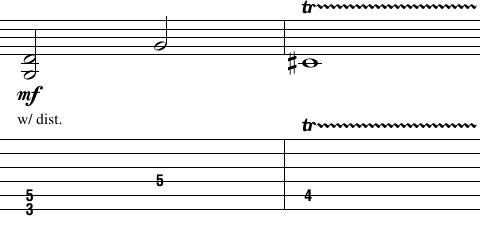
They can highlight major and minor chords, and sound great when you slide into them up and down the scales you’re using, as well as chromatically (think of the stereotypical blues ‘ending’). They’re great for soul playing too, implying a chord or scale with only two notes (as with tenths – see below). I’m not alone in this – examples exist across the various genres that the guitar is used for, including:
Steve Cropper’s guitar intro to the classic Sam & Dave song Soul Man
Chuck Berry on the intro to You Never Can Tell
Steve Cropper’s guitar playing uses this time and time again, on many classic recordings from Otis Redding to The Blues Brothers. He had a knack for finding the right guitar line that complimented the songs he played on, without overpowering them, and rightly deserves his own article looking into his style in greater detail (watch this space)!
Tenths
Tenths are essentially thirds, but with an additional octave between the two notes. This has the interesting effect of creating the impression of a chord, while still leaving a sense of space. It is the interval used in the opening phrase of the well-known classical guitar standard Lagrima. Here’s a chart to demonstrate where the tenth harmony for Bb (played alongside a D, two notes then one additional octave higher) across the guitar fretboard:
Picture Credit: PlayTheAxe.com
There has been a few examples of this in big singles recently. In each case, t tenths are used for the main guitar park in the songs:
Scar Tissue by The Red Hot Chilli Peppers
Love Yourself by Justin Bieber
Hold Back The River by James Bay
Tenths are also used in jazz. They provide a nice open-sounding stretch which is easy to play on guitar; they implied the chordal harmony while still leaving space for other instruments.
In summary
One thing that all three of these interval types have in common is their ability to reflect a major or minor chord. I think of them as the same interval, using a base note of C as an example again:
Third: C, played with an E (2 tones higher)
Sixth: An inverted third; C is played with an E a sixth lower (4 tones)
Tenth: A third, plus one additional octave between both notes; C, plus E (8 tones higher)
Each has it’s own feel and characteristic, and they are not always as interchangeable as you might think. Try playing around with them, across major and minor scales, then in your solos, and let me know how you get on!
Coming next: Part two of this subject will focus on intervals which can utilised over major and minor chords – fourths and fifths.
Welcome back to theGreat Guitarists series. We’re continuing along a jazz theme for now, with a sometimes underrated master of understated single line guitar soloing…
Grant Green
Green was born in St. Louis, Missouri, in 1935, and died in 1979, aged just 43. In his all-too-short career, he played on hundreds of records, including numerous solo titles – almost thirty cuts for Blue Note Records alone. Many of these were played as part of an organ trio (organ, guitar, drums) in a style known as Soul Jazz. This style was sometimes sniffed at by jazz purists, but has since gone on to be something of a cherished gem, and ripe pickings for sampling, especially in hip ho and acid jazz (Read Jorge Cervera’s defence of Grant Green and soul jazz here).
Although less well known than some of his contemporaries, such as Wes Montgomery, his friend George Benson and his main guitar influence Charlie Christian, Green nonetheless possessed a highly recognisable guitar sound, which can be heard in the playing of many guitarists today, myself included. Indeed, his mix of blues, soul and hard bop licks over a funky back beat has become the quintessential sound of upbeat jazz guitar playing.
Equipment and guitar sound
Green most famously used a Gibson ES-330, which is essentially the same shape as the brand’s better-known 335, but with P90 single coil pickups (not unlike an Epiphone Casino). Later on in his career, he played a Gibson L7, Epiphone Emperor and custom-made D’Aquisto guitars, all of which featured similar P90 style pickups. This type of pickup was one of the first kinds added to hollowbody guitars, and Green obviously enjoyed the full, clear sound they provided.
Interestingly, for a guitar player known for his fluid single line style, Green was known to roll the treble and bass entirely off on his amplifiers, to better emphasise the midrange for more bite and attack in his tone – try it with a P90 neck pickup, and see if you can recreate Green’s sound!
Essential listening
Idle Moments (1963) is a great place to start. It’s a slow, contemplative masterclass in cool jazz guitar,and one of my favourite jazz guitar records, along with Midnight Blue by Kenny Burrell (more about that here).
There’s a couple of good options for live cuts, but the recently released collection Funk in France, From Paris to Antibes (1969-1970) (2018, Resonance) captures Green at his best. A few of the tracks see the trio lineup complimented by none other than the legendary Barney Kessel, which makes it essential listening for me!
It’s also worth seeking out some of Greenvs funkier efforts, such as… He also made an interesting album of Latin music (The Latin Bit from 1963, on Blue Note again), in which the main theme (the ‘heads’) were played in the usual samba or bossa nova style, but the solos are swung – give it a listen and make of it what you will!
As a sideman, he played on hundreds of recording sessions. Among my personal favourites are Herbie Hancock’s My Point Of View (1963, Blue Note) and Art Blakey’s Hold On I’m Coming (1966, Limelight). However, each record in Green’s expansive discography features great playing and lead lines that we guitarists would benefit from adding to our repertoire!
Just as Green (and countless other great jazz guitarists) did with Charlie Christian’s recordings, listen, learn, then find a way of making it your own…
I was recently tagged in a Facebook challenge by my friend David, in which you post 10 albums which have informed your early musical tastes.
I find things like this almost impossible. It’s so personal, but based on hundreds of musical memories. How do you select just ten LPs from years of discovering & listening to new music? So I made my criteria a little more specific, and chose ten records which, as well as being ones I listened to frequently, also served as early influences on my guitar playing & songwriting.
Because I’m focusing on my earliest influences, this list looks rather narrow. I’d like to think that my guitar playing influences, as well as my music listening tastes, are much more eclectic than this list would imply. But then, these are my earliest influences, rather than the wider world of music that these albums (and countless others not in this list) opened up to me.
In some cases I chose a favourite album by artists who could have filled a ‘top ten’ list all by themselves. I also decided to omit quite a few 90s choices which were heavy-rotation at the time, but didn’t accompany my out of the 90s, so to speak…
And because I’m looking at albums, I’ve not included any classical or folk pieces. Although they were a huge part of what I was playing on the guitar back then, just as now, I learned these pieces individually, rather than via any one particular LP – perhaps that’s a separate list of its own for a future post…
Likewise, jazz was a genre I started digging deeper into in my very late teens, so they while it has certainly influenced my playing, it didn’t happen until later. As such, only one jazz record makes an appearance on this particular list.
So what you see below is perhaps better catogorised as ten rock & pop albums which had a lasting influence on my guitar playing. Also, because it was really tricky narrowing down to just 10 choices, I’ve included a few contenders which nearly made the cut.
Strangely, some significant guitar influences don’t appear in these picks, for various reasons – not least because 10 albums isn’t enough! I think it’s because I view some guitar player’s work over their whole career (or live performances), rather than limited to just one record.
Anyway, here they are. The list is (very loosely) organised by chronology of when I discovered them, where my memory makes that possible. Enjoy!
The Shadows – 20 Golden Greats (1977)
The album that started it all. I was six years old and going through the ‘tennis racket guitar’ phase. My Dad suggested I listen to some “proper guitar music” and player this album to me (on cassette, naturally). There was no turning back. That famous clean Stratocaster tone was under my skin.
As I reached my teenage years I soon learned that The Shadows & their legendary lead guitarist Hank Marvin were far from fashionable, and I expect many young players may never have even heard of them. But one way or another, the landscape of popular music would be very different without their influence.
The Moody Blues – In Search of the Lost Chord (1968)
My father is to blame for this one too. He has all seven of the ‘classic’ Moodies albums (from 1967-72), and any one of them could have been chosen for inclusion here. Why Lost Chord? It best represents the mix of influences on my playing, featuring both fantastic acoustic & electric guitar work, as well as an abundance of non-rock instrumentation like sitar, flute and some of the best played mellotron in the history of popular music (it was this band’s keyboard player, Mike Pinder, who introduced the instrument to The Beatles).
Another element I’ve always enjoyed in the music of The Moody Blues is that they were a five-piece band with four singers. They divided up lead vocal duties equally, and performed some beautiful harmony arrangements. Meanwhile, the drummer (the only non-vocalist) wrote poetry which the band performed as spoken word on each album. Sometimes a little dated, but very experimental & extremely fun.
Close contenders: ‘Days of Future Passed’ (1967), ‘On the Threshold of a Dream’ (1969), ‘To Our Children’s Children’s Children’ (1969), ‘Question of Balance’ (1970), ‘Every Good Boy Deserves Favour’(1971) & ‘Seventh Sojourn’ (1972), all by The Moody Blues
The Beatles – Abbey Road (1969)
Of course The Beatles feature on this list. I chose this LP above some of their other groundbreaking albums (particularly the studio-bound later records) for two reasons. Firstly, the suite of sings which takes up most of side two of the record. Secondly, it features two of George Harrison’s best songs, Something & Here Comes The Sun.
Close contenders: ‘Sgt Pepper’s Lonely Hearts Club Band’ (1967) by The Beatles & ‘Pet Sounds’ (1966) by The Beach Boys
Blur – The Great Escape (1995)
Blur were always more than just a Britpop band. Their music had an air of adventure & experimentalism that simply wasn’t present in the work of their contemporaries. This album shows how observational pop songs could still have a grungy & left field edge to them. As well as this, guitarist Graham Coxon has left his mark on my approach to creating parts in a band with only one guitar player (and no keyboards for the most part) that go beyond the obvious but still fit the tunes perfectly.
Close contenders: Blur’s preceding album ‘Parklife’ (1994) & ‘Return to the Last Chance Saloon’ (1998) by The Bluetones
Deep Purple – Machine Head (1972)
This album’s most famous song (Smoke On The Water) tells the story of its own creation. It is also my least favourite track on this LP, most likely due to over-saturation (are you allowed to play it in guitar shops yet?) bit there’s riffs & solos aplenty on this gem. Guitarist Ritchie Blackmore undoubtedly influenced my early soloing style. I loved how his tone was almost clean, unlike every guitar player who followed in his wake. His single-note slide playing has also had on effect on the melodic approach I try to employ in my lap steel playing.
Close contenders: Aerosmith‘s ‘Toys in the Attic’ (1975) & ‘Back in Black’ (1980) by AC/DC
Gomez – Liquid Skin (1999)
Their debut album Bring It On won Gomez that year’s Mercury Music Award. This was their follow up, released the following year. Both albums are of a similar vein (coming so close together). I chose this one because I think I ever so slightly prefer the songs on this one. Alternative, inventive, experimental, but still melodic. And like the Moody Blues and The Beatles, this group had several leas singers and performed some sublime vocal harmonies.
Close contenders: ‘Bring It On’ (1998) by Gomez & ‘K’ (1996) by Kula Shaker
Sam & Dave – The Best of Sam & Dave (1969)
Classic soul tunes from the legendary Stax Records label. As great as Sam & Dave were as singers and performers, it’s the backing band which brings me back to this record time and time again. The Stax House band were Brooker T & The MGs, featuring Steve Cropper on guitar. Every song is an masterclass in creating parts which serve the song. Many of my own chops come directly from Cropper, especially his use of sliding sixths in his lead playing & fills. Check this record out – in fact, check out any album released by Stax in the sixties and early seventies.
Close contender: OtisRedding’s posthumous greatest hits ‘The Dock of the Bay – The Definitive Collection’ (1987) is another great example from Stax Records and features more amazing arrangements by Brooker T & The MGs
Led Zeppelin – Led ZeppelinI (1968)
Any Zep album could have ended up on this list, particularly their first four eponymous LPs (known as I, II, III & IV). But their debut record, recorded in just three days, was one I kept coming back to again and again as a teenager. The group were part of a wave of British acts turning the blues on it’s head, alongside the likes of Jimi Hendrix and Cream. But unlike, Led Zeppelin felt more like a meeting of equally talented musicians, and (no offence to Hendrix or Jack Bruce) they certainly had the best singer in the then-unknown Robert Plant. Powerful, beautiful, but ultimately, accessible got a fledgling guitarist.
Close contenders: ‘Disraeli Gears’ by Cream (1967) & ‘Tres Hombres’ by ZZ Top (1973)
B. B. King – Live at the Regal (1965)
Unlike many live albums, which cherry-pick the best examples from numerous dates, this release was taken from a recording of one show at Chicago’s Regal Theater, on the 21st of November, 1964. It captures B.B. on top form, backed by a large band of superb musicians. This record provides a masterclass in phrasing, demonstrating King’s economical & tasteful playing, each note dripping with the blues. Highlights include Sweet Little Angel and Help The Poor.
Close contender: ‘In Session’ by Albert King & Stevie Ray Vaughan (1983)
Kenny Burrell – Midnight Blue (1963)
This record is the epitome of cool jazz. It sounds like it was recorded in the wee small hours, and it probably was. I’ve dedicated a recent post entirely to Burrell, who’s playing has just enough blues to make this jazz record accessible to a novice such as I was in my teenage years.
Close contender: ‘Julie Is Her Name’ (1955) by Julie London
Special mentions should also go to Queen’s Greatest Hits (I & II), because my family sometimes had a car growing up, and these albums were standard issue with all cars back then…
As always, I’d love to hear your thoughts on this list, as well as your own. Get in touch in the usual way! Until next time…














 Tim Higgins, Guitarist
You must be logged in to post a comment.