Albêniz’s ‘Leyenda’- open to interpretation

Music

A few years ago, I was hired to perform (quite specifically) Spanish guitar music at a wedding service. Amongst other choices was Leyenda (meaning ‘legend’). Originally written by Spanish composer Isaac Albêniz (1860-1909) for piano, but transcribed for guitar within Albêniz’s lifetime, Leyenda is one of the more well-known pieces in the classical guitar repertoire.

Isaac Albêniz (1860-1909), looking rather stylish in a portrait, circa 1900

Typically, the opening section is played quite fast. Sometimes this makes it feel like an exercise in machismo by the performer, who may be working on the assumption that faster = more impressive to listen to.

However, the most famous transcription of this piece is by Andrés Segovia. Segovia is considered the Godfather of modern classical guitar, having mentored several well-known players in the generation that followed (including Australian guitarist John Williams and the UK’s own Julian Bream). Brazillian composer Heitor Villa-Lobos dedicated his Etudes for Classical Guitar (1929) to Segovia, whom he had kept in mind while composing them. Segovia had similar close working relationships with several other 20th Century composers, such as Federico Moreno Torroba, Mario Castelnuovo-Tedesco and Joaquin Rodrigo, and his transcriptions of certain works originally written for other instruments have become the standard in how they should be performed on guitar.

Hear the great man himself performing Leyenda on this YouTube video. You may notice that Segovia’s interpretation is slower than you might hear on most other recorded versions of this piece.

I’ve had some pretty interesting discussions with guitarists in the last few weeks and months regarding artistic interpretation. In almost all of these chats, the focus has been on the interpretation of the performer. However, what we hadn’t considered is the interpretation of the arranger. When I say arranger, I mean one who transcribes music for other musicians to perform, rather than a player making interpretive changes solely for their own performance.

Composer & arranger Stanley Yates created a new arrangement of Leyenda, which is still available to download for free via this link to his website. This version differs more from Segovia’s than you might expect. The chief differences for me are the absence of sixteenth triplets in the opening section, which was Segovia’s invention (be honest, how many of you knew that?!) and a few differences to the interval of certain ‘grace notes’.

The source for Yates’ arrangement is the original published piano work. He argues that he has attempted to stay true to the original piece without being pressured by the subsequent traditions of this piece which have grown over the last century. It is worth checking Yates’ arrangement out in order to see these differences for yourself and experience a piece many classical guitarists thought they knew intimately in a rather different light.

Interpretation, whether it is that of an arranger or the in-the-moment feelings of the performer, is key to making music more than mere sounding out notes written down by someone else. It plays a large part in how an audience experiences the piece; even subtle changes to a performance can alter how the listener might feel in response. I’ve long been fascinated with interpretation as a subject, and note with a small degree of frustration that it remains a factor of performance that often goes overlooked, sometimes by guitarists who really should know better.

This brief examination of Leyenda is but one example from which we can learn the importance of interpretation. I believe that neglecting to give it the consideration it deserves might end up becoming something which hinders your growth as a musician. Make of that what you will.

Art is life’s dream interpretation

– Otto Rank (psychoanalyst & philosopher)

Creativity v Convention: What happened to improvisation in classical music?

Music

During lockdown, I wrote a piece featuring only a starting and ending theme, leaving the space in between entirely free for the performers (taking turns) to improvise. Players had complete freedom of expression in how they choose to navigate from one theme to the other. The notes they chose, how long they took, and style were entirely at the discretion of each performer.

I approached a few of my musician friends to test this conceptual piece out. When faced with no rules and no harmonic foundation on which they could improvise against, many of them struggled. I found this surprising, especially from performers I know to be excellent jazz improvisers.

However, my friends who are classical musicians failed the task entirely. Why?

Improvisation seems to have all but disappeared not just from the repertoire of classical music, but from the skill set of classical performers. Audiences attending classical concerts and recitals generally expect to hear faithful renditions of the pieces they know, and doubtless have in their music collections at home. Deviation from the score is seen as a failure, perhaps even an insult to the express will of the composer.

It wasn’t always this way. Many early pieces were based around a framework where improvisation would be expected, not just on the main theme (similar to a jazz ‘head’ followed by solos nowadays), but in the accompanymeny itself. The basso continuo parts in Baroque scores (usually played by the harpsichord) were loose fragments, using a special shorthand (known as figured bass) to highlight the expected harmony at certain points in the piece. It was up to the player to fill in the gaps. Similarly, soloists were given freedom of expression in their performance, often at the end of a piece in a completely improvised coda known as a cadanza:

It was the performer’s job to “finish” the composition for the audience (in the same way, today, that an interior decorator finishes the work of an architect and a builder)

Rhode Island Philharmonic, THE STORY BEHIND… (2021)
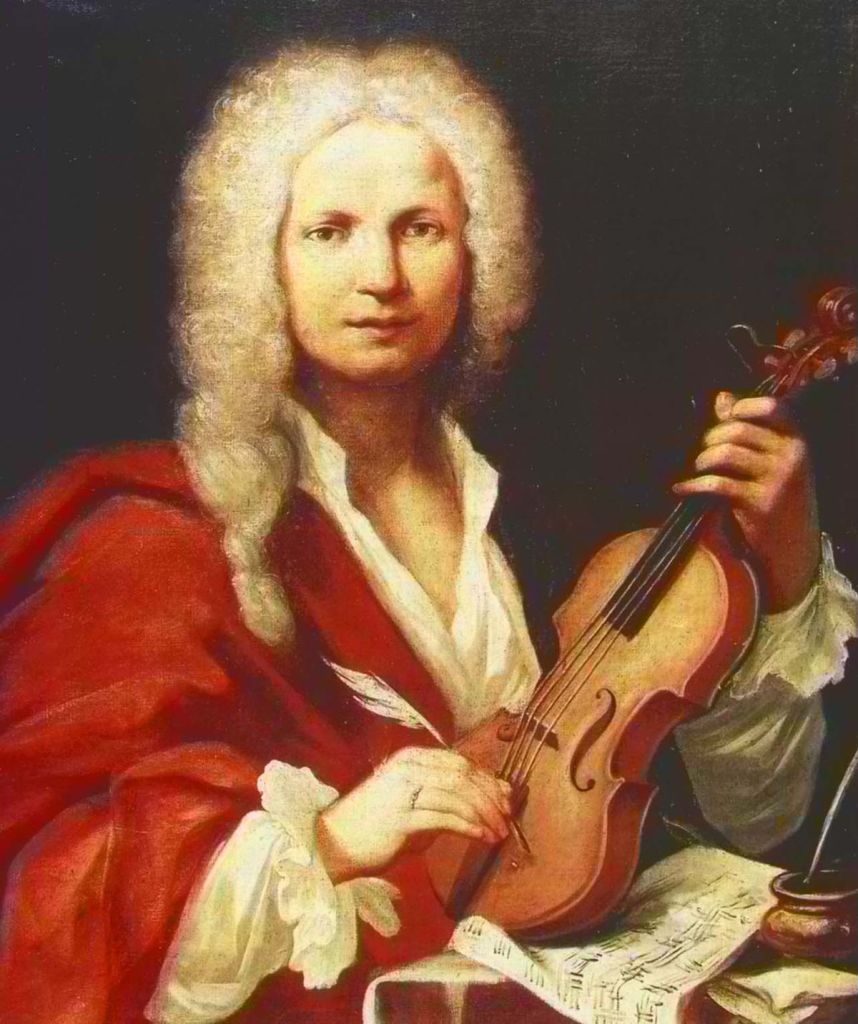
Composer & violin pioneer Antonio Vivaldi was renowned (and even feared by his peers) for the virtuosity of his improvised cadenzas (picture credit: Eboracum Baroque)

Nowadays, there is almost no improvisation to be heard at a classical concert or recital. Sticking strictly to the notes on the page has become convention.

Did the beginning of the end start with Beethoven? His fifth and final piano concerto, the so-called ‘Emporer Concerto’, features a unique instruction at the end of the first movement: “Do not make a cadenza, but immediately proceed to the following” (usually marked on the score as Non si fa una cadenza, ma s’attacca subito il seguente).

At this time in his life, Beethoven once one of the most celebrated piano improviser of his time, if it the best among his contemporaries, was now struggling with his hearing to the extent that he was no longer able to improvise when playing alongside an orchestra.

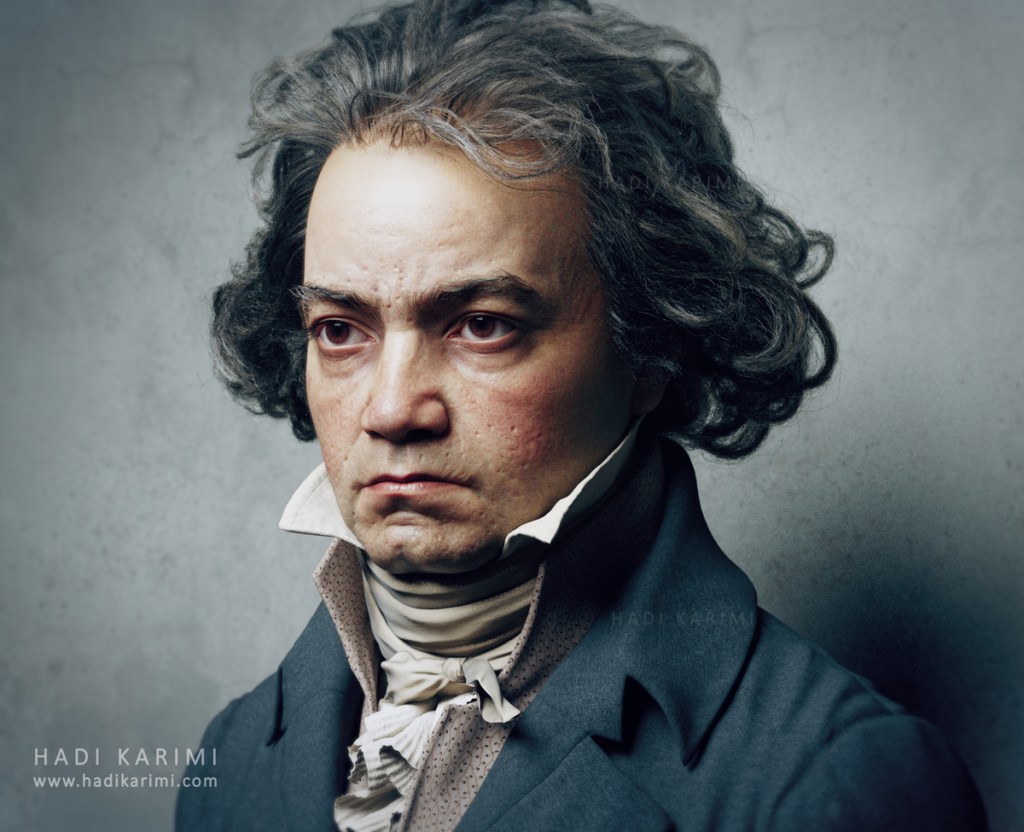
A wonderfully striking 3D interpretation of Beethoven’s portrait, circa 1812 (picture credit: Hadi Karimi)

Some believe that he decided to formally write a cadenza to be played as written, which was very rare for the time, almost out of a sense of spite; frustration at not being able to improvise the way he wanted to led to the instruction specifying that no other performer could either.

At the same time, pieces were becomg more elaborate, orchestras were increasing in size and composers were becoming more experimental and imaginative. This left little room for the spontanetny of one individual’s instantaneous composing. Similarly the widening of audiences themselves to include more of the emerging middles classes led to an increased formalisation of concert going etiquette, much like the ever-expanding rules of dining (which fork to use, passing the port from the left). Invented rules designed to separate the ‘old money’ from the ‘neveau riche’ soon became simply the way things are done. Instruction because convention. Convention became tradition.

So how do we come back from this? There are those who argue that without the skill of improvisation, you’re not a complete musician.

When we repeat music we have learned by rote, are we repeating memorised phrases in a foreign language in which we are unable to actually converse? Music is, after all, the oldest language. We don’t exchange information and ideas solely through the quotation of famous speeches (at least, not most of the time), so why does this still such a strong convention in western classical music performance?

That’s just how things are done around here.

There is something stultifying about a tradition where millions of pianists are all playing the same 100 compositions… everyone has to play a Bach prelude and fugue, a Beethoven sonata, a Chopin nocturne, and we’ll do that until the end of the world, something in our soul dies

John Mortensen, quoted in The Guardian (2020)

But it doesn’t necessarily have to be this way.

Real art is about breaking the rules and going against convention. Perhaps it is time classical performers took back their right to own their own performance and interpretation. Audiences won’t mind (according to this relatively recent research). Beethoven and the Old Masters won’t mind. They’re dead, but their music doesn’t have to be…