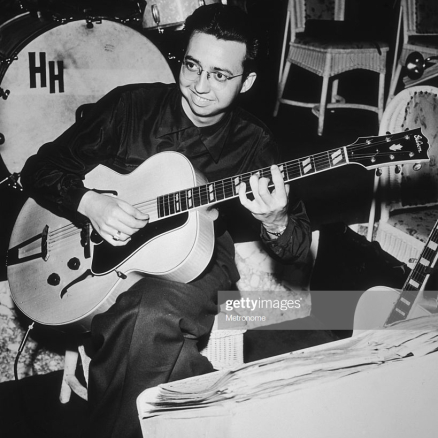
Great Guitarists #2: Barney Kessel

Great Guitarists

Welcome back to my Great Guitarists mini series (you can read my previous piece, on Earl Klugh, here). Today, allow me to introduce you to my favourite guitar player of all time. You might not recognise the name, but you’ve certainly heard him on recordings from the jazz greats to The Beach Boys. Introducing…

Barney Kessel

Born in Muskogee, Oklahoma, in 1923, Kessel was known by early bandmates for practising up to 16 hours a day. Judging by the amount of work he had, those hours of practice clearly paid off – and I haven’t even touched upon the countless records he released under his own name, not to mention his film scores, world tours with other legendary jazz guitarists or his regular guitar advice column!

While Kessel might not be the most recognisable face or name to many, his prolific session work over several decades means you are guaranteed to have heard his guitar playing. Early gigs for Kessel included the bands of Chico Marx, Artie Shaw, Charlie ‘Bird’ Parker and Oscar Peterson.

Later, he was one of the regular LA session players known collectively (and famously) as The Wrecking Crew. Around the same time, Kessel found ample work as an accompanist. His most recognisable song is Julie London’s definitive version of ‘Cry Me A River’ (from her 1955 album Julie Is Her Name – worth checking out for Kessel’s guitar arrangements alone). He also provided similar guitar backing for several other great jazz singers, such as Billie Holiday, Ella Fitzgerald and Anita O’Day.

One of the most heard examples of his session work comes at the very start of Brian Wilson’s classic and sixties-defining record with The Beach Boys. The opening harp-like notes of track one, Wouldn’t It Be Nice, are actually Kessel playing something called a Mando-guitar (sometimes mid-credited as a 12-string guitar). In Situations such as this, session players such as Kessel could call on their training and in-depth knowledge of their instrument and technique to quickly provide the sound that producers and artists such as Wilson were searching for, often when this was not very clearly defined.

In terms of a definitive track, where do I start? Pick up any album led by him and you’ll be rewarded with his amazing jazz guitar playing, from choral soloing through to wonderfully fluid single note lines. Kessel played hollowbody electrics almost exclusively, and although he moved around from various Gibson guitars to Kay models (including variations of a signature model at different price points) and back again, his thick tone with a piano-like clarity rings through. Perhaps we should begin with his beautiful version of the jazz standard Autumn Leaves, performed live in this video from 1979. Enjoy!

As always, do tell me what you think. The full list of guitar players featured in this week’s series aren’t set in stone yet, so if you have any suggestions (ideally with a jazz bent for this week’s run), please do get in touch. I love hearing what you guys think!

Until next time…

Upcycled music: my custom-built, eco-friendly classical guitar

Guitars & Gear

Those of you who follow me on Twitter may be aware that I recently had a new classical guitar custom made for me by Neil McHardy Guitars in Cumbria. Here’s some details and a closer look…

McHardy’s eco-friendly mindset

Neil works alone and handbuilds his guitars to order. His offset sound hole design came from his father, who built guitars for the boys he used to teach, using old wood. Neil, a retired engineer, has kept the same overall design & philosophy, creating beautiful instruments out of old wood. Most of his guitars had previously been doors, floorboards or old workbenches. It goes against the mentality of many high-end luthiers, who prize certain ‘tonewoods’ over others. Believe me, these guitars sound brilliant & play as well (if not better) than their (considerably) more expensive rivals.

Unique in more ways than one

I first discovered Neil’s craftsmanship at the Sunbeams Music Centre in Penrith, which has a guitar donated by him amongst its collection. Intrigued by his philosophy of using recycled wood, I contacted him to ask if he had ever made a nylon-strung guitar. Neil told me he had not (all of his creations until then had been steel-strung acoustics), but was up for the challenge.

After lots of careful of research, Neil designed & built a guitar to my specifications. He also sent me regular work in progress pictures (below).

The finished product

Neil finished the guitar for me in late January, and it was great to finally have it in my hands to play. All of my requests & requirements had been met, from the thinner body depth to the input jack being placed separately from the bridge pin/end strap button. The offset soundhole does not effect volume, but rather allows for more vibration of the top. It also suits my more percussive style of playing better.

Specifications

Top: Red Cedar
Back & Sides: Spanish Cedar
Neck: Cherry, with a Beech stripe
Fretboard & Bridge: African Ebony
Head Facing & Golpe: American Walnut

Nut & Saddle: Camel Bone
Pickup: Fishman ‘Presys’

Depth: 90mm at bottom, tapering to 70mm at top
Width of lower bout: 370mm
Length: 1,000mm
Nut Width: 52mm (2″)

I’ve played this guitar for a couple of months now and still very pleased with it. The thinline body & offset soundhole create less conventional nylon-strung sound which is perfect for jazz and latin styles, while still retaining an intrinsic classical vibe.

Unplugged, it is loud enough to be heard, but the onboard mic/pickup combo is very versatile for both live performance and recording – I especially like being able to blend the ratio of microphone (just under the soundhole on the guitar’s upper bout) and pickup. Having a tuner on there means one less thing to forget to pack in my gigbag too!

I’m terms of how it looks, I think this guitar is a real stunner. To me, it mixes the best of classic Spanish guitar with elements of African design – particularly in the binding & rosette. Speaking of which, these are another feature unique to all McHardy Guitars, as they are pieced together from spare wood chippings. No two rosettes made by Neil look the same!

Playability

The action is low but clean, and the 52mm (2 inch) nut, the standard in classical guitar making, feels perfectly comfortable. Its thinline body make it easy to hold in the right position and the neck is well intonated. Big stretches aren’t a problem and full chords hold their tuning across the fretboard. In short, it feels as good to play as it sounds.

The electrics are simple to navigate and sound superb. I’ve already found two settings which will likely become my main voicings for this instrument.

One of a kind

When I first met Neil in his workshop, I noticed he had a collection of wooden circles on a string. These, he explained, were the cut-outs from the soundhole of every guitar he had ever made. He estimated there to be around 50 in total. All of them steel-strung six string acoustics, until mine.

However, it seems Neil continues to diversify and experiment. At time of writing, he was starting on his first ever twelve string, another requested build. I’m sure he’ll nail it as brilliantly ass he did with my nylon-strung axe.

In a follow up conversation, Neil mentioned one of his Facebook followers admiring photos of my finished guitar so much that he had started enquiring about his own. So perhaps this could be the start of a whole new range for Neil!

For more info…

If you asked about his work, Neil would tell you that he’s “just a man in a shed”. However, if you would like to see more of his guitars, or even discuss a future build of your own, then please do check him out via the Neil McHardy Guitars Facebook page – just don’t inundate the poor guy with requests for the Tim Higgins Signature Model!