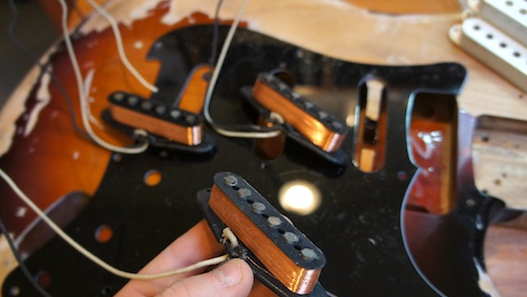
Tonerider pickups Vs Squier Classic Vibe Pickups

Advice & Tips, Guitars & Gear

This article has been one of my most viewed pieces, as fans of Squier guitars try to get to the bottom of a pickup mystery. I heard of it being shared on forums discussing the link between Squire’s Classic Vibe range and Tonerider pickups. However, I also recently learned of an important update, so have returned to this post to bring it up to date.

This article was first published in May 2020, and was updated in November 2024.

A few years ago, I was in the process of changing the pickups in my two Stratocasters. One, my blonde Squier Vintage Modified (pictured below), was fitted out with custom pickups handmade for me by Rohdan Pickups in the USA. These were made using Alnico III magnets in the neck and middle pups, the same as the very first run of Fender Strats in 1954. The bridge was a mix of Alnico V & II, for better definition, without the harsh trebley bite.

strats

My three Strats, before I sold the red one (top) or changed the pickups in the other two…

For the other guitar, my trusty Mexican HSS Strat (the blue one, pictured above), I only needed replacement neck and middle pickups. I was playing with different groups with less emphasis on heavy rock, and needed something more versatile. I’m still really happy with the Seymour Duncan ’59 humbucker in the bridge (this is usually a Les Paul replacement/upgrade, and has a great tone for classic rock). Having loved the sound of one of my other Strats, a Squier CV, or ‘Classic Vibe’ (Simon Neil signature model, based on a CV 60’s model), I started researching it’s pickups online. I thought I might get an idea of where to look for similar-sounding pups to install in my Mexican Strat. However, in my search, I happened upon an interesting, and ultimately money-saving, discovery…

Tonerider Pickups

Tonerider make replacement pickup sets for Strats and Teles. They appear to operate out of Squier’s main factory and sound as similar to the pickups used in Squier’s Classic Vibe guitar range as to lead most people to believe they are the stock pups built into the instrument.

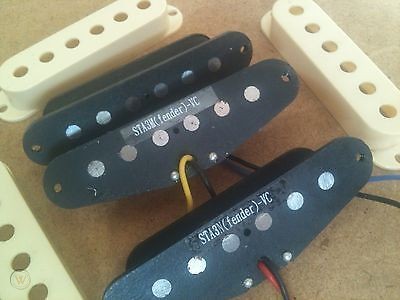
An excellent article by Tidy Words seemed to confirm what many Squier players had long suspected, and which Tonerider set was (allegedly!) being used in which guitar:

  • CV 50’s Strat – Tonerider Surfaris
  • CV 60’s Strat – Tonerider Classic Blues
  • CV signature Strat (Simon Neil signature, etc) – Tonerider Vintage Classics

For full details, you can see the full article here.
tonerider

Picture courtesy of Worth Point.

However, this only appears true for Squier Classic Vibe guitars made before 2019 in China

According to Fuzz Faced, Squire CV production tool place in the Grand Reward factory, based in the Guang Dong province of Southern China. Tonerider pickups were made in the same factory, leading to the noticeable similarities in construction and sound between their pickups and the stock CV ones.

Squire moved production of the Classic Vibe range to Indonesia in 2019, as a means of lowering costs and avoiding US import tarrifs on goods manufactured in China. As a result, these newer guitars are no longer made in the same factory as Tonerider pickups. So what might have been true of a pre-2019 CV is much less likely now.

However, the sound of a CV 50s Strat made in China is the same is one made in Indonesia. Their pickup voicings remain almost identical to models of Tonerider pickup available.

The takeaway message…

If you have a Squire Classic Vibe guitar, don’t rush to upgrade it with Tonerider pickups. They are, for all intents and purposes, already in there! And frankly, if you’ve bought a CV guitar to get the overall ‘vibe’ of a certain era in Fender’s history, the stock (Tonerider-sounding) pickups do a great job, and don’t need replacing in the first place! These guitars are well built and in terms of sound, playability and build quality, give the ‘real’ Fenders a run for their money – at a fraction of the price!

On the other hand, if you like the Strat you have, but it’s not from the Classic Vibe range, and want to improve the pickups, you could do a lot worse than the Tonerider range. Check out their full range of Strat pickups here.

How did it work out for me?

I bought a City Limits single coil set from Tonerider for the Mexican HSS Strat. These use Alnico V magnets, and are aiming for the ‘Texas Blues’ sound Fender Strats do so well – think ‘SRV’ and you’ll have a fairly good idea what I mean.

city-limits-new

Picture courtesy of Tonerider.com

These pickups worked brilliantly for blues, rock, funk, jazz and everything else I threw at it. However, I found the difference between the sound of my two Strats to be an issue (as one guitar serves as backup for the other onstage), so I switched the bridge pickup to a more original-sounding single-coil, and decided to put in a new, fully balanced set. Having grown to prefer the sound of my blonde Strat, I opted for Tonerider’s Alnico-3 Surfari set. I also made the ‘tele mod’, making it possible to select the bridge and neck pickups at the same time. Now I have that wonderfully airy but funky Telecaster sound, making for a very versatile guitar which pairs much better with my blonde Strat.

I hope this has been helpful, and clears up any misunderstanding about the Squier CV range. As always let me know your thoughts, and good luck in your buying choices!

Upcycled music: my custom-built, eco-friendly classical guitar

Guitars & Gear

Those of you who follow me on Twitter may be aware that I recently had a new classical guitar custom made for me by Neil McHardy Guitars in Cumbria. Here’s some details and a closer look…

McHardy’s eco-friendly mindset

Neil works alone and handbuilds his guitars to order. His offset sound hole design came from his father, who built guitars for the boys he used to teach, using old wood. Neil, a retired engineer, has kept the same overall design & philosophy, creating beautiful instruments out of old wood. Most of his guitars had previously been doors, floorboards or old workbenches. It goes against the mentality of many high-end luthiers, who prize certain ‘tonewoods’ over others. Believe me, these guitars sound brilliant & play as well (if not better) than their (considerably) more expensive rivals.

Unique in more ways than one

I first discovered Neil’s craftsmanship at the Sunbeams Music Centre in Penrith, which has a guitar donated by him amongst its collection. Intrigued by his philosophy of using recycled wood, I contacted him to ask if he had ever made a nylon-strung guitar. Neil told me he had not (all of his creations until then had been steel-strung acoustics), but was up for the challenge.

After lots of careful of research, Neil designed & built a guitar to my specifications. He also sent me regular work in progress pictures (below).

The finished product

Neil finished the guitar for me in late January, and it was great to finally have it in my hands to play. All of my requests & requirements had been met, from the thinner body depth to the input jack being placed separately from the bridge pin/end strap button. The offset soundhole does not effect volume, but rather allows for more vibration of the top. It also suits my more percussive style of playing better.

Specifications

Top: Red Cedar
Back & Sides: Spanish Cedar
Neck: Cherry, with a Beech stripe
Fretboard & Bridge: African Ebony
Head Facing & Golpe: American Walnut

Nut & Saddle: Camel Bone
Pickup: Fishman ‘Presys’

Depth: 90mm at bottom, tapering to 70mm at top
Width of lower bout: 370mm
Length: 1,000mm
Nut Width: 52mm (2″)

I’ve played this guitar for a couple of months now and still very pleased with it. The thinline body & offset soundhole create less conventional nylon-strung sound which is perfect for jazz and latin styles, while still retaining an intrinsic classical vibe.

Unplugged, it is loud enough to be heard, but the onboard mic/pickup combo is very versatile for both live performance and recording – I especially like being able to blend the ratio of microphone (just under the soundhole on the guitar’s upper bout) and pickup. Having a tuner on there means one less thing to forget to pack in my gigbag too!

I’m terms of how it looks, I think this guitar is a real stunner. To me, it mixes the best of classic Spanish guitar with elements of African design – particularly in the binding & rosette. Speaking of which, these are another feature unique to all McHardy Guitars, as they are pieced together from spare wood chippings. No two rosettes made by Neil look the same!

Playability

The action is low but clean, and the 52mm (2 inch) nut, the standard in classical guitar making, feels perfectly comfortable. Its thinline body make it easy to hold in the right position and the neck is well intonated. Big stretches aren’t a problem and full chords hold their tuning across the fretboard. In short, it feels as good to play as it sounds.

The electrics are simple to navigate and sound superb. I’ve already found two settings which will likely become my main voicings for this instrument.

One of a kind

When I first met Neil in his workshop, I noticed he had a collection of wooden circles on a string. These, he explained, were the cut-outs from the soundhole of every guitar he had ever made. He estimated there to be around 50 in total. All of them steel-strung six string acoustics, until mine.

However, it seems Neil continues to diversify and experiment. At time of writing, he was starting on his first ever twelve string, another requested build. I’m sure he’ll nail it as brilliantly ass he did with my nylon-strung axe.

In a follow up conversation, Neil mentioned one of his Facebook followers admiring photos of my finished guitar so much that he had started enquiring about his own. So perhaps this could be the start of a whole new range for Neil!

For more info…

If you asked about his work, Neil would tell you that he’s “just a man in a shed”. However, if you would like to see more of his guitars, or even discuss a future build of your own, then please do check him out via the Neil McHardy Guitars Facebook page – just don’t inundate the poor guy with requests for the Tim Higgins Signature Model!

Warm up & practice recommendations

Advice & Tips

This week, I’ve had the rare luxury of free time. Free time to pick up my guitar whenever I like and play. Not specifically for any particular goal, just to PLAY for the love of playing. It then occurred to me just how little I get to do this. Usually I pick up my guitars to practice or prepare for an upcoming show, or to learn new material. The rest of the time, I’m actually at a gig playing.

Using it as a great opportunity to go over my classical repertoire, I found it almost scary how much my discipline had slipped. Don’t get me wrong, I still play well and in a musically pleasing manner (in my opinion, anyway!) but there are ways of performing on guitar (with classical pieces in particular) which enhances the music and makes playing easier (not to mention lessening any strain and preventing injuries long term).

So this week, I have been delving into my old practice and warm up notes and dug out my old favourite, Pumping Nylon by Scott Tennant. For the classical guitarists out there who do not have this book, I strongly recommend you purchase it as soon as possible.

91or8zjkZOL.jpg

This book focuses solely on technique improvement for both hands (including thumb for the right hand). After the initial basics and starters, it progresses into joint techniques (working exercises for both hands together) and demonstrates a closer look into flamenco techniques. These not only go to strengthen your right hand, but to widen your overall playing ability. It also includes specially written study pieces to incorporate all the techniques it has taught.

Around fifteen years ago, I suffered a broken ring finger on my right hand. This has never fully regained it’s original strength (and as a result my days of regular classical guitar recitals are mostly behind me). The exercises in this book went a long way in helping my rebuild the muscle and bring my ability back, something I feared would never happen. Because of this, the right hand techniques and exercises int his book are of particular importance to me.

That’s the basic warm ups covered, but what about actually rehearsal starters? For me, as with many classical guitar players, the studies (or ‘Etudes’) of Francisco Tarrega and Fernando Sor provide plenty of examples for rehearsal focus, especially with right hand technique. It’s absolutely amazing the depth of ground these two teacher-composers (not to mention pioneering players) covered in advancing the technical study of the guitar. I cannot recommend them highly enough.

Alongside these, there are also the studies of Mauro Giuliani. Although his concert and recital pieces are widely known (in fact the staple of most player’s repertoire), his studies are often neglected. However, I would definitely suggest investing in a transcription of his complete studies. While not as technique-practice heavy as Sor (who, in contrast, is remembered historically more for his studies than his concert pieces), they present a more musically varying set and some new colour into your practice routine.

My standard practice routine (looking at my old notes from my true classical playing days) went roughly as follows:

  • 5-10 mins warm ups (both hands, featuring exercises from Pumping Nylon and scale practice
  • Selected studies from Sor, Tarrega and Giuliani (2 or 3 from each, focusing on specific improvement areas)
  • Looking at any new pieces to learn; slow play-through; focus on tricky areas; attempt to play through without stopping (I would try not to spend more than 20-25 minutes on this to prevent fatigue or frustration – the piece can be returned to on the next day)
  • A better known piece which also requires mastering. Ideally play-through should be reached far more quickly
  • Another piece (already known) to ‘refresh’ the fingers (ideally this will also be an upcoming concert piece)
  • Free playing – At this point, I could have been rehearsing for up to an hour and a half, so this should be an old favourite or two which you know well, to act as a cool down. Be careful, though, to remain watchful on technique and accuracy, as this is more likely to slip on pieces you are over familiar with.

These, of course, are my tips only. I would however be delighted to hear from other guitarists and their tips/routines for warm-ups and rehearsals. You can contact me via the  contact page on this site, or my social media (see links).

Good luck and happy practicing!