Hello and Happy New Year! How’s the New Year’s resolutions going?
I’m starting 2026 the way I mean to go on, with lots of fun gigs and NEW MUSIC!
As well as various wedding gigs, both as a solo guitarist and with my function band, I also have a few shows and releases with my original music project, Solcade.
I’ve been involved in a few original projects over the last decade, but mainly as an arranger and band leader. My songwriting contributions have been minimal. As a result, I’d been storing up a small collection of ideas that didn’t really suit any of the acts I was working with. These sketches mixed funk and jazz with the afro and latin-fused rhythms I’d developed a deep love for through past work with older ‘world’ music acts, and mixed with a heavy dose of psychedelia and garage rock.
After we began to emerge from the pandemic and start performing live again, I decided to put together a group of musicians with a shared interest in less common styles of music (at least within the UK), including afrobeat. Initial jamming and writing sessions yielded some interesting results, and almost saw the project reshape into something closer to free jazz. However, the lineup didn’t remain stable and I had to rethink what I was trying to achieve.
By 2023, I had assembled a slightly altered lineup that shared the same vision: to write interesting and genre-blending music; and to credit all compositions to all members equally (in this case, as a five-way split). This can sometimes cause issues such as resentment of one member is not perceived to be adequately pulling their weight in terms of writing. However, I was fortunate enough to be working with enthusiastic creatives who stepped up to the challenge, and we soon had enough songs to get onstage and perform live.
Best of all, this collective approach applies to more than just the songwriting process. I may have kicked this whole thing off, but we now work as a team, with no singular leader, making this a true band; a collaborative experience. You can find regular updates on the band on our Instagram page.
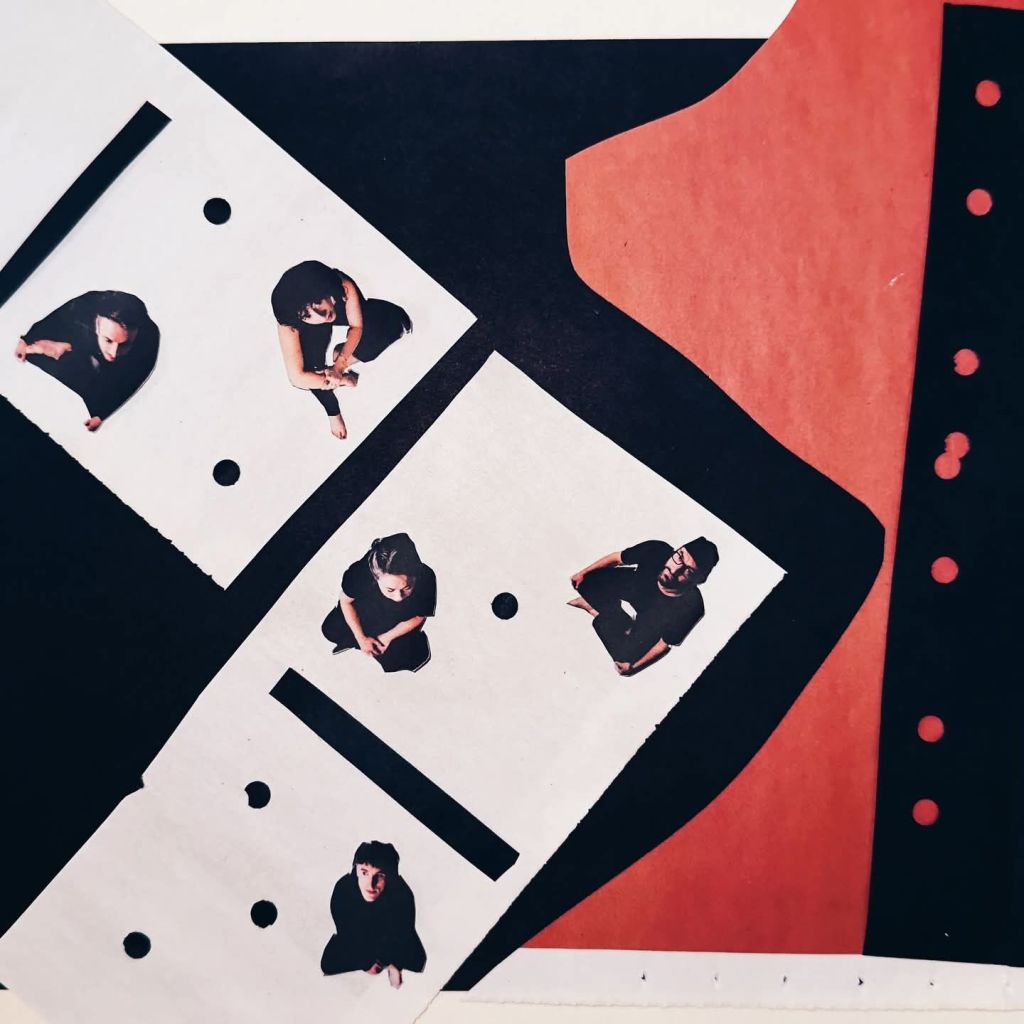
Our first single, ONE MORE DOMINO, is out now, available everywhere. This song focuses on the feelings that come with the build-up to revolutions throughout history. Listen to the new track here and let me know what you think.
As the rain sets in here in the UK, for what looks like a prolonged period, it seems that summer is well and truly over.
The last few months have been pretty busy, so I thought I’d quickly let you in on what I’d been up to…
…aside from the usual, that is
My main working week is still taken up with the music therapy service I provide in a range of settings. Most of my therapy work is with children and young people, and one of the best things about my job is seeing how music helps to communicate feelings which, for some of my clients, can be hard to articulate with words. It makes the more difficult aspects about this work (such as the seemingly endless stream of reports) worthwhile.
Wedding season is coming to an end
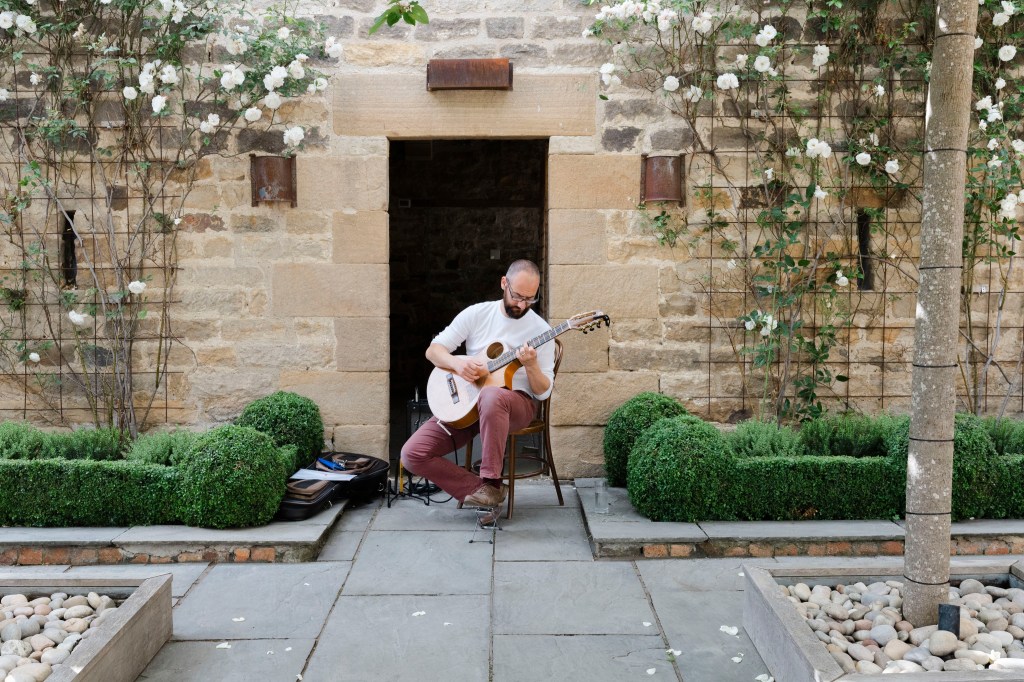
In terms of live music, it is the covers bands that continue to make up majority of my professional output. However, I enjoyed playing more solo guitar gigs, performing at wedding services and receptions.
Credit: Imogenkate Photography (2023).
It’s nice to see this type of work coming back through into my diary again. After Covid, I feared that live classical guitar may have been an expense too far for couples planning their big day, but this summer has thankfully proven my fears to be unfounded. I’ve already got several dates in my diary for 2024 (if you are looking for a solo guitarist for your own big day please get in touch via my contact page).
Nick Gladdish is recording his next LP
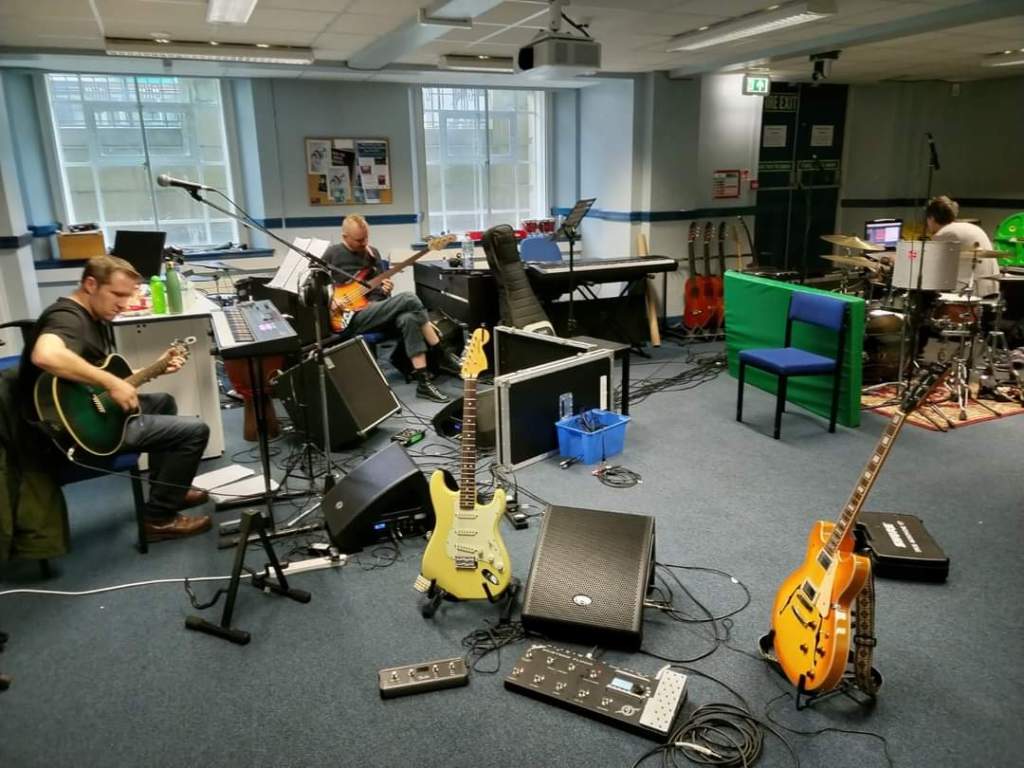
In August, Nick called his usual crew into the studio to lay down baking tracks for his new album, he follow-up to 2021’s Last One Get The Lights. Although we all (Nick included) expected this record to feel like a companion piece to LOGTL, we soon discovered a slightly more rock-orientated edge to the arrangements. This may be a result of the tighter arrangements, as Nick told us he was consciously trying to keep the tunes on this record shorter than his usual fare. With John Timey back in the joint producer/drummer chair, and the brilliant Adam Cornell on bass guitar, this felt like one of the smoothest recording sessions I’ve ever been involved with.
NG Band in-studio.Positive feedback?
The results so far are promising; ten pop-rock songs about love, loss, disillusionment and corruption. I certainly enjoyed writing and layering rhythm guitar tracks. There’s not many guitar solos this time around, but there is some interesting experimentation going on, from drowning out the end of one song in multi-tracked guitar feedback, to a bluesy ukulele solo on the opening track! Next come the overdubs, editing and mastering…
New original project finally ready to launch
Finally, despite various obstacles thrown at me, I am pleased to announce that I have a new original music project about to start performing live. Solcade began as an outlet for music I was writing which didn’t fit anywhere else – too jazzy, bluesy or indeed too varied for many of the ensembles I have been working with.
After recruiting a stable five-piece lineup, the project quickly became much more of a democratic process, and the music is all the better as a result. With each member having an equal credit in writing and arranging, everyone involved has been bringing their ‘A game’ and making some amazing contributions. If you’re a fan of psychedelic funk, Jazz, soul and rythym & blues, then watch this space for upcoming details about our forthcoming debut record (likely scheduled for completion & release in 2025).
We have some live shows coming up in the autumn, too. Follow us on Instagram to hear the latest updates.
But what have you been up to?
Let me know! Also, I’m planning on writing a Q&A article so if you have any guitar, composition, music therapy or psychotherapy-based questions, get in touch and I may well include it!
Albert Nelson (1923-1992) is one of the most influential blues guitar players of the mid-29th century, at the height of the Blues’ electric period, and one of the early exponents of the modern blues. But you probably know him better by his stage name, Albert King.
He took the stage moniker of King due to the success of another popular blues guitarist, B.B. King. In fact, it is believed he even passed himself off as a cousin of B.B.’s early in his career in order to raise his profile and get more gigs!
Despite the somewhat cheeky start, both B.B. and Albert, together with Freddie King (also no relation to either of the other two), are now.often referred to collectively as The Three Kings of the Blues, given their enormous influence on countless guitar players both in the next generation of players and among their contemporaries.
Breakthrough Success
King had played with other artists (including as a drummer for Blues Legend Jimmy Reed, for a brief time) as well as leading his own band on the blues club circuit in Illinois in the USA. However, it wasn’t until he moved to Memphis and signed to Stax Records that he started to have a successful run of single releases. King believed that it was his decision to play blues songs in an upbeat, soul-based style which proved crucial to his success. He recorded with the Stax House band, Brooker T and the MGs (featuring none other than Steve Cropper on rhythm guitar), as well the Memphis Horns. Stax singer-songwriter Isaac Hayes also contributed piano to the sessions alongside organist Brooker T. Jones.
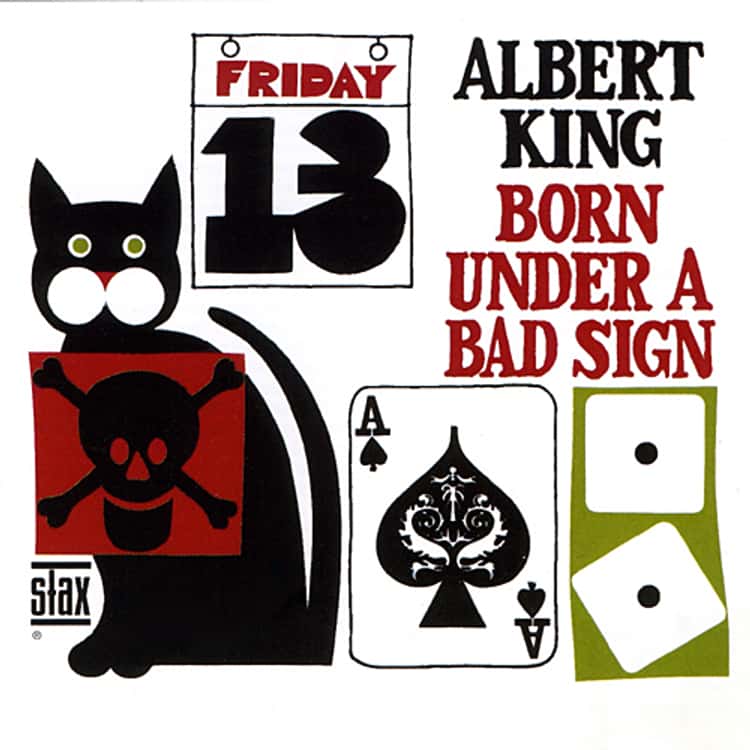
Eleven of the Stax singles, recorded over five seasons from March 1966 to June 1967, were complied and released as the album Born Under a Bad Sign in 1967. The album became a reference point for guitar players such as Eric Clapton, and the title track from the album became King’s signature song (also covered by Clapton with his late sixties blues-rock supergroup Cream).
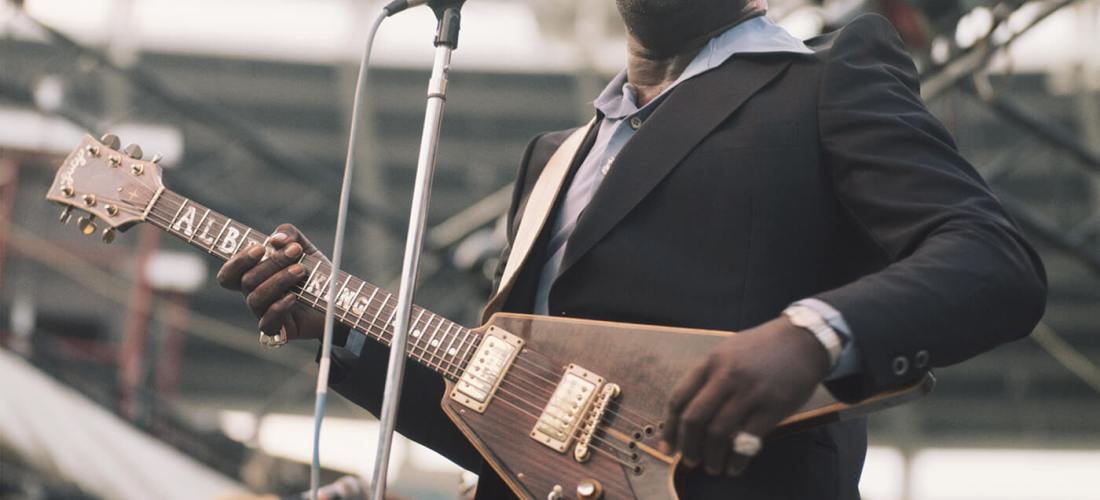
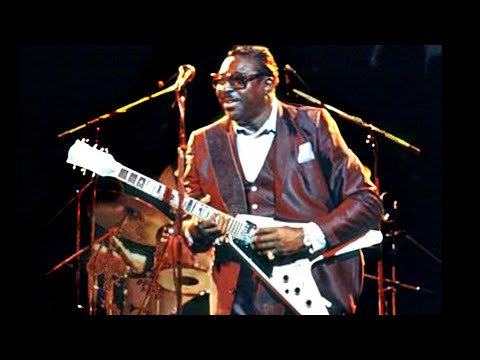
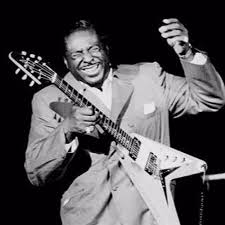
King performing live across the years.
Unorthodox technique
Albert King was known as the “Velvet Bulldozer” due to his soulful voice, which contrasted his large physical frame (standing 6’4″ tall). He was left-handed but opted to play a (standard) right-handed guitar upside down. The guitar he is most associated with is Gibson’s Flying V (see pictures), or custom-built guitars based on this model. It’s unusual ‘V’ shape made it much easier to play left-handed without anything getting in the way (Hendrix occasionally used one too, likely for the same reason). King strung his guitars the opposite way to the ‘standard’ layout, with the thinnest/highest sounding string at the top – he was literally playing a ‘standard’ guitar upside down.
Another ‘upside down’ element to King’s technique can be found in the way he bends his notes. His large hands bent the strings by pulling them downwards, towards the floor. Some players (like Jeff Beck, I believe) have remarked on this, saying it allows for greater control of the pitch. In King’s case, he was able to raise the pitch by over two tones of he wanted to. He was also able to comfortably bend several strings at once, a technique much-copied since.
King’s unique style has been identified as a key element in the playing styles of Eric Clapton, Jimi Hendrix, Buddy Guy, Albert Collins, Mike Bloomfield and in particular, Stevie Ray Vaughan, who cited King as his primary influence.
King largely played on the three highest-sounding strings of his guitars, usually playing variations on the same musical phrases. But it was the numerous different ways that he was able to phrase the same simple blues licks; his huge string bends; and the harsh, stinging ‘attack’ he utilised in his playing, which gave King his unique sound.
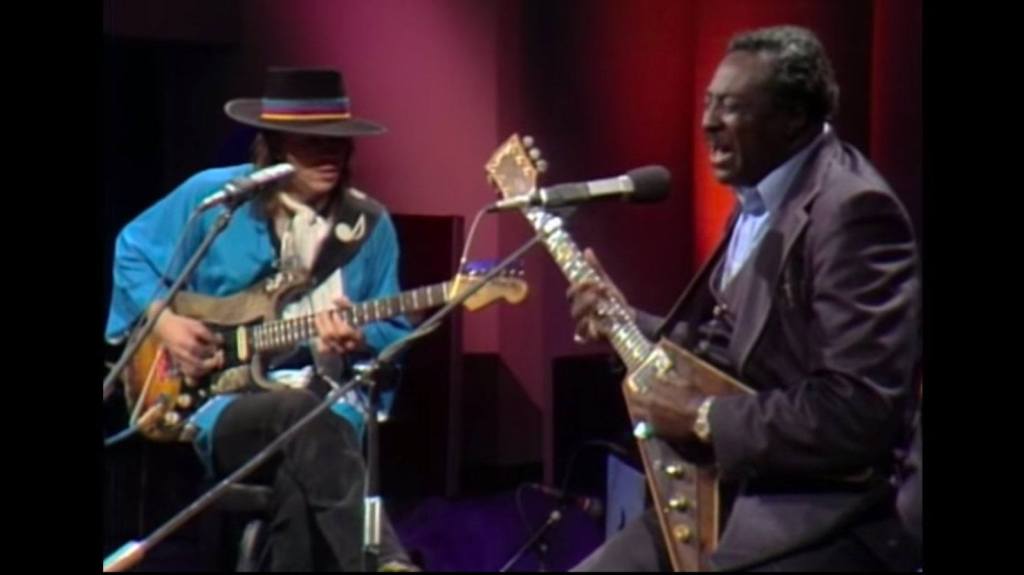
King with Stevie Ray Vaughan (left) recording the In Session TV special/album (1983).
Guitar Tuning
There remains to this day an ongoing debate about how exactly King tuned his guitar – yet another unorthodox element to his style. Rather than use the standard guitar tuning (low to high: EADGBE), King made use of a more unusual tuning, believed to be either (low to high): CBEF#BE (according to Steve Cropper, who recorded with King and produced some of his records), or CFCFAD (according to Dan Erlewine, who built custom guitars for King later in his career). He may have switched between both options and others.
In either case, since King only played lead, he did not have to contend with the difficult chord shaped these tunings would have thrown up. It is likely he found them useful for easily finding his root note and being able to execute his particular repertoire of blues licks across a greater range of the fretboard.
Recommended listening
Aside from Born Under a Bad Sign (1967), I’d suggest checking out King’s love album Live Wire / Blues Power (1969), which features cuts taken from a three-night stint at the Filmore West.
Also worth listening to is In Session, the audio record of a TV special from 1983, but only released in 1999. In Session is a collaboration between King, who leads processing as the ‘old master’ and the then up-and-coming blues guitar superstar (and Albert King disciple) Stevie Ray Vaughan. As well as hearing both guitar players trade licks, the record also includes a few brief moments of ‘chat’ between the two which adds to the atmosphere of the project.
Left to right: King, B.B. King, Eric Clapton & Stevie Ray Vaughan sharing a joke backstage.
If you are looking to learn how to get the most out of less in your lead guitar playing, you could do far worse than listen to King’s sharp but tasteful playing. As always, let me know what you think, and keep an eye out for future articles on the other two ‘Kings of the Blues’, coming very soon…








 Tim Higgins, Guitarist
You must be logged in to post a comment.