Quiet Quitting isn’t a thing – but fair working should be

Advice & Tips

Recently the term Quiet Quitting has emerged in the public sphere this year. The term refers to the apparently new trend of only working one’s contracted hours, foregoing unofficial overtime, answering emails from home, or living to serve one’s employer. Pieces have provided an overview on the BBC’s website and in newspaper articles often highlighting the anxieties of large corporations as they lose thousands of unpaid hours of labour. This piece by Guardian columnist Tayo Bero provides an informative insight into the practice.

Except it isn’t a new phenomenon at all. Some people have brought this mindset to their jobs for years. This article from Time Magazine (published just a month before the world closed down because of Coronavirus), discusses the work-life balance and comes very close to saying the same points that the Quiet Quitting ‘movement’ are saying now.

But not everyone can do this. The term mainly applies to those in what might unkindly be referred to as a ‘dead end’ job, from office workers to hospitality staff. Healthcare professionals don’t have the luxury of being able to clock off once they have reached their contracted hours for the day if patients still require care then and there. The same is true in allied healthcare professions such as therapy, my own area of work. Even in the regular routine of weekly sessions, there are issues, from last minute meetings to safeguarding emergencies that mean your presence and insight is required, and you have a duty of care to ensure the best care possible.

But is that always reflected in the financial compensation therapists receive? That largely depends on the employer. Those at the highest risk of working far beyond what they are paid for are those in the sector who are self-employed. These professionals face the struggle to balance charging fairly for their time against the threat of pricing themselves out of the market for a contracted service.

I have wrestled with this conundrum myself as both a music therapist and as a guitar player for hire. It’s certainly not rare to feel like you should have invoiced for more after the full scale of the work involved becomes clear. Getting this balance right is largely a lesson we learn from experience, but in a society where average wages are falling below the cost of living, it is a balance which many find increasingly difficult to maintain.

By contrast, the practice of Quiet Firing, described in this article, has also been highlighted, where employers distance some of their employees from opportunities to progress in their career. It is highly likely that both practices are being fuelled by the other, creating an unhealthy cycle that no employee would wish to be part of.

Some are even attempting to relabel Quiet Quitting as burnout, or a means of dealing with or avoiding burnout. I even read one which went as far as to suggest that the practice was a coping mechanism by employees which will help them be more productive in the future:

It’s another sign of workers — sometimes not even consciously — looking “for ways to feel less burnt out, more motivated and more engaged.”

Nathalie Baumgartner, quoted In The Washington Post

While burnout is in doubtedly a factor, I think viewing this as the workers trying to be even better workers is one hell of a stretch. Perhaps HR teams across the land are finding ways to exonerate themselves of any unpleasant behaviour by placing all the onus on the employees? The very term Quiet Quitting is misleading, as it implies that not working beyond what you are paid to do is somehow falling short of the standards expected.

Something is clearly wrong with our work culture if we have reached this point. So what do we need to change? Perhaps businesses should have been more mindful to learn lessons from the Covid pandemic, instead of panicking about getting back to Business As Usual.

It’s time we, as a society, ha took a good hard look at the way we work, and perhaps if we continue to slowly stop pandering to big businesses (where possible), they will be forced to change And if a change comes from society, then everyone benefits – even the  self-employed. But first, we have to know our worth, and accept that fairness is worth fighting for.

Creativity v Convention: What happened to improvisation in classical music?

Music

During lockdown, I wrote a piece featuring only a starting and ending theme, leaving the space in between entirely free for the performers (taking turns) to improvise. Players had complete freedom of expression in how they choose to navigate from one theme to the other. The notes they chose, how long they took, and style were entirely at the discretion of each performer.

I approached a few of my musician friends to test this conceptual piece out. When faced with no rules and no harmonic foundation on which they could improvise against, many of them struggled. I found this surprising, especially from performers I know to be excellent jazz improvisers.

However, my friends who are classical musicians failed the task entirely. Why?

Improvisation seems to have all but disappeared not just from the repertoire of classical music, but from the skill set of classical performers. Audiences attending classical concerts and recitals generally expect to hear faithful renditions of the pieces they know, and doubtless have in their music collections at home. Deviation from the score is seen as a failure, perhaps even an insult to the express will of the composer.

It wasn’t always this way. Many early pieces were based around a framework where improvisation would be expected, not just on the main theme (similar to a jazz ‘head’ followed by solos nowadays), but in the accompanymeny itself. The basso continuo parts in Baroque scores (usually played by the harpsichord) were loose fragments, using a special shorthand (known as figured bass) to highlight the expected harmony at certain points in the piece. It was up to the player to fill in the gaps. Similarly, soloists were given freedom of expression in their performance, often at the end of a piece in a completely improvised coda known as a cadanza:

It was the performer’s job to “finish” the composition for the audience (in the same way, today, that an interior decorator finishes the work of an architect and a builder)

Rhode Island Philharmonic, THE STORY BEHIND… (2021)
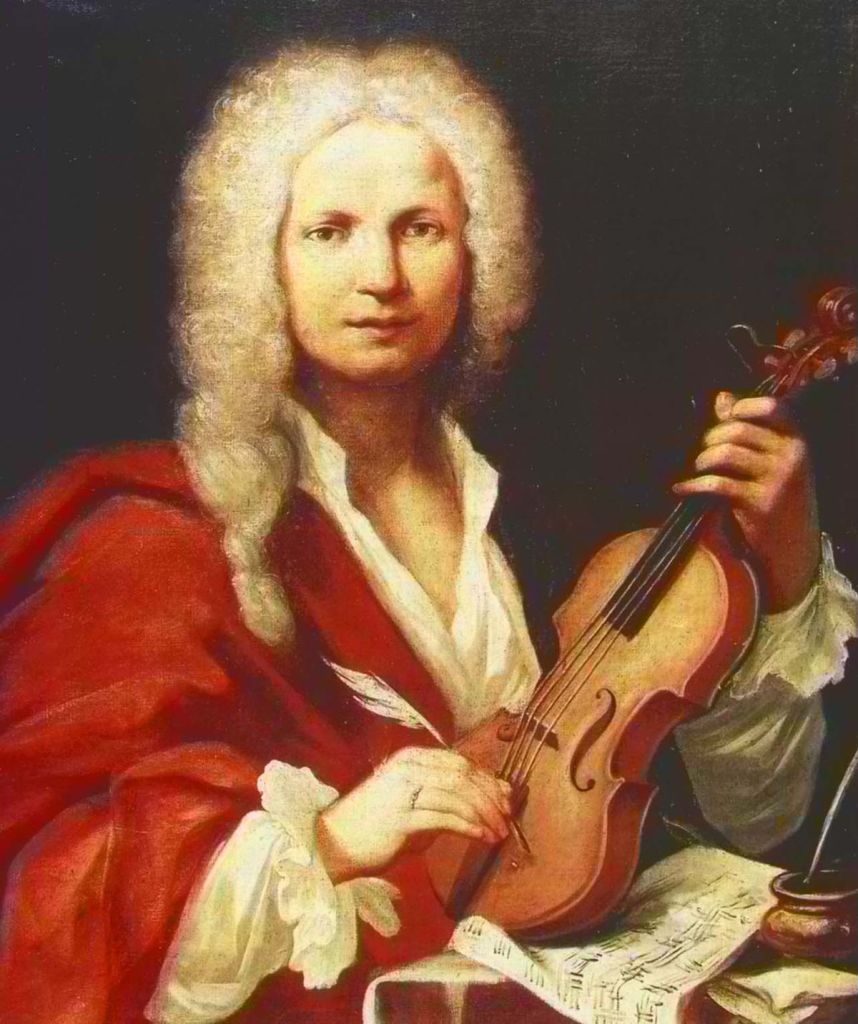
Composer & violin pioneer Antonio Vivaldi was renowned (and even feared by his peers) for the virtuosity of his improvised cadenzas (picture credit: Eboracum Baroque)

Nowadays, there is almost no improvisation to be heard at a classical concert or recital. Sticking strictly to the notes on the page has become convention.

Did the beginning of the end start with Beethoven? His fifth and final piano concerto, the so-called ‘Emporer Concerto’, features a unique instruction at the end of the first movement: “Do not make a cadenza, but immediately proceed to the following” (usually marked on the score as Non si fa una cadenza, ma s’attacca subito il seguente).

At this time in his life, Beethoven once one of the most celebrated piano improviser of his time, if it the best among his contemporaries, was now struggling with his hearing to the extent that he was no longer able to improvise when playing alongside an orchestra.

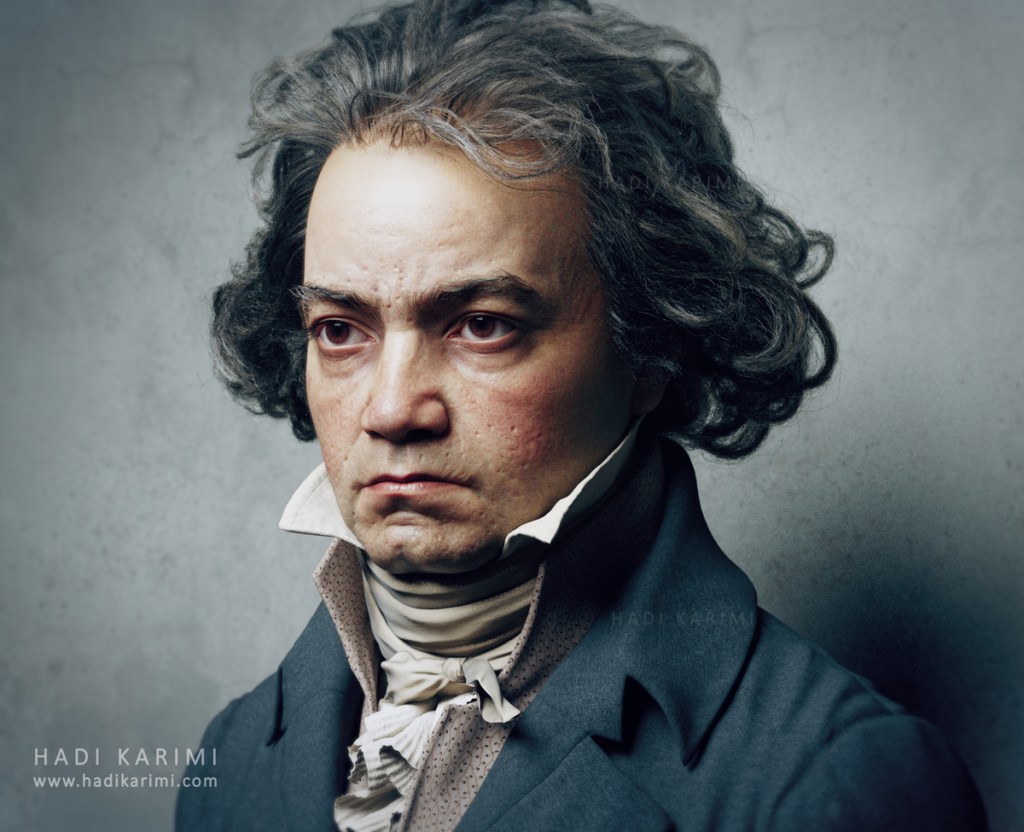
A wonderfully striking 3D interpretation of Beethoven’s portrait, circa 1812 (picture credit: Hadi Karimi)

Some believe that he decided to formally write a cadenza to be played as written, which was very rare for the time, almost out of a sense of spite; frustration at not being able to improvise the way he wanted to led to the instruction specifying that no other performer could either.

At the same time, pieces were becomg more elaborate, orchestras were increasing in size and composers were becoming more experimental and imaginative. This left little room for the spontanetny of one individual’s instantaneous composing. Similarly the widening of audiences themselves to include more of the emerging middles classes led to an increased formalisation of concert going etiquette, much like the ever-expanding rules of dining (which fork to use, passing the port from the left). Invented rules designed to separate the ‘old money’ from the ‘neveau riche’ soon became simply the way things are done. Instruction because convention. Convention became tradition.

So how do we come back from this? There are those who argue that without the skill of improvisation, you’re not a complete musician.

When we repeat music we have learned by rote, are we repeating memorised phrases in a foreign language in which we are unable to actually converse? Music is, after all, the oldest language. We don’t exchange information and ideas solely through the quotation of famous speeches (at least, not most of the time), so why does this still such a strong convention in western classical music performance?

That’s just how things are done around here.

There is something stultifying about a tradition where millions of pianists are all playing the same 100 compositions… everyone has to play a Bach prelude and fugue, a Beethoven sonata, a Chopin nocturne, and we’ll do that until the end of the world, something in our soul dies

John Mortensen, quoted in The Guardian (2020)

But it doesn’t necessarily have to be this way.

Real art is about breaking the rules and going against convention. Perhaps it is time classical performers took back their right to own their own performance and interpretation. Audiences won’t mind (according to this relatively recent research). Beethoven and the Old Masters won’t mind. They’re dead, but their music doesn’t have to be…