Great Guitarists #10: Mary Osborne

Great Guitarists

In this, the tenth installment of my Great Guitarists series, I’m a little ashamed to say we have only looked at male guitar players so far. So, to round off my first ‘dectet’ of influential guitar players (and keeping in a jazz theme, like the previous installments), let me introduce to you Mary Osborne…

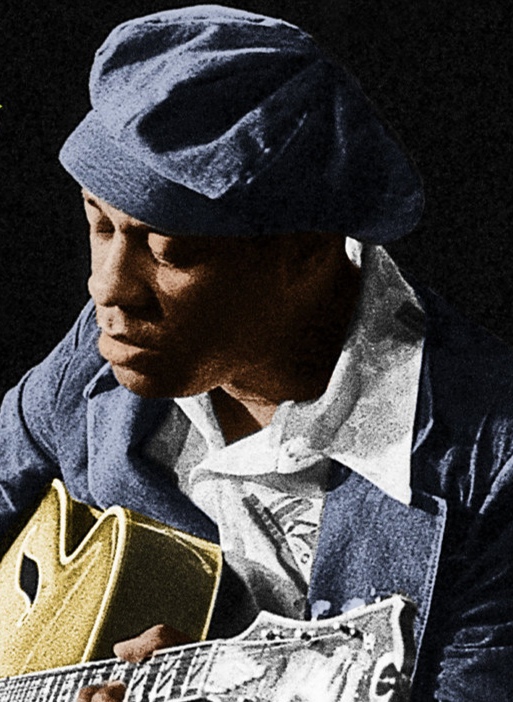
Picture Credit: Gretsch, 1959

Osborne was born into a musical family in North Dakota, 1921. Both her parents were musicians and her father’s barbershop was a known gathering place for local players. Already playing live by the time she was a teenager, Osborne was influenced by the playing of early jazz pioneers Django Reinhardt and Eddie Lang. However, it was Charlie Christian who first captivated her, and mentored her for a while, fine tuning her great sense of swing.

Osborne’s career ranged from trios (her own, and the Winifred McDonnell Trio near the start of her professional career), as well as some work as a sideman (or sidewoman) for the likes of Buddy Rogers, Joe Venuti (whose act included vocalists Kay Starr and The Andrews Sisters), amog many others. In the first of two spells in New York, she was the guitarist in Minton’s house band, where bebop was invented during the jams the legends of jazz had there. Her career continued throughout her life, and she was still performing live up until her death in 1992, at the age of seventy.
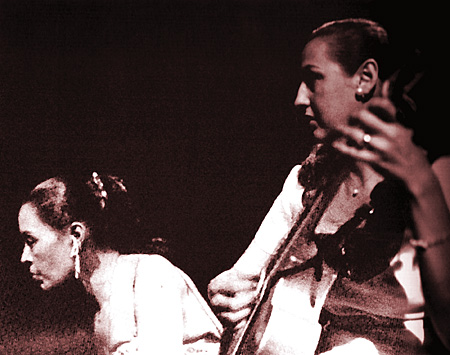
Osborne (R), with Billie Holiday (L), 1958. Picture Credit: Nancy Miller Elliot

Equipment

Osborne purchased the same model of Gibson archtop that Charlie Christian played – the ES-150, an early version of the classic archtop ‘jazz boxes’ we know and love today. It came with a large spruce body and a single-coil pickup near the neck, itself containing a large magnet that helped deliver good definition and attack. She later played other guitars by Gibson, as well as models by Gretsch, such as the White Falcon. In the 1970’s, Osborne founded her own guitar company, Osborne Sound Laboratories, formed from the ashes of the Mosrite Guitar Company (whom her husband had worked for at the end of the 1960’s). Osborne Sound Laboratories made amplifiers personally tested by Mary herself, as well as a selection if interesting instruments (including funky looking solid bodies such as in the picture below). Sadly, they couldn’t penetrate the market due to the dominance of the big manufactures, such as Fender (despite their well-known quality issues in this decade) and the company folded in 1980.
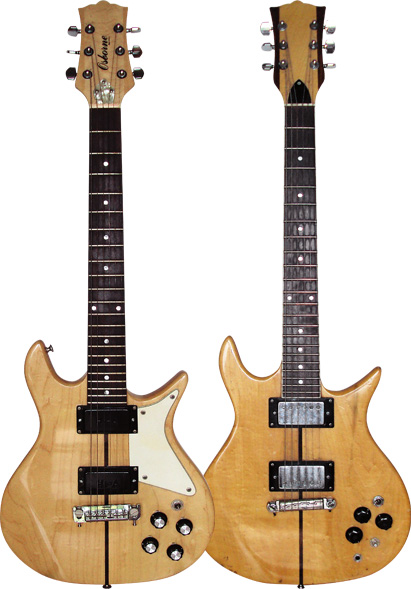
Osborne Sound Laboratories guitars from the 1970’s. Picture Credit: VintageGuitar.com

Recommended listening

Osborne’s 1959 LP A Girl And Her Guitar (Warwick) stands testament to her talents in a golden era for jazz guitar. Her later record Now And Then (Stash, 1981) shows a player who survived longer than most of her contemporaries, and continued to play beautifully.

Also, check out The Mighty Two (1963, Roulette), an LP by the two legendary drummers Louis Bellson and Gene Krupa. Although this was conceived as an instructional album for budding drummers, several tracks feature six musicians accompanying both drummers through nine of the songs on the record. As well as featuring Osborne on guitar, you can hear Milt Hinton (bass), Joe Wilder and Joe Newman (trumpet), Phil Woods (alto sax), Dick Hymen (piano) and Tyree Glenn (trombone) – something of a who’s who in sidemen for the time. The ensemble playing is tight, and the entire LP is a unique artefact of jazz history.

Great Guitarists #9: Grant Green

Great Guitarists

Welcome back to the Great Guitarists series. We’re continuing along a jazz theme for now, with a sometimes underrated master of understated single line guitar soloing…

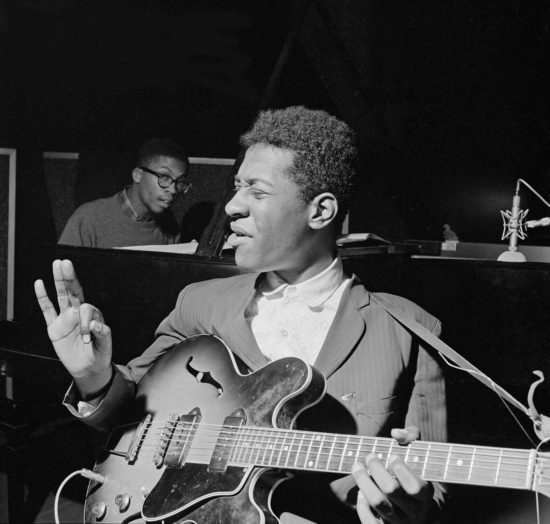
Grant Green

Green was born in St. Louis, Missouri, in 1935, and died in 1979, aged just 43. In his all-too-short career, he played on hundreds of records, including numerous solo titles – almost thirty cuts for Blue Note Records alone. Many of these were played as part of an organ trio (organ, guitar, drums) in a style known as Soul Jazz. This style was sometimes sniffed at by jazz purists, but has since gone on to be something of a cherished gem, and ripe pickings for sampling, especially in hip ho and acid jazz (Read Jorge Cervera’s defence of Grant Green and soul jazz here).

Although less well known than some of his contemporaries, such as Wes Montgomery, his friend George Benson and his main guitar influence Charlie Christian, Green nonetheless possessed a highly recognisable guitar sound, which can be heard in the playing of many guitarists today, myself included. Indeed, his mix of blues, soul and hard bop licks over a funky back beat has become the quintessential sound of upbeat jazz guitar playing.

Equipment and guitar sound

Green most famously used a Gibson ES-330, which is essentially the same shape as the brand’s better-known 335, but with P90 single coil pickups (not unlike an Epiphone Casino). Later on in his career, he played a Gibson L7, Epiphone Emperor and custom-made D’Aquisto guitars, all of which featured similar P90 style pickups. This type of pickup was one of the first kinds added to hollowbody guitars, and Green obviously enjoyed the full, clear sound they provided.

Interestingly, for a guitar player known for his fluid single line style, Green was known to roll the treble and bass entirely off on his amplifiers, to better emphasise the midrange for more bite and attack in his tone – try it with a P90 neck pickup, and see if you can recreate Green’s sound!

Essential listening

Idle Moments (1963) is a great place to start. It’s a slow, contemplative masterclass in cool jazz guitar,and one of my favourite jazz guitar records, along with Midnight Blue by Kenny Burrell (more about that here).

There’s a couple of good options for live cuts, but the recently released collection Funk in France, From Paris to Antibes (1969-1970) (2018, Resonance) captures Green at his best. A few of the tracks see the trio lineup complimented by none other than the legendary Barney Kessel, which makes it essential listening for me!

It’s also worth seeking out some of Greenvs funkier efforts, such as… He also made an interesting album of Latin music (The Latin Bit from 1963, on Blue Note again), in which the main theme (the ‘heads’) were played in the usual samba or bossa nova style, but the solos are swung – give it a listen and make of it what you will!

As a sideman, he played on hundreds of recording sessions. Among my personal favourites are Herbie Hancock’s My Point Of View (1963, Blue Note) and Art Blakey’s Hold On I’m Coming (1966, Limelight). However, each record in Green’s expansive discography features great playing and lead lines that we guitarists would benefit from adding to our repertoire!

Just as Green (and countless other great jazz guitarists) did with Charlie Christian’s recordings, listen, learn, then find a way of making it your own…

Great Guitarists #5: Charlie Christian

Great Guitarists

Many of the jazz guitarists featured so far will have been influenced by today’s Great Guitarist. Not only one of the foundations of how jazz guitar can be played & appreciated, but also one of the innovators behind bebop…

Charlie Christian

As one of the first players to ensure the guitar was taken seriously as a lead-playing instrument (along with Django Reinhardt), Christian arguably helped lay for foundation for all jazz guitar to follow. Born into a musical family Texas in 1916, he was the youngest of three brothers. His introduction to jazz and first break came while playing in his oldest brother Edward’s band across the state border in Oklahoma, impressing fellow musicians in late-night jam sessions while still only a teenager.

Taking his style from horns, Christian’s goal was for his guitar to sound like a tenor saxophone. Although he was undoubtedly aware of Django Reinhardt’playing, it does not appear to have influenced him anywhere near as much as the various horn and reed players Christian was surrounded by and worked alongside.

Christian was recommended to band leader Benny Goodman in 1939. Various accounts demonstrate a reluctance on Goodman’s part, largely due to the fact that the electric guitar was a very new instrument, and not regarded as a soloing one. Up until then, it has largely been an alternative to the banjo as an accompanying instrument. As Goodman was mainly leading a sextet at the time, he clearly preferred versatility in his performers. However, Christian’s skill at melodic improvising soon won him over. When Goodman overhauled his sextet in 1940,Christian was the only band member who stayed on, playing in a new ‘supergroup’ lineup which included Count Basie on piano and Cootie Williams on trumpet.

During this time, Christian was also a prominent figure in the after hours jams at Minton’s Playhouse in Harlem, where bebop was born. Many of the leading jazzmen of the day frequented these sessions, including Thelonious Monk, Dizzy Gillespie, Charlie Parker and Kenny Clarke, almost others. According to Leonard Feather (1960), several participants in these jams attribute Christian’s humming of the melodic phrases as the onomatopoetic origin of the name bebop.

According to the legendary guitarist (and Charlie Christian fan) Barney Kessel (read my Great Guitarists installment on Barney Kessel here), Christian played almost entirely using downstrokes with a large triangular pick held between his thumb and forefinger. His remaining right hand fingers apparently remained steadfast against his guitar’s pick guard. I’m always amazed at how early pioneers of single-note guitar playing sounded so smooth without using an alternate picking technique. It only goes to show what can be achieved when the music needs to come out…

Unfortunately, the world never got to see where Christian would take jazz, or at least his own playing, next. Having contracted tuberculosis in the late thirties, Christian’s health started to decline, not helped by the lifestyle of a busy working jazz musician. He died in a sanatorium on Staten Island in New York in 1942, aged just twenty-five. He was buried in an unmarked grave in Bonham, Texas, the town of his birth. Today, the exact location of the father of modern jazz guitar remains unknown.

Essential Listening

Due to his untimely demise, Christian never cut any records as a band leader. A few amateur recordings exist of groups he led playing live (presumably between Goodman dates), as well as some of those Minton’s Playhouse sessions, such as Swing To Bop (1941).

The main way to hear Christian’s playing is from recordings made with the Benny Goodman sextet between 1939-1941. Thankfully, Goodman recognised Christian’s talent and allowed him plenty of time in the spotlight. These solos have been listened to and learned by jazz guitarists the world over, not least greats such as Wes Montgomery, Kenny Burrell and many more. Among the recordings by the Goodman sextet , Solo Flight is a great starting point.

Christian (front row), between Count Basie (piano) and Benny Goodman (clarinet). Freddie Green, a guitarist famous entirely for his rhythm playing, can be seen in the back row.

Christian’s influence lives on beyond the world of jazz guitar. Countless musicians have credited him as an early influence, from Miles Davis to Charlie ‘Bird’ Parker. Outside of jazz, Christian’s pioneering use of the guitar as a lead instrument helped pave the way fir rock’n’roll. His direct musical influence can be heard in artists such T-Bone Walker, Chuck Berry, Scotty Moore and Eddie Cochran. Indirectly, he probably reached all of us…

Great Guitarists #7: Wes Montgomery

Great Guitarists

As we arrive at part seven in this occasional series, there is one Great Guitarist left to feature, one who is up there with Charlie Christian  and Django Reinhardt as one of the most influential jazz guitar players of all time. Since I’ve focused this short run of articles on jazz guitar players, it is essential to include the man who has left an indelible influence on how jazz guitar is played…

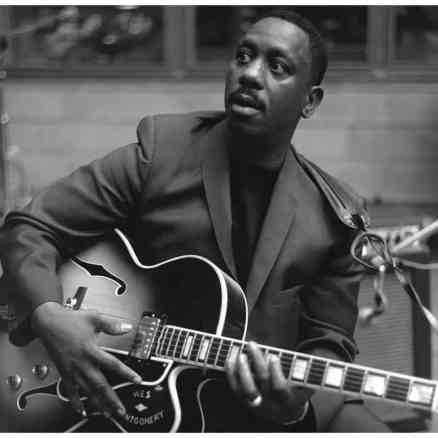
Wes Montgomery

He played impossible things on the guitar because it was never pointed out to him that they were impossible

– Ronnie Scott

Like the origins of jazz itself, nothing about Montgomery’s career was orthodox. Born John Leslie Montgomery in Indianapolis, 1923, ‘Wes’ only dabbled in music until hearing a Benny Goodman record, aged nineteen. The record in question featured the guitar playing of Charlie Christian, and inspired Montgomery to buy a guitar the very next day. He spent almost a year learning Christian’s solos, particularly those from the record Solo Flight.

Working as a welder during the day, Montgomery’s guitar practice sessions took place at night, leading to complaints from his neighbours and his wife. His solution was to ditch the pick and pick the guitar’s strings with the dude if his thumb, as this was much quieter. His use of octave playing also comes from this period, as it enabled Montgomery to better hear what he was playing as he practiced. This technique, which Montgomery has said gave him real “headaches” when learning, was relatively rare in guitar playing; following the influence Montgomery left behind, it is now one of the most definitively recognisable characteristics of jazz guitar.

Success didn’t come easy or quick for Montgomery. Although he had started to build his reputation as a guitarist while playing in ensembles with his two brothers, Monk (bass) and Buddy (piano & vibraphone). These early recordings did not garner much commercial success. In his mid-thirties, Montgomery had returned to working factory shifts during the day, to support his wife and six children, then gigging in jazz clubs until the wee small hours.

This lifestyle ultimately took a toll on his health, but the sheer amount of graft Montgomery was devoting to his playing was paying off. Without being able to read a note of music, Montgomery used his ears and his heart to make his playing swing. His prolific use of octaves, as well as his chord-based soloing (usually on the highest four strings), all without fully understanding the theory of what he played, revolutionised the way in which jazz guitar could be approached and performed.

A chance discovery by saxophonist Cannonball Alderley led to Montgomery being signed to Riverside Records in 1959. Montgomery was soon a rising star, although his more pop-friendly crossover records in the mid-sixties (covers of pop songs, often featuring additional orchestration) led to him being considered a ‘sell out’ by some jazz musicians. He died of a heart attack while on tour in June 1968,aged just forty-five.

Montgomery’s legacy survives through the countless guitar players he influenced. These include his friend (and another guitarist to experience crossover success) George Benson, Pat Matheny and Earl Klugh, to name only a handful.

Essential Listening

Despite Montgomery’s short recording career, he recorded sixteen LPs as band leader in his lifetime, as well earlier recordings with his brothers as The Mastersounds and a handful of posthumous releases. Smokin’ At The Half Note (1965) is a fantastic live album that I wholeheartedly recommended you give some time to.

For studio cuts, you won’t go wrong with his first few albums with Riverside. A personal favourite is The Incredible Jazz Guitar of Wes Montgomery (1960), which includes some of his more well-known pieces such as ‘Four On Six’ and ‘West Coast Blues’.

For the guitar players amongst us keen to emulate Montgomery’s playing style, there exists a wealth of articles and tutorials on how to get started. However, as is often the case, the best thing would be to listen, play, listen, play, listen, then play some more!

Good luck and see you with the next installment soon!