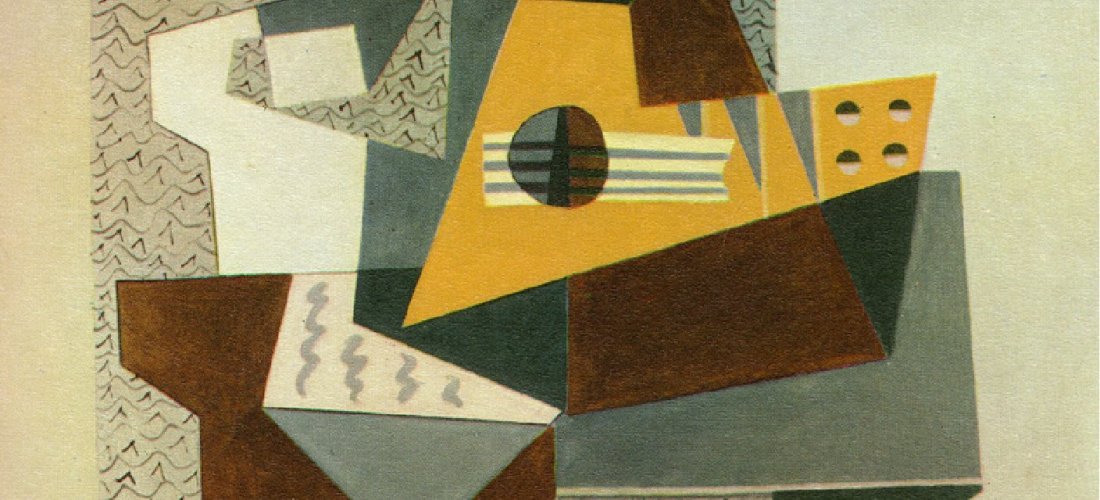
The abstract movement in early 20th century art often seemed to use stock figures, and the guitar seems to come up frequently. I believe artists used the familiar and sensual (in the feminine form of the curves), shape of the guitar because it was easy to recognise. Artists could therefore demonstrate their own interpretation of the instrument’s form in order to encourage the viewer into looking at these forms & shapes in new ways.
I’ve always loved the early abstract takes in the guitar, so I thought I’d share a few of my favourites here. I have also included some of Kandinsky’s attempts to capture the spirit of music – that is, the essence of music, rather than the mechanics or energy of live performance – in his abstract works across a career spent exploring shape, colour & form.
It should go without saying (but I will anyway) that these examples are my personal favourites, and I am not attempting to create an exhaustive catalogue of every . possible example.
Picasso & Gris
Pablo Picasso (1881-1973) may be one of the most well-known artists of the 29th century, if not all time. He often used repeated motifs, such as bulls, doves, the human form and of course, the guitar.
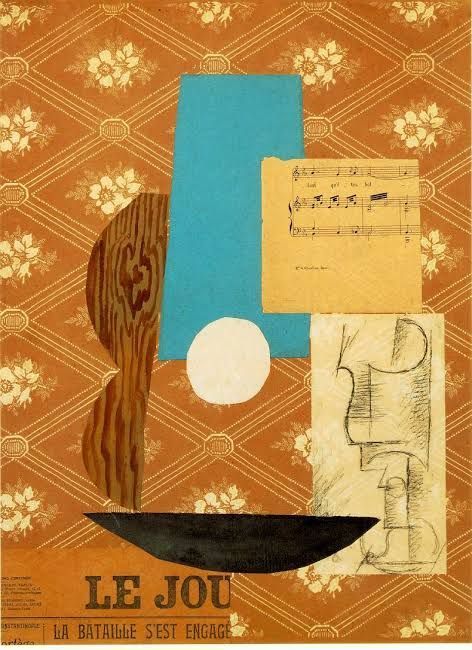
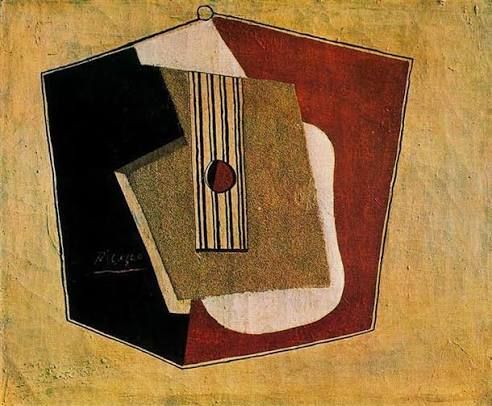
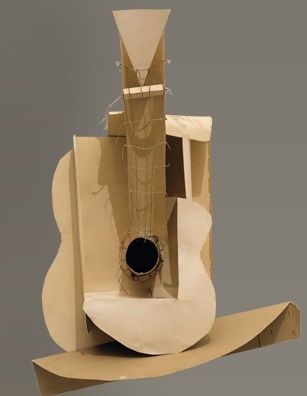
Here I have highlighted a few examples below, starting with a collage of mixed materials (first image, below) which Picasso developed into a form of Synthetic Cubism which further mixed traditional painting with collage and additional material (see second image, below). Finally, I have demonstrated Picasso’s attempts to define the essence and perception of the guitar in sculpture, using cardboard, paper, string & wire (third image, below).
Abstract collage: Guitar, Sheet Music, Glass (1912) by Pablo Picasso
Synthetic Cubism: The Guitar (1916)by Pablo Picasso
Abstract sculpture: Maquette for Guitar (1912) by Pablo Picasso
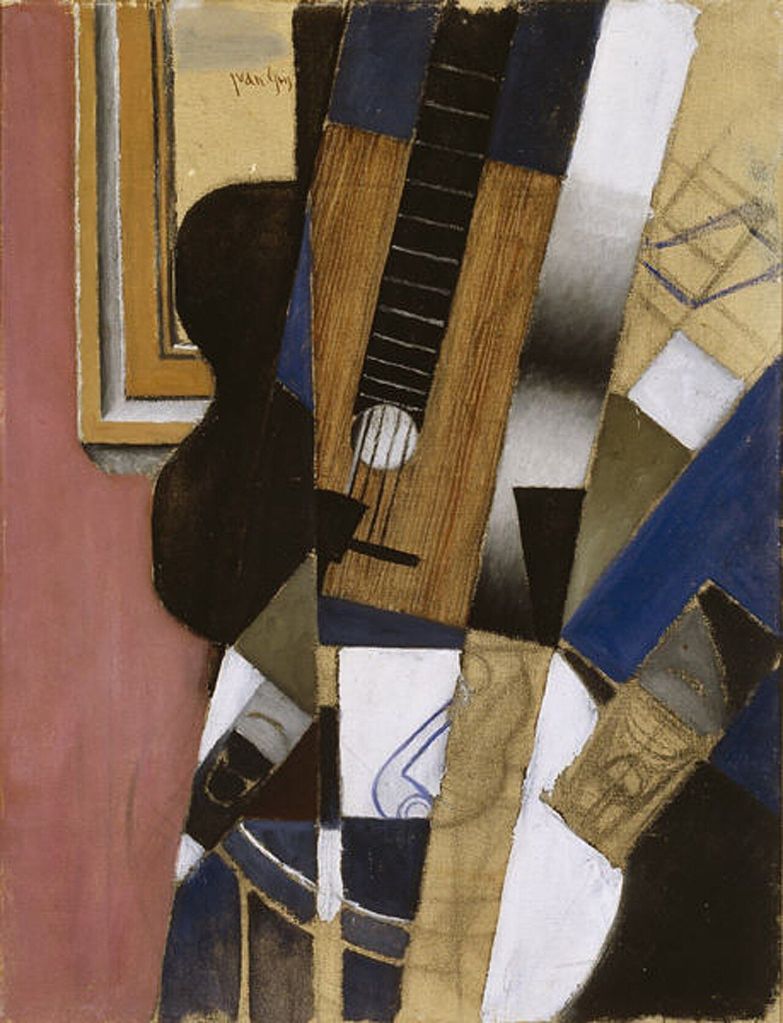
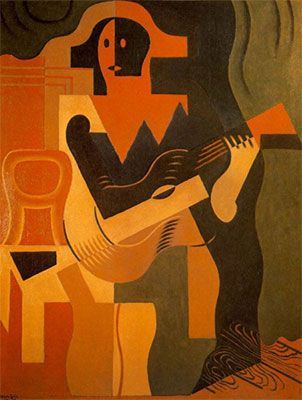
Juan Gris (1887-1927) is a less recognised name to many, but he is considered one of the foremost examples of early cubism in art. Like Picasso, Gris also returned to the guitar and the figure of the Harlequin, which seems to have been another common theme at the time.
Analytical cubism: Guitar and Pipe (1913) by Juan Gris
Synthetic cubism: Harlequin with a Guitar (1918) by Juan Gris
Wassily Kandinsky’s Composition Series
An early pioneer of abstract expressionism, the Russian-born Wassily Kandinsky (1866-1944) created striking works (often in large canvases) in an effort later termed “absolute subjectivity” by French philosopher Michel Henry.
There is evidence of Kandinsky’s interest in Chromesthesia, which is a a form of synesthesia in which sound involuntarily evokes colours and shapes. Music was a major theme in much of Kandinsky’s art, and never more so than in his ten Compositions (the first seven of which were painted between 1910 and 1913 in Germany; the final three between 1923 and 1939 in Germany and France).
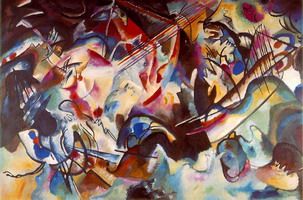
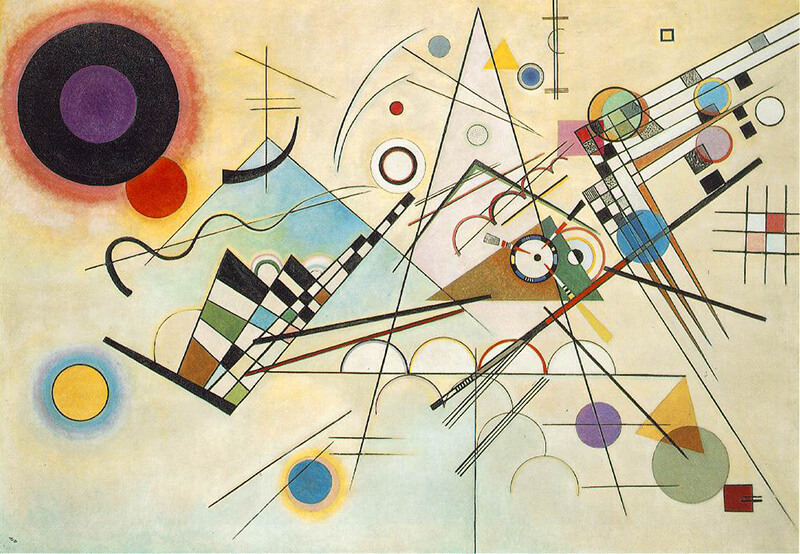
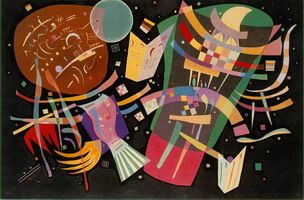
These paintings were Kandinsky’s attempt to capture the vibrancy and feeling of music through the use of bright colours, bold lines and abstract shapes. Here are my three personal favourites, where I feel he has come closest to achieving that goal.
Composition VI (1913)
Composition VIII (1923)
Composition X (1939)
A final caveat…
These eight images (nine, if you include the article header image, Picasso’s Guitar from 1920) represent a mere handful amongst countless attempts to capture the spirit of the guitar, the guitar player, and music itself. Readers who do not share my enthusiasm or appreciation of the artworks showcased here may still find other artistic representations of the same subject which inspires or fascinates them. As with all good art, each to their own.
Interestingly, there doesn’t seem to be any concise collection or discussion about depictions of the guitar in modern art, or art in general – the closest I could find was The Art and Times of the Guitar by Frederic V. Grunfeld (published in 1970 and available for over £70!) so perhaps I should work with an art historian to create such a tome? Any volunteers are very welcome!
Hello and Happy New Year! How’s the New Year’s resolutions going?
I’m starting 2026 the way I mean to go on, with lots of fun gigs and NEW MUSIC!
As well as various wedding gigs, both as a solo guitarist and with my function band, I also have a few shows and releases with my original music project, Solcade.
I’ve been involved in a few original projects over the last decade, but mainly as an arranger and band leader. My songwriting contributions have been minimal. As a result, I’d been storing up a small collection of ideas that didn’t really suit any of the acts I was working with. These sketches mixed funk and jazz with the afro and latin-fused rhythms I’d developed a deep love for through past work with older ‘world’ music acts, and mixed with a heavy dose of psychedelia and garage rock.
After we began to emerge from the pandemic and start performing live again, I decided to put together a group of musicians with a shared interest in less common styles of music (at least within the UK), including afrobeat. Initial jamming and writing sessions yielded some interesting results, and almost saw the project reshape into something closer to free jazz. However, the lineup didn’t remain stable and I had to rethink what I was trying to achieve.
By 2023, I had assembled a slightly altered lineup that shared the same vision: to write interesting and genre-blending music; and to credit all compositions to all members equally (in this case, as a five-way split). This can sometimes cause issues such as resentment of one member is not perceived to be adequately pulling their weight in terms of writing. However, I was fortunate enough to be working with enthusiastic creatives who stepped up to the challenge, and we soon had enough songs to get onstage and perform live.
Best of all, this collective approach applies to more than just the songwriting process. I may have kicked this whole thing off, but we now work as a team, with no singular leader, making this a true band; a collaborative experience. You can find regular updates on the band on our Instagram page.
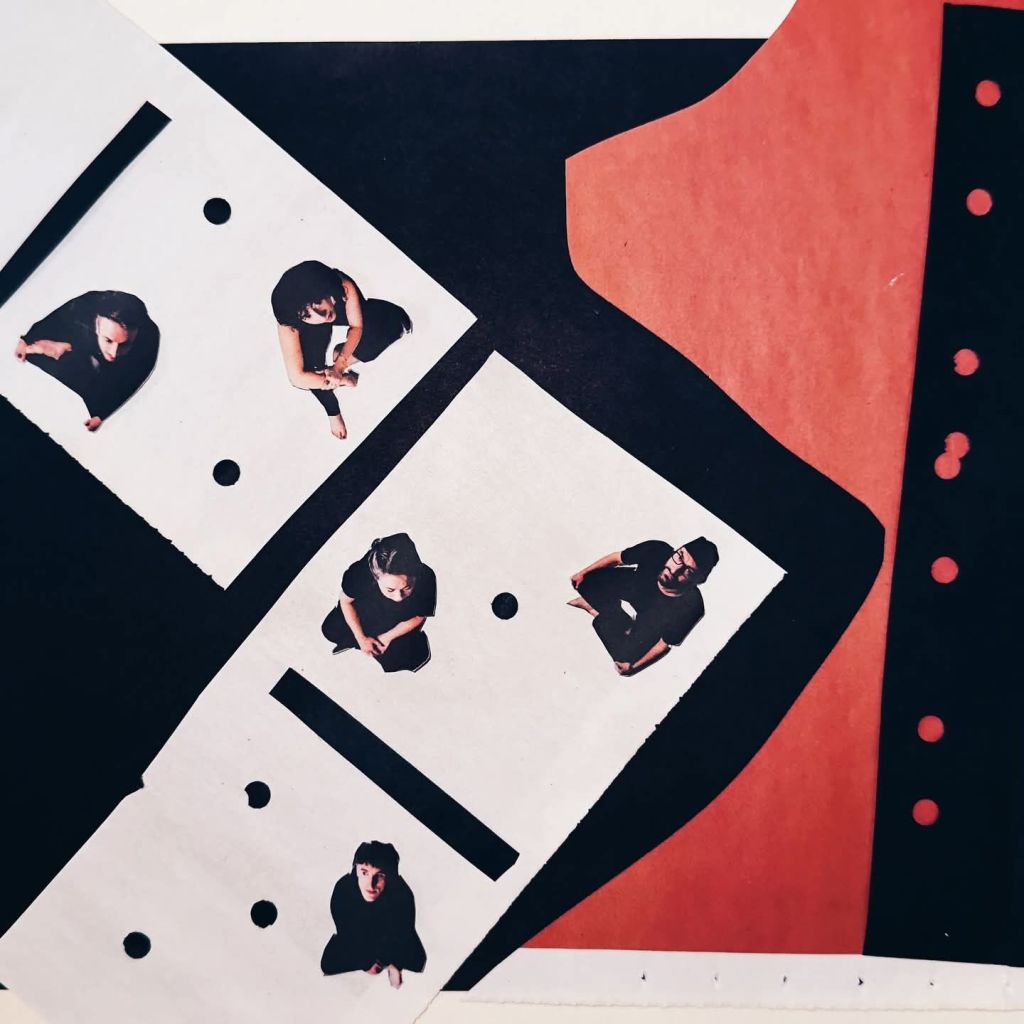
Our first single, ONE MORE DOMINO, is out now, available everywhere. This song focuses on the feelings that come with the build-up to revolutions throughout history. Listen to the new track here and let me know what you think.
As the end of the year draws nearer, I find myself in a brief period without any gigs.
After quite a busy run recently, I’m now enjoying a few days of voice rest (a result of several shows in a row combined with a minor cold) before the shows ramp up again from New Year’s Eve.
This much-needed rest has reminded me of the importance of self care and taking time to recover.
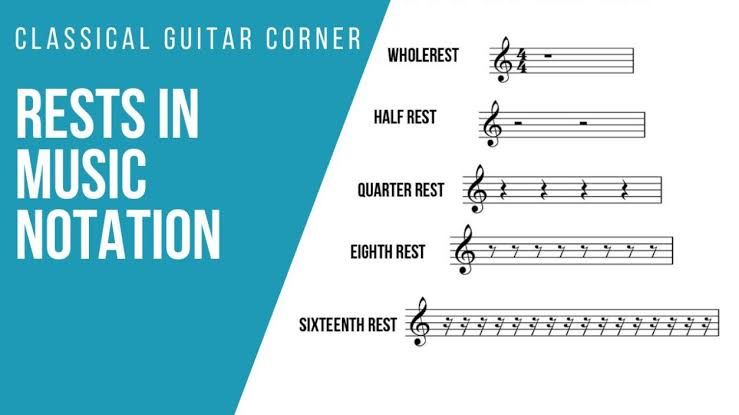
Many working musicians find it hard to stop. The fear of losing a regular gig means we can often push ourselves too hard far too often. For us, the word ‘rest’ can be a purely musical term:
Courtesy of Classical Guitar Corner.
…but rests can mean so much more than gaps between the notes we play or hear.
Musically, rests are more than mere pauses; they’re essential to shaping how the music sounds. Away from music, rests can similarly help us make sense of everything else.
Help Musicians, a UK-based charity providing support to musicians unable to perform for health reasons, have a really useful article all about the importance of rest. They outline several different types of rest:
Physical rest
Mental rest
Emotional rest
Social rest
Sensory rest
Creative rest
Spiritual rest
All of these different definitions of what rest can mean will vary depending not only on individual perspective, but on what’s most important to someone at any given moment that rest takes place. I’ve written about Subjectivity, interpretation and their effect on creativity before, and the concept of silence and rest are no different. I encourage you to read the article and consider which elements resonate most strongly with you (whether it’s something you already do, or something you recognise that you need to work on more).
Personally, I find rests in music similar to rests in life. They are not just a moment in which we calm the noise and remain still, but a time to reflect on the quality of the silence itself.
Every rest, in music or life in general, is informed by the sounds which precede the silence. In a way, rests are shaped as much by the activity on either side of it as much as it is by the length of inactivity within.
Miles Davis famously referred to rests in music as ‘Hot Space’, maintaining that the notes you don’t play were the secret to great improvisation. I believe he too was referring to the timbre and feeling of a rest in the context it’s setting. This is equally true in our lives outside of musical performance.
Think about everything that surrounds your work. The preparation before a show, the admin, chasing invoices, making time for loved ones. Now think about where the time for you resides amongst all of that. Is it enough?
Sometimes we best serve others by getting our own house in order first. This is as true musically as it is on a more humanistic level.
So for now, if you can, take time. If you can’t, try to make time.
Breathe in. Breathe out.
Listen to the silence. Reflect on everything that led up to this pause. Think about what follows after this rest comes to an end.
And as always, take care of yourselves and each other.
I’ll see you all on the other side, in 2026…
Original image courtesy of G4guitarmethod.com
Important postscript:
If you are a musician based in the United Kingdom and looking for mental health support, you can contact Help Musicians via the their website here.
In a recent article, I used Albêniz’s Leyenda as an example of varying interpretations, from a performer’s and arranger’s perspective. I stated my belief that interpretation is one of the crucial elements of artistic performance, yet it remains one which is often overlooked in musical performance. It’s what makes a performance unique to you, rather than a carbon copy of notes on a page. I say this because sometimes meaning can be lost if we do not remain mindful of what we want a piece to convey.
Views on interpretation vary, not only in how it should be defined but also in who has the right to do the act of interpreting in the first place. There are no right answers – only opinions. There are mine, based on my experiences of a wide range of musical genres, all of which I have interacted with in many different ways; composer, arranger, performer, and most of all, listener.
Interpretation as an act of translation, rather than the inferring of meaning
Interpretation often comes in for criticism, but usually in the context of art being explained to an audience. Literary critic E. D. Hirsch stated that “the author’s intention must be the sole determiner of meaning” (The Aims of Interpretation,1976), though many would disagree. Artists and creatives such as Charlie Chaplin to Salvador Dali have made similar-sounding statements against the imposition of another’s interpretation onto an audience. In effect: art doesn’t require an explanation. Meaning can be interpreted by the recipient in their own way.
A Visual Interpretation of Mark di Suvero’s Mindseye, by Lauren Kordas (2017)
This is undoubtedly true, but what about the creator of the art? In terms of the composer, a sense of meaning will have been part of the original creation of any work of art. Even a piece purposely left open to the audience’s own interpretation is a deliberate choice on the part of the creator.
And what of the middle-men between creator and audience? In the case of music and performing arts, how can arrangers and performers interpret previously written works? Consider just how many modern films, etc, are modern versions of Shakespeare, classic Greek plays, etc, where the setting and characters has been changed. Often, it is brought up to the present time of the new adaptation, and usually re-scripted in language more accessible to the audience of these more recent times. Sometimes works are transposed to completely different media, such as tone poems based on paintings or poems.
A concert performer will often choose works of a similar theme for recitals. This act of curation demonstrates that someone other than the composer – be it the performer or program director – has imposed a new theme onto the chosen pieces which in all likelihood was not part of their original creation. Along these theme is the jukebox musical, an early example of this is Return to the Forbidden Planet, based on the 1956 sci-fi film Forbidden Planet, which in turn is based on Shakespeare’s final play, The Tempest. The score of songs sung by the cast (or used as incidental music) throughout the play is comprised entirely of rock’n’roll hits from the 1950s and 1960s, none of which were conceived or recorded with the story or themes of this musical (premiered in the 1980s) in mind – old works were chosen and presented in a new format to tell a new story.
A Visual Interpretation of Mark di Suvero’s Mindseye, by Allison Rice (2017)
Be sure to include your own voice, and your own meaning
For performers, interpretation is unavoidable. Many performers appear happy to perform pieces written and arranged by others, repeating their original vision and intent without adding anything to the process apart from the immediacy of live performance. In some cases, this may be the most appropriate course of action. However, I’d argue that the opposite is true far more often than you might think.
Sometimes the effects of presenting a piece through the lens of your own interpretation is barely noticeable. The results will be felt rather than consciously observed by audiences. In some cases, they have been known to have a longer lasting effect. In my article on Leyenda, I noted that the most widely accepted adaptation for guitar includes a series of sixteenth triplets near the beginning which are not present in the original piano score, but an invention of noted classical guitarist Andres Segovia. I have noted in an additional piece that such rhythmic variations used to be the norm in musical performance. The apparent convention in modern classical music concerts, which seems to impose limits on the range of individual creativity permitted by performers, is likely to have led to the neglect of artistic interpretation in more recent times.
In more immediate terms, the way you perform a piece will affect the way the audience hear it, and the kind of meaning they might derive from it. This doesn’t mean grand re-imaginings are required for every performance. Sometimes the simplest (and best) option is to be mindful of your intent in preparation for an upcoming performance, and during the performance itself, rather than focusing solely on technique – or achieving a faithful reproduction of note sequences.
Put simply: be mindful about what you are playing, and how you are playing it
The composer’s views are important. So is understanding the context of the times in which the pieces were commissioned, written and first performed. These will affect your understanding of a piece. The same goes for your audience. But if we are to consider the context of time and place, it is essential that we include the most important factors which separates a performance from a recording (or past performance): the here and now.
In Music Therapy, both improvised music and pre-existing songs are used as a language to communicate feelings the client might struggle to adequately articulate verbally. However, when performing a well-known song, neither the client or therapist is primarily concerned with a faithful recreation of the original artist’s recording. Instead, we are using the musical language in the here and now of the therapeutic space to communicate new feelings, and new meanings. That is, and has always been, the intrinsic power of music.
A few years ago, I was hired to perform (quite specifically) Spanish guitar music at a wedding service. Amongst other choices was Leyenda (meaning ‘legend’). Originally written by Spanish composer Isaac Albêniz (1860-1909) for piano, but transcribed for guitar within Albêniz’s lifetime, Leyenda is one of the more well-known pieces in the classical guitar repertoire.
Isaac Albêniz (1860-1909), looking rather stylish in a portrait, circa1900
Typically, the opening section is played quite fast. Sometimes this makes it feel like an exercise in machismo by the performer, who may be working on the assumption that faster = more impressive to listen to.
However, the most famous transcription of this piece is by Andrés Segovia. Segovia is considered the Godfather of modern classical guitar, having mentored several well-known players in the generation that followed (including Australian guitarist John Williams and the UK’s own Julian Bream). Brazillian composer Heitor Villa-Lobos dedicated his Etudes for Classical Guitar (1929) to Segovia, whom he had kept in mind while composing them. Segovia had similar close working relationships with several other 20th Century composers, such as Federico Moreno Torroba, Mario Castelnuovo-Tedesco and Joaquin Rodrigo, and his transcriptions of certain works originally written for other instruments have become the standard in how they should be performed on guitar.
Hear the great man himself performing Leyenda on this YouTube video. You may notice that Segovia’s interpretation is slower than you might hear on most other recorded versions of this piece.
I’ve had some pretty interesting discussions with guitarists in the last few weeks and months regarding artistic interpretation. In almost all of these chats, the focus has been on the interpretation of the performer. However, what we hadn’t considered is the interpretation of the arranger. When I say arranger, I mean one who transcribes music for other musicians to perform, rather than a player making interpretive changes solely for their own performance.
Andrés Segovia (L) & Stanley Yates (R), two masters of interpretive guitar arrangements
Composer & arranger Stanley Yates created a new arrangement of Leyenda, which is still available to download for free via this link to his website. This version differs more from Segovia’s than you might expect. The chief differences for me are the absence of sixteenth triplets in the opening section, which was Segovia’s invention (be honest, how many of you knew that?!) and a few differences to the interval of certain ‘grace notes’.
The source for Yates’ arrangement is the original published piano work. He argues that he has attempted to stay true to the original piece without being pressured by the subsequent traditions of this piece which have grown over the last century. It is worth checking Yates’ arrangement out in order to see these differences for yourself and experience a piece many classical guitarists thought they knew intimately in a rather different light.
Interpretation, whether it is that of an arranger or the in-the-moment feelings of the performer, is key to making music more than mere sounding out notes written down by someone else. It plays a large part in how an audience experiences the piece; even subtle changes to a performance can alter how the listener might feel in response. I’ve long been fascinated with interpretation as a subject, and note with a small degree of frustration that it remains a factor of performance that often goes overlooked, sometimes by guitarists who really should know better.
This brief examination of Leyenda is but one example from which we can learn the importance of interpretation. I believe that neglecting to give it the consideration it deserves might end up becoming something which hinders your growth as a musician. Make of that what you will.
Today has been a rather bleak day for musicians in the North East of England’s local scene, as the oldest and best known music shop in the region, J. G. Windows, closed its doors for the final time. Many musicians bought their musical instruments from there,including many famous musicians over the years.
In a statement from the shop, the representatives explained that the shop had been put up for sale in 2023, but a buyer could not be found, meaning they closed with immediate effect and the seventeen employees were all made redundant.
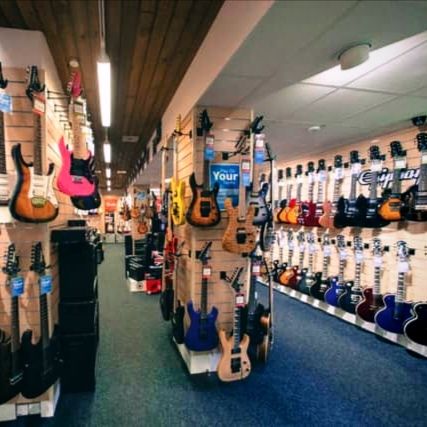
Many young players got their very first instruments there, using the store’s very generous hire purchase agreements. Unlike many other shops, they stocked more than guitars and ‘rock’ instruments. Their range of instruments catered for all, from pianos to every single section and instrument in an orchestra.
Just a small section inside J. G. Windows
As a youth, I used to love going in to look at the rows of shiny trombones or stringed instruments ranging from the enormous (to me) double basses down to the tiny viols. To be honest, I still did as an adult.
Similarly, their extensive sheet music collection meant you could find almost anything you were looking for, from Bach cantatas to arrangements of movie theme tunes for the French horn, and everything in between.
The sheet music department at J. G. Windows
I still own several guitar scores purchased from Windows over the years, often when asked to play a specific classical pieces over my years playing guitar for a living. More than once it saved my neck, especially in a time slightly before absolutely everything was available on the Internet.
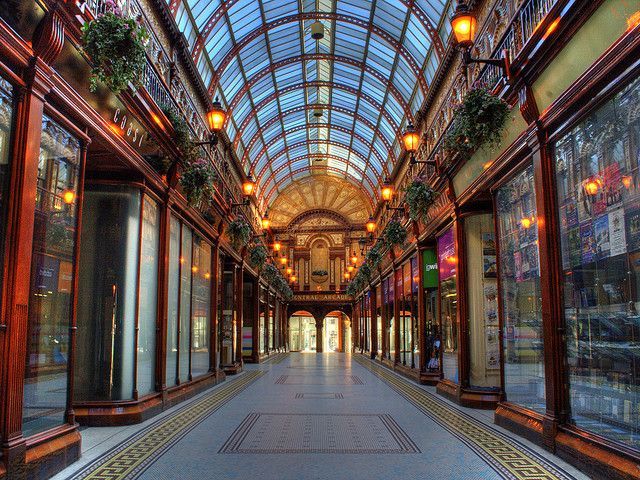
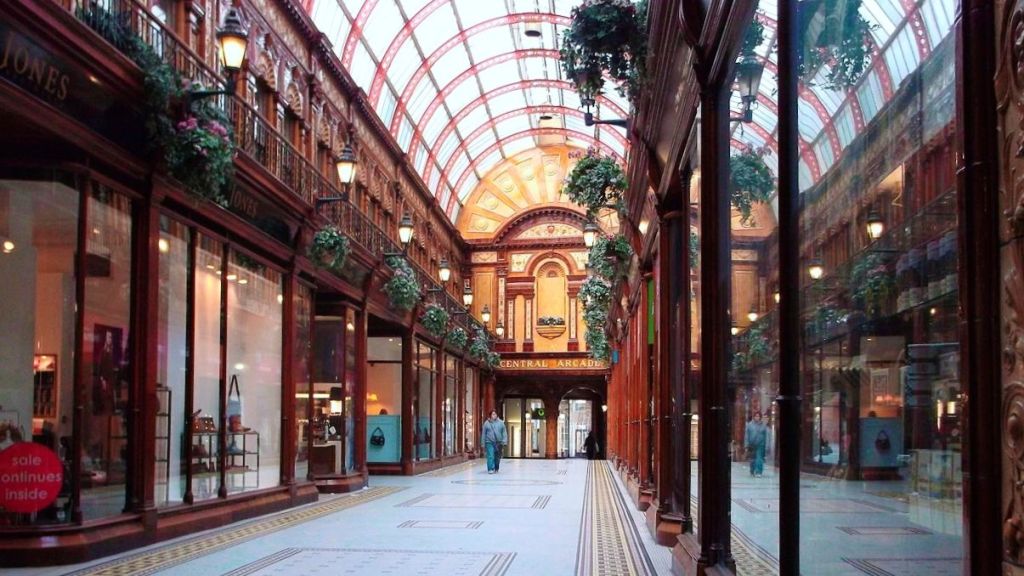
Equally magical to the endless instruments awaiting visitors inside Windows is the gorgeous tiled arcade outside, and the stunning stone building in which the shop resided.
Central Arcade, seen from the outside (left) and its stunning centralwalkway (right)
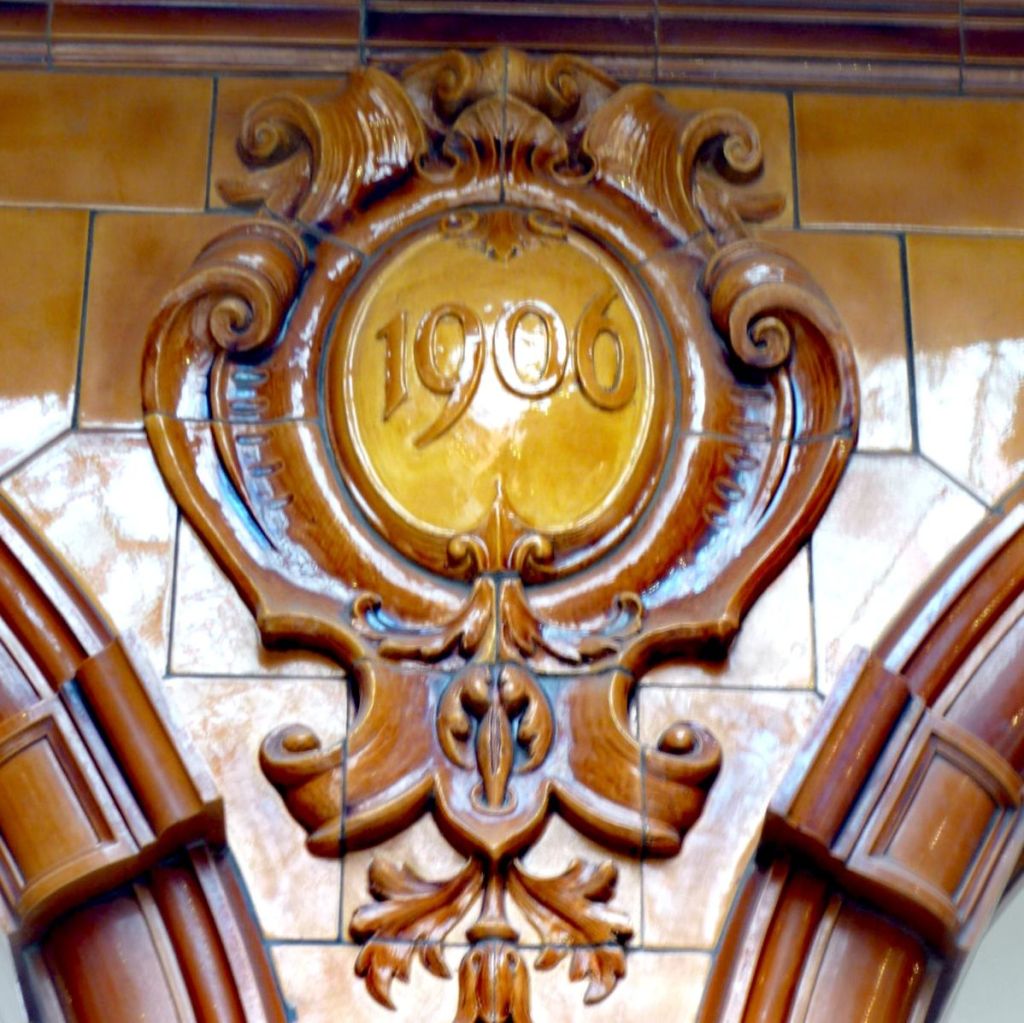
Central Arcade is housed within a Grade II listed building, part of the wider area of gorgeous Edwardian architecture built by Richard Grainger between 1824 and 1841 (and after whom the area is known as Grainger Town). The gorgeous tiled shopping acrcade currently inside the building was created in 1906 by Joseph Oswald & son, after having had previous lives as a newsroom and a vaudeville theatre (which was destroyed by a fire in 1901).
This building has had many lives and will certainly continue. I just hope this beautiful interior remains available for the public to enjoy in one form or another. However, it will take some time to disentangle the memory of Windows music shop from this arcade for many residents and visitors.
Internal shots of Central Arcade, Newcastle
As for J. G. Windows, it looks like after almost 116 years, they simply couldn’t keep up with the competition of cheaper products, readily available online without a middleman to sell it. I’ve known several friends who worked there, and I always made a point of popping in when I was back in Newcastle, even if it was just to browse – but then, that’s certainly a factor in its demise.
Another win for capitalism, but a great loss to the region – and we’re all to blame for allowing it to happen.
It’s just a shame for all the children and young people learning an instrument for the first time. It was more than a music and musical instrument shop. It was a community, with a network of teachers (some of whom provided tuition onsite), repair experts, advice and shared love for the joy of making music. Their ‘band members wanted’ board was the first point of call for players looking to join or start a new band in Newcastle; another aspect of the local scene which has emigrated to an online space without any of us really noticing…
Farewell, J. G. Windows, and thank you for your many, many years of service.
Top session bassist Herbie Flowers sadly passed away on the 5th of September, aged 86.
Although most people may not have heard of the British session musician, Flowers was well known within the music industry, having been performing and recording since the 1960s. After starting out playing tuba and double bass in the RAF in the 1950s, Flowers moved into session work and soon the bass guitar became his main instrument. Among his earliest recorded work was the band Blue Mink, who had hits with ‘Melting Pot’ and ‘Good Morning Freedom’.
Flowers soon began playing sessions for artists in the late sixties, working regularly for famous producers such as Mickie Most (The Animals, Herman’s Hermits, Donovan, Lulu, and many more), Tony Visconti (T. Rex, David Bowie, The Moody Blues, and countless others), and Shel Talmy (The Kinks, The Who, among others). His playing credits are almost too long to list. In fact, it’s estimated he’d played on at least 500 hit recordings by the end of the 1970s!
Here’s a few of the more well-known highlights…
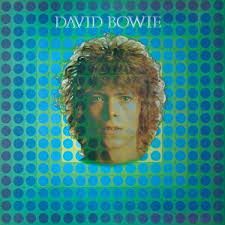
Flowers played bass on Bowie’s eponymous second album, including his first hit, ‘Space Oddity’. He then returned to the studio with Bowie to record his Diamond Dogs album.
When working on Lou Reed’s Transformer album, Flowers created his most recognisable bassline, used on the song ‘Walk On The Wild Side’. This bassline is actually two basses a double bass with a fretless Fender Jazz playing the higher part. As well as creating a unique sound that’s harder to achieve when playing both lines on one guitar, it also allowed Flowers to collect additional royalties for playing additional instruments on the song!
In 1971, Flowers co-wrote the novelty song Grandad, sung by actor Clive Dunn. The song reached the number one spot on the UK charts the same year, where it stayed for three weeks.
Flowers played bass on Jeff Wayne’s famous masterpiece, his musical and spoken-word adaptation of War of the Worlds. He then toured with Wayne when he took his famous concept album on the road decades later.
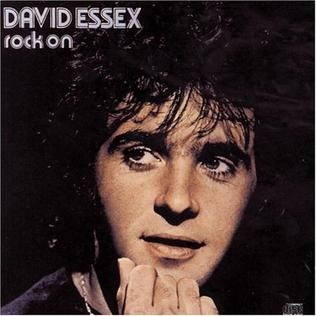
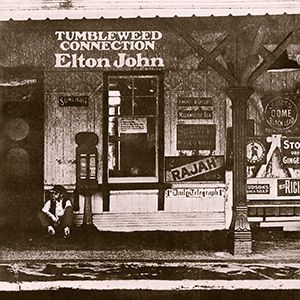
Flowers also appeared on recordings for Elton John, David Essex, Olivia Newton John, Bryan Ferry, AL Kooper, Harry Nilsson, Cat Stevens as well as on solo albums by three of the Beatles; Paul McCartney, George Harrison and Ringo Starr.
His work on a crossover record Changes by Australian classical guitarist John Williams (which included Williams’ arrangement of ‘Good Morning Freedom’) created a connection which came to fruition in 1978, when Flowers and Williams teamed up with other session musicians to form the famous instrumental group Sky. This supergroup of sorts (although only Williams was recognisable to most of the general music-buying public) released several albums over five years and toured regularly, bringing their fusion of classical, jazz and pop music to a wide audience.
What can we learn from Herbie Flowers?
Unlike other famous session men, such as ‘The Wrecking Crew’ in the USA’s pop music scene, Flowers seems to have developed a good reputation as a reliable performer, making him the first-call for several producers and composers. Why was this?
Put simply, he was not only a good musician, but a reliable one. Studios are expensive places to waste time, so having a roster of musicians who can not only play to a high standard, but also turn up on time is essential to producers, arrangers, musical directors and band leaders. Musical skill and a good ear allow the best session players to grasp a new song quickly and do their best to make it sound as good as possible, but the real professionals are he ones who treat it like the job that it is.
Nowadays, studios and recordings work a little differently. The ones that do make use of session musicians on a regular basis are far more rare, and getting a gig in such a place can feel almost impossible. It’s worth remembering that this side if the industry is – and to an extent, always has been – something of a closed shop. However, opportunities still exist in live performance, which in my experience have led to recording opportunities that I would otherwise not been offered. To give yourself the best chance of being considered for such roles, ask yourself:
Do I have a reputation for turning up on time, setting up quickly, and having working equipment?
Am I recognised as a competent musician (not the flashiest) who can cope with most styles?
Am I considered easy to get along with?
Divas don’t get invited back to future sessions. Nor do musicians who show up with faulty gear. I’ve also known artists to get frustrated with the brilliant ‘hot new thing’, fresh from music school with a head full of jazz theory and the chops to back it up, citing their input as overplaying or lacking in any real soul. Be like Herbie Flowers and that select group of ‘top’ session players: turn up, don’t make trouble, and serve the song. It worked for him. It will work for you.
In both cases, a little hard work and luck is involved, but t’was ever thus. And Herbie Flowers seems to have made the best of the cards he was dealt.
As the rain sets in here in the UK, for what looks like a prolonged period, it seems that summer is well and truly over.
The last few months have been pretty busy, so I thought I’d quickly let you in on what I’d been up to…
…aside from the usual, that is
My main working week is still taken up with the music therapy service I provide in a range of settings. Most of my therapy work is with children and young people, and one of the best things about my job is seeing how music helps to communicate feelings which, for some of my clients, can be hard to articulate with words. It makes the more difficult aspects about this work (such as the seemingly endless stream of reports) worthwhile.
Wedding season is coming to an end
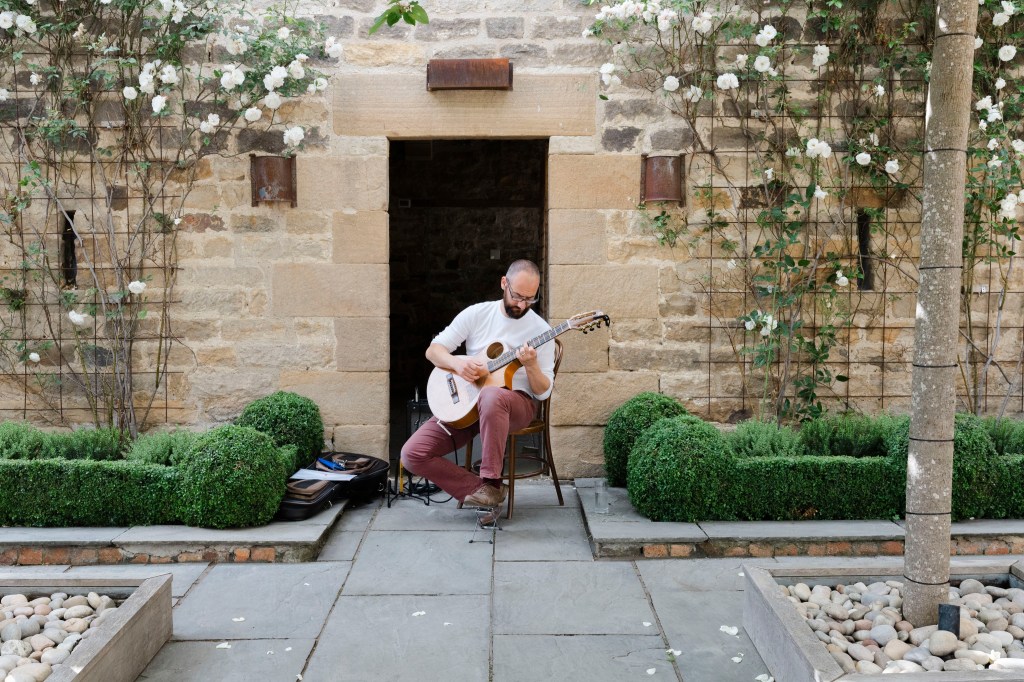
In terms of live music, it is the covers bands that continue to make up majority of my professional output. However, I enjoyed playing more solo guitar gigs, performing at wedding services and receptions.
Credit: Imogenkate Photography (2023).
It’s nice to see this type of work coming back through into my diary again. After Covid, I feared that live classical guitar may have been an expense too far for couples planning their big day, but this summer has thankfully proven my fears to be unfounded. I’ve already got several dates in my diary for 2024 (if you are looking for a solo guitarist for your own big day please get in touch via my contact page).
Nick Gladdish is recording his next LP
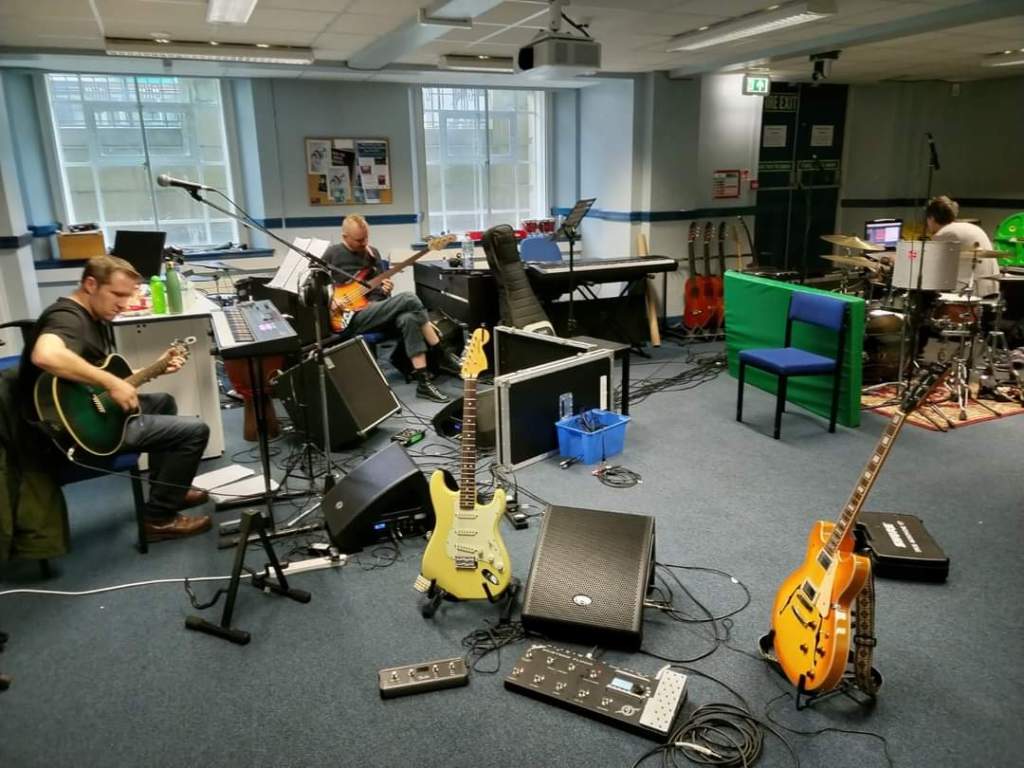
In August, Nick called his usual crew into the studio to lay down baking tracks for his new album, he follow-up to 2021’s Last One Get The Lights. Although we all (Nick included) expected this record to feel like a companion piece to LOGTL, we soon discovered a slightly more rock-orientated edge to the arrangements. This may be a result of the tighter arrangements, as Nick told us he was consciously trying to keep the tunes on this record shorter than his usual fare. With John Timey back in the joint producer/drummer chair, and the brilliant Adam Cornell on bass guitar, this felt like one of the smoothest recording sessions I’ve ever been involved with.
NG Band in-studio.Positive feedback?
The results so far are promising; ten pop-rock songs about love, loss, disillusionment and corruption. I certainly enjoyed writing and layering rhythm guitar tracks. There’s not many guitar solos this time around, but there is some interesting experimentation going on, from drowning out the end of one song in multi-tracked guitar feedback, to a bluesy ukulele solo on the opening track! Next come the overdubs, editing and mastering…
New original project finally ready to launch
Finally, despite various obstacles thrown at me, I am pleased to announce that I have a new original music project about to start performing live. Solcade began as an outlet for music I was writing which didn’t fit anywhere else – too jazzy, bluesy or indeed too varied for many of the ensembles I have been working with.
After recruiting a stable five-piece lineup, the project quickly became much more of a democratic process, and the music is all the better as a result. With each member having an equal credit in writing and arranging, everyone involved has been bringing their ‘A game’ and making some amazing contributions. If you’re a fan of psychedelic funk, Jazz, soul and rythym & blues, then watch this space for upcoming details about our forthcoming debut record (likely scheduled for completion & release in 2025).
We have some live shows coming up in the autumn, too. Follow us on Instagram to hear the latest updates.
But what have you been up to?
Let me know! Also, I’m planning on writing a Q&A article so if you have any guitar, composition, music therapy or psychotherapy-based questions, get in touch and I may well include it!
July the 31st this year marks the 92nd birthday of Kenny Burrell, who, unlike many of the greats I feature in my Great Guitarists series, is still with us!
Such an occasion is enough of an excuse to revisit his classic cut from 1963, Midnight Blue (if an excuse is even needed)…
Loved by some, derided by others. You will have heard at least some of the music of The Doors.
Despite their short time together at their height, they left behind an impressive legacy. As with similar articles (such as my look at the wider impact of The Animals and The Bryds), I’ll try to keep it brief, focusing on the factors that I believe made The Doors unique and influential.
So, on the understanding that this is not a definitive history, let’s dive in…
A quick rise
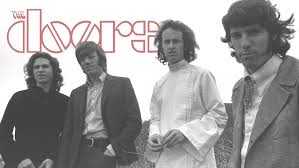
The Doors were formed in Los Angeles in 1965 by vocalist Jim Morrison and keyboardist Ray Manzarek, initially under the name Rick & The Ravens with Manzarek’s brothers Rick and Jim. They soon changed their name to The Doors in honour of Aldous Huxley’s book The Doors of Perception, recording their first one demo along with drummer John Denmore. After brothers Ray and Jim left the group, the group, guitarist Robby Krieger joined the band and the classic lineup of The Doors was complete.
They very quickly became popular, despite having played few gigs. In the start of 1966, the band managed to secure a residency at The London Fog club on Sunset Strip by having all of their friends turn up to their initial trial gig and cheer loudly. This residency not only gave Morrison the chance to overcome his stage fright, but also provided an opportunity for the band to experiment with their songs, many of which appeared on their debut album the following year.
In May 1966, the group became the house band at the more prestigious Whiskey a Go-go club, supporting the visiting acts such as Van Morrison with his band Them. By August, The Doors had been signed to Elektra Records. They recorded their eponymous debut album the same month, released at the very start of 1967. Their follow up, Strange Days, was released in September of the same year. This started an impressive run which saw the band release one studio album every subsequent year, ending with LA Woman in April 1971.
(copyright Elektra Records)
A polarising frontman
Over the years, Morrison’s behaviour had become increasingly erratic and difficult for the ban to manage. He was already living in Paris by the time LA Woman was released, taking time out from the group to focus on his poetry. He was dead just three months later, likely of an accidental overdose on heroin (although no autopsy was performed to officially rule the cause of death).
I put out a poll on my social media pages to canvass for opinions on The Doors. It seemed that, by and large, those who said they didn’t like the group generally cited Morrison’s vocal delivery style lyrics, or his persona as the main reason. He seems to have become a love-him-or-hate-him figure in music history. For some, Morrison represented the epitome of a certain type of masculine sexuality. Several bedrooms have been adorned with posters featuring well-known pictures of Morrison, topless and brooding. which seemingly turned ob as many people as it turned off.
Furthermore, in passing away at such a young age, fans never had the opportunity to watch him grow old, or indeed display an change or sense of ongoing maturity in his work. What is left behind becomes immortalised, while Morrison himself became a legendary figure. His grave in Paris remains a popular tourist attraction for would-be Bohemians to congregate.
But what we’re the critics opinions of Morrison before he died? The music of The Doors left fans divided. Fiona Sturges claimed that “Lester Bangs was right when he described Morrison, the son of a US rear admiral, as ‘a drunken buffoon masquerading as a poet‘” (quoted in The Independent, 2012). Yet Bangs had the maturity in later years to recognise the legacy of Morrison on his peers:
Think about it. Without Jim Morrison no Patti, but what’s more or less no Iggy perhaps no Bryan Ferry in his least petit-bonbonned moments. Without Iggy, of course, no punk rock renaissance at all, which means obviously that Jim was the real father of all that noise
Similarly, the music was considered by some to be twee in places (with those fiddly organ lines) or even downright pretentious. Listening to their entire run of six albums highlights inconsistencies in style, but I’d argue that this was common for groups at the time. In a time of psychedelia and increasing experimentation in pop music, record executives seemed to have lost their sense of what would sell and what wouldn’t, and allowed some artists time – and often several albums – to find a formula that worked. The Doors were no exception to this, although I believe they stood out for a few reasons.
Grounded in the Blues, but not limited to them
Like many bands of the time, The Doors were rooted in the Blues as the bedrock of their sound. When he wanted to, Morrison could write lyrics that were reminiscent of blues men such as Muddy Waters or Howling Wolf,such as on Love Me Two Times or LA Woman, for two well-known examples.
Musically, many of the songs were grounded with blues-based riffs, common to other R&B acts of the time. It was the combination of electric blues with the more poetic elements to Morrison’s words, coupled with a sense of exploration and a willingness to add elements of jazz to their sound, which gave The Doors an edge over their contemporaries in the world of psychedelic rock.
No bass player?
No – not for their live performances, at least.
In the studio, Doors producer [name] felt that Manzarek’s left-hand organ bass notes didn’t cut through as well as the second of a plucked string, and a session bass player was called in. This started something of a tradition for the band, who had bass guitar on the vast majority of their recorded material while maintaining their bass-less quartet format onstage.
In most cases, the session bassists – including bit hitters such as Harvey Brooks (who had played on Dylan’s first electric album and subsequent live shows) and Jerry Scheff (who has played with everyone from The Everley Brothers to Elvis Presley’s Vegas band) – were given strict instructions on what to play. This often following the Blues-based riffs. Otherwise, they simply filled in the sonic space a little, leaving ample room for [keys] and [guitar] to take flight, often in surprisingly intricate ways (a full and fascinating read on the bass players working with The Doors can be found here).
Robby Krieger’s guitar style
The final element to be discussed is The Doors’ guitar player, Robby Krieger. Although the last member to join the band, his playing gave the group a certain ‘lift’, mixing various styles and moving beyond solely blues-based lead lines.
Before picking up the electric guitar, Krieger had studied flamenco, who requires a strong right hand picking technique. Elements of this can be heard throughout the band’s output, not only in overt references such as Spanish Caravan, but also in his jazz-rock solo on Light My Fire. Krieger also maintained the flamenco/classical tradition of playing fingerstyle, eschewing plectrums (is it that plectra?) for his entire career.
Krieger, circa 1965 (pic credit: Chris Walter)
As I sat down to research and write this article, I started to realise the extent to which Krieger had been an influence on my own lead guitar playing. However, I rarely cite him as an influence. This may due to our similarities in background; I too, was a classical guitar player long before I started on the electric guitar, and my first electric influences were blues players and the experimental artists of the nineteen-sixties.
It may also be that Krieger’s influence came indirectly, via the first ever tuition book I bought to help me learn lead guitar, Lead Guitar by Harvey Vinson (which is a whole thing in itself – expect an article all about it in the near future). Looking back through the example riffs in that book, most of them could easily have been lifted from Doors tunes. I even owned a cheap SG copy too, but that’s a story for another time…
Recommended listening
There’s something interesting to be found on all six of the band’s studio albums. It is worth giving them all a listen to see what jumps out for yourself. Having said that, I find that for me, their first two LPs The Doors and Strange Days (both 1967), as well as their final offering, LA Woman (1971), showcase the group at their finest.
As always, let me know what you think. I enjoy having discussions with readers who get in touch and would love to know your opinions on The Doors, Morrison’s legacy, Krieger’s technique and everything else. But for now, this is the end…






















 Tim Higgins, Guitarist
You must be logged in to post a comment.