Great Guitarists #8: Freddie Green

Great Guitarists

Unlike most of the guitar players I have profiled previously in this series, the jazz man featured in this installment was not a soloist, or a innovator in the genre, or his instrument. But what he did do, he did brilliantly. So brilliantly, he kept the same gig for well over four decades…

Freddie Green

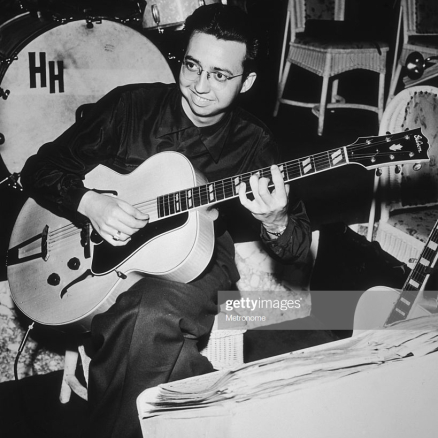
Green moved to New York City in his teens, and after being spotted playing a club by the legendary talent scout John H Hammond, got a gig in Count Basie’s ensemble. He remained in Basie’s band for almost fifty years, the longest serving member in his band – possibly the most enduring swing-era guitarist – by far. Green did’t believe the guitar should be heard by itself, choosing to lock in with the drums instead. Playing strictly rhythm – no solos – Green played four beats to the bar, using a chord technique known as comping (which I will revisit in an upcoming article).

Comping

Comping (derived from the work ‘accompanying’) consists of playing the chord changes to a song, but only by using two or three notes of an extended chord voicing. That way, the important harmonic characteristics of the chord are conveyed without cluttering the sonic space. In a big band with several horn players and complex arrangements, keeping it clear is often the best option. It’s a difficult technique to master, but it was Green’s forte. Although he was only playing four strums per bar, he could change chord or voicing every two beats. On some occasions, he changed chord on every beat.

The closest Green ever came to a solo was during a famous concert at Carnegie Hall, featuring members of Count Basie’s and Benny Goodman’s ensembles (including Green on rhythm guitar), as well as various guest players. During Honeysuckle Rose, Goodman pointed to green to take one of the solos (possibly by accident). Although he was not expecting it, Green hammered out an astonishing comped chord break, the closest thing he ever came to a guitar solo in his long career as ‘Count Basie’s right arm’.

Recommended listening

The incident described above is featured on The Famous Carnegie Hall Concert by Benny Goodman (1950, Columbia Records). For other examples of his playing, check out the Count Basie discography (anything from 1938 to the mid-1980s). Green also released two solo records (leading a small ensemble, but still not taking any solos), the best of which is Mr Rhythm in 1950 (RCA Victor).

As always, if you have any suggestions for Great Guitarists you would like me to profile on this blog, please do get in touch, via the Contact Page or my social media pages (links below).
Great Guitarists #6: Django Reinhardt

Great Guitarists

This installment features the only artist in this week-long mini series to hail from outside of the USA. But boy, did he leave his mark on jazz, with an influence that stretches far beyond the guitar…

Django Reinhardt

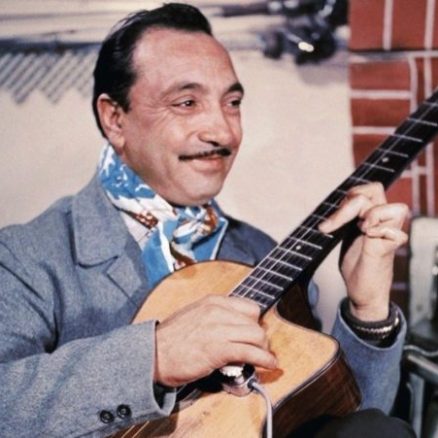
Jean ‘Django’ Reinhardt was born in a Romany Gypsy camp in Belgium, 1910, moving to Paris with his family as a youth. He was reportedly something of a child prodigy within his community, capable of playing back melodies flawlessly after only one hearing. He first discovered jazz via a Louis Armstrong recording as a teenager. On hearing the record in question, the young Reinhardt reportedly cried out “my brother!” and thus, it seems he had found his musical path from that day onward.

One amazing thing about Reinhardt is how he relearned his entire fingering technique, following a fire in his caravan when he was eighteen. The blaze left him with a permanently damaged left hand; his ring and little fingers were partially fused together. As a result, Reinhardt’s entire career – all those lightening-fast single note runs – we’re performed using only two fingers (although he would sometimes incorporate his fused ring finger for chords). In overcoming an injury which, for many, would have made guitar playing a write-off, Reinhardt demonstrates the combined power of will, alongside the power of music.

Reinhardt’s most famous music was made the Quintette du Hot Club de France, a five piece band of three guitars (two rhythm, plus Reinhardt on lead), bass and one violin. Three spots the Quintette’s lineup were fairly fluid over the years, but one mainstay was violinist Stéphane Grappelli. It is his duets with Grappelli which have mesmerized listeners for almost a century. Their style of ‘Gypsy Jazz’ remains synonymous with Paris to this day, although the Quintette were only a working musical entity until between 1934-1938, when World War II put an end to their activities.

After the war, Reinhardt toured the USA and was a featured guest with larger ensembles such as The Duke Ellington Orchestra. He died of a brain hemorrhage in 1953,at the age of forty-three, leaving behind a vast musical legacy that still influences musicians to this day.

Essential Listening

I’m terms of recordings, anything by the Quintette du Hot Club de France is a great starting point; plenty of reissued albums and compilations exist of this group. However, there aren’t many video recordings of Reinhardt’s playing, so what little footage we do have is worth seeking out. For this post, I shall suggest this short documentary film which features a minute or two highlighting Reinhardt’s unorthodox, yet necessary, technique.

You can hear Django’s style of  gypsy jazz playing in the most unexpected of places. However, it remains largely synonymous with France, and Paris in particular. The style retains a loyal following to this day. It amazed me to learn that no less a guitar player than Hank Marvin, the legendary British rock’n’roll pioneer, devotes himself to playing gypsy jazz, now that The Shadows have finally hung up their Stratocasters! It’s somehow fitting that both guitarists have had an immeasurable influence on the instrument, and now one devotes his time to studying the other – but more on him in another article, later in this series!

As always, do get in touch with your thoughts and suggestions for future posts…

Great Guitarists #5: Charlie Christian

Great Guitarists

Many of the jazz guitarists featured so far will have been influenced by today’s Great Guitarist. Not only one of the foundations of how jazz guitar can be played & appreciated, but also one of the innovators behind bebop…

Charlie Christian

As one of the first players to ensure the guitar was taken seriously as a lead-playing instrument (along with Django Reinhardt), Christian arguably helped lay for foundation for all jazz guitar to follow. Born into a musical family Texas in 1916, he was the youngest of three brothers. His introduction to jazz and first break came while playing in his oldest brother Edward’s band across the state border in Oklahoma, impressing fellow musicians in late-night jam sessions while still only a teenager.

Taking his style from horns, Christian’s goal was for his guitar to sound like a tenor saxophone. Although he was undoubtedly aware of Django Reinhardt’playing, it does not appear to have influenced him anywhere near as much as the various horn and reed players Christian was surrounded by and worked alongside.

Christian was recommended to band leader Benny Goodman in 1939. Various accounts demonstrate a reluctance on Goodman’s part, largely due to the fact that the electric guitar was a very new instrument, and not regarded as a soloing one. Up until then, it has largely been an alternative to the banjo as an accompanying instrument. As Goodman was mainly leading a sextet at the time, he clearly preferred versatility in his performers. However, Christian’s skill at melodic improvising soon won him over. When Goodman overhauled his sextet in 1940,Christian was the only band member who stayed on, playing in a new ‘supergroup’ lineup which included Count Basie on piano and Cootie Williams on trumpet.

During this time, Christian was also a prominent figure in the after hours jams at Minton’s Playhouse in Harlem, where bebop was born. Many of the leading jazzmen of the day frequented these sessions, including Thelonious Monk, Dizzy Gillespie, Charlie Parker and Kenny Clarke, almost others. According to Leonard Feather (1960), several participants in these jams attribute Christian’s humming of the melodic phrases as the onomatopoetic origin of the name bebop.

According to the legendary guitarist (and Charlie Christian fan) Barney Kessel (read my Great Guitarists installment on Barney Kessel here), Christian played almost entirely using downstrokes with a large triangular pick held between his thumb and forefinger. His remaining right hand fingers apparently remained steadfast against his guitar’s pick guard. I’m always amazed at how early pioneers of single-note guitar playing sounded so smooth without using an alternate picking technique. It only goes to show what can be achieved when the music needs to come out…

Unfortunately, the world never got to see where Christian would take jazz, or at least his own playing, next. Having contracted tuberculosis in the late thirties, Christian’s health started to decline, not helped by the lifestyle of a busy working jazz musician. He died in a sanatorium on Staten Island in New York in 1942, aged just twenty-five. He was buried in an unmarked grave in Bonham, Texas, the town of his birth. Today, the exact location of the father of modern jazz guitar remains unknown.

Essential Listening

Due to his untimely demise, Christian never cut any records as a band leader. A few amateur recordings exist of groups he led playing live (presumably between Goodman dates), as well as some of those Minton’s Playhouse sessions, such as Swing To Bop (1941).

The main way to hear Christian’s playing is from recordings made with the Benny Goodman sextet between 1939-1941. Thankfully, Goodman recognised Christian’s talent and allowed him plenty of time in the spotlight. These solos have been listened to and learned by jazz guitarists the world over, not least greats such as Wes Montgomery, Kenny Burrell and many more. Among the recordings by the Goodman sextet , Solo Flight is a great starting point.

Christian (front row), between Count Basie (piano) and Benny Goodman (clarinet). Freddie Green, a guitarist famous entirely for his rhythm playing, can be seen in the back row.

Christian’s influence lives on beyond the world of jazz guitar. Countless musicians have credited him as an early influence, from Miles Davis to Charlie ‘Bird’ Parker. Outside of jazz, Christian’s pioneering use of the guitar as a lead instrument helped pave the way fir rock’n’roll. His direct musical influence can be heard in artists such T-Bone Walker, Chuck Berry, Scotty Moore and Eddie Cochran. Indirectly, he probably reached all of us…

Great Guitarists #4: Kenny Burrell

Great Guitarists

Today we look at the man behind one of my favourite jazz albums of all time…

Kenny Burrell

Kenny Burrell, at the Midnight Blue sessions, 1963

Born in Detroit, Michigan, in 1931, and into a musical family, Burrell has been recording and performing on the guitar since the start of the 1950’s.

Burrell’s recording debut recording was as part of none other than trumpet player Dizzy Gillespie’s sextet in 1951. He started recording solo records almost immediately after, often working in collaboration with other big names in jazz. His discography as band leader is enormous (well over fifty studio cuts). Yet Burrell still found time to work as a sideman for scores of artists, such as Oscar Peterson, Tony Bennett, Billie Holiday, Bill Evans, Wes Montgomery and Benny Goodman (taking the chair once held by his hero Charlie Christian), and many, many more.

His main guitar influences are a mix of jazz (Charlie Christian & Django Reinhardt) and blues (T-Bone Walker & BB King). This blurring of the lines between jazz & blues continued throughout his career, in a style known as Hard Bop (or Soul Jazz). This sub-genre of jazz, of which Burrell is considered a key proponent, is considered by some to be a reaction to the Cool Jazz of the West Coast musicians. His warm tone came from his Gibson Super 400 (a fairly large archtop) combined with failing down the treble on his Fender amplifiers for a ‘fatter’ tone.

One of the reasons I really enjoyed listening to Kenny Burrell when I started learning jazz was how accessible he made the genre sound. His more blues-tinged works (see below) provided an aural link I found familiar as a blues player. However, I soon discovered that his phrasing was as sophisticated and intelligent as the other jazz players – he just made it sound effortless. Making such advanced playing appear so effortless, and therefore more listenable, is one if the traits which makes Burrell a great guitarist!

Essential Listening

It can only be Midnight Blue (1963). I’ve linked to the title track here – a masterclass in laid back, bluesy jazz – but do yourself a favour and spare yourself 45 minutes to enjoy the entire album.

To hear a different side to Burrell’s playing, try Kenny Burrell & John Coltrane, also from 1963. Bebop plays more prominent on this album although Burrell’s tasteful restraint still shines through,and hearing him trade solos with Coltrane feels genuinely seminal. This LP is an underrated album which deserves more attention and acclaim.

Remember, don’t be shy about getting in touch with your thoughts on the series so far, as well as your suggestions for future features. Bye for now!

Great Guitarists #3: George Benson

Great Guitarists

Today’s player has a connection to my first featured player, Earl Klugh, and is another guitarist influenced by Wes Montgomery. Any guesses? Read on…

George Benson

Born in 1943 in Pittsburgh, Pennsylvania, Benson started performing at the age if eight, and recorded his first single a year later, although it did not garner much success for him at the time. After graduating high school, Benson found work as a sideman, and recorded his first record as band leader, The New Boss Guitar of George Benson in 1964, aged just twenty-one. Amazingly, his guitar during these early years was hand-built for him by his stepfather!

Benson continued a prolific run of albums throughout the sixties & seventies, often with some big jazz names guesting (Earl Klugh played guitar in his band for two albums and tours in 1972-73). He even found time to perform on the Miles Davis track ‘Paraphernalia’ from Miles In The Sky (1968). To date, Benson has released thirty-six albums across the last six decades and still tours regularly, which certainly puts plenty other musicians to shame!

Guitar Style

A lifelong user of archtop guitars, such as his signature Ibanez models, Benson’s playing style comes directly from his hero and number one influence, Wes Montgomery. Like Montgomery (and Klugh), Benson doesn’t use a guitar pick, nor does he employ the conventional classical method in his fingerpickng. Instead, all three make extensive use of their thumbs. When using his other right hand fingers, Benson seems to use the rest stroke style of Django Reinhardt.

What sets Benson apart is his speed, all while remaining fluid and innately soulful. It’s hard to maintain a melodic heart during such fast runs, although Benson’s habit if singing/scatting his guitar lines while improvising them probably helps!

Essential listening

To be honest, Benson’s back catalogue is chock full of amazing guitar work. However, if you’d prefer to stay away from the singing, anything before the 1976 album/hit instrumental Breezin’ is your best bet. Personally, I’d recommend White Rabbit (1972) and the wonderfully titled Giblet Gravy from 1968 (featuring fellow jazz legends Herbie Hancock & Billy Cobham, among others) for starters.

Good King Bad (1976) shows where Benson’s style was heading, with a tighter, funkier backline, which some critics believe led to more focused phrasing in his guitar playing. The title track from this album, Theme from Good King Bad, demonstrates Benson’s soloing prowess wonderfully. Yes, the main theme might sound a little dated to our ears, but stick with it. The guitar solo (over the song’s B section) starts with octave melodies, then three notes at once, moving as melody chords, before Benson really starts to cut loose with some dazzling – yet tasteful – single note phrases.

One of the things that I love about this solo in particular is Benson’s choice of landing note. Namely, where he ends his phrases, and how they relate to the chords underneath. This is something I plan on exploring deeper in a future post, but it’s worth summarising here: with a strong opening and a tight landing will make almost all solos (or the phrases they are made up of) sound great. This is something Benson has done throughout his career, and he still seems to be going strong, continuing to record and perform through his eightieth decade…

As always, let me know what you think. I’d especially love to hear your suggestions for future players to feature, as I plan to return to this series from time to time. Make your voice heard!

Great Guitarists #1: Earl Klugh

Great Guitarists

In this series, I’ve selected artists who have been both an inspiration and influence on my own guitar playing or musical practice. I’ll try to include a few details about them as well as a track for ‘essential listening’. I hope you get something out of it. Do feel free to comment on my picks for Great Guitarists – perhaps suggest your own! First up…

Earl Klugh

Earl Klugh was born in Detroit, Michigan, in 1953, and first picked up the guitar at the age of ten. His early influences included legendary Brazilian guitarist Laurindo Almeida, pioneering jazz guitarist Wes Montgomery and Country/crossover star Chet Atkins (with whom he would later record). Many jazz players (including the pianist Bill Evans) as well as an array of Latin and classical players continued to inform the way Klugh developed his guitar technique. Like many Latin-influenced guitarists, Klugh has stuck largely with nylon-strung guitars for his entire career, but his wide mix of influences give him a unique voice of his own.

Klugh made his professional debut on flautist Yusef Lateef’s 1970 album, Suite 16, aged just 15, after Lateef heard him playing in his local music store. Later, Klugh joined the band of the legendary guitarist George Benson. As well as performing guitar live with Benson’s band, Klugh also played on two of his classic jazz albums (before Benson started to focus more on singing & becoming a more commercial star), White Rabbit (1972) & Body Talk (1973).

Releasing his eponymous debut solo album in 1976, Klugh has since released over thirty records, in a variety of formats, including solo, duo and ensembles of various sizes. Over his career, he has received twelve Grammy nominations, winning the award for ‘Best pop instrumental performance’ with 1981’s One On One, recorded with jazz pianist Bob James.

I first discovered Klugh in the late 90’s and often used his composition ‘Kiko’ (from his 1976 album Living Inside Your Love) as a solo guitar piece for auditions. It featured in my repertoire for performances long before I caught the bug for Latin music, and Klugh (along with Santana) were the gateway to discovering the wonderful genres of South America.

As a classically trained guitarist, the sound of Klugh’s instrument felt comfortably familiar, although his main way of plucking the strings (using his thumb in both directions, like Wes Montgomery) was a rather alien concept to start with. Try it though – it’s worth persevering with, as it opens up a whole new, and potentially faster, way of playing the lower strings.

The track featured in this video is ‘Dr Macumba’ from his 1977 album Finger Paintings. It’s a great example of Klugh’s style, opening with a funky latin-infused riff, through to his cloud yet melodic jazz phrasing. Although it appears to start as a fairly small ensemble piece, this tune turns out to be a bigger production than expected, including rather brief string arrangement providing a classic 70’s lift in the middle of the piece!

Dr Macumba’ by Earl Klugh

I thoroughly encourage you to take a look into Klugh’s extensive back catalogue of LPs and concert videos. Even if the Latin stylings aren’t your thing, there’s a lot to be learned about jazz soloing from his playing. As always, let me know what you think, and enjoy the video!

Great Guitarists #7: Wes Montgomery

Great Guitarists

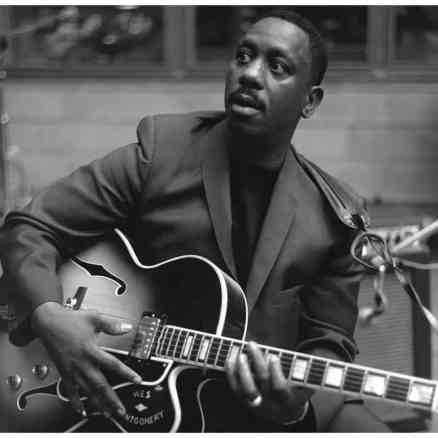
As we arrive at part seven in this occasional series, there is one Great Guitarist left to feature, one who is up there with Charlie Christian  and Django Reinhardt as one of the most influential jazz guitar players of all time. Since I’ve focused this short run of articles on jazz guitar players, it is essential to include the man who has left an indelible influence on how jazz guitar is played…

Wes Montgomery

He played impossible things on the guitar because it was never pointed out to him that they were impossible

– Ronnie Scott

Like the origins of jazz itself, nothing about Montgomery’s career was orthodox. Born John Leslie Montgomery in Indianapolis, 1923, ‘Wes’ only dabbled in music until hearing a Benny Goodman record, aged nineteen. The record in question featured the guitar playing of Charlie Christian, and inspired Montgomery to buy a guitar the very next day. He spent almost a year learning Christian’s solos, particularly those from the record Solo Flight.

Working as a welder during the day, Montgomery’s guitar practice sessions took place at night, leading to complaints from his neighbours and his wife. His solution was to ditch the pick and pick the guitar’s strings with the dude if his thumb, as this was much quieter. His use of octave playing also comes from this period, as it enabled Montgomery to better hear what he was playing as he practiced. This technique, which Montgomery has said gave him real “headaches” when learning, was relatively rare in guitar playing; following the influence Montgomery left behind, it is now one of the most definitively recognisable characteristics of jazz guitar.

Success didn’t come easy or quick for Montgomery. Although he had started to build his reputation as a guitarist while playing in ensembles with his two brothers, Monk (bass) and Buddy (piano & vibraphone). These early recordings did not garner much commercial success. In his mid-thirties, Montgomery had returned to working factory shifts during the day, to support his wife and six children, then gigging in jazz clubs until the wee small hours.

This lifestyle ultimately took a toll on his health, but the sheer amount of graft Montgomery was devoting to his playing was paying off. Without being able to read a note of music, Montgomery used his ears and his heart to make his playing swing. His prolific use of octaves, as well as his chord-based soloing (usually on the highest four strings), all without fully understanding the theory of what he played, revolutionised the way in which jazz guitar could be approached and performed.

A chance discovery by saxophonist Cannonball Alderley led to Montgomery being signed to Riverside Records in 1959. Montgomery was soon a rising star, although his more pop-friendly crossover records in the mid-sixties (covers of pop songs, often featuring additional orchestration) led to him being considered a ‘sell out’ by some jazz musicians. He died of a heart attack while on tour in June 1968,aged just forty-five.

Montgomery’s legacy survives through the countless guitar players he influenced. These include his friend (and another guitarist to experience crossover success) George Benson, Pat Matheny and Earl Klugh, to name only a handful.

Essential Listening

Despite Montgomery’s short recording career, he recorded sixteen LPs as band leader in his lifetime, as well earlier recordings with his brothers as The Mastersounds and a handful of posthumous releases. Smokin’ At The Half Note (1965) is a fantastic live album that I wholeheartedly recommended you give some time to.

For studio cuts, you won’t go wrong with his first few albums with Riverside. A personal favourite is The Incredible Jazz Guitar of Wes Montgomery (1960), which includes some of his more well-known pieces such as ‘Four On Six’ and ‘West Coast Blues’.

For the guitar players amongst us keen to emulate Montgomery’s playing style, there exists a wealth of articles and tutorials on how to get started. However, as is often the case, the best thing would be to listen, play, listen, play, listen, then play some more!

Good luck and see you with the next installment soon!

Great Guitarists #2: Barney Kessel

Great Guitarists

Welcome back to my Great Guitarists mini series (you can read my previous piece, on Earl Klugh, here). Today, allow me to introduce you to my favourite guitar player of all time. You might not recognise the name, but you’ve certainly heard him on recordings from the jazz greats to The Beach Boys. Introducing…

Barney Kessel

Born in Muskogee, Oklahoma, in 1923, Kessel was known by early bandmates for practising up to 16 hours a day. Judging by the amount of work he had, those hours of practice clearly paid off – and I haven’t even touched upon the countless records he released under his own name, not to mention his film scores, world tours with other legendary jazz guitarists or his regular guitar advice column!

While Kessel might not be the most recognisable face or name to many, his prolific session work over several decades means you are guaranteed to have heard his guitar playing. Early gigs for Kessel included the bands of Chico Marx, Artie Shaw, Charlie ‘Bird’ Parker and Oscar Peterson.

Later, he was one of the regular LA session players known collectively (and famously) as The Wrecking Crew. Around the same time, Kessel found ample work as an accompanist. His most recognisable song is Julie London’s definitive version of ‘Cry Me A River’ (from her 1955 album Julie Is Her Name – worth checking out for Kessel’s guitar arrangements alone). He also provided similar guitar backing for several other great jazz singers, such as Billie Holiday, Ella Fitzgerald and Anita O’Day.

One of the most heard examples of his session work comes at the very start of Brian Wilson’s classic and sixties-defining record with The Beach Boys. The opening harp-like notes of track one, Wouldn’t It Be Nice, are actually Kessel playing something called a Mando-guitar (sometimes mid-credited as a 12-string guitar). In Situations such as this, session players such as Kessel could call on their training and in-depth knowledge of their instrument and technique to quickly provide the sound that producers and artists such as Wilson were searching for, often when this was not very clearly defined.

In terms of a definitive track, where do I start? Pick up any album led by him and you’ll be rewarded with his amazing jazz guitar playing, from choral soloing through to wonderfully fluid single note lines. Kessel played hollowbody electrics almost exclusively, and although he moved around from various Gibson guitars to Kay models (including variations of a signature model at different price points) and back again, his thick tone with a piano-like clarity rings through. Perhaps we should begin with his beautiful version of the jazz standard Autumn Leaves, performed live in this video from 1979. Enjoy!

As always, do tell me what you think. The full list of guitar players featured in this week’s series aren’t set in stone yet, so if you have any suggestions (ideally with a jazz bent for this week’s run), please do get in touch. I love hearing what you guys think!

Until next time…